
The harsh truth: yes, you can switch into a lifestyle specialty after completing another residency—but it will cost you time, money, seniority, and pride. For some people, it’s still absolutely worth it.
Let’s walk through this like adults and not like Reddit fantasy planners.
The Short Answer: Yes, It’s Possible. No, It’s Not Simple.
If you’ve already finished one residency (say IM, surgery, EM, OB/GYN, peds) and now want something more lifestyle-friendly (like derm, optho, radiology, pathology, anesthesia, PM&R), you’re asking two basic questions:
- Is it allowed?
- Is it realistic for someone in my position?
Here’s the direct answer:
- It’s allowed. There’s no rule that says “one residency only.”
- The main filter is whether a program director thinks you’re worth the hassle.
- Many people have successfully switched from “bad lifestyle” specialties to “good lifestyle” ones—just not in massive numbers, and not usually into the most competitive ones (derm, plastics, etc.) without a strong hook.
Your chances depend on:
- Your current specialty and PGY level
- Your USMLE/COMLEX scores and academic record
- How competitive the target lifestyle specialty is
- Whether you’re willing to start over (or partially over) and take the hit financially and personally
If you want an actual decision framework instead of vague hope, keep reading.
Step 1: Know Which Specialties Are Actually “Lifestyle”
Let’s define what you’re probably talking about when you say “lifestyle”: predictable hours, less call, fewer nights/weekends, flexibility for part-time or outpatient-only work, and less chronic chaos.
Here’s a quick, no-BS snapshot.
| Target Specialty | Typical Lifestyle | Competitiveness | Common Prior Backgrounds |
|---|---|---|---|
| Dermatology | Excellent | Extreme | IM, FM, Med-Peds |
| Radiology | Very Good | High | IM, Surgery, EM |
| Anesthesiology | Good-Very Good | Moderate-High | IM, Surgery, EM |
| PM&R | Good | Moderate | IM, FM, Neuro, Peds |
| Pathology | Very Good | Moderate | IM, FM, Other |
| Ophthalmology | Excellent | Extreme | Surgery, IM |
And then there are “lifestyle-ish” niches inside less-friendly specialties:
- IM → outpatient only / concierge / hospitalist with protected shifts
- Peds → outpatient general peds or developmental-behavioral
- EM → low-volume community, urgent care, telemedicine
- OB/GYN → gyn-only, MIGS, or hospitalist models
So you don’t always have to do a second residency. Sometimes you just need a smarter niche within your own field.
Step 2: Switching Pathways – How People Actually Do It
There are really three main routes people take.
Route 1: Full Second Residency (Most Common for Big Switches)
This is what you’ll do if you’re going from something like surgery → radiology or IM → derm.
You:
- Apply through ERAS like a new grad (with a weird CV)
- Interview as an “experienced applicant”
- Start as a PGY-1 or PGY-2 in the new specialty depending on credit given
Pros:
- Clean slate in the new field
- True board eligibility in second specialty
- Programs know exactly what they’re getting
Cons:
- Years of delayed attending income
- Resetting your seniority
- Call again. Exams again. Fellow residents younger than you.
Route 2: Credit for Prior Training (Sometimes Possible, Not Guaranteed)
Some boards and programs can give you “advanced standing” and shave off a year. This is very program-dependent and board-dependent.
Examples I’ve seen:
- IM → Anesthesia with 1 year credit (start as CA-1 after a transition)
- IM → PM&R with some intern year credit
- Surgery → Radiology with PGY-1 credited if it met requirements
Do not assume you’ll get credit. You ask programs directly. They tell you what their clinical competency committee and the ACGME/board will accept.
Route 3: Reframing Within Your Current Specialty (Smart First Step)
Before you blow everything up, see if you can “lifestyle-ize” what you already have.
Common plays:
- IM: outpatient clinic, DPC/concierge, strictly 7-on/7-off hospitalist with boundaries
- EM: part-time, low-volume community, urgent care chains, telehealth-only
- Surgery: outpatient-only, vein centers, wound care, endoscopy centers, industry gigs
- OB/GYN: gyne-only, hospitalist OB, fertility clinics
Sometimes the right answer isn’t “derm residency at 37.” It’s “I stop picking the worst jobs in my current field.”
Step 3: Competitiveness Reality Check
Let me be pretty blunt: finishing a non-lifestyle residency does NOT give you a golden ticket into derm, ophtho, or rads. It gives you a narrative and some maturity. That’s it.
You need to ask:
- Do my board/Step scores match or beat current residents in that specialty?
- Do I have any evidence I care about that specialty beyond “I hate nights”?
Here’s a rough mental map using 1–5 pain scale for switching (5 = brutal):
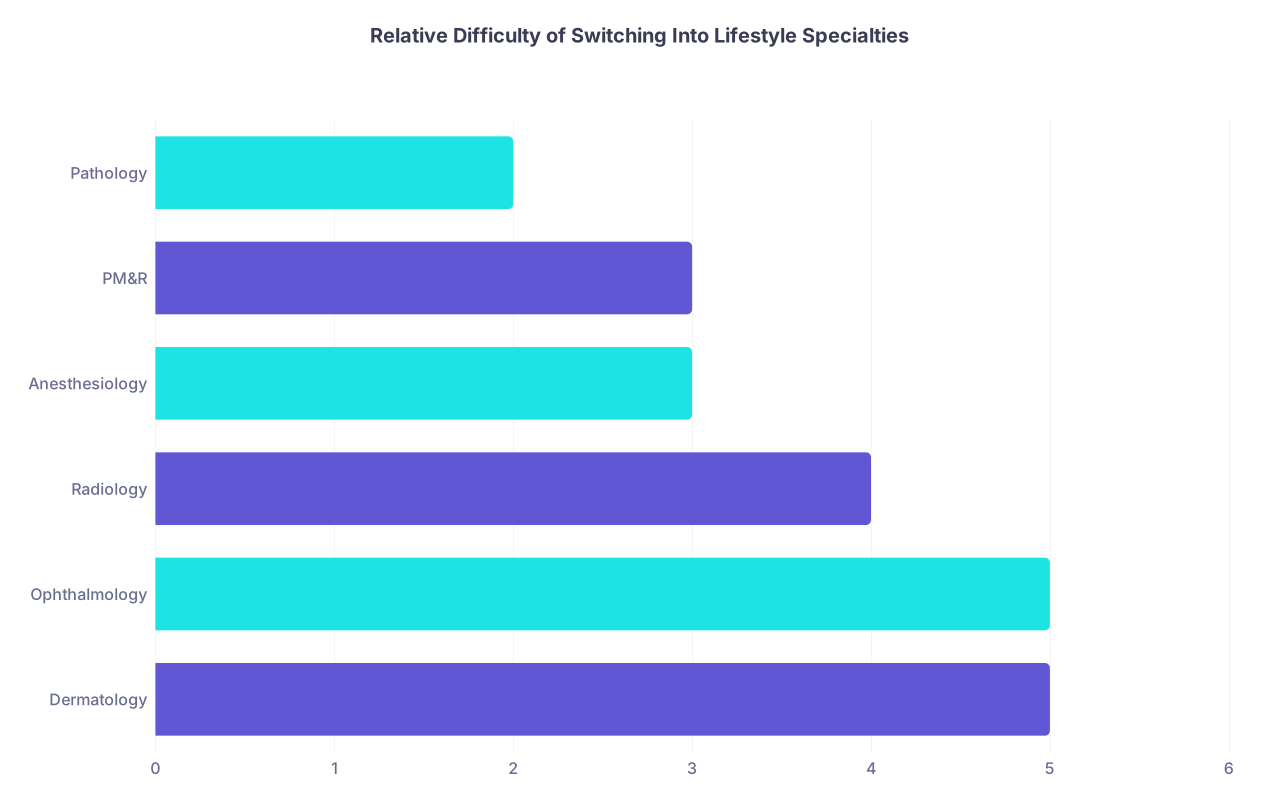
| Category | Value |
|---|---|
| Dermatology | 5 |
| Ophthalmology | 5 |
| Radiology | 4 |
| Anesthesiology | 3 |
| PM&R | 3 |
| Pathology | 2 |
If you’re coming from:
- IM/Peds/FM: easiest to pitch PM&R, anesthesia, path, maybe rads
- Surgery: easier to pitch anesthesia, rads, ophtho (if you have the stats)
- EM: easier to pitch anesthesia, rads, PM&R
Derm and ophtho are basically rebuilding your whole application from scratch—research, letters, maybe even a prelim year repeat—unless you’re truly exceptional.
Step 4: What Program Directors Actually Care About
Here’s what you’re up against in their heads:
- Are you going to quit again?
- Are you going to be bitter, entitled, or burned out?
- Are you going to be clinically excellent and actually happy here?
You need to make their risk worth it.
That means:
- Clear, specific story: not “I want lifestyle,” but “I realized I’m most fulfilled in X-type patient interactions/procedures/workflow, which I’ve consistently gravitated toward in my current specialty” with concrete examples.
- Real exposure: shadowing, electives, per-diem work in overlap areas if possible, observerships if you’re out of training.
- Letters from people in the target specialty (this is where most people fail).
A PD once said to me, “If their personal statement is just ‘I burned out in surgery and now hate the OR,’ they’re a hard no for anesthesia.” That’s the vibe you must avoid.
Step 5: Financial, Personal, and Credentialing Costs
You can’t pretend this is cheap or easy.
Here’s the actual hit you’re considering:
, Lower resident salary, Lifestyle hit during training, Opportunity cost (family, location)](https://cdn.residencyadvisor.com/images/articles_svg/chart-tradeoffs-of-doing-a-second-residency-8846.svg "Tradeoffs of Doing a Second Residency")
| Category | Value |
|---|---|
| [Lost attending income](https://residencyadvisor.com/resources/lifestyle-friendly-specialties/how-much-do-lifestyle-friendly-physicians-actually-earn-compared-to-peers) | 50 |
| Lower resident salary | 20 |
| Lifestyle hit during training | 15 |
| Opportunity cost (family, location) | 15 |
Real numbers for a typical case:
- Lost attending income: $250–400k/year
- Resident salary: $60–75k/year
- Duration: 3–4 more years for many lifestyle specialties
- Loans: still accruing, unless already paid off
So if you’re a hospitalist making $280k, doing 3 years of radiology is realistically a 7-figure decision when you factor income + interest + opportunity cost. That doesn’t mean it’s wrong. Just real.
Personally? I’ve seen:
- EM attending at 34 → anesthesia, now in a cushy private group and much happier. Calls it the best decision of his life.
- Surgery PGY-4 → rads PGY-2. Took a massive short-term hit but now has zero regret.
- IM PGY-3 → attempted derm. Spent 2+ years doing research, didn’t match, ended up back in hospital medicine. That one hurt.
You need to run the numbers, not just vibe your way through this.
Step 6: Strategic Plan If You’re Seriously Considering Switching
Here’s the actual playbook, step-by-step.

| Step | Description |
|---|---|
| Step 1 | Unhappy in current specialty |
| Step 2 | Talk to mentors and PD |
| Step 3 | Assess job changes first |
| Step 4 | Explore lifestyle niches in field |
| Step 5 | Stay in specialty |
| Step 6 | Shadow target specialty |
| Step 7 | Try better jobs or schedule |
| Step 8 | Secure mentors and letters |
| Step 9 | Check competitiveness and scores |
| Step 10 | Reconsider / adjust target |
| Step 11 | Apply for second residency |
| Step 12 | Still in residency? |
| Step 13 | Improved enough? |
| Step 14 | Still miserable? |
| Step 15 | Reasonable chance? |
Tactically, do this:
Fix what you can within your current field first.
New job. Different setting. Better group. Clearer boundaries. If that doesn’t work, then consider a switch.Get real-world exposure to the target specialty.
Shadow. Moonlight if there’s overlap (like sedation work for anesthesia, rehab consults for PM&R). Go beyond just “I read about it.”Find at least one honest mentor in the target field.
Someone who will:- Tell you if you’re competitive
- Help you shape your story
- Potentially write a letter
Collect proof you belong there.
Electives, research, QI projects, case reports, conference posters—whatever fits that specialty’s culture.Be honest with your current PD if you’re still in training.
The sooner the better. Many will help you quietly. Some will not. But you can’t really play both sides forever.Apply once you’ve actually built a credible application.
Not when you’re just “tired” of your current job. There’s a difference between burnout and true misalignment with the work.
Which Lifestyle Specialties Are Most Realistic to Switch Into?
Let’s rank a few common targets from “most realistic after another residency” to “basically climbing Everest without oxygen.”

Most realistic (with a prior residency)
Pathology
Often open to non-traditional paths. IM/FM backgrounds respected. Lifestyle is great in many jobs. Competitive but rarely cutthroat.PM&R
IM, neuro, peds, FM folks slide in reasonably often. Strong fit if you genuinely like function, rehab, MSK, and chronic disease management.Anesthesiology
Very common switch from EM, surgery, and IM. PDs are used to seeing career changers here.
Moderate realism
- Radiology
Frequently sees former IM, EM, surgery folks. But boards and Step scores matter a lot. Academic programs can be picky.
Very tough but not impossible
Dermatology
You’re rebuilding your whole app. Research, letters from derm faculty, often geographic flexibility needed. You need top-tier stats and persistence.Ophthalmology
Similar story. And it uses SF Match, not NRMP. You’re competing with people who’ve wanted ophtho since M1 and stacked their whole CV.
Special Case: Switching After You’re Already an Attending
Different beast than switching as a resident.
Big points here:
- Credentialing and malpractice matter. Some “switches” aren’t formal second residencies—they’re gradual moves into related work (e.g., from EM → urgent care → telemedicine).
- You can still match into a second residency as an attending, but you’ll need:
- A clear story that doesn’t scream “I just hate my current job”
- Strong, current clinical letters
- Proof you can handle being a trainee again (no ego)
If you’re 5–10 years out and have a family, mortgage, lifestyle inflation, the financial hit is much more brutal. I’ve seen people still do it and be happier—but you need your partner very much on board.
Red Flags That Mean “Don’t Do a Second Residency Yet”
If any of these describe you, pause:
- You haven’t seriously tried changing jobs or settings in your own specialty.
- You’re just coming off a toxic job or fellowship and everything feels awful.
- You can’t clearly say what you actually like doing day-to-day in medicine.
- Your primary driver is “my friend in anesthesia works fewer weekends.”
Another lump of truth: if your problem is boundaries, perfectionism, or saying yes to everything, dermatology won’t fix that. You’ll just be overcommitted in a nicer clinic.
FAQs
1. Will my previous residency shorten the length of my new lifestyle residency?
Sometimes, but don’t count on it. You might get 1 year of credit (usually if your intern year matches the new board’s requirements). Path, PM&R, and anesthesiology are more flexible here than derm or ophtho. You need to ask specific programs how much advanced standing they’ve given people like you before.
2. Does being older or already an attending hurt my chances of matching a second residency?
It can, but it’s not an automatic rejection. Programs will wonder if you can adapt to being a trainee again and if you’re switching for the right reasons. I’ve seen plenty of 30s and early 40s residents in second specialties, especially anesthesia, rads, PM&R, and path. What kills apps is a weak story, not the birthdate.
3. Can I switch into a lifestyle specialty without completely starting over financially?
You can soften the blow, but you can’t avoid it. Options:
- Move to a lower cost-of-living area during residency
- Moonlight safely and legally once your new program allows it
- Aggressively reduce fixed expenses (housing, cars, lifestyle creep) But you’re still trading years of attending income for trainee salary. No way around that.
4. Is doing a fellowship in my current field better than a second residency?
Often, yes. Example: IM → outpatient cardiology or allergy/immunology instead of derm. EM → pain, palliative, or admin roles. Surgery → breast, wound care, outpatient GI. If a fellowship gets you 80% of the lifestyle you want with 20–30% of the disruption, it’s usually the smarter play.
5. How do I explain my switch in interviews without sounding flaky or burned out?
You frame it around pull, not just push. Less “I hate nights and call,” more “I consistently found myself most engaged in X-type cases/clinics/procedures, which align directly with [target specialty]. Over time, I realized that’s where I can give the most and build a sustainable career.” Then give specific stories. And you own your past, not trash it.
6. What’s the first concrete step if I’m 60–70% sure I want to switch?
Not ERAS. Not a personal statement. Step one: get direct exposure to the target specialty with an actual attending who can give you unfiltered feedback. Shadow a few days to a week. Ask them, “Given my background, does this make sense and what would it actually take?” If they shrug you off or say you’re not a fit, listen. If they’re excited and offer tangible next steps, you might be onto something.
Bottom line:
- Yes, you can switch into a lifestyle specialty after another residency—but it’s a real sacrifice, not a cheat code.
- Always try to optimize your current specialty first before burning it all down.
- If you do switch, do it with a concrete plan, honest mentorship, and eyes wide open about the costs and the payoff.