
The idea that choosing a “lifestyle specialty” means you’re less committed to medicine is nonsense. Worse than nonsense — it’s cultural gatekeeping dressed up as virtue.
Let me be blunt: working 100 hours a week does not make you a better doctor. It just makes you tired. And the data backs that up.
Where This “Lifestyle = Less Committed” Myth Comes From
This idea did not fall from the sky. It’s the product of a very specific culture in medicine.
I’ve heard the lines on rounds and in lounges:
- “Derm is for people who don’t want to work hard.”
- “Real doctors take call.”
- “If you care about work–life balance, you’re in the wrong field.”
That’s not wisdom. That’s hazing.
The “hardcore vs lifestyle” divide really exploded after a few things happened:
Duty-hour reforms (80-hour work week) Older attendings trained in the true dark ages: no caps, q2 call, sleeping in call rooms as a lifestyle. When residents finally got some protections, a chunk of the older generation interpreted it as weakness.
The rise of outpatient and procedural “ROAD” specialties
- Radiology
- Ophthalmology
- Anesthesiology
- Dermatology
Plus EM, PM&R, pathology and some non-surgical subs became known as “lifestyle friendly.” Suddenly not everyone was competing to be the martyr on surgery.
Burnout data became impossible to ignore Studies in JAMA, NEJM, MedEd journals started showing sky-high burnout, depression, and error rates. Students and residents began asking: “Why am I supposed to be proud of this?” Culture didn’t like the question.
The older “suffering = virtue” mindset never fully died. It just shifted target to anyone who openly values their own life outside the hospital.
What the Data Actually Shows About “Lifestyle” Specialties
Let’s stop hand-waving and look at something more concrete than hallway gossip.
Work hours and burnout by specialty
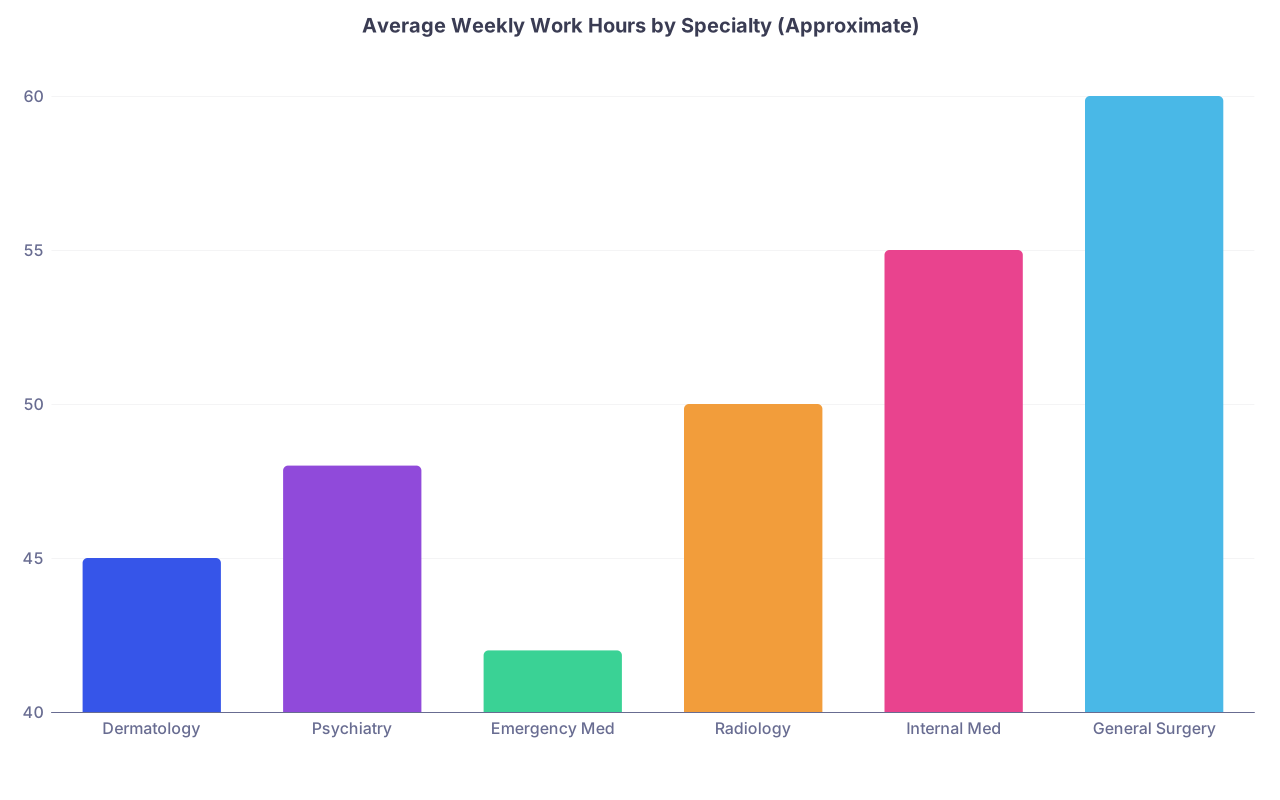
Yes, some specialties have fewer hours. That’s not a rumor; it’s documented.
| Category | Value |
|---|---|
| Dermatology | 45 |
| Psychiatry | 48 |
| Emergency Med | 42 |
| Radiology | 50 |
| Internal Med | 55 |
| General Surgery | 60 |
Are these exact numbers? No. They vary by country, practice setting, and career stage. But across multiple physician surveys (Medscape, national workforce studies, specialty boards), the pattern is consistent:
- General surgery, ortho, neurosurg, OB/GYN, cardiology → longer hours, more call.
- Derm, psych, path, PM&R, radiology, ophthalmology → comparatively fewer hours, more schedule control.
- EM → fewer weekly hours, but brutal circadian disruption and intensity.
Here’s the part almost no one mentions when they’re shaming “lifestyle choices”:
- Burnout rates are not simply a function of hours.
- They’re driven by:
- Loss of autonomy
- Documentation burden
- EMR hell
- Moral injury (being forced to do bad medicine by systems)
- Poor leadership & toxic culture
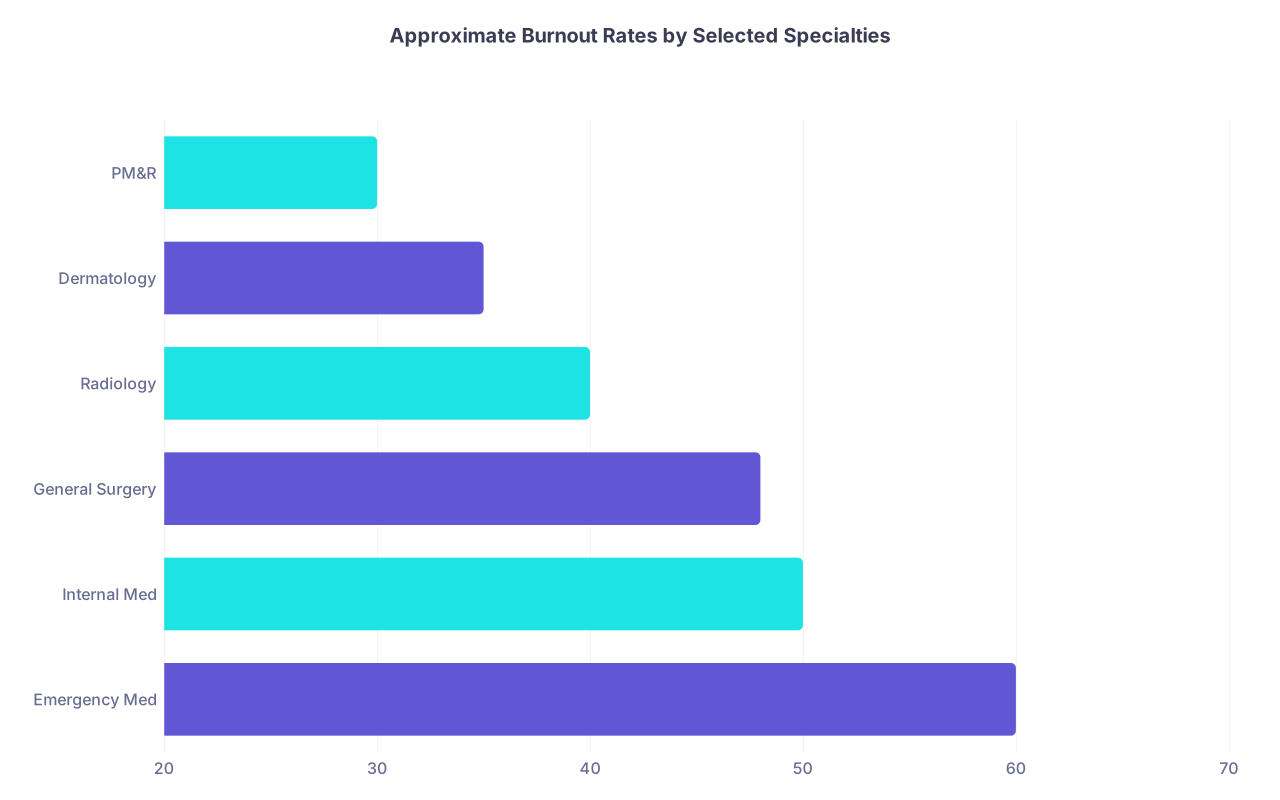
Some “lifestyle” fields actually have high burnout (looking at you, EM), despite fewer hours, because the nature of the work and system constraints are miserable.
So if lifestyle = fewer hours = less committed, explain to me why EM, with 40–45 hours/week and night shifts, has historically had some of the highest burnout in all of medicine.
Your hours don’t define your commitment. They define your risk factors.
The Training Path: Lifestyle ≠ Easy
A lot of this myth survives because students confuse end-state lifestyle with the training slog.
Let’s actually compare.
| Specialty | Avg USMLE Step 2 (approx, US MD matched) | Typical Research/EC Expectations | Residency Length |
|---|---|---|---|
| Dermatology | 250+ | Strong + often publications | 4 years |
| Ophthalmology | ~245–250 | Strong + often research | 3–4 years |
| Radiology | ~245 | Moderate–strong | 5 years |
| Anesthesiology | ~242 | Moderate | 4 years |
| PM&R | ~235–240 | Moderate | 4 years |
Again, numbers vary by year and data source, but the trend is clear: so-called “lifestyle” specialties are among the most competitive fields to match.
You don’t casually stroll into derm because you “don’t want to work hard.” You:
- Crush Step scores
- Build research portfolios
- Network
- Grind through away rotations and sub-Is
- Then work in busy clinics seeing high volumes daily
I’ve seen derm residents at 7 pm still charting biopsies and coordinating complex biologic regimens for psoriasis, juggling prior auth battles. No, it’s not a trauma laparotomy at 2 am. But this idea that it’s “Starbucks at noon then go home” is fantasy.
Same with radiology. People picture a dark room, Netflix in one corner, “next next next” on CT scans. Reality: constant diagnostic decision-making, malpractice risk, interruptions, STAT reads, and a never-ending image queue. The mental load is massive.
Difficulty ≠ visible blood. Commitment ≠ always being in the OR.
“Lifestyle” Specialties Still Carry Heavy Responsibility
Here’s another thing the “less committed” narrative ignores: the scope and stakes of these fields.
Let’s run through a few.
Dermatology
Myth: “Acne and Botox.”
Reality:
- Melanoma detection. Miss it, and your 30-year-old patient with a small changing nevus dies in a few years.
- Severe autoimmune disease: pemphigus vulgaris, toxic epidermal necrolysis, vasculitis.
- Complex immunosuppressive regimens with real organ toxicity.
- Genetic disorders, debilitating chronic skin disease wrecking mental health.
These are not low-responsibility decisions. They’re life-and-death, just not packaged dramatically.
Radiology
Myth: “Hiding in the dark.”
Reality:
- You’re the diagnostic backbone of nearly every other specialty.
- Missed PE, aortic dissection, stroke, subtle fracture, early lung cancer → catastrophic outcomes.
- Constant time pressure from ED and inpatient demands.
- Night float systems that crush your circadian rhythm.
Radiology doesn’t “feel” committed only if you’ve never seen a good radiologist save an entire team from going down the wrong path.
Anesthesiology
Myth: “They just sit there.”
Reality:
- Airway management, hemodynamics, acute crisis response.
- One miscalculation on dosing or one missed event on the monitor, and someone doesn’t wake up.
- Long cases, high vigilance, constant micro-adjustments.
It’s not glamorous to the surgically-minded med student who thinks “cut = real doctor,” but ask a surgeon if they want a disengaged anesthesiologist.
Ophthalmology
Myth: “Glasses and cataracts. Cute.”
Reality:
- Microsurgery with millimeter-level precision.
- Vision-threatening emergencies: retinal detachments, acute angle-closure glaucoma, endophthalmitis.
- Chronic disease management that profoundly affects quality of life and independence.
Funny how no one remembers the commitment conversation when it’s their own vision on the line.
Emergency Medicine
Often lumped as “lifestyle” because of defined shifts.
Let me just say: that’s nonsense. EM is:
- Constant acuity whiplash — minor complaints to full arrest in minutes.
- No longitudinal relationship, but full responsibility with limited info.
- Non-stop decision-making while the waiting room fills and metrics tick.
You might be “off” after your shift, but your nervous system doesn’t always agree.
Where “Less Committed” Actually Shows Up (And It’s Not Where You Think)
You know where I see lack of commitment? It’s not in the person who chooses derm and goes home by 5.
It’s in:
- The resident who brags about working 90 hours but shortcuts notes and never reads.
- The attending who worships volume and RVUs while practicing cookie-cutter, lazy medicine.
- The culture that treats self-preservation as selfishness and burnout as a badge of honor.
Commitment is:
- Showing up prepared
- Owning your patients’ outcomes
- Continually improving your knowledge and skill
- Calling consultants early when needed instead of letting pride hurt people
- Mentoring juniors instead of humiliating them
- Staying curious after graduation
You can do all of that in derm, in neurosurgery, in psych, in EM, in path. Or you can fail at all of that in any of them.
This is not a specialty problem. It’s a values problem.
Lifestyle Is Not a Dirty Word — It’s Risk Management
Here’s the part medicine still struggles to admit: many of the specialties with the worst lifestyles have:
- Higher divorce rates
- Higher depression and substance use risk
- More burnout
- Earlier retirement or career change
You’re not more “committed” because you sign up for a field that will chew you up and spit you out by 50. You’re just accepting a worse risk–benefit ratio.
Students who select “lifestyle friendly” specialties are often:
- Looking at actual physician satisfaction and burnout data
- Calculating whether they can be present parents or partners
- Considering their own mental health risk (especially if they’ve already struggled)
- Choosing fields where they’ll be sustainably good for decades, not a brilliant flameout in ten years
That’s not selfish. That’s adult.
| Category | Value |
|---|---|
| Emergency Med | 60 |
| Internal Med | 50 |
| General Surgery | 48 |
| Radiology | 40 |
| Dermatology | 35 |
| PM&R | 30 |
Again, these numbers shift year to year and by study, but EM and broad primary care consistently live at the high end. Some lifestyle specialties stay lower, not because they’re cush, but because they’re more sustainable.
If anything, the “less committed” narrative should be flipped: blindly choosing a specialty that routinely burns its doctors out might be the less responsible move — for you and your patients.
The Hidden Hypocrisy: Who Gets to Be “Committed”?
There’s another uglier layer here: who gets accused of lacking commitment.
I’ve watched:
- Women interested in derm or outpatient fields get hit with, “So you want kids, huh?”
- IMG students told they should “prove” their dedication by going into shortage fields even when it’s a terrible fit.
- Students from lower-income backgrounds pressured into “high-paying” fields “to make it worth it,” then called selfish if they also care about lifestyle.
The “commitment” accusation is not neutrally applied. It’s political. It’s about enforcing norms:
- Sacrifice your life to the hospital
- Don’t talk about mental health
- Don’t prioritize yourself or your family
- Don’t question why the system is built this way
Anyone deviating from that script is framed as less dedicated, less serious, less “real.”
The data says otherwise. Doctors in “lifestyle” fields:
- Score extremely high on patient satisfaction in many settings
- Contribute heavily to teaching and research
- Fill critical system needs (diagnostics, anesthesia, vision, cancer detection)
They just don’t die on the altar of work hours to prove it.
How You Should Actually Choose a Specialty
Here’s the real framework — the one that makes sense when you strip away the fake moralizing:
You should choose a specialty at the intersection of:
Clinical interest you can sustain
You need some genuine curiosity. You’re going to see the same kinds of problems for 30+ years.Innate strengths & temperament
- Pattern recognition and visual skills? Radiology, derm.
- Tolerance for uncertainty and chaos? EM.
- Love of procedures but not into big open surgeries? Anesthesia, IR, GI, ophtho.
Lifestyle that supports you as a human being
Not a perk. A requirement. Sleep, relationships, hobbies, family. The version of you that isn’t in the hospital also matters.Risk profile you can accept
- Med-legal exposure
- Night shifts
- Call frequency
- Income variability
You can absolutely put “I want to see my kids” on that list. Or “I don’t function well with chronic sleep deprivation.” That is not lack of commitment. That’s clarity.
What you shouldn’t do is:
- Pick a field to gain respect from people who secretly regret their own choice.
- Avoid a “lifestyle” field you love because you’re scared of being judged.
- Flee to a “prestige” field you hate because it sounds more hardcore.
The judgmental people will find something else to criticize anyway.
The Bottom Line
Choosing a lifestyle-friendly specialty does not mean you’re less committed to medicine. It means you’re refusing to equate suffering with virtue.
You’re still going to train hard. You’re still going to carry real responsibility. You’re still going to have patients whose outcomes depend on whether you paid attention in residency or phoned it in.
The difference is that you’re planning to be a functioning, engaged physician not just at 32, but at 52.
Medicine does not need more martyrs. It needs more clear-eyed, long-game clinicians who protect their capacity to care.
Years from now, you’re not going to sit there and fondly remember how many call nights you took. You’re going to remember whether you built a life you could actually stand to keep living — while still being the doctor your patients deserve.