
The cult of dermatology as the “only sane lifestyle specialty” is lazy thinking—and flat-out wrong.
Derm is excellent. Competitive for a reason. But the idea that it’s derm-or-suffer is a myth people repeat because they’ve never looked at actual workload data, talked honestly with attendings 15+ years out, or seen how practice patterns have shifted.
If you’re early in training and quietly panicking that you didn’t honor every rotation and will “never have a life” because you’re not matching derm—calm down. Your lifestyle is going to depend far more on practice setting + case mix + geography + boundaries than on whether your badge says Dermatology.
Let’s be precise instead of vibes-based.
The Myth: Only Derms Have a Life
The story you keep hearing sounds roughly like this:
Derm. Maybe outpatient psych. Maybe heme/onc in a unicorn private practice. Everyone else? Eternal call, divorces, and missed soccer games.
I hear this mostly from MS2s and MS3s who’ve never seen a real outpatient week, or from burnt-out PGY-1s who assume intern year is the entire future. It’s not.
When you actually look at the numbers, the “derm is the only lifestyle specialty” myth falls apart.
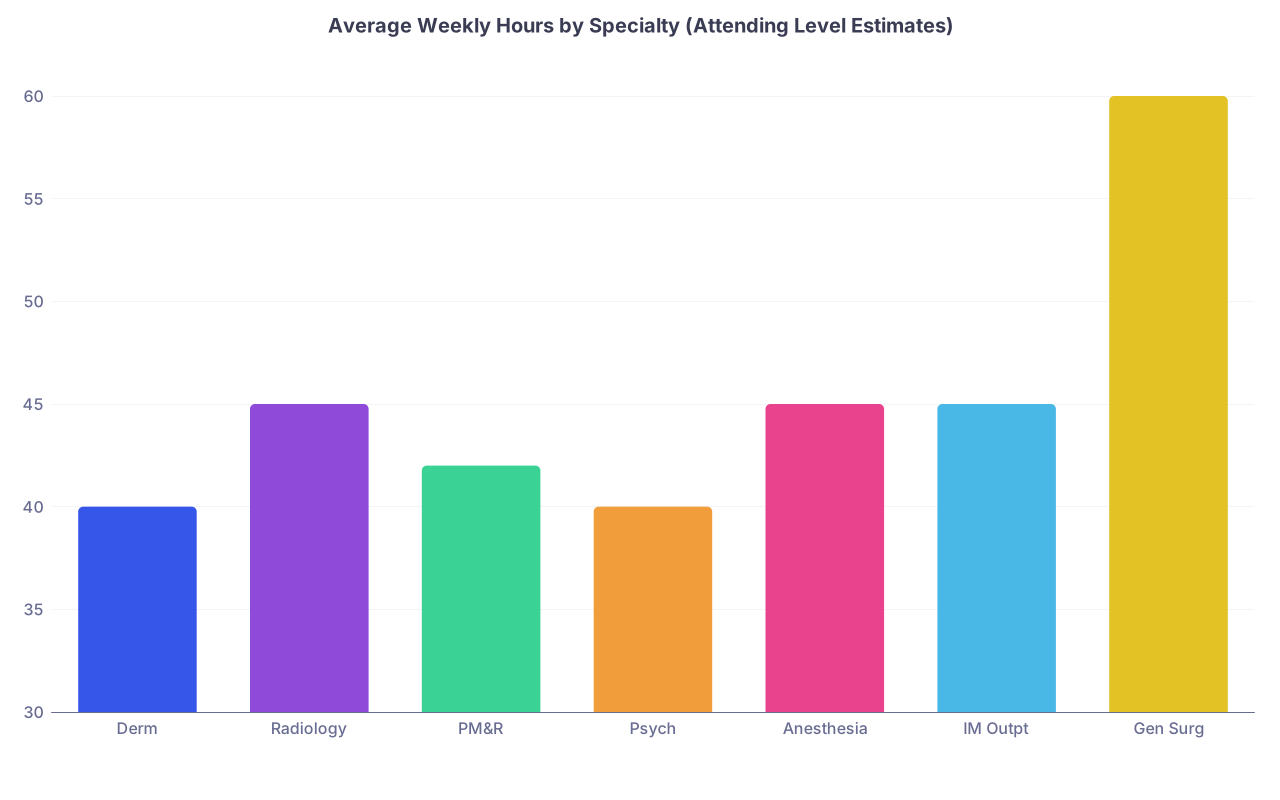
| Category | Value |
|---|---|
| Derm | 40 |
| Radiology | 45 |
| PM&R | 42 |
| Psych | 40 |
| Anesthesia | 45 |
| IM Outpt | 45 |
| Gen Surg | 60 |
Are these exact down-to-the-decimal? No. But they’re consistent with physician surveys and what people actually report living. The point is simple: several specialties cluster around the 40–45 hour mark when practiced in a lifestyle-conscious way.
Derm is not a magical portal to a 25‑hour workweek and infinite yoga retreats. Academic derm in a major city can easily hit 50 hours, with notes, inbox, and admin. Private cosmetic derm with heavy procedures can be intense, just differently intense.
Now let’s unpack where lifestyle actually comes from.
What “Lifestyle” Really Means (And What It Absolutely Does Not)
Lifestyle gets flattened into “hours per week,” which is crude and often misleading. Lifestyle has at least four separate dimensions:
- Schedule control – Do you decide when you work, or do emergencies and call schedules decide for you?
- Work intensity – Are you constantly in crisis mode, or are there built-in slower moments?
- Emotional load – Are you dealing with death, conflict, and trauma daily, or mostly routine, stable patients?
- Flexibility over a career – Can you dial up/down over time? Part-time? Shift work? Telehealth?
Derm tends to score well on all four—hence the hype. But it’s not alone.
Meanwhile, many people chase “lifestyle derm” but ignore the single biggest factor: outpatient vs inpatient.
If your typical patient can walk into clinic on their own two legs and schedule an appointment two weeks out, odds are your lifestyle is already better than someone whose patients arrive by ambulance.
That’s why several non-derm paths can rival or match derm lifestyle—if you are intentional.
The Overlooked Lifestyle All-Stars
Let’s walk through the actual contenders. Not fantasy jobs; real specialty + practice types that repeatedly produce sustainable lives.
1. Outpatient Psychiatry: The Quiet Lifestyle Giant
Psychiatry is what derm was 15–20 years ago in terms of lifestyle arbitrage: everyone knows it’s “less intense,” but most still underestimate how good it can be when structured smartly.
Typical outpatient psych attending week in a non-academic setting:
- 4 clinic days
- 1 admin day or half-day (or just shorter clinic)
- No nights. Minimal or no weekends. Telehealth increasingly common.
Is there emotional load? Yes, especially in inpatient or emergency psych. But pure outpatient med management + therapy often runs at a sustainable pace.
The kicker: psych is flexible. Part-time private practice, group practice, telepsychiatry, hybrid schedules. If you want 0.8 FTE after kids, psych is one of the easiest places to do that without being marginalized.
2. Radiology: Great Lifestyle If You Avoid the Trap Doors
Radiology is the introvert’s lifestyle specialty stereotype. Dark room, good salary, no clinic. Anecdotally, I’ve heard more “I can pick my shifts” and “I work 7-on/7-off and travel” from rads than from any other large specialty.
Reality check though: not all rads jobs are lifestyle-friendly. Teleradiology groups can squeeze you hard. Academic neurorads in a big center might have heavy call and tons of studies.
But in community practice or well-structured groups, hours and control look suspiciously like a “dream derm job”. 45-ish hours. No clinic. Night shifts separated and often well-compensated.

3. PM&R (Physical Medicine & Rehab): Underrated and Under-hyped
PM&R gets almost no preclinical buzz, which is ridiculous. It’s often:
- Predominantly outpatient
- Focused on function and quality of life, not constant medical crisis
- Rich in procedures (injections, EMGs, spasticity treatments) that can be scheduled
Lifestyle-wise, outpatient musculoskeletal and sports PM&R can compete directly with ortho sports in procedure satisfaction, but without the 5 a.m. OR times or 24/7 trauma call.
Again, practice type matters: inpatient rehab units can have call and more complexity. But a lot of PM&R attendings work 4–4.5 day weeks with very reasonable hours.
4. Anesthesiology: Not “Lifestyle” for Everyone, But Incredibly Modifiable
The memes about anesthesia—coffee, Sudoku, “I put people to sleep and read Reddit”—are obviously nonsense. OR days can be early, long, and intense. Emergencies don’t schedule themselves.
But anesthesiology has one massive lifestyle advantage: shiftability.
You can:
- Work at ambulatory surgery centers with mostly weekday, daytime cases
- Focus on low-acuity elective procedures
- Join a group that caps late shifts and outsources most night/weekend call
Your work stops when the last case is done. No clinic inbox, no refills, no long-term patient panel. For people who want clean separation between work and home, this matters.
Is this “better” than derm? Not universally. But for a subset of people who crave variety, hands-on procedures, and no clinic bureaucracy, yes—it’s more satisfying while still very livable.
5. Outpatient-Focused Internal Medicine and Pediatrics
Here is where people really underestimate the possibilities.
Everyone sees malignant IM residencies with q4 call and 80-hour weeks and concludes, “IM is suffering forever.” That’s just wrong. Residency ≠ career.
A community outpatient IM or peds physician in a well-run practice can absolutely:
- Work four days a week
- Have minimal (or phone-only) call
- See largely stable, scheduled patients
- Trade off weekends in a group
Where do people get burned? Poorly managed volume, inbox overload, and bad practice leadership. Those are system problems, not “IM vs derm” problems.
And outpatient peds, especially, often has a social/lifestyle sweetness people ignore: playful patients, shorter visits, fewer life-or-death crises, lots of preventive care. Flu season is rough, yes. But derm has its own seasonal crunches too.
| Specialty | Practice Type | Typical Schedule |
|---|---|---|
| Derm | Private medical derm | 4 days clinic, no call |
| Psych | Outpatient group | 4 days clinic, telehealth mix |
| Radiology | Community group | 7-on/7-off or 4–5 day weeks |
| PM&R | Outpatient MSK | 4.5 days, procedures + clinic |
| IM | Community primary care | 4 days clinic, light phone call |
Where Residents Get Misled About Lifestyle
I’ve watched this play out in real time. Third-years fall in love with derm during a cush elective: late starts, grateful patients, academic half-days, no overnight calls. Of course it looks good compared with your surgery month where you’re pre-rounding in the dark.
But you’re not comparing like with like. You’re comparing:
- Peak derm elective vs worst-rotation-of-your-life in a call-heavy specialty
A more honest comparison would be:
- Outpatient derm private practice in a mid-sized city
vs - Outpatient psych / radiology / PM&R / community IM / outpatient peds in that same city, 5+ years after training, when you’ve chosen your job intentionally
Once you compare that way, derm still looks very good—but not mythical.
There’s also pure prestige distortion. People conflate:
- Hard to match
with - Best lifestyle
Derm is hyper-competitive because:
- Limited spots
- Good pay
- Perceived lifestyle
- Strong academic cachet
But “hard to match” doesn’t mean “only path to a normal life.” Radiology, PM&R, anesthesia, and psych all have strong markets and flexible jobs. Primary care shortages are massive; outpatient IM and peds doctors can increasingly dictate terms.
The real constraint will not be “I can’t have a lifestyle if I’m not derm.” It will be “Will I have the courage and discipline to say no to jobs that don’t match my priorities?”
The Uncomfortable Truth: Your Future Lifestyle Is a Series of Choices
Specialty absolutely moves the baseline. Trauma surgery will always be more disruptive than outpatient derm. Critical care will always feel different than outpatient psych.
But once you’re in the universe of reasonably lifestyle-compatible specialties—derm, psych, rads, PM&R, outpatient anesthesia, outpatient IM/peds—the differences between them shrink, and individual choices matter more.
Those choices include:
Academic vs community vs private practice.
Academic jobs bring teaching and prestige, but also lower pay and often more committees and after-hours work. Community jobs may have better hours and pay but less “glamour.” Decide what trade-off you’re actually willing to live with.Urban center vs smaller city.
Big coastal cities often mean higher volume, higher expectations, and more competition—and you’ll take home less after cost of living. A well-structured practice in a mid-sized city can give you more money and more time.Volume expectations.
A derm clinic pushing 40+ patients per day may feel more exhausting than a psych clinic seeing 12–14. A radiology group reading 100+ RVUs daily feels very different from one with more moderate targets.Boundary setting.
I’ve seen derm attendings burned out and psych attendings thriving—often because the psych docs were ruthless about what they’d tolerate: number of patients, charting at home, evening hours, weekend coverage.
And career stage matters. Many people in their 30s and 40s deliberately work more for a financial runway. Some cut back into their 50s. The same derm attending can experience “this is manageable” at 35 and “this is too much” at 55 if they never adjust.
The Residents Who Regret Chasing Derm at All Costs
No one talks about this publicly, but it happens.
I’ve seen residents who contorted their entire med school existence around derm—research in fields they didn’t care about, toxic away rotations, insane Step expectations—only to realize once they matched that they actually liked procedures and acute care and team-based surgery more than clinic.
They chased what they thought was the only lifestyle option and ignored fit. Then they got the lifestyle and hated the day-to-day.
Flip side, I’ve seen IM residents who thought they’d doomed themselves by “missing” derm, only to end up in concierge primary care or direct care practices with:
- 8–10 patients per day
- No rushed visits
- Great pay
- 3–4 day weeks
Meanwhile, a derm colleague across town is doing 30+ patients per day, double-booked, fighting with insurers about biopsy coverage.
The moral isn’t that derm is bad. It’s that specialty ≠ destiny. Over-fixating on derm can blind you to careers that might fit you better and give you equal or better lifestyles.
A More Honest Way to Think About “Lifestyle-Friendly”
Here’s the mental model that actually matches how physicians live 10–20 years out:
Pick the right quadrant, not the one prestige option.
There’s a broad quadrant of specialties where outpatient-focused, schedule-predictable lives are very realistic: derm, psych, rads, PM&R, anesthesia (in the right setting), outpatient IM/peds, even some EM and hospitalist gigs with sensible shift loads.Within that quadrant, optimize practice type, not bragging rights.
A derm job with insane volume can be worse lifestyle than a well-structured outpatient psych or PM&R job. If you keep chasing “most prestigious” instead of “best fit” you’ll sabotage your own life.Accept that your future happiness is more about your boundaries than your badge.
Saying no to extra sessions, choosing a group with humane expectations, moving cities if needed—those actions will dictate your lifestyle far more than whether your white coat says Dermatology or Psychiatry.
Bottom Line
Dermatology is a great specialty with strong lifestyle potential. But the myth that it’s derm-or-bust for a sane life is nonsense.
Three takeaways:
- Several specialties—psych, radiology, PM&R, outpatient-focused anesthesia, IM, and pediatrics—can match or rival derm lifestyle when you choose the right practice setup.
- Residency misery and prestige culture massively distort how students perceive “lifestyle.” Compare long-term outpatient jobs, not worst-rotation experiences.
- Your eventual lifestyle will be driven less by specialty label and more by practice type, volume expectations, geography, and your willingness to set boundaries.
Chase fit and structure, not just derm. The data—and real attendings’ lives—back that up.