Telemedicine is not your shortcut to a chill, semi-retired career. It is just a different flavor of grind.
The marketing pitch is seductive: pajamas, coffee, laptop, flexible schedule. And if you hang around resident forums or Telegram groups, you’ll hear the same line on repeat: “I’ll just do telemed for lifestyle.” As if swapping in-person clinic for virtual visits magically erases all the things that make medicine exhausting.
The physicians actually doing high-volume telemedicine? They’re a lot less romantic about it.
Let’s walk through what lifestyle-focused docs—people who chose “cushier” specialties and then went hard into telemedicine—actually report about the day-to-day reality.
The Telemedicine Lifestyle Sales Pitch vs Reality
Telemedicine absolutely has lifestyle advantages. But it’s not the binary people think—clinic = misery, telemed = easy days. The truth is more nuanced and way less Instagrammable.
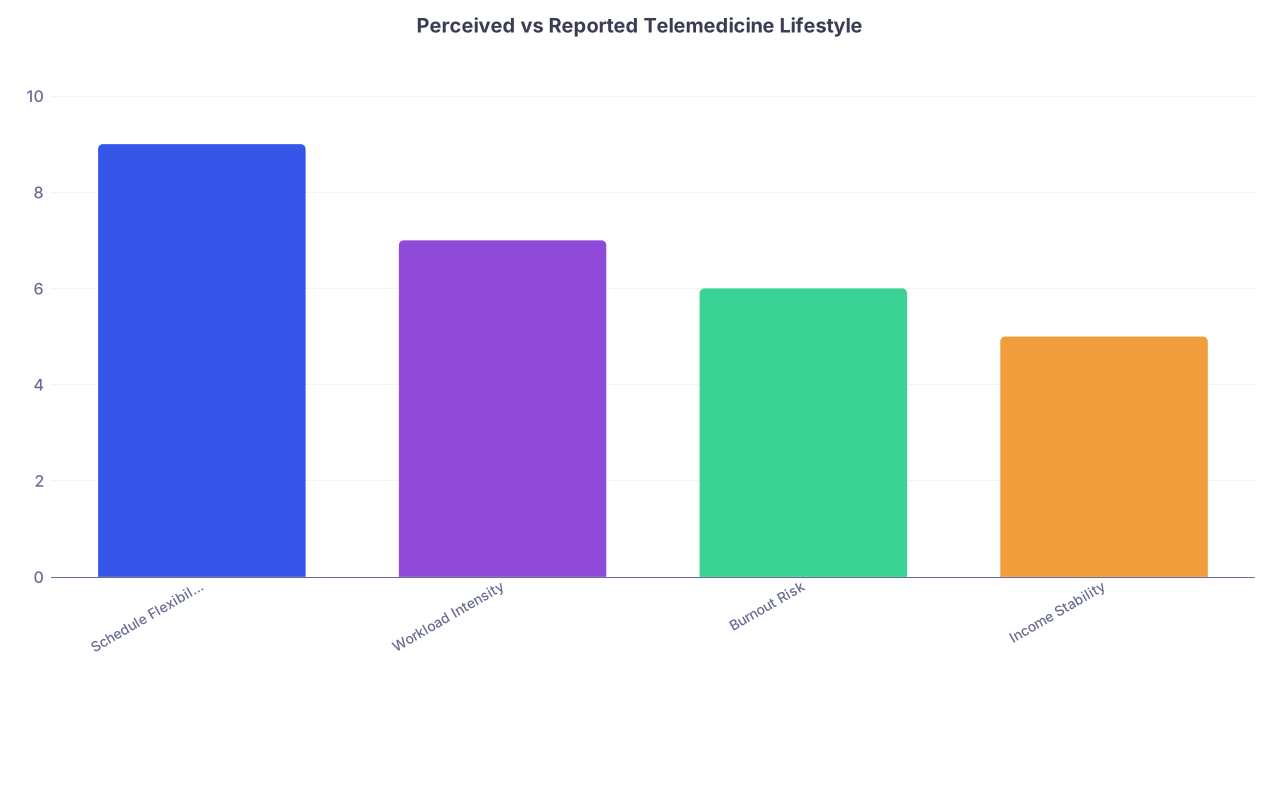
| Category | Value |
|---|---|
| Schedule Flexibility | 9 |
| Workload Intensity | 7 |
| Burnout Risk | 6 |
| Income Stability | 5 |
Interpretation (because the chart alone is meaningless): schedule flexibility really is high. But workload intensity, burnout risk, and income stability are not “3 out of 10.” They’re mid-to-high. It’s not a spa day.
Here’s the split you actually see when you talk to lifestyle-driven docs doing telemedicine in specialties like:
- Family medicine / outpatient IM
- Psychiatry
- Endocrinology, allergy, rheum (niche tele-consults)
- Dermatology (asynchronous tele-derm photos)
They report three real upsides:
- No commute, no waiting room drama, fewer physical interruptions
- More control over hours (especially in per-visit marketplaces)
- Less physical exhaustion (you’re sitting, not running room to room)
And four serious downsides:
- High visit volume and “hamster wheel” pressure
- Intense cognitive fatigue from compressed, back-to-back visits
- Isolation and weaker team support
- Unstable pay and constant pressure to be available at peak times
Let’s break it out specialty by specialty and then by lifestyle realities.
Which “Lifestyle” Specialties Actually Translate Well to Telemedicine?
Spoiler: Not all “lifestyle” specialties stay lifestyle once you turn them into 15-minute video boxes.
| Specialty | Telemed Fit | Typical Use Case |
|---|---|---|
| Psychiatry | High | Med management, therapy |
| Family Med | Moderate | Acute care, chronic f/u |
| IM (outpt) | Moderate | Chronic disease mgmt |
| Derm | Moderate | Async image review |
| Endocrine | Moderate | Diabetes, thyroid mgmt |
| Allergy/Immuno | Low-Mod | Follow-up, education |
Psychiatry: The Poster Child… With Strings Attached
Telepsych is probably the best true lifestyle fit. Your tools—conversation, assessment, meds—translate well to video. You don’t need to look in an ear or tap a knee.
Lifestyle-focused telepsych docs report:
- 30–60 min evals, 15–30 min follow-ups
- Strong remote continuity models in many groups
- Predictable schedules once you’re panel-based
But here’s what gets glossed over:
- Emotional fatigue is higher on video. Staring at faces and screens nonstop is draining in its own way.
- Burnout still happens. A 2022 paper in Psychiatric Services showed telepsych was not a magic burnout shield—workload and organizational support still mattered more than video vs in-person.
- Many high-volume telepsych platforms push 15-min med checks stacked tightly. That’s not a lifestyle; that’s speed dating with benzodiazepines and mood stabilizers.
Does telepsych beat inpatient psych call and ED consults for lifestyle? Absolutely. Is it some low-stress, low-output gig? No.
Outpatient FM/IM: Urgent Care in Your Laptop
Family medicine and outpatient internal medicine are the backbone of commercial telemedicine. That’s where you see the urgent-care style “10–15 visits an hour if you want” pay structures on big platforms.
Here’s what lifestyle-focused primary care docs actually report when they move heavily into telemed:
- It feels like working in a fast-track ED or retail clinic, not a slow suburban office
- Chief complaints: URIs, UTIs, rashes, med refills, minor injuries, anxiety/depression med refills
- Heavy protocolization and pressure to keep visits under 10–12 minutes
- Charting still eats your life—now you just do it in the same chair you sit in for 8 hours

The lifestyle benefit is mainly: you can say “no” more easily. You can choose not to open the app. You can schedule fewer blocks. But when you do work, you work hard and fast.
Derm, Endo, Allergy: Niche Tele-Consults With a Ceiling
These specialties get hyped as telemedicine gold mines. The truth:
Derm telemed (especially store-and-forward photos) can be decent lifestyle:
- Asynchronous work: you batch cases and read them on your time
- Lower “live interaction” fatigue
- But rates per case are often lower than people assume, and medicolegal risk remains if the images are bad or incomplete
Endocrine and allergy/immunology:
- Work well for stable follow-up: diabetes titration, thyroid management, asthma plans
- Don’t work great when you lack vitals, lung exams, or labs (you’re constantly chasing outside data)
- Volume is more limited—these are not viral, high-demand urgent-care specialties
These can be part of a balanced, lifestyle-friendly tele-portfolio, but few people are running pure tele-endo or tele-allergy at high pay with banker’s hours. Most do hybrid models.
What Lifestyle-Focused Docs Actually Complain About
Ask residents and fellows what they think telemed life looks like. Then ask a 42-year-old FM doc who left clinic for full-time telemed. The gap is huge.
Here are the most common “I wish I’d known” themes clinicians report.
Myth 1: “Working from Home Will Fix My Burnout”
No. It just changes the flavor.
Research from the pandemic telehealth surge showed mixed effects on burnout. Some physicians loved ditching the commute and chaotic clinic flow. Others felt more isolated, more screen-tired, and less supported.
Common realities:
- Zoom fatigue is real. Back-to-back video visits are more cognitively taxing than in-person for many people. You’re constantly reading micro-expressions on a low-res feed.
- No team buffer. In clinic you can catch a MA or nurse in the hallway, debrief with a colleague, vent for 30 seconds. At home, your “hallway” is your kitchen. You stew alone.
- Boundaries blur fast. When your exam room is your bedroom desk, your brain never fully clocks out.
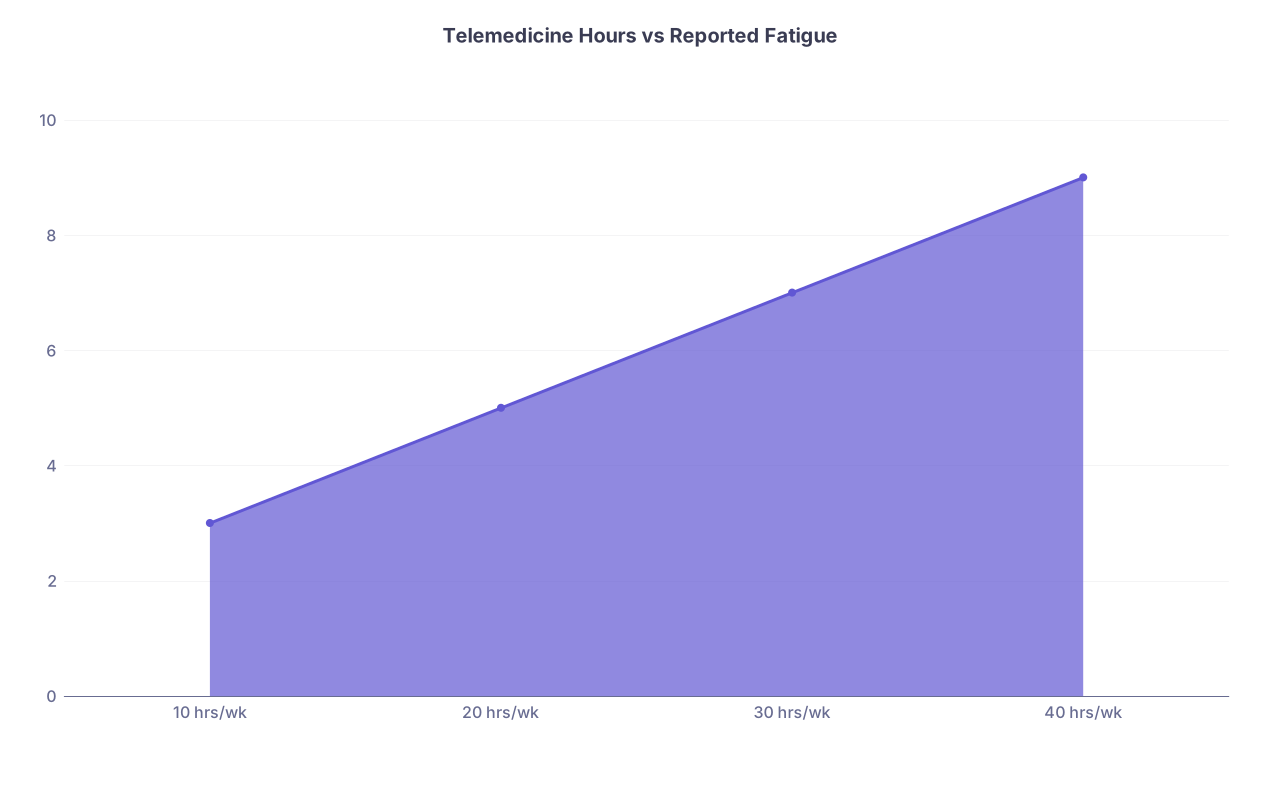
Lifestyle docs who like telemed long-term almost always do one thing: they cap their hours hard. When they go over ~20–25 clinical hours of pure video, the complaints start to sound like their old clinic life, just without the drive.
| Category | Value |
|---|---|
| 10 hrs/wk | 3 |
| 20 hrs/wk | 5 |
| 30 hrs/wk | 7 |
| 40 hrs/wk | 9 |
(Scale 1–10, where 10 = “I am wrecked.” That spike beyond 20 hours is what you hear anecdotally over and over.)
Myth 2: “Telemed Visits Are Short and Easy”
Telemedicine shifts work intensity from physical to cognitive-temporal.
You save time on:
- Walking between rooms
- Physical room turnover
- In-person chaos (door-knocking, “one quick question,” lost paperwork)
You pay that back with:
- Higher visit density. Platforms and groups rapidly learn your maximum throughput and quietly normalize it.
- Less non-verbal context. That “sense” you get walking into a room? You lose a chunk of that on video. So your brain has to process more data consciously.
- More patient misunderstanding. Tech issues, audio delays, distractions on the patient’s side all slow things down.
Lifestyle docs I’ve talked to say things like:
- “In clinic, 20 patients in a day feels full. On telemed, 25–30 fairly straightforward cases a day is routine. But I’m more mentally done at the end.”
- “I traded running around for staring at a screen. My feet stopped hurting. My head started.”
So are visits “easier”? For some acute, low-risk stuff, yes. But the net workload isn’t trivial—it’s just different.
Myth 3: “I’ll Have So Much Control Over My Time”
This one is partly true—and heavily oversold.
There are essentially three telemed models:
Employed, schedule-based (hospital system, large group):
- You get fixed half-days or full days, like clinic, just remote.
- Lifestyle can be good if the group sets sane expectations.
- But control is limited—you’re still plugged into a system.
Marketplace / gig-style (Teladoc, MDLive, Amwell, etc.):
- You can theoretically log in whenever.
- Peak demand is nights/weekends and flu season. If you want top pay, “lifestyle” starts looking like “always available when others want to be off.”
- Volume can crater in off-hours, so your hourly rate fluctuates.
Private practice telemed (your own panel):
- Maximum control, maximum overhead and hustle.
- Lifestyle can be excellent once established—but getting there is not exactly chill.

You can definitely arrange your week better with telemed than with hospitalist or surg call. But the choice is usually between:
- More control, less guaranteed income
- Less control, more stability
That is not “easy days.” That is a tradeoff.
What Residents and Early-Career Docs Get Wrong About Telemed
You’re in training and watching seniors bail to telemed. So you assume: that’s the escape hatch. Here’s where the mythology really misleads you.
Disconnect #1: Volume Expectations
In residency, “busy” is a 24-patient clinic day with documentation chaos.
In commercial telemed, 24 visits might be 4–5 hours of clicking pills, rashes, and coughs. Then the platform nudges you for more.
If your mental model of “full day” never updates, you’ll either:
- Be constantly behind on income expectations
- Overwork because you think you’re “supposed” to be seeing more
Lifestyle docs who are actually happy set their own max: “I do 12–16 visits a day, period, even if the platform will give me 40.”
Disconnect #2: Nature of Burnout
Residents imagine burnout is mostly about hours and call.
Attendings know burnout is more about:
- Loss of control
- Moral injury (being forced to practice in ways that feel wrong)
- Administrative and documentation pressure
Telemedicine helps a bit with autonomy and environment. It does not magically fix:
- Prior auths
- Documentation burden
- The pressure to keep patients and employers happy with impossible time constraints
I’ve watched more than one doc move from a soul-sucking clinic to a soul-sucking telemed factory and be confused why they still feel terrible. Same metrics. Different venue.
Disconnect #3: “I’ll Just Do Telemed If My Specialty Sucks”
Some specialties convert atrociously to telemedicine. Surgery is obvious. But also:
- EM: yes, there are tele-urgent care gigs, but acuity is constrained and the pay rarely matches in-person EM early on.
- Procedural specialties: GI, cards, pulm—you might do some tele-consults, but the actual money and interest are in procedures.
If you’re banking on telemed as your escape from a fundamentally misaligned specialty, you’re gambling badly. The specialty still dictates:
- How much of your work can realistically be done virtually
- How much patients and systems will pay for that work
- How much variety and interest you’ll have
Telemed is a practice setting, not a specialty patch.
How Lifestyle-Focused Docs Actually Use Telemedicine (When They’re Smart About It)
The people who seem sustainably happy with both lifestyle and telemed tend to do one of a few things:
- Hybrid setups: 2–3 in-person days, 1–2 tele-days. Less screen fatigue, more variety, still no full clinic grind.
- Capped volume: They explicitly trade income for sanity and ignore platform pressures to do more.
- Niche focus: ADHD med management, perinatal psych, HIV PrEP, gender-affirming care, derm triage—these niches let them build semi-predictable, lower-acuity panels.
- Strong boundaries: No answering platform messages at midnight “just because it’s on my phone.”

| Step | Description |
|---|---|
| Step 1 | Residency |
| Step 2 | Traditional Clinic Job |
| Step 3 | Explore Telemed Part Time |
| Step 4 | Hybrid Model |
| Step 5 | Adjust Volume or Niche |
| Step 6 | Stable Lifestyle Practice |
| Step 7 | Burnout or lifestyle misfit |
| Step 8 | Like telemed pace? |
This is the pattern you actually see. Very few people go from residency straight into 100% high-volume telemed and stay happy long-term. Most test the waters, adjust, and end up with some blend.

If You Care About Lifestyle, What Should You Actually Do?
Here’s the unromantic answer.
- Choose a specialty that matches your tolerance for cognitive intensity, emotional load, and procedures—before you think about telemed vs in-person.
- Assume that pure, high-volume telemedicine will feel more like urgent care than like “easy money from the couch.”
- Plan for a hybrid or niche-based practice if you want both income and sanity.
Two or Three Things to Remember
- Telemedicine changes where and how you’re stressed, not whether you’re stressed. It’s not automatically “easy days,” just different days.
- The specialties that translate best—psych, outpatient primary care, some derm and endocrine—can be lifestyle-friendly, but only when you control volume and boundaries, not when you chase every available visit.
- Treat telemedicine as a tool to shape your life, not as a magic exit door from a bad specialty or bad job. If you pick the wrong door, you just move your burnout from the hospital hallway to your home office.