
The ‘9–5 Clinic’ Illusion: Why Outpatient Doesn’t Automatically Mean Lifestyle
Think outpatient equals “walk out at 4:59, gym by 5:15, no weekends”? Let’s dismantle that fairy tale right now.
A lot of med students talk about “lifestyle” like it’s a checkbox:
Inpatient = bad. Outpatient = good.
Clinic = 9–5. Wards = misery.
Reality is not that simple. Some of the most quietly brutal jobs I’ve seen were 100% outpatient. And some inpatient-heavy specialties have more predictable and protected time than their clinic-only cousins.
You’re being sold a simplistic story by older attendings who trained in a different era, training programs that need warm bodies, and frankly, your classmates who have no idea how RVUs work but repeat “clinic is lifestyle” like gospel.
Let’s go through what actually determines lifestyle—and why “outpatient” on its own is almost meaningless.
What People Think “Lifestyle Outpatient” Looks Like
The dream version of clinic, the one I hear from MS3s on family med or peds rotations, goes like this:
- Show up at 8
- See a “reasonable” panel of patients
- Lunch without interruption
- Finish by 4, chart done by 4:30
- No nights, no weekends, minimal call
- Low acuity, low stress, “relationship-based” medicine
That schedule exists. For some people. In some clinics. Under very specific conditions.
But it’s not inherent to outpatient medicine. It’s the result of:
- How you’re compensated (salary vs heavy RVU pressure)
- How many patients are stuffed into your schedule
- How much of your work is invisible (in-basket, refills, forms)
- Whether you have residents/APPs or you’re solo
- The payer mix and practice model (FQHC vs concierge vs academic vs corporate)
So if you just aim for “outpatient” as your primary filter, you’re basically rolling dice.
What Outpatient Actually Looks Like in 2024
Let me walk you through what I’ve actually seen, not what’s in the brochure.
The Hidden Second Shift: EHR, In‑basket, and “Quick Questions”
Clinic day “ends” at 4:30. Your work does not.
- The nurse messages: triage questions, refill requests, abnormal labs
- MyChart messages: patients writing essays at 11 p.m. about “new chest pain since Friday”
- Referrals: insurance authorizations, writing magic words so GI will actually see your patient
- Documentation: “Just finish your notes at home” is now standard culture in many systems
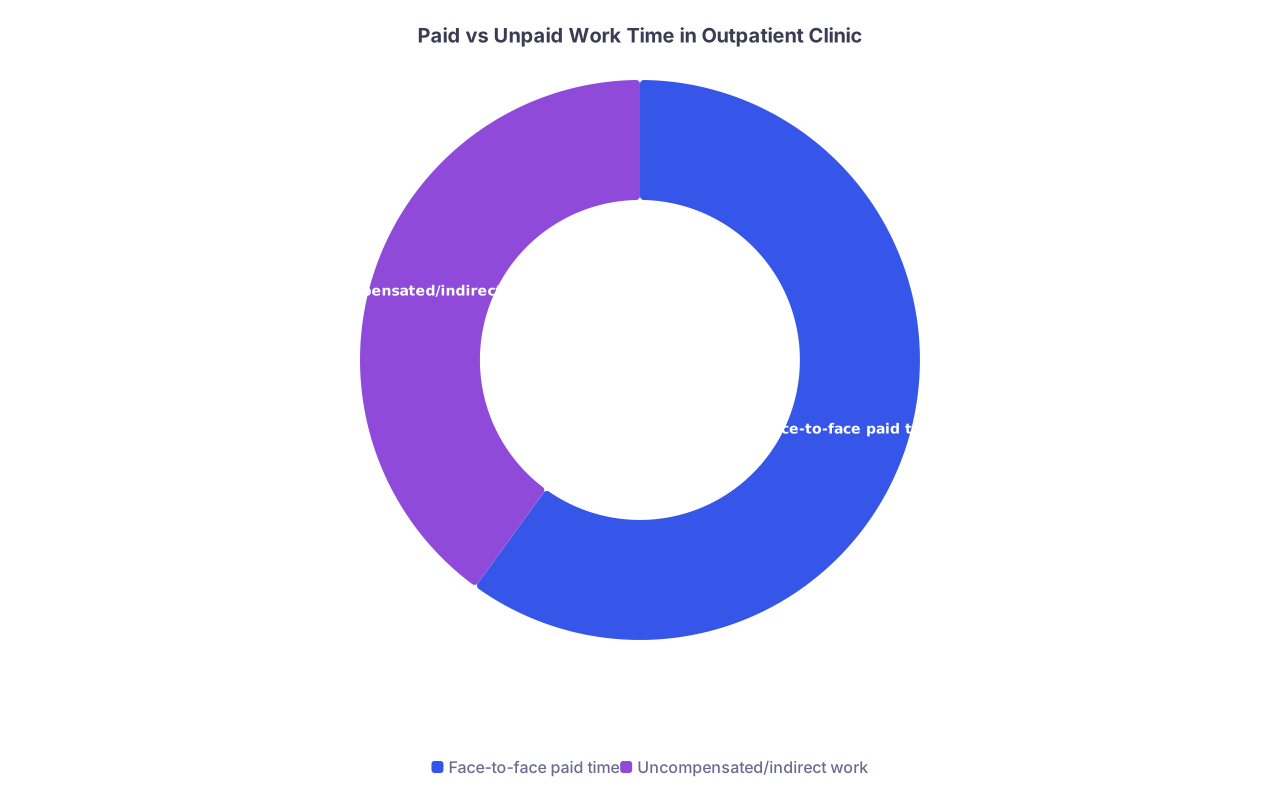
Here’s the kicker: a ton of this work is unpaid. You get RVUs for visits and procedures. You do not reliably get RVUs for 45 minutes of MyChart detective work for three complex diabetics who rescheduled.
| Category | Value |
|---|---|
| Face-to-face paid time | 60 |
| Uncompensated/indirect work | 40 |
In surveys of primary care physicians, 30–50% report 1–2 hours of charting and inbox work after scheduled clinic ends. That’s how your “8–5” quietly morphs into 7:30–6:30 plus a few hours on Sunday.
Panel Size and Visit Volume: The Silent Lifestyle Killer
Lifestyle is driven less by “outpatient vs inpatient” and more by “how many humans do they make you see per day?”
I’ve seen clinics where the schedule is:
- 16 patients/day – manageable, time to think
- 22–24 patients/day – constant hustle, no buffer
- 28–30+ patients/day – chaos, assembly-line medicine, guaranteed evening charting
| Practice Type | Typical Patients/Day |
|---|---|
| Concierge IM/FM | 8–12 |
| Academic subspecialty clinic | 10–16 |
| Standard employed primary care | 20–26 |
| High-volume corporate clinic | 26–32+ |
You can call all of these “outpatient.” Only one of them actually feels like lifestyle.
The RVU Trap: Why “Lifestyle” Clinics Burn People Out
Let’s talk about the thing nobody explains well to students: RVUs and productivity.
Most employed outpatient docs are paid using some variation of:
- Base salary + productivity bonus
- Pure RVU-based compensation after a guarantee period
- “We pay you well, but btw your target is 5,000–7,000 RVUs/year”
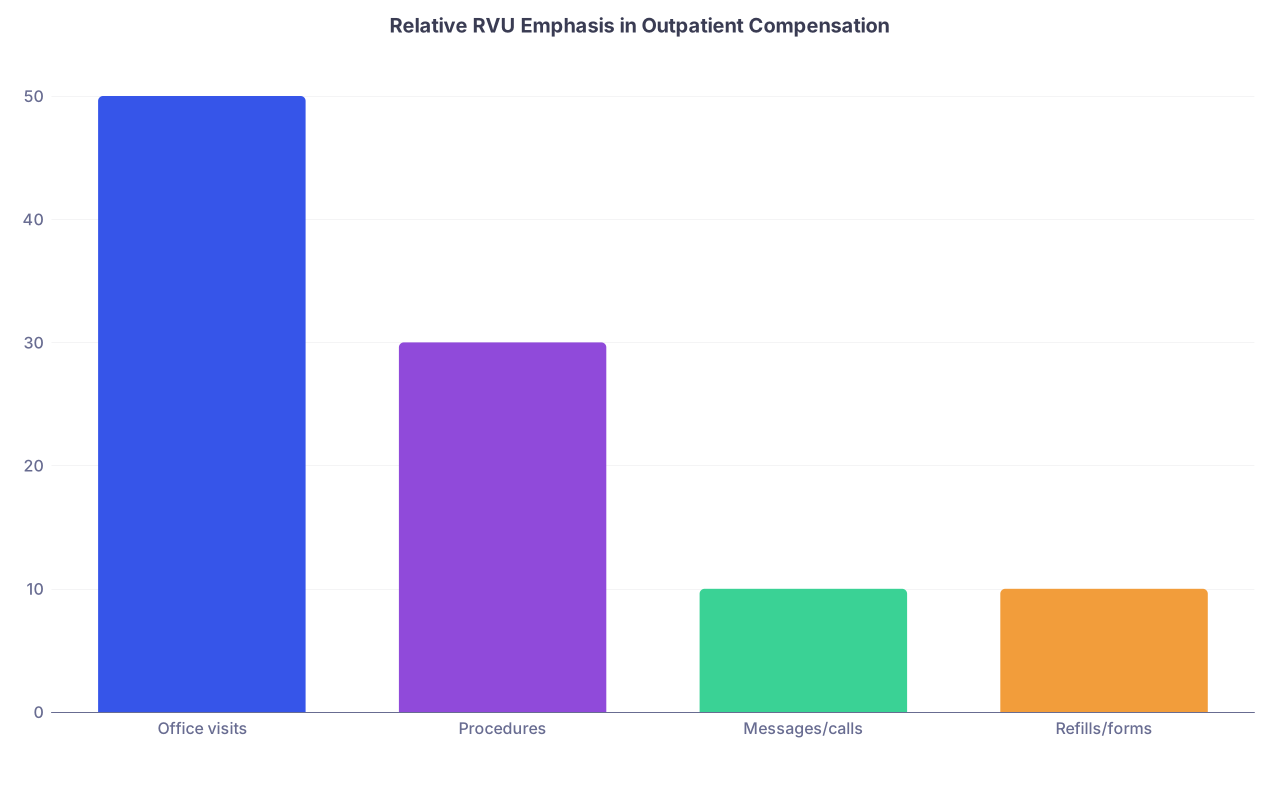
You generate RVUs primarily by:
- Seeing more patients
- Doing higher-complexity visits
- Doing procedures
Everything else—care coordination calls, patient messages, refill protocols, prior auths, long family meetings—is either poorly reimbursed or not reimbursed at all.
| Category | Value |
|---|---|
| Office visits | 50 |
| Procedures | 30 |
| Messages/calls | 10 |
| Refills/forms | 10 |
So what happens?
- Clinic templates get more crowded
- 15-minute visits become 10-minute visits
- Complex patients are double-booked with acute visits
- Docs feel pressure to squeeze in “just one more” because comp is tied to volume
You can be 100% outpatient and feel like you are on a hamster wheel. All day. Every day.
That’s not lifestyle. That’s just a different flavor of grind.
Comparing Specialties: Outpatient Doesn’t Mean What You Think
Students often bucket specialties like this:
- INVASIVE/HARD: surgery, OB, EM
- LIFESTYLE/CHILL: derm, psych, outpatient FM, outpatient IM
Reality is more nuanced.
Let’s compare some broad patterns. This is directional, not absolute. There are exceptions everywhere.
| Specialty | Mostly Outpatient? | Lifestyle Reality (Typical) |
|---|---|---|
| Dermatology | Yes | Genuinely lifestyle-friendly |
| Outpatient Psych | Yes | Often lifestyle, depends on setting |
| Outpatient FM/IM | Yes | Highly variable, often overworked |
| Endocrinology | Mostly | Lower pay, high complexity, inbox |
| GI (clinic + procedures) | Mixed | Excellent pay, but very busy days |
| Allergy/Immunology | Mostly | Often good lifestyle |
| Rheumatology | Mostly | Moderate lifestyle, heavy inbox |
The key point:
“Outpatient” is a setting, not a lifestyle guarantee. Pay, complexity, and inbox burden change everything.
- Derm and allergy often are as good as advertised. High control over schedule, procedures, low inpatient.
- Outpatient FM and IM in big systems are often not lifestyle: heavy panel, high RVU pressure, intense inbox.
- Outpatient subspecialties (rheum, endo, cards clinic) can have long days of complex visits and insane message volume, even if the call is relatively light.
The Residency Illusion: Why Training Years Trick You
Here’s a trap: judging the lifestyle of a specialty by your residency schedule.
During residency, outpatient blocks can feel amazing:
- 8–5 in clinic, protected didactics
- You don’t take clinic notes home, because you simply cannot
- Attendings buffer you from RVU pressure
- You’re not yet the one responding to 90% of patient messages
So you think, “Wow, clinic is so much better than wards. I want a lifestyle. I’ll just do outpatient.”
Then you become an attending. Now:
- Your template is double-booked
- You are the one responsible for refills, results, messages, portal essays
- You are suddenly measured monthly on productivity and patient satisfaction
- Your “no weekends” job morphs into “weekends catching up on the inbox”
The shift from resident clinic to attending clinic is like thinking you’re good at flying because you did a few hours in the simulator.

| Step | Description |
|---|---|
| Step 1 | Resident clinic |
| Step 2 | Protected time |
| Step 3 | Limited panel |
| Step 4 | Minimal inbox |
| Step 5 | Perceived lifestyle |
| Step 6 | Attendingship |
| Step 7 | Full panel responsibility |
| Step 8 | Heavy inbox and RVUs |
| Step 9 | Real lifestyle emerges |
Do not choose a specialty based only on how its outpatient rotation felt in residency. That’s the most common lifestyle-selection mistake I see.
What Actually Predicts Lifestyle (Hint: It’s Not Just Setting)
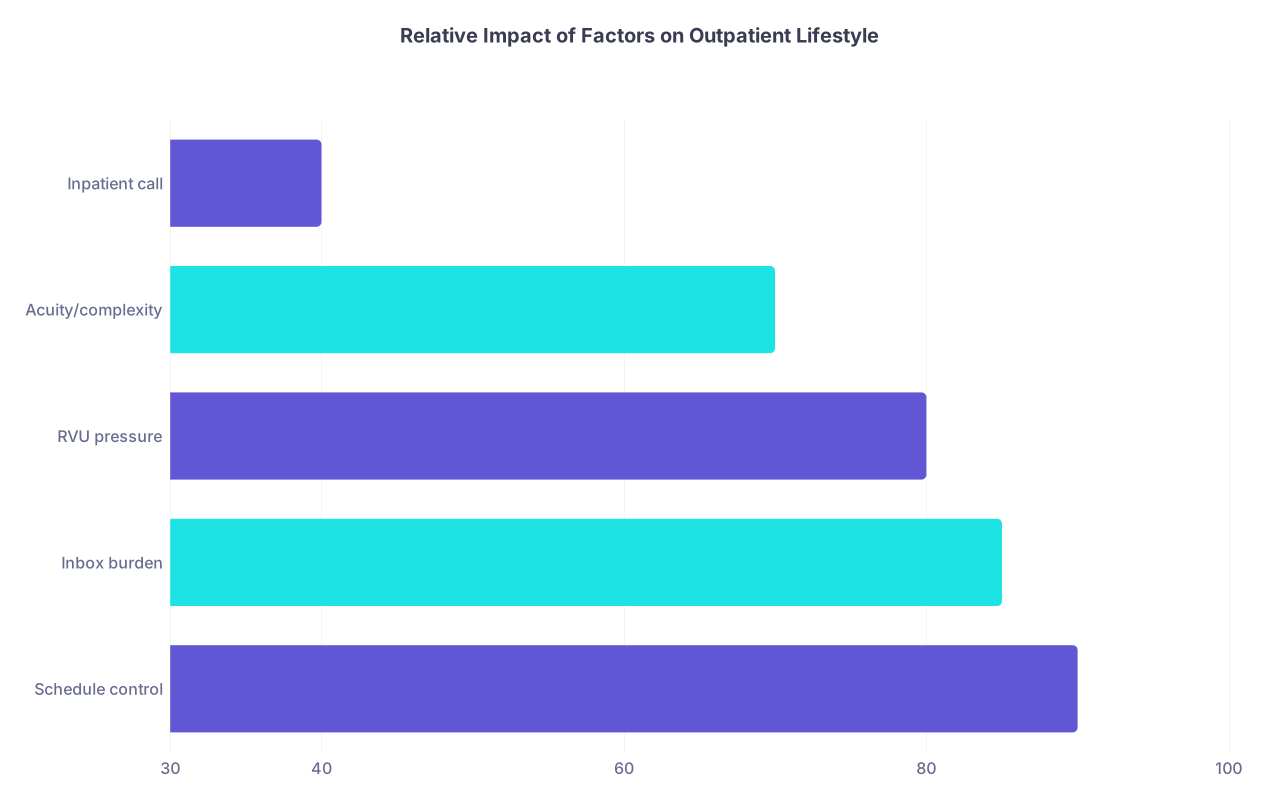
If you want a specialty that is truly lifestyle-friendly, you need to look at a different set of variables. Outpatient vs inpatient is just one line item.
The big ones:
Control over your schedule
- Can you cap how many patients you see per day?
- Can you go 0.8 FTE without being punished financially or culturally?
- Can you say no to double-booking and add-ons?
Inbox burden and delegation
- Who handles 80% of MyChart messages—nurse, APP, or you?
- How many controlled substance refills are you tied to?
- Are you expected to “check the inbox” on nights/weekends?
-
- Heavy productivity-based comp = you are incentivized to overwork
- A sane base salary with reasonable expectations = more lifestyle
- FQHC/VA/academic often trade income for slightly better hours (but not always)
Acuity and complexity
- Primary care with a sick, underinsured, complex panel: emotionally and cognitively draining
- Derm, allergy, elective procedures: often time-limited problems, fewer life-or-death spirals
Work density
- 8 hours in a low-acuity allergy clinic is not the same as 8 hours in a safety-net IM clinic
- “Full-time” isn’t just hours, it’s how cooked your brain is at the end
| Category | Value |
|---|---|
| Schedule control | 90 |
| Inbox burden | 85 |
| RVU pressure | 80 |
| Acuity/complexity | 70 |
| Inpatient call | 40 |
Notice where “inpatient call” sits. Important, yes. But for many outpatient specialties, it’s not what burns people out most.
Where Outpatient Is Genuinely Lifestyle-Friendly
Let’s be fair. There actually are outpatient-dominant paths that are, frankly, pretty good.
Patterns I’ve seen that tend to work:
Dermatology in most settings:
- Visits are short, problems are visible, inpatient consults limited
- High procedure density, strong pay, lower inbox chaos than primary care
- Panel tends to be healthier; fewer midnight crises
Allergy/Immunology in private practice or stable groups:
- Controlled schedule, fewer emergencies
- Predictable outpatient procedures (testing, shots)
- Call is usually light
Well-structured outpatient psychiatry (especially private/concierge/cash-based):
- 50- or 60-minute visits, clear schedule, less EHR insanity in cash practices
- Inpatient exposure depends on your choice, not the specialty itself
Highly controlled concierge primary care:
- Smaller panels, more time per patient, higher direct payment
- Still busy, but the density and inbox load are more reasonable
Contrast this with:
- High-volume corporate primary care clinics
- Under-resourced FQHC primary care without strong team support
- Subspecialty clinics that see complex referrals all day with minimal staff
All of these are also outpatient. Only some give you a life.
Concrete Red Flags to Watch For (As a Student or Resident)
Instead of asking, “Is this mostly outpatient?” ask these questions when you rotate or interview:
- How many patients do your attendings see per day?
- What time do they actually leave the building?
- Do they chart at home? How often?
- Who handles patient messages and refills? Nurses? APPs? Or the doc?
- What’s the expected RVU target? What happens if you miss it?
- How many evenings/weekends do they check their inbox?
- How many docs in this practice are 0.8 FTE or job-share—and are they respected?
Do not be distracted by the fact nobody is sleeping in the hospital. Overnight call is visible. Inbox slavery is invisible until you live it.

A Quick Reality Check on “Most Lifestyle Friendly Specialties”
Since you’re looking at “most lifestyle friendly” specialties, let me be blunt.
- If you want a reliably good lifestyle: dermatology, radiology, anesthesiology, pathology, allergy, and well-chosen psychiatry tend to outperform generic “outpatient internal medicine” or “outpatient family med” in real life.
- Outpatient-heavy primary care can be great if:
- You choose your practice model wisely
- You’re willing to leave bad jobs
- You protect your schedule like a hawk
- The worst plan is: “I’ll do any outpatient-heavy specialty, it’ll be fine.” That’s how you wake up at 39, charting at midnight, thinking, “I picked this to see my kids.”

How to Actually Use This When Choosing a Specialty
Some practical ways to not fall for the 9–5 clinic illusion:
Stop treating “outpatient” as a synonym for “lifestyle.”
It’s just one variable. It reduces night shifts and inpatient chaos, sure. But it says nothing about inbox burden, volume, or RVU pressure.Shadow real attendings in real jobs, not just academic clinics.
Ask to follow someone in private practice FM, a high-volume IM clinic, a derm practice, an allergy group. Watch what they do after “clinic ends.”Ask rude questions. Privately.
“How many hours a week do you actually work if you include home charting?”
“How much does RVU pressure affect your day-to-day?”
“If your kid had to pick your specialty, would you be happy or sad?”Think about your tolerance for administrative nonsense.
If you hate messages, refills, and prior auth battles, heavy-outpatient primary care is going to hurt. If you prefer fewer but sicker patients, some inpatient-heavy fields may actually fit you better.

Bottom Line: Outpatient ≠ Lifestyle
Let me condense this into what actually matters:
Outpatient is a setting, not a lifestyle. Your real quality of life depends on volume, inbox burden, schedule control, and compensation structure—not just the absence of hospital nights.
Some outpatient fields (derm, allergy, good psych practices) truly are lifestyle-friendly. Generic “outpatient primary care” in high-volume systems often is not. Treat them differently.
When you evaluate specialties, interrogate how the work is done, not just where. Ask about patient load, after-hours work, RVU expectations, and inbox realities. That’s where your evenings and weekends really go.