The idea that “radiology is the flexible, work-from-home specialty” is wildly overstated.
It’s not pure fantasy—you can work from home in radiology more than in surgery or EM—but the Instagram version of remote radiology is not what most residents and early attendings actually live. The data, the job ads, and the hospital realities paint a much messier picture.
Let’s walk through what’s myth, what’s partially true, and what your actual odds are of reading CTs in sweatpants while your anesthesia friends are drawing up propofol at 5 a.m.
The Origin of the “Radiology Is WFH” Myth
The myth didn’t come from nowhere.
Radiology was one of the first specialties to be technologically ready for remote work. PACS, VPNs, teleradiology groups—these existed years before COVID forced the rest of medicine to pretend Zoom was revolutionary.
Then three big things happened:
- Massive PACS improvements and broadband made remote reading smooth.
- Night-hawk and teleradiology companies exploded, marketing hard to hospitals and burnt-out rads.
- COVID hit, elective imaging dropped, and hospitals rushed to set up home workstations for some radiologists.
If you were a premed or M3 lurking on Reddit in 2020–2022, you saw posts from attendings saying, “Yeah, I’m reading from home now 4–5 days a week.” You also saw the salary numbers. The conclusion was obvious: radiology = high pay + remote work + no patients = peak lifestyle.
Reality check: that snapshot was an anomaly, not the stable baseline.
Residency: Radiology Is Not a Work-From-Home Field
Let’s destroy this one cleanly: as a resident, radiology is basically in-person. Almost everywhere. For good reasons.
You’re needed on site for:
- Procedures: LPs, myelograms, biopsies, drain placements, joint injections, IR/fluoro support.
- Direct teaching: readouts where the attending sits with you, scrolls through the CT, grills you on differentials, and fixes your report in real time.
- Clinical integration: walking down to the ED or ICU, consulting with surgeons, neurology, OB, ortho.
- Conferences and didactics: some are hybrid now, but a lot of programs still expect physical presence.
Radiology is an apprenticeship specialty. You’re learning thousands of pattern recognitions, normal variants, pitfalls, and failure modes. You do not get that level of supervision and osmosis over a shaky VPN connection.
If you see a residency promising extensive remote reading for juniors, be suspicious. That usually correlates with:
- Fewer real procedures.
- Weaker in-person clinical integration.
- Attendings too stretched to teach.
For residents, the “lifestyle” in radiology comes more from:
- Predictable scheduling (compared with surgical fields).
- Fewer 28-hour in-house calls.
- Less emotional trauma from codes, deaths, and angry families.
Not from logging in from your couch.
What the Job Market Actually Looks Like
You do not choose “radiology” as a generic job. You choose: hospital-employed, academic, private practice (PP), teleradiology, hybrid models. Each has a completely different reality.
Here’s a simple comparison snapshot:
| Job Type | Typical Remote Flexibility | Typical Hours Pattern |
|---|---|---|
| Academic | Low–Moderate | Mostly days, some call |
| Hospital-Employed | Low–Moderate | Days + in-house/backup call |
| Private Practice | Moderate (varies by group) | Days, evenings, some nights |
| Teleradiology | High | Evenings, nights, weekends |
And here’s what’s driving those differences.
Academic Radiology
Academic centers are:
- Heavy on procedures (especially IR, neuro IR, breast, MSK).
- Deeply involved with trainees who are physically in the hospital.
- Running tumor boards, multidisciplinary conferences, and leadership meetings.
Remote reading exists—some faculty get 1–2 remote days a week, or do home call reads—but fully remote academic radiology jobs are rare.
Universities like their people in the building. They also rely on faculty to cover fluoroscopy, ultrasound consults, spine procedures, and emergent cases that you simply cannot do from your living room.
If your dream is maximum flexibility and geographic freedom, academics is the wrong direction.
Hospital-Employed Radiology
These are the “work for a health system” jobs. They usually come with:
- Fixed shifts.
- In-person imaging consults and fluoroscopy.
- Political expectations to be physically present (administration, committees, random “can you speak to this patient?” moments).
Some systems offer hybrid setups: 1–2 home days per week, maybe more for overnight coverage. But again: fully remote is not the norm.
Hospitals pay for a local, embedded radiology service. They are not thrilled when that morphs into a decentralized, invisible service.
Private Practice (PP)
This is where flexibility can be real—but it’s highly group-dependent.
In PP, I’ve seen all of the following:
- Groups where every partner has a home workstation and rotates 1–3 days/week from home.
- Groups where only the overnight people work from home.
- Groups that went remote during COVID and then dragged everyone back on-site.
- New hires shoved into all the in-person call, while senior partners cherry-pick remote daytime reads.
The nice part? You can negotiate this. The bad part? You usually have to earn it.
Most practices still need in-person bodies for:
- Fluoro studies.
- Procedures and US-guided interventions.
- Real-time ED/ICU consults.
- Being “visible” so surgeons and ED doctors do not feel abandoned.
The radiologist who is totally off-site tends to be the one reading stacks of CTs and MRIs, not the one doing hands-on work.
Which raises another point: a lot of the high-value, relationship-building work in radiology is still in-person.
Teleradiology: The Only True Work-From-Home Radiology
If what you mean by “flexible” is “I can live anywhere, roll out of bed, turn on PACS, and never see a hospital again,” you’re describing teleradiology. Not generic radiology.
And yes, it’s absolutely real.
Telerad:
- 100% remote.
- Usually focused on high-volume CT, MR, and X-ray.
- Often evenings, nights, and weekends—because that’s when hospitals outsource.
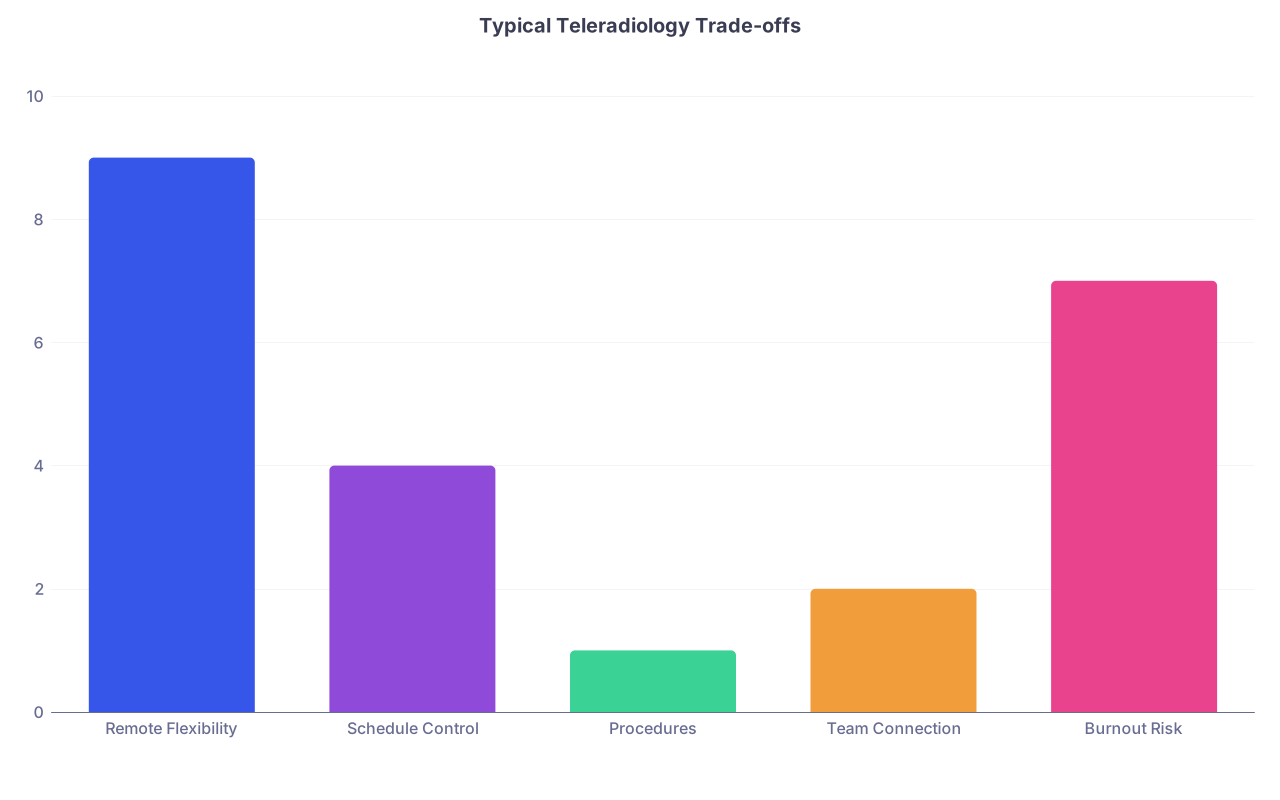
Here’s the lifestyle catch:
| Category | Value |
|---|---|
| Remote Flexibility | 9 |
| Schedule Control | 4 |
| Procedures | 1 |
| Team Connection | 2 |
| Burnout Risk | 7 |
You gain:
- Location freedom.
- Zero commuting.
- No procedures, no clinic, minimal direct conflict with other specialties.
You lose:
- Procedural skills and variety.
- In-person collegiality.
- Strong ties to one institution.
- Often, schedule control if you’re junior—night shifts are what get outsourced.
Many telerad jobs are brutal on volume. You’re paid per RVU or with very high expectations per shift. It is not “sip coffee, read a few scans, shut it down early.”
And if you want to pivot back to a procedure-heavy PP or academic role after several years of pure telerad, that transition can be painful. Groups will ask how current you are on fluoro, biopsies, drain placements, etc.
So yes, radiology has a truly remote pathway. But you’re trading other aspects of lifestyle (and career leverage) to get it.
What the Data Actually Shows About Radiology Lifestyle
Let’s zoom out from anecdotes.
Across surveys (Medscape, AAMC, specialty-specific data), radiology consistently lands in the “more lifestyle-friendly” tier compared to:
- Surgical fields (ortho, neurosurg, gen surg).
- Acute shift-based hospital fields (EM, critical care).
You see:
- Higher satisfaction with work–life balance.
- More predictable daytime schedules once established.
- Higher likelihood of part-time or reduced FTE options.
Not because everyone is working from home. But because the core work is:
- Scheduled.
- Non-physically-exhausting.
- Less dependent on patient/family drama.
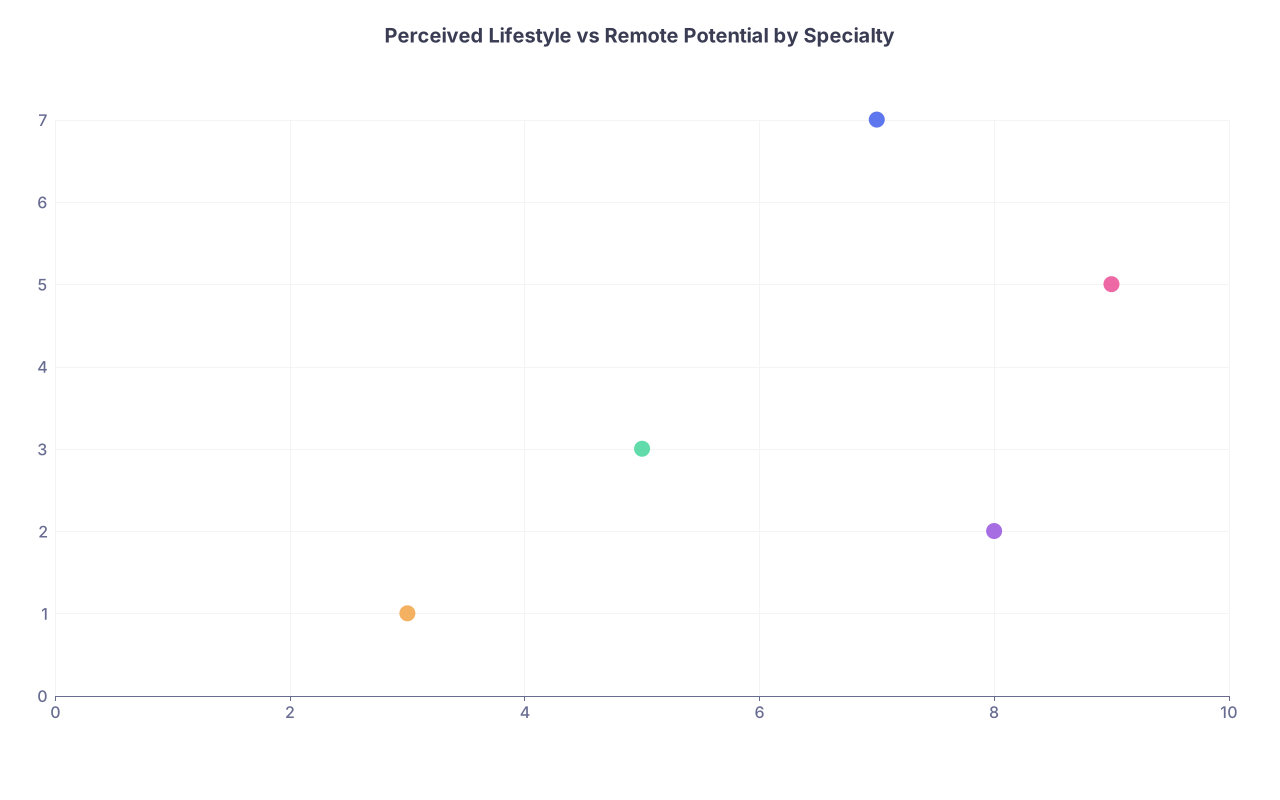
If you look at intensity vs flexibility, radiology sits in a middle-to-favorable zone:
| Category | Value |
|---|---|
| Radiology | 7,7 |
| EM | 8,2 |
| Internal Med | 5,3 |
| Gen Surg | 3,1 |
| Derm | 9,5 |
(Each point: [lifestyle satisfaction, remote potential] on a 1–10 scale, rough approximations based on survey patterns + job structures.)
Radiology is up there, but not because hospitals are thrilled to replace their reading rooms with suburban basements.
What Flexibility in Radiology Actually Looks Like
This is where students get misled. Flexibility isn’t just “I’m home.” It’s also:
- Control over when you work.
- Control over how many hours you work.
- Ability to modulate intensity across your career.
Radiology does pretty well on those. Examples I’ve personally seen:
- Partners working 0.7 FTE, reading only 3 days/week for lower pay.
- Senior rads dropping call entirely and just working weekday days.
- Parents front-loading evening shifts so they can attend daytime kid events.
- People taking several weeks at a time off by stacking shifts.
But that comes with structure. Coverage requirements. Equity among partners. RVU expectations. The typical career arc looks something like this:
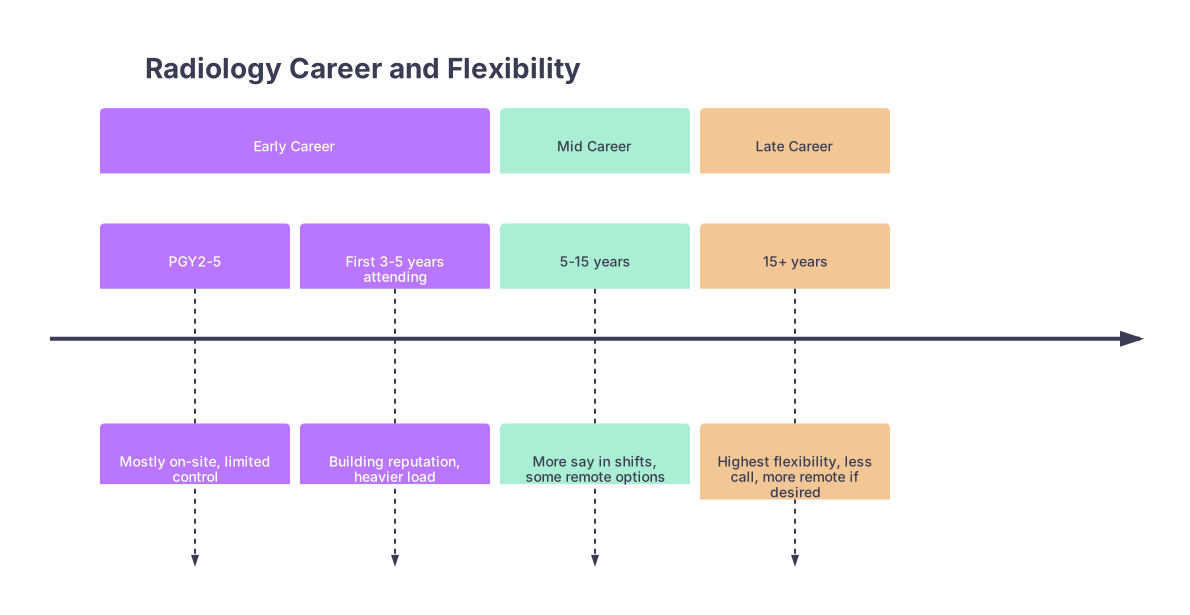
| Period | Event |
|---|---|
| Early Career - PGY2-5 | Mostly on-site, limited control |
| Early Career - First 3-5 years attending | Building reputation, heavier load |
| Mid Career - 5-15 years | More say in shifts, some remote options |
| Late Career - 15+ years | Highest flexibility, less call, more remote if desired |
The students who imagine radiology as: “Graduate residency at 32, immediately work 4 days/week, fully remote, $600k, minimal nights”—they’re extrapolating the lifestyle of a senior, well-entrenched partner or a niche telerad gig, and assuming it’s the default.
It is not.
Pandemic Distortion: Why You’re Hearing Confusing Stories
COVID made radiology look more remote than it actually is.
Elective imaging tanked. Hospitals scrambled. A bunch of academic and PP groups pushed a sizeable portion of reads to home workstations to reduce on-site density.
Residents and med students who rotated in 2020–2021 saw half-empty reading rooms and attendings Zooming into conference from home. It was a weird time.
Many departments have since:
- Pulled people back on-site.
- Limited home days.
- Prioritized in-person coverage for consults and procedures.
And some of those “I work from home 5 days/week as an academic neurorad” posts are from people at very specific places with very specific politics and niche expertise. You cannot generalize them.
How to Reality-Check Radiology Flexibility When You’re Choosing
If you’re serious about radiology and lifestyle is one of your big priorities, you need to stop listening to vague stereotypes and start interrogating specifics.
Here’s how.
Questions to ask residents and attendings on rotation:
As residents:
- “How often are you physically in the hospital?”
- “Do any residents read from home? If so, which year and how often?”
- “How much time do you spend in procedures vs at the workstation?”
As attendings:
- “What’s your breakdown of on-site vs home days?”
- “Did that change post-COVID?”
- “What are the expectations around procedures and in-person conferences?”
For job hunting later, read actual job postings and dissect:
| Phrasing | Likely Meaning |
|---|---|
| "On-site coverage required" | Minimal remote days |
| "Hybrid with home workstations" | Some remote days, still hospital-based |
| "100% remote teleradiology" | True work-from-home, often nights |
If a posting doesn’t mention remote options at all, assume it’s primarily on-site.
So Is Radiology “Actually Flexible”?
Yes—and no.
Radiology is more flexible than most procedural and acute-care specialties once you’re an attending with a few years under your belt. It also has the unique advantage of a true, fully remote pathway (telerad) that most other specialties simply do not have.
But:
- During residency: expect to be on-site.
- Early in your attending career: expect less control and fewer home days than the senior partners.
- In academics or hospital-employed roles: expect limited or modest remote reading.
- For full work-from-home: you’re probably talking teleradiology, with all the trade-offs that entails.
Radiology is one of the most lifestyle-friendly specialties—if you define lifestyle as:
- High compensation per hour.
- Predictable, schedulable work.
- The ability to reduce hours or call later in your career.
It is not, by default, a “sit at home with your laptop” specialty.
If you want radiology for the intellectual puzzle, image-based diagnosis, and high control over when and how much you work, that’s a solid bet. If you want it primarily because you think you’ll be fully remote from day one—then you’re chasing a marketing image, not the median reality.
Years from now, you won’t remember whether you were logging in from your kitchen or a hospital reading room. You’ll remember whether the work itself felt sustainable—and whether you chose it for the right reasons.