
The blanket claim that “academic jobs are always worse for work‑life balance” is wrong. Not just oversimplified—flat‑out wrong for a lot of specialties and a lot of people.
You’re hearing one story, mostly from burned‑out residents on malignant services and from private attendings who have never set foot in a real academic job. The data—and the contracts—tell a much messier story.
Let’s pull it apart.
The origin of the myth: you’re seeing the worst slice of academia
Residents generalize from their own misery. Understandable, but still bad sampling.
What you see as a trainee in many academic centers:
- Night float that feels endless
- 28‑hour calls on q3 or q4
- Endless notes “for billing and metrics”
- Research meetings wedged into your post‑call day
- Faculty who are constantly around, e‑mailing late, calling you in early
Then someone tells you: “This is what academic life is like. Private practice is where people have lives.”
Except that’s not actually how the attending world works.
Your residency reality is shaped by graduate medical education rules, service needs, and hospital throughput—not by “academia” as a career category. Private‑practice‑run residencies can be just as brutal. And the academic attending three floors up whose life you never see might be working 0.7 FTE and leaving at 3:30 p.m. to pick up their kids.
You don’t see them, because you’re in the hospital at 9 p.m. finishing notes.
What the data actually show about hours
We do have some real numbers, even if they’re not perfect.
Several surveys over the last decade (Medscape, AAMC Faculty Forward, specialty society workforce surveys) have consistently shown a pattern that should make you pause:
- Clinical‑track academic physicians often work similar or slightly longer total hours than private counterparts—but
- Their hours are more predictable, with more non‑clinical time and more vacation
- Academic physicians in lifestyle‑friendly specialties (derm, psych, PM&R, pathology, some outpatient subspecialties) often report equal or better work‑life satisfaction than private peers
Let me translate that: more structured time, more control over when the work happens, and more weeks away from clinic, even if a portion of that time gets eaten by email and committees.
Here’s a simplified comparison for a mid‑career attending in a relatively lifestyle‑friendly field (think rheum, endocrine, PM&R, psych) in a reasonably well‑run system:
| Setting | Clinical Hours | Other Work (research/admin/teaching) | Total Hours | Vacation (weeks) |
|---|---|---|---|---|
| Academic | 32–40 | 8–15 | 45–55 | 6–8 |
| Private | 40–50 | 5–10 (mostly admin/business) | 50–60+ | 3–5 |
Is this universal? No. But the claim that “academic = awful lifestyle, private = cushy” just does not hold up across specialties or institutions.
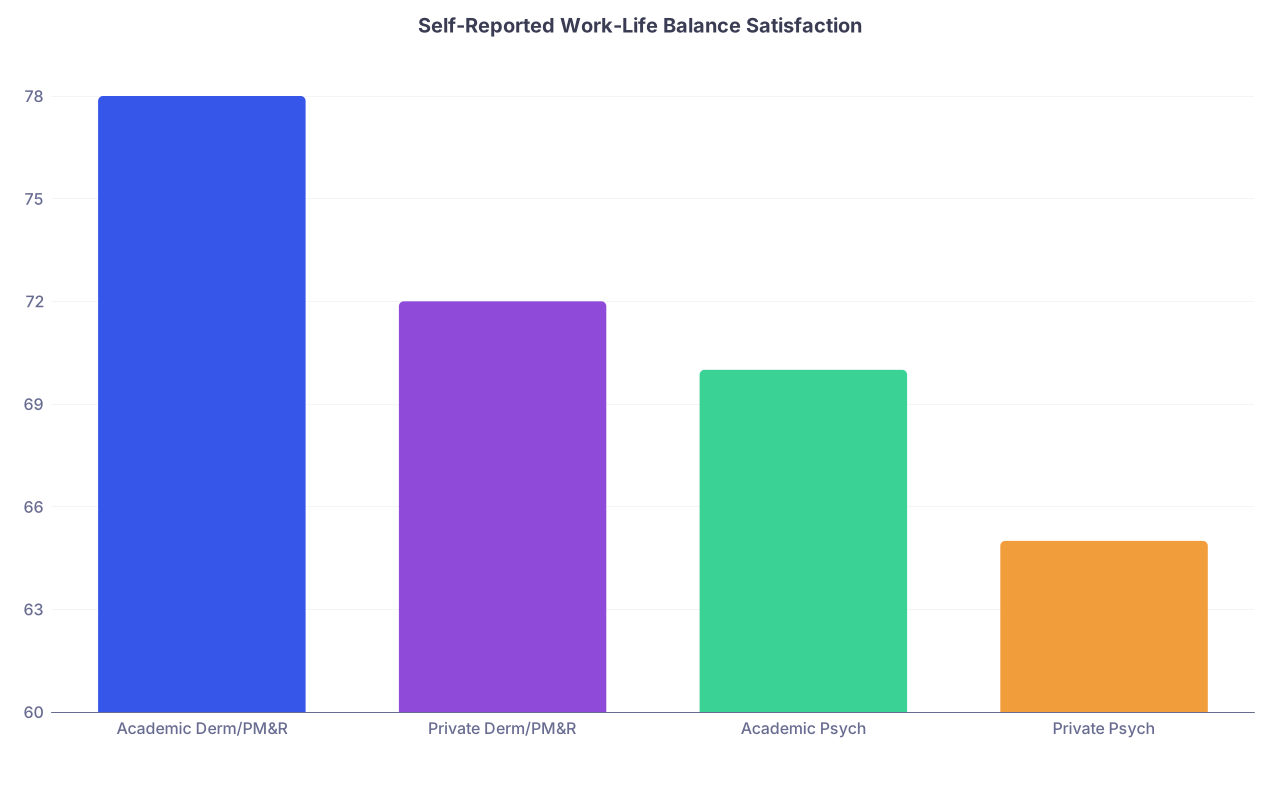
| Category | Value |
|---|---|
| Academic Derm/PM&R | 78 |
| Private Derm/PM&R | 72 |
| Academic Psych | 70 |
| Private Psych | 65 |
Those are ballpark satisfaction percentages from multiple survey cycles. Notice anything? Academic in these fields is not some lifestyle death sentence.
The three levers that actually determine lifestyle
Stop obsessing about “academic vs private” as a binary. The lifestyle equation is driven way more by three things:
- Specialty choice
- Practice structure
- Compensation model
1. Specialty: the ceiling and floor for lifestyle
If you pick trauma surgery, neurosurgery, or OB with heavy L&D, your baseline lifestyle range is just narrower. Academic or private, someone’s getting cut at 2 a.m. and it might be you.
If you pick:
- Dermatology
- PM&R
- Psychiatry
- Pathology
- Outpatient rheumatology, allergy/immunology, endocrine
- Some radiology niches
…then you’ve already bought yourself a fundamentally different risk profile. Less emergent middle‑of‑the‑night work. More scheduled care. More ability to time‑block.
And in these specialties, academic jobs can be remarkably sane.
In one PM&R department I know well, the typical academic attending:
- Has 3 days of clinic or procedures
- 1 day of inpatient or consults
- 1 “academic” day for teaching, research, admin
- No standing overnight call, just a rare home‑call weekend
- 7 weeks off per year between vacation + CME + institutional holidays
Meanwhile, their private counterparts in the same city:
- Work 4.5–5 clinic days per week
- Run at higher patient volumes (RVU pressure)
- Take more frequent call coverage for post‑op or pain patients
- Get 3–4 weeks of “real” vacation
So if you chose PM&R for lifestyle and then reject academia because “work‑life balance is worse there,” you might literally be walking away from the better‑balanced option.
2. Practice structure: who controls your time?
Here’s where the myth really collapses. Control over your time is often better in academia for certain personality types.
Academic structure usually includes:
- Protected non‑clinical time written into your contract (20–40% for many non‑pure‑clinical tracks)
- Scheduled teaching blocks that are predictable year to year
- Fixed clinic templates designed by division leadership instead of by a revenue‑maximizing office manager
- Institutional backing when patients demand unreasonable after‑hours access (“we don’t give out personal cell numbers” actually enforced)
Private practice, especially small groups, can mean:
- The business survives or dies on you hitting RVU targets
- “Lunch” is a theoretical concept that lives between 12:07 and 12:19
- You are your own IT, part‑time HR, and part‑time collections department
- Patient expectations blur boundaries (“you’re my doctor, why can’t I text you at 10 p.m.?”)
Are there private jobs with beautiful boundaries? Yes. Academic jobs with no boundaries? Also yes. But as a system, academia is more likely to embed structure that protects at least some of your time, particularly in the lifestyle‑friendly specialties.
3. Compensation model: RVUs vs salary vs hybrid
This is where lifestyle and money collide.
Typical patterns:
- Academic: more salary‑heavy, lower RVU thresholds, and explicit non‑clinical time that still gets you paid
- Private: more eat‑what‑you‑kill, higher income ceiling, but your time is monetized minute‑by‑minute
You want to know why your academic mentors are sitting in their office working on papers at 3 p.m. while your private attendings are cranking through 30 patients in a half‑day? Because one of them is salaried for “0.3 FTE research/teaching.” The other gets paid only for butts in seats and procedures done.
For many lifestyle‑friendly specialties, the academic pay gap is smaller in percentage terms than in procedural specialties. That matters. In derm or PM&R or psych, you might be trading, say, 10–20% income for an extra academic day and more vacation. In ortho, you might be trading 40–60% for that same structural predictability. Very different calculus.
But what about call, nights, and weekends?
Let’s tackle the part everyone obsesses over.
The lazy claim: “Academics have terrible call. You’re covering the county hospital, the VA, the tertiary center, everything.”
Reality depends heavily on specialty.
In lifestyle‑oriented fields, academic call can be:
- Less frequent overall (bigger departments, more people in the call pool)
- More predictable (published call grids months in advance)
- More likely to be home call rather than in‑house
- Better supported by residents and fellows
Where it can be worse: when the academic center is the only tertiary or quaternary referral hub and your field gets slammed with referrals. A neuro ICU attending at a big academic center is going to have a different experience than a general neuro in a sleepy private hospital.
But again—compare like with like. The private neuro is often covering multiple hospitals, potentially with worse ancillary support and no trainees to help.
A quick contrast I’ve seen repeatedly:
- Academic psych: 1 in 8–10 weekend calls, mostly phone, hospitalist managing med issues, residents on site
- Private psych: 1 in 3–4 weekend call for a big group, all your own inpatients, you’re writing every order
Or:
- Academic PM&R: consults triaged by residents, weekends shared across large inpatient team
- Private PM&R: solo coverage of a rehab facility or SNF panel with little backup
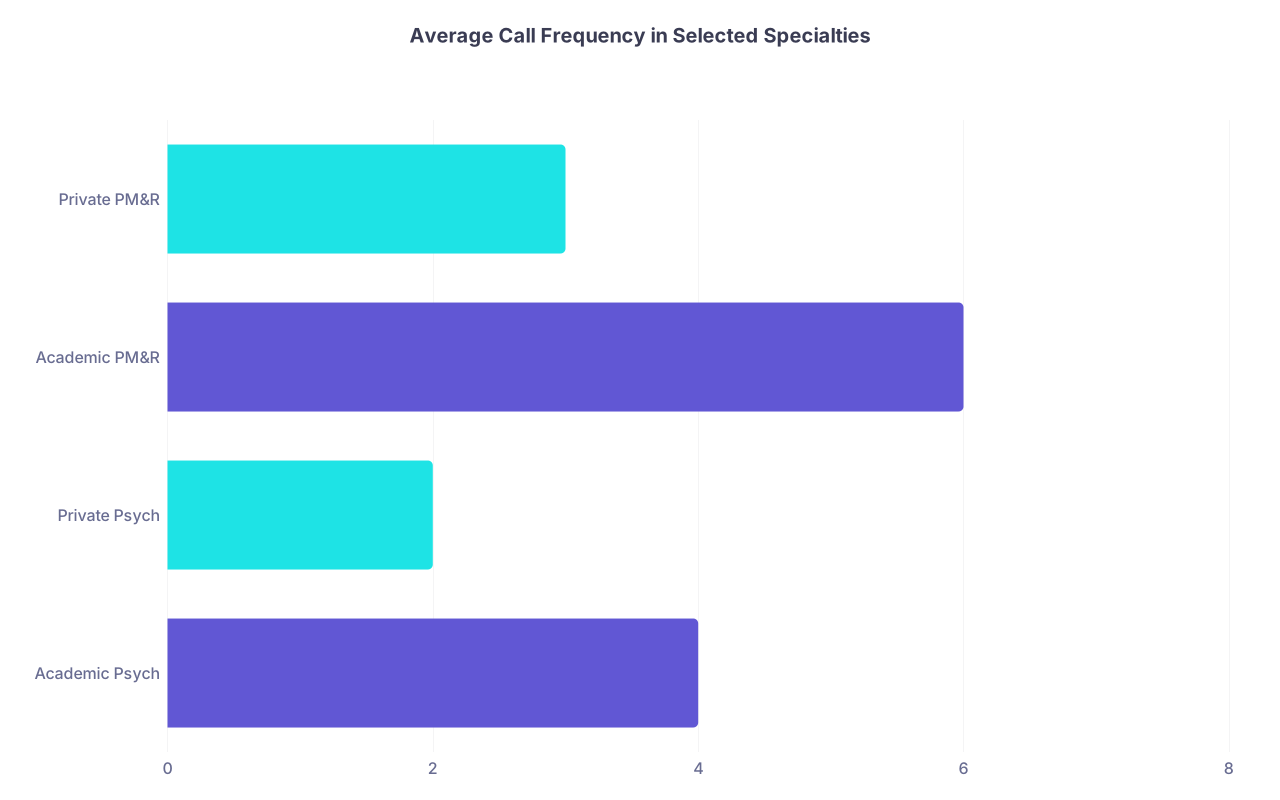
| Category | Value |
|---|---|
| Academic Psych | 4 |
| Private Psych | 2 |
| Academic PM&R | 6 |
| Private PM&R | 3 |
(Approximate “calls per month.” Higher number = more frequent call. Notice private often isn’t the easy road.)
Hidden benefits of academic jobs for lifestyle
The myth ignores several things that show up only when you actually look at contracts and schedules.
1. Real vacation and protected time away
Academic centers nearly always have:
- More weeks of vacation and CME combined
- Actual coverage when you are away (residents, NPs, other attendings)
- Less direct income loss from time off because you’re not pure RVU
In private practice, especially partnership‑track, your income is directly tied to your productivity. Three weeks of vacation might mean three weeks of near‑zero revenue and months of playing catch‑up.
2. Part‑time and flexible options that aren’t career suicide
Academic departments, especially in the less‑procedural specialties, are often far more open to:
- 0.6–0.8 FTE roles
- Flexing clinic days around childcare or elder care
- Tenure‑ineligible or clinician‑educator tracks that explicitly assume less “traditional” academic output
I have seen multiple academic psychiatrists and PM&R physicians drop to 3 or 4 days/week clinically while keeping benefits and a meaningful role in the department. Try pulling that off in a small private group without resentment from partners.
3. Identity beyond “RVU generator”
This sounds fluffy, but it matters for burnout.
Academic physicians can spread meaning across multiple domains: patient care, teaching, curriculum work, quality improvement, mentoring. When a clinic day is rough, they still have a resident teaching win or a paper coming out.
Private practice can compress your identity into “producer of billable care.” If clinic goes badly and the numbers don’t look good, there’s not much else in your professional life to balance that.

When the myth is closer to the truth
Now for the uncomfortable part. There are scenarios where the horror stories about academic lifestyle are not exaggerated.
- Highly procedural specialties in high‑volume academic centers (surgery, IR, cath‑heavy cardiology)
- Understaffed departments where “protected time” is a myth on paper only
- Toxic leadership that weaponizes “academic mission” to guilt people into unpaid evenings and weekends
- Environments where research expectations are insane relative to actual support
If you’re in general surgery or OB and you want maximum control of your time and income, the average academic job is absolutely going to be a tougher lifestyle than a carefully chosen private practice role with defined call and strong partners.
But that’s not the question you asked. You asked whether academic jobs are always worse for work‑life balance.
They’re not. For some of the most lifestyle‑friendly specialties, an academic job may actually be your best shot at sustainable boundaries.
How to actually evaluate lifestyle in real jobs
When you’re looking at specialties and eventually jobs, stop asking “academic vs private?” like that question alone means anything. Instead, interrogate these:
- How many half‑days of clinic per week?
- What is the expected patient volume per session?
- How is non‑clinical time protected and tracked?
- Exact call schedule: frequency, in‑house vs home, who else is in the call pool?
- Vacation: how many weeks, and what actually happens when you are gone?
- RVU expectations if any, and what happens if you’re below target?
- How many faculty in this department are <1.0 FTE, and how are they treated?
Then compare actual schedules:
| Day | Academic Psych | Private Psych |
|---|---|---|
| Mon | AM clinic, PM clinic | Full day clinic |
| Tue | AM clinic, PM teaching/admin | Full day clinic |
| Wed | Research/admin day | Full day clinic |
| Thu | AM clinic, PM supervision | Full day clinic + notes after hours |
| Fri | Inpatient consults (shared) | AM clinic, PM business/admin |
Now tell me which one is “always worse” for work‑life balance.

| Step | Description |
|---|---|
| Step 1 | Choose Lifestyle Friendly Specialty |
| Step 2 | Consider Private with Guardrails |
| Step 3 | Lean Toward Academic Job |
| Step 4 | Compare Hybrid or Employed Models |
| Step 5 | Analyze Call and Volume |
| Step 6 | Select Job With Best Actual Schedule |
| Step 7 | Need High Income Ceiling |
| Step 8 | Value Teaching and Predictability |
Reality check: most residents are overcorrecting from trauma
Here’s the behavioral pattern I see all the time:
- You train at a malignant-ish academic program.
- You assume the entire academic world works like your residency did.
- You swing hard toward private practice to escape.
- You end up in a high‑RVU, high‑volume job with less support and less time off than the chill academic department down the street.
You overcorrect from one bad data point.
If you’re headed into a lifestyle‑friendly specialty, the smartest move is not to romanticize academic medicine or private practice. It is to actually look at:
- Schedules
- Contracts
- Call pools
- Culture
And yes, that means asking uncomfortable, specific questions on interviews and talking to junior faculty without leadership in the room.

FAQs
1. If I care most about lifestyle, should I always choose academic over private?
No. You should choose the right job in a lifestyle‑friendly specialty. In many cognitive or outpatient fields, academic roles often have better structural protections for your time and more vacation, but a well‑run private practice with reasonable volume and clear call expectations can absolutely match or beat that. Treat “academic” and “private” as variables, not destinies.
2. Is it true that academic jobs pay so much less that they’re not worth it?
The pay gap is very specialty‑dependent. In high‑RVU procedural fields, yes, academics can pay dramatically less. In psychiatry, PM&R, derm, outpatient subspecialties, and pathology, the difference is often modest relative to the additional weeks off, pension/benefits, and protected time you get. You’re trading some income for structure and often less stress. For some people, that’s a fantastic trade.
3. How can I tell if an academic department actually respects work‑life balance or just markets it?
Ignore the brochure language. Ask junior faculty how much of their “protected time” gets eaten by clinical work. Ask who covers their patients when they’re on vacation. Ask how often people stay late finishing notes and whether weekend email culture is intense. If everyone hesitates, laughs nervously, or says “we make it work” without specifics, you have your answer. Departments that truly protect lifestyle can give concrete examples and numbers, not vibes.
Key points: the myth that academic jobs are always worse for work‑life balance is lazy and wrong; specialty and practice structure matter much more than the academic/private label; and in many of the most lifestyle‑friendly specialties, a well‑chosen academic job may actually be your best path to a sane, sustainable life.