
The idea that surgeons cannot have work-life balance is outdated — and was never fully true to begin with.
What is true: if you pick the wrong surgical niche and the wrong practice model, you will torch your personal life. I have watched people do it in real time — the partner-track trauma surgeon who keeps a toothbrush in the call room, the general surgeon who has not seen a kid’s weekday bedtime in years.
But I have also watched plastic surgeons who do school drop-off daily, hand surgeons who coach youth sports, and breast surgeons whose schedules are more predictable than many hospitalists. Same degree. Same “surgery.” Completely different lives.
So the real question is not “Can surgeons have work-life balance?”
It’s: “Which surgeons, in which niches, under which practice structures, actually do?”
Let’s break that myth open.
The Lie You’re Sold About Surgical Lifestyle
You’ve probably heard some version of this:
- “If you care about lifestyle, don’t go into surgery.”
- “Surgeons are always on call.”
- “Surgery means you’ll miss every holiday, every birthday.”
Some of that narrative is surgeons trauma-bonding and bragging. Some of it is senior attendings who trained in the 80s and still talk like 120-hour weeks are a badge of honor. And some of it is just ignorance about how wildly different surgical niches have become.
Here’s the uncomfortable truth:
Surgery as a monolith is a lifestyle disaster.
Surgery as a set of niche practices is incredibly stratified — from total chaos to near-9‑to‑5.
Let me show you what I mean.
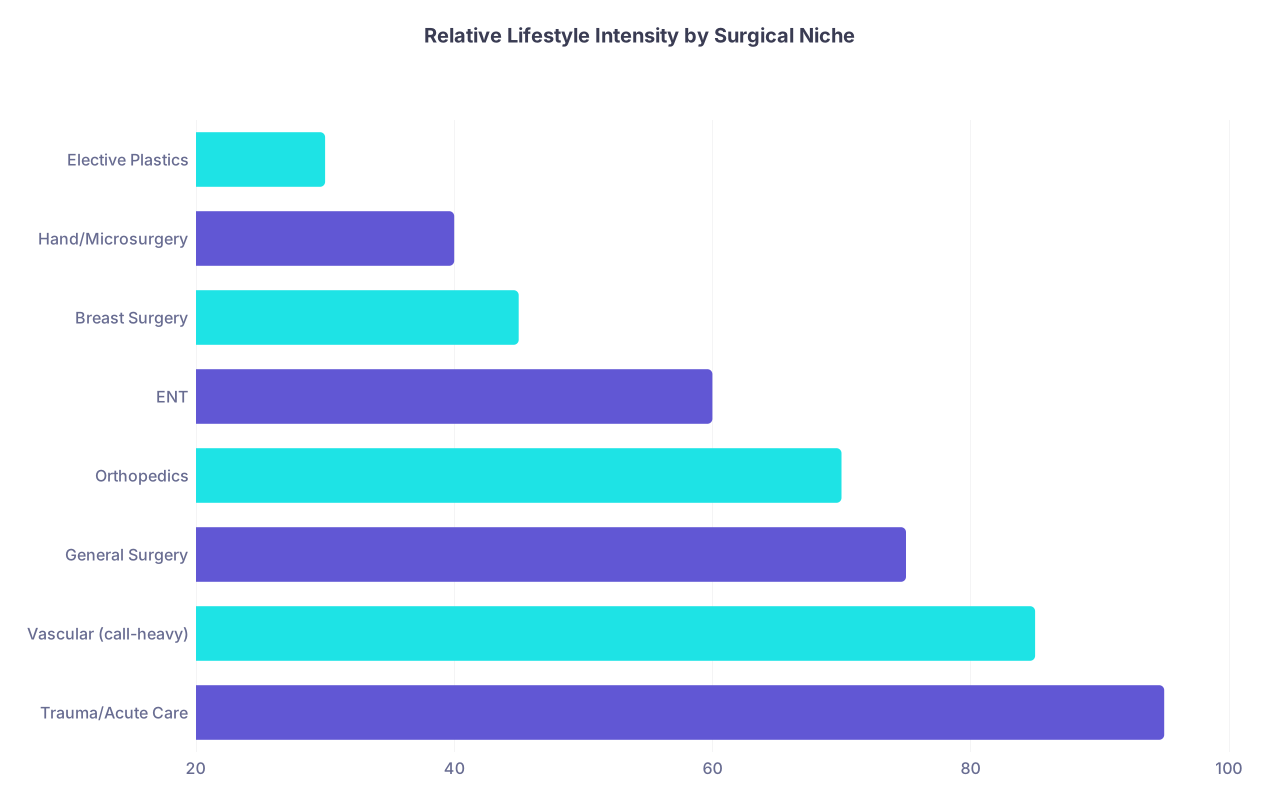
| Category | Value |
|---|---|
| Trauma/Acute Care | 95 |
| Vascular (call-heavy) | 85 |
| General Surgery | 75 |
| Orthopedics | 70 |
| ENT | 60 |
| Breast Surgery | 45 |
| Hand/Microsurgery | 40 |
| Elective Plastics | 30 |
These are obviously approximate, but if you rotate through these subspecialties, you’ll feel this gradient viscerally. Same OR. Very different lives.
The Three Variables That Actually Control Surgical Lifestyle
Forget the specialty name for a second. What really determines lifestyle is a three‑variable equation:
- Acuity – How often do bad things happen right now that only you can fix?
- Electivity – How much of your work is scheduled, planned, and delayable?
- Coverage model – When something happens, is it you, or “whoever’s on call from the group”?
If you ignore those three and just say “I like operating,” you’re gambling with your 30s and 40s.
1. Acuity: The Siren of the Pager
High-acuity fields: trauma, acute care surgery, transplant, many vascular practices.
These are the “car crash at 2 a.m.” fields. You are the fire department.
Low-acuity fields: most elective plastics, many hand practices, a chunk of breast surgery, a decent portion of ENT, some ortho niches (sports, joints in big groups).
Low acuity translates very directly into fewer middle‑of‑the‑night phone calls and genuinely quiet weekends. High acuity means you are never fully off mentally.
2. Electivity: How Much Can Be Booked
Elective heavy = predictable:
Bariatrics in a well-run center, bread‑and‑butter ortho joints, aesthetic plastics, most pelvic floor gyn surgery, many endocrine surgery practices. The clinic fills, the OR block fills, the days are busy but not chaotic.
Emergency heavy = chaos:
Bread‑and‑butter general surgery that still takes all the appys, choles, perforations, bowel obstructions. You think you’re going home at 4; then an ED phone call nukes the plan.
3. Coverage Model: Solo Martyr vs Group Shield
This is the one prefix nobody talks about enough: “solo” vs “group.” Or “small group” vs “large group / hospital-employed” vs “academic team.”
A solo surgeon taking general call for a community hospital will have a brutal life, even in a theoretically lifestyle‑friendly niche.
But a hand surgeon in a 7‑person group doing 1:7 call, with PAs triaging, can have a genuinely sustainable 45–50‑hour week most of the time.
| Practice Type | Typical Call Burden | Schedule Predictability |
|---|---|---|
| Solo community general | Very high | Very low |
| Small private ortho (3–4) | Moderate–high | Moderate |
| Large multi-specialty group | Moderate | High |
| Academic subspecialty team | Low–moderate | High |
| Elective cash-pay plastics | Very low | Very high |
Once you understand those three variables, the “surgery = no balance” mantra falls apart. The real pattern is:
High acuity + low electivity + thin coverage = lifestyle hell.
Low acuity + high electivity + robust coverage = surprisingly livable.
The Niche Practices That Quietly Have Great Lifestyle
Now the part people actually care about: which surgical niches tend to support work‑life balance, in the real world, not in abstract Reddit fantasies.
Breast Surgery: Cancer Surgeon, Predictable Life
Breast surgery is the perfect counterexample to “surgery can’t be lifestyle friendly.”
Most breast work is urgent but not emergent. Cancer cases get booked within days to weeks, not hours. Many breast surgeons:
- Work mostly weekdays.
- Take limited general surgery call (or none in some setups).
- Have clinic days and block OR days that are fairly stable.
- Are embedded in cancer centers with strong multidisciplinary support.
A typical full‑time breast surgeon might run 2–3 OR days and 2–3 clinic days, be home most evenings, and have call 1:6–1:8 or just backup oncology call.
Is it emotionally heavy? Yes. Is it shift‑like EM? No. But it’s night‑and‑day different from trauma.
Hand Surgery: Subspecialty Skill, Bounded Chaos
Hand is a classic “your lifestyle depends on the practice” field.
The reality you do not hear from residents: a lot of hand surgeons in large groups or hospital-employed jobs have:
- A mix of elective work (carpal tunnels, releases, arthritis).
- Semi‑urgent but rarely life‑threatening cases (fractures, tendon lacs).
- Shared hand call among multiple surgeons.
- Decent ability to book cases during the day rather than 3 a.m.
Yes, there are add‑ons and there’s still OR creep. But compare that to vascular. Or transplant. Or perpetual acute care.
The risk in hand is small or mid-size groups that are overleveraged: too few surgeons covering too many hospitals. When that happens, lifestyle tanks. Again: coverage model, not the scalpel itself, is the issue.
ENT and Urology: The “Stealth” Lifestyle Surgical Fields
Both ENT and urology straddle a nice middle ground: real OR time, real procedures, but a relatively controllable acute burden in many settings.
ENT:
- Lots of elective sinus, ear, airway, thyroid work.
- Emergencies exist (airway, bleeds), but in many places, call is spread across a group.
- Pediatric ENT in particular can be very block‑heavy and schedule‑driven.
Urology:
- Scope days, OR days, clinic days.
- Stones can wreck a weekend, but again, group call distributes this.
- Cancer work is urgent, not usually cut‑tonight urgent.
You still work hard. But many ENT and uro attendings I’ve seen have more stable routines than the “lifestyle” IM hospitalist who is forever flipping between days, nights, and random swing shifts.
The Lifestyle Outliers: Elective Plastics and Concierge‑Like Micro‑Niches
Let’s talk about the one everyone gossips about: plastic surgery.
Aesthetic Plastics: When You Control the Calendar
A purely aesthetic, elective plastic surgery practice is almost comically different from trauma surgery.
- Near 100% elective.
- No ED calling you about a facelift at midnight.
- Patients are relatively healthy, table times are predictable.
- Many practices book full days of similar cases (rhino day, breast day, etc).
I have seen successful aesthetic surgeons:
- Work 4 operating days a week, 1 clinic/preop day.
- No in‑house call. Some just carry a phone for postop issues.
- Earn in the top 1–2% of all physicians while still being home for dinner most nights.
What’s the tradeoff? Risk, business, and grind. You must build a patient base, compete in a crowded market, manage staff, marketing, overhead, online reviews. If you’re lazy or bad with people, this niche will eat you alive financially.
Micro‑Niches with “Hidden” Lifestyle Perks
There are small surgical niches inside bigger ones where lifestyle flips:
- Outpatient vein centers (often run by vascular or IR): Mostly elective, clinic + procedure-based, business-heavy but schedule-friendly.
- Endocrine surgery in tertiary centers: Thyroid/parathyroid/adrenal, largely planned, with many patients funneled from a regional catchment.
- Benign gyn surgery in dedicated MIS practices: Laparoscopic hysterectomies, prolapse repairs, high-volume, low emergent call.
These are often invisible during residency because they don’t run the ED board. They sit in outpatient centers and specialty clinics, grinding quietly, going home at 5.
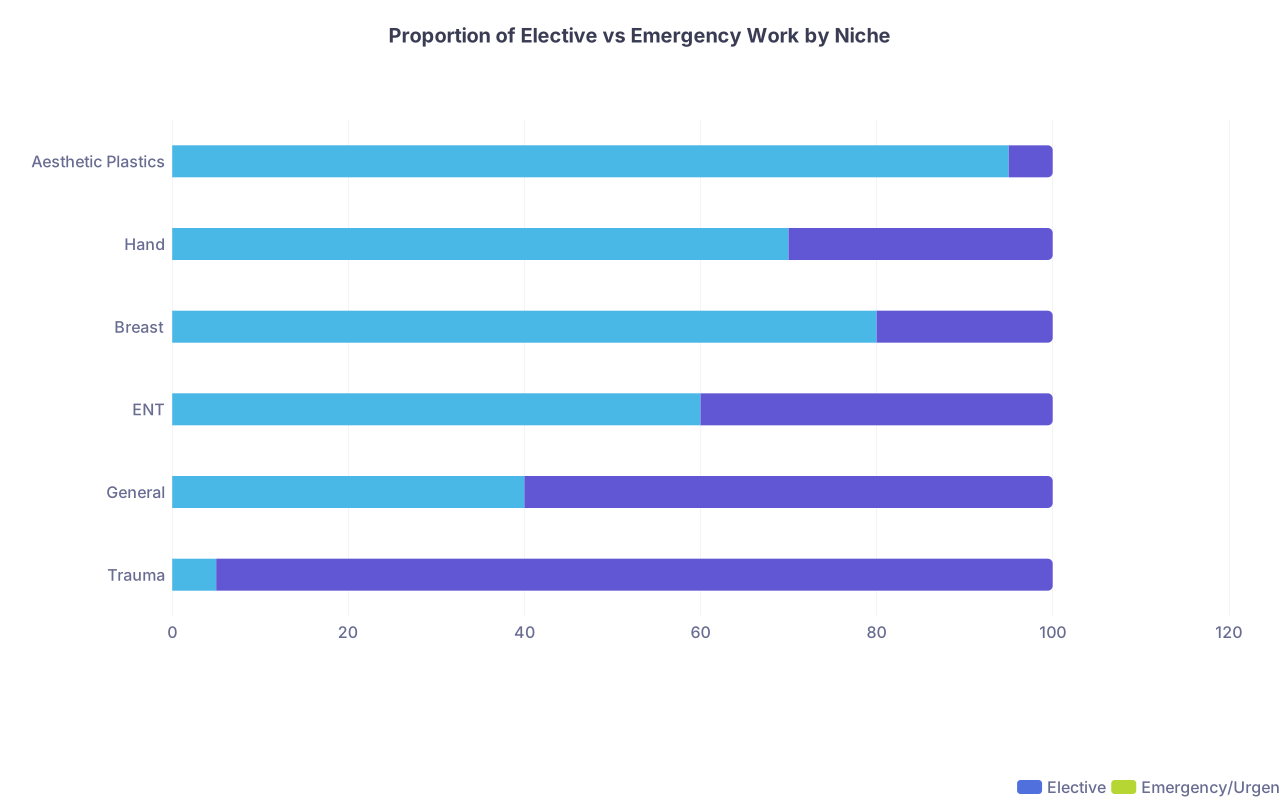
| Category | Elective | Emergency/Urgent |
|---|---|---|
| Trauma | 5 | 95 |
| General | 40 | 60 |
| ENT | 60 | 40 |
| Breast | 80 | 20 |
| Hand | 70 | 30 |
| Aesthetic Plastics | 95 | 5 |
Where Lifestyle Really Dies: Not Just “Hard” Specialties, But Specific Patterns
Let me flip the lens and show you the patterns where I consistently see work‑life balance implode, regardless of the specific surgical field.
Pattern 1: Chronic Understaffing + Hero Culture
If the group has “been looking for another partner for years,” run.
A perpetual 1:2 or 1:3 call schedule, covering multiple hospitals, with a leadership team that tells every recruit “it’s not that bad once you get used to it” — that’s not a job, that’s a lifestyle trap. I don’t care if it’s general, ortho, or ENT. The math doesn’t work.
Pattern 2: Taking All Comers in a Small Hospital
The community general surgeon who covers everything — endoscopy, bread‑and‑butter general, emergent appys, choles, hernias, maybe some OB backup — gets crushed.
The problem is not “general surgery is bad.” It’s “general surgery + small hospital + thin backup = chronic pager slavery.”
Pattern 3: Academic Prestige With No Boundaries
This one hurts people who love the field.
Big‑name transplant, cardiac, or complex oncologic services can look sexy from the outside. Cutting‑edge cases, high‑impact pathology, fellowship prestige. Also: 80‑90 hour weeks for years, endless “urgent” cases, and the expectation that you’re always available “for the team.”
Some people genuinely want that. Many residents think they do, until they try to sustain it with small children or aging parents or their own health issues.
If you want an intense field, fine. But do not pretend you’ll have a mellow life and be on the most demanding service five days a week and three weekends a month.
How Residents Actually End Up in Lifestyle-Friendly Surgical Jobs
You do not “accidentally” land in a cushy breast or hand job. You engineer it. And most residents do this wrong.
Here’s the pattern I see in the ones who win the lifestyle game:
They pay attention not just to cases, but to lives.
They ask:
“How often are you home for dinner?”
“How many nights a month are you truly interrupted?”
“What did your last partner who left complain about?”
“How many surgical FTEs would this service ideally have, and how many does it actually have now?”
They notice which attendings:
- Have hobbies that require consistent time (coaching, regular sports leagues, music).
- Look tired vs just normally busy.
- Talk openly about boundaries: “I don’t schedule clinic on Fridays,” “I don’t do elective cases after 4.”
And crucially, they match their fellowship and job choices to the reality they observe, not the mythology they were fed as interns.

| Step | Description |
|---|---|
| Step 1 | Interest in Surgery |
| Step 2 | Consider trauma, vascular, transplant |
| Step 3 | Consider breast, hand, ENT, plastics |
| Step 4 | Explore elective plastics, vein centers |
| Step 5 | Seek academic or hospital employed niche |
| Step 6 | Need strong boundaries to avoid burnout |
| Step 7 | Join well staffed group with shared call |
| Step 8 | High vs low acuity tolerance |
| Step 9 | Value business risk? |
The Data Problem: Why You Keep Hearing the Same Myths
Part of why the “no balance in surgery” myth persists is simple: the data that gets quoted is usually crude.
You’ll see averages like “surgeons work 55–65 hours per week” or “X% of surgeons report burnout.” That’s real, but it hides the distribution.
The burnout is not evenly spread. Trauma, vascular, and under‑resourced general eat the lion’s share. Elective, niche, well‑staffed practices skew way better, but they’re underrepresented in surveys because they’re busy living their lives and not filling out burnout questionnaires at midnight post-call.
So you get this warped view: the noisiest, most miserable experiences dominate the narrative.
But you’re not picking “an average surgeon life.” You’re picking a specialty, a subspecialty, a practice type, and a market. Your outcome will look like that micro-slice of the bell curve, not the national mean.
So… Can Surgeons Have Work‑Life Balance?
Yes — if they choose niches and practice models that are structurally capable of supporting it.
And no — if they blindly accept the first job that will sponsor a visa, pay off loans fast, or stroke their ego with a fancy hospital logo, then wonder why they never see their family.
The myth is not that surgery is hard. It is.
The myth is that the hardship is fixed, uniform, and inevitable.
Here’s what the niche practices really reveal:
- “Surgery” is not one lifestyle; it’s a spectrum. High-acuity, under‑covered fields are brutal. Elective, niche, group‑based fields can be shockingly livable.
- Coverage and acuity matter more than the specialty label. A well‑staffed breast or hand practice will beat an understaffed “lifestyle” IM hospitalist gig on predictability any day.
- Work-life balance in surgery is engineered, not granted. The residents who end up in balanced surgical careers are the ones who scrutinize acuity, electivity, and coverage — and are ruthless about saying no to jobs that fail that test.
If you want to operate and still see your kids, your friends, and the inside of a gym occasionally, you do not need to abandon surgery.
You just need to stop asking, “Is surgery compatible with balance?” and start asking, “Which surgical niches and practice structures give me the leverage to live like a human being?”