
The Myth of the ‘Chill’ Community Job: Hidden Workloads You Don’t Hear About
Think you’ll escape the grind by “just doing a chill community job” after residency? No academics, no research, no teaching. Just “easy bread-and-butter medicine” and a better lifestyle. Right?
Let’s dismantle that fantasy.
The idea that community jobs in fields like hospitalist medicine, EM, anesthesia, radiology, outpatient IM, or FM are automatically lifestyle-friendly is one of the most persistent myths among residents. I have heard this exact sentence from graduating seniors more times than I can count: “I don’t care about prestige, I’ll just do a community gig and have a life.”
Some of those people are now working 18 straight hospitalist shifts a month, with night call and “just one more” add-on before they can leave. A couple are on the verge of burnout. One left clinical medicine entirely.
Not because community jobs are inherently bad. Because they’re deeply misunderstood.
What Residents Think a “Chill” Community Job Is
The fantasy version usually sounds like this:
You finish residency in a “lifestyle-friendly” specialty—say, outpatient internal medicine, family medicine, radiology, anesthesia, EM. You skip the academic grind. You find a small or mid-sized community hospital or clinic. You work decent hours, cover bread-and-butter cases, avoid committee meetings, and spend your free time actually living.
No call. No nights. No QI projects. No admin headaches. “Just show up, do the work, go home.”
Reality: that type of unicorn job exists, but it’s rare, competitive, and often underpaid relative to the work you actually do. Most community jobs have hidden workload traps that are not visible on the glossy recruitment flyer.
Let’s walk through what the data and real contracts actually show, specialty by specialty.
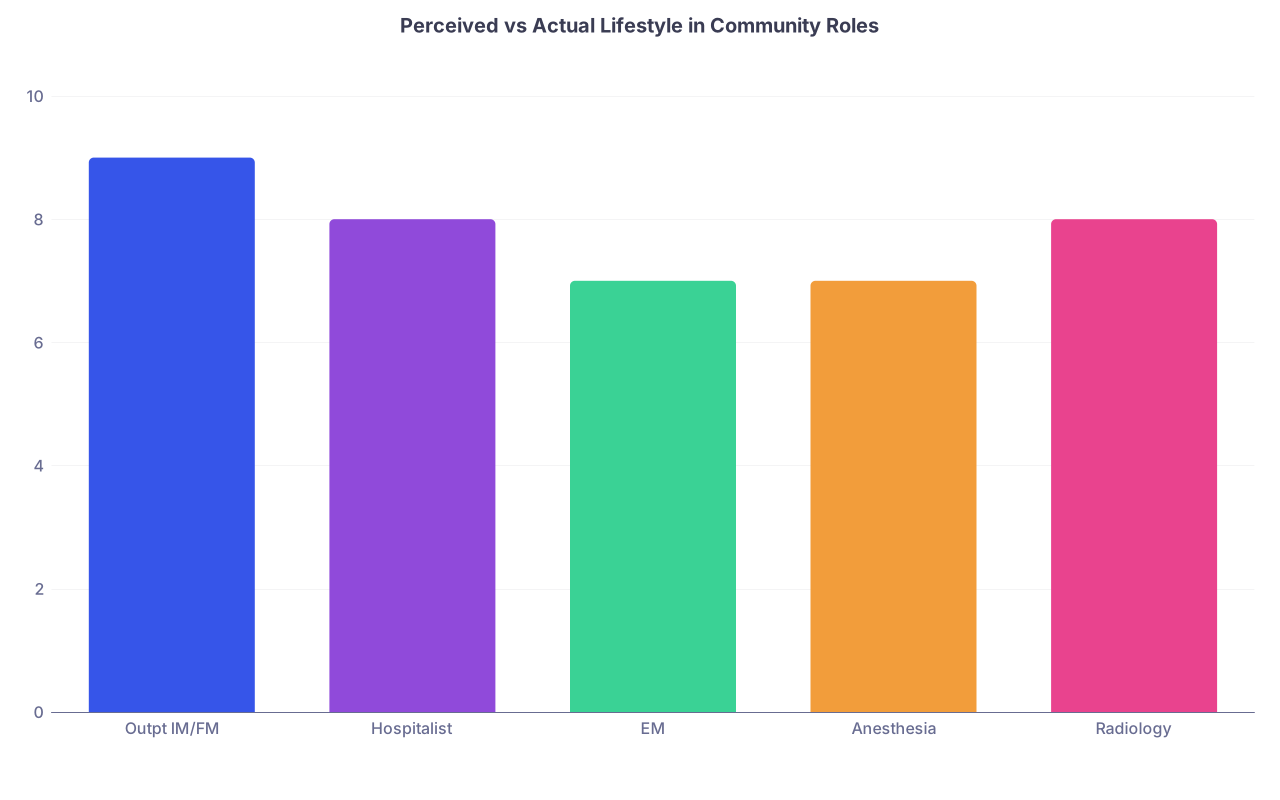
| Category | Value |
|---|---|
| Outpt IM/FM | 9 |
| Hospitalist | 8 |
| EM | 7 |
| Anesthesia | 7 |
| Radiology | 8 |
(Scale 1–10: difference between resident perception of lifestyle and actual workload burden; higher = bigger mismatch.)
Trap #1: The “Lifestyle” Outpatient Clinic That Owns Your Life
Outpatient internal medicine and family medicine are heavily marketed as lifestyle specialties. And in academic clinics, with protected admin time and lower panel pressures, they can be.
Community primary care is a different planet.
I’ve seen multiple contracts where the headline is “8–5, Monday–Friday, no nights, no weekends” and residents stop reading there. What they miss:
- 20–24 patients per day is now conservative. I regularly see job postings expecting 24–28, and I’ve seen 30+ “strongly preferred” in private groups.
- Charting is absolutely not done at 5 p.m. You’re finishing notes, prior auths, and portal messages at 7–9 p.m. at home.
- “No call” often means “no inpatient call.” But you still do clinic call, refill call, triage messages, sometimes OB call if you’re FM in a smaller town.
| Item | Typical Expectation |
|---|---|
| Booked visits per day | 22–28 |
| New patient visit length | 30–40 min |
| Follow-up visit length | 15–20 min |
| Same-day slots | 3–6 per day |
| Admin time per week | 0–2 hours |
Here’s the hidden workload: messages and unpaid work.
In a large community multispecialty group I’m familiar with, IM docs had panels around 2200–2500 patients. The EMR data showed:
- 60–80 inbox messages per day, including refills, patient portal questions, lab follow-ups.
- 1–2 hours per day of “invisible” work outside booked visits.
None of that is protected time. A few “progressive” groups build in half-days for admin, but they’re the exception, not the rule.
So yes, you technically work “clinic hours.” But your brain and your laptop are chained to that panel far outside business hours.
Lifestyle-friendly for some personalities? Sure. Automatically chill? No.
Trap #2: Hospitalist Jobs With Quiet Days… and Soul-Crushing Nights
Hospitalist medicine is probably the single biggest myth zone for “chill community jobs.”
Residents see their attendings on 7-on/7-off schedules, hear about the salary, and imagine 7 days off every two weeks to travel, relax, or moonlight.
But look at what’s actually happening in community hospitals:
- Day census routinely 16–20+ patients on solo coverage
- Cross-covering 40–70 patients at night
- NP/PA “support” that still leaves you holding the risk and the sign-out mess
- Admission caps that mysteriously disappear when someone calls out
At one 200-bed community hospital I know, the hospitalist group was “lifestyle-friendly” on the brochure: 7-on/7-off, 12-hour shifts, 15-patient cap. The reality:
- Cap “softly” increased to 18, then 20, “during surges”
- Admission caps blown multiple times per week
- “12-hour shifts” with sign-out and notes routinely hitting 13–14 hours
- Nights counted 1:1 with days, despite being far more brutal
And then metrics show up. Length of stay, readmission penalties, sepsis bundles, discharge by noon. These are not abstract concerns in community settings; they’re often directly tied to your bonus or your group’s contract survival.
Lifestyle effect: your 7 days “off” are partially spent recovering from the 7 days on. Ask the 3rd-year resident who told me, “If I do this for 10 years, I’m done.”
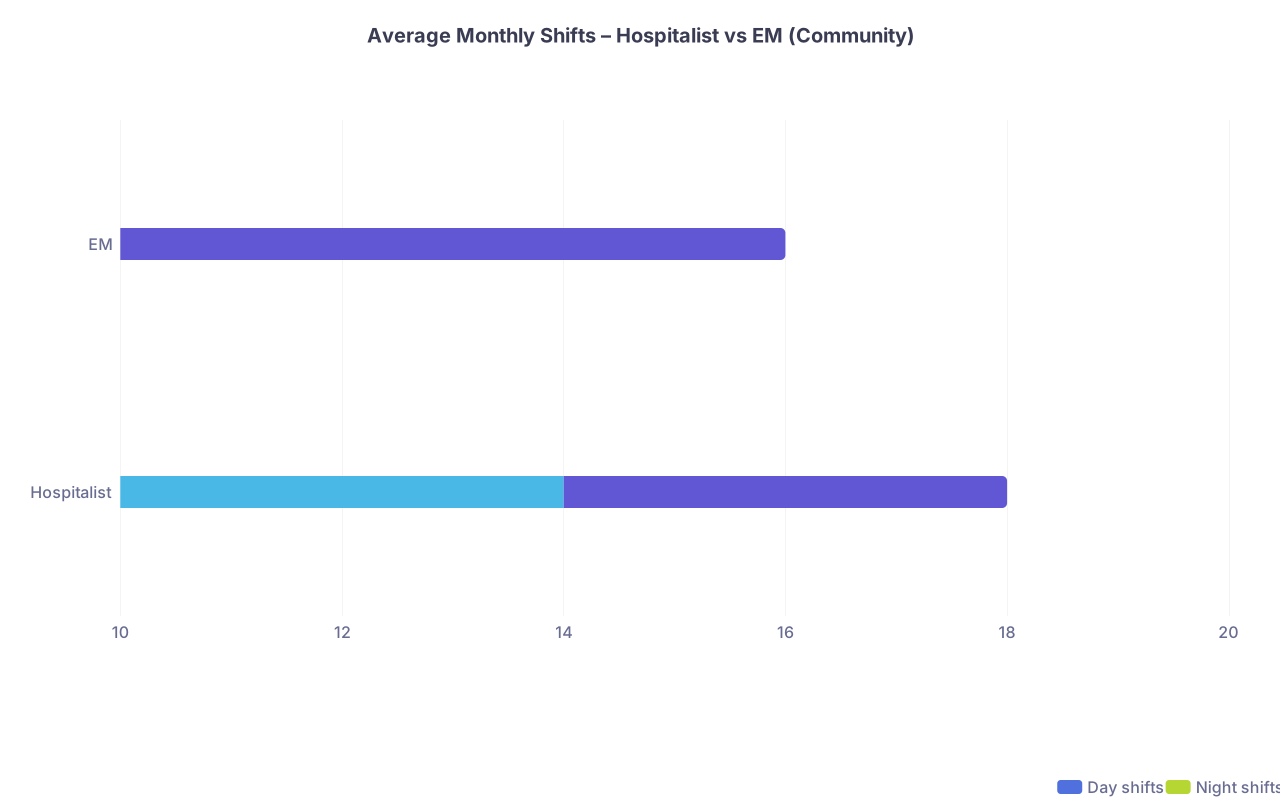
| Category | Day shifts | Night shifts |
|---|---|---|
| Hospitalist | 14 | 4 |
| EM | 10 | 6 |
Notice that both look “reasonable” on paper. The devil is the intensity per shift, and the recovery time you actually need.
Trap #3: Emergency Medicine – “I’ll Just Do Low-Acuity Community”
Emergency medicine used to be sold as a top lifestyle specialty. Work your shifts, no call, and you’re done.
A lot has changed.
In community EM, you face:
- Rising volumes and boarding: you’re running an inpatient unit in your ED, without the staffing.
- Shrinking coverage: two attending shifts cut to one “to improve efficiency.”
- Non-stop metrics: door-to-provider time, LWBS rates, throughput benchmarks.
Residents tell me, “I’ll just work at a smaller community hospital with less acuity.” Here’s what that often means in reality:
- You’re the only doc on duty overnight
- You cover codes in the hospital because there’s no in-house intensivist
- The lower acuity is offset by less backup and fewer resources
The burnout data in EM is not subtle. ACEP and Medscape surveys consistently place EM near the top for burnout. Community docs are not immune just because they’re not in a big academic center.
The secret no one puts on the recruitment slide: a “quiet” night shift can still destroy your circadian rhythm. Mix in some “swing” shifts and weekend rotations and your so-called lifestyle specialty starts eating away your social life.
Trap #4: Anesthesia, Radiology, and the “We Just Read / We Just Sit” Lie
The two specialties people love to label as “easy lifestyle” in community jobs are anesthesia and radiology. Both have some cushy positions. Both also hide brutal workload patterns if you do not read the contract very carefully.
Community Anesthesia
The myth: “Bread-and-butter cases, good pay, home by 3 p.m. most days.”
The regular pattern I see outside cushy suburban private groups:
- Early starts: 6:30–7:00 a.m. first case wheels in
- Late add-ons: cases spontaneously appear at 2:30–3:30 p.m.
- In-house or home call, Q4–Q6, with post-call “days off” that still get encroached upon by staffing issues
That “home by 3” schedule survives until a surgeon demands their add-on cases “today” or administration decides to squeeze turnover times and stretch staffing thinner. I’ve seen groups go from 1:6 call to 1:4 in 18 months because of recruitment issues. That’s not theoretical.
Community Radiology
Telerads changed the game. So did 24/7 imaging and exploding study volumes.
Your day can look like this:
- 60–100+ RVUs worth of reads
- Constant pressure on turnaround times
- Little control over case mix if you’re covering multiple sites
A radiology group I’m familiar with in a midwestern community hospital tracks “wRVUs per hour” and uses it for compensation. The result is predictable: people read faster, push harder, and break less. The job becomes a treadmill.
And then there’s nights. Teleradiology shifts from home sound great… until you realize:
- You’re solo for large stretches
- Every scan is “STAT”
- Your sleep schedule is shredded
Lifestyle-friendly? Maybe, if you’re in a stable, well-staffed group that protects boundaries. But the automatic assumption that “community rads is chill” is fantasy.
Trap #5: The Administrative and Non-Clinical Work You Don’t See
Residents have a blind spot: they dramatically underestimate non-clinical work in community settings.
In academics, at least the expectations are obvious: teaching, research, committees.
In the community, your non-clinical workload is sneaky:
- Quality metrics and documentation audits
- Mandatory meetings for compliance, EMR changes, hospital initiatives
- Forced participation in committees if your group holds a service line contract
- “Service recovery” conversations with patients and families that risk management wants documented
None of that is accounted for in RVUs.
Over a year, this adds up. You’re not “just seeing patients and going home.” You’re carrying the business side responsibilities of modern medicine, just without a fancy title.
Trap #6: The Rural “Lifestyle” Job That Burns You Out Alone
The most dangerous version of the myth is the rural “chill” job.
Residents imagine a smaller, slower pace. Grateful patients. Simpler systems.
What they actually walk into sometimes:
- You’re one of two hospitalists. Vacation means your partner is dying, or locums are filling in poorly.
- You’re the only anesthesiologist or the only EM doc overnight.
- Consult services don’t exist. You are the “cardio,” “ID,” and “nephro” until transfers go through—if they do.
A rural FM doc I know in a “lifestyle-friendly” town was doing:
- Full outpatient panel
- Nursing home rounds
- OB with call
- ED coverage some weekends
The brochure said: “Strong community, broad scope, great lifestyle.” The reality? 60–70 hour weeks and a three-physician group that was one retirement away from collapse.
The Real Lifestyle Variables No One Puts in the Ad
If you actually care about lifestyle—and you should—stop thinking in simplistic “community = chill” terms. The true levers of lifestyle look more like this:
- Clinical intensity per shift: boarding, acuity, case complexity, support staff quality.
- Control over your schedule: ability to say no to extra shifts without punishment.
- Stability of staffing: chronically understaffed groups will devour your free time.
- Admin culture: do they protect physician time or use you as an infinitely elastic resource?
- Compensation structure: pure RVU or visit-based pay incentivizes overwork and under-documentation for your own sanity.
| Lever | Red Flag Version | Better Version |
|---|---|---|
| Schedule control | Fixed, frequent changes | Predictable, real input |
| Staffing levels | Chronic openings, locums heavy | Stable, low turnover |
| Call structure | In-house, frequent, vague rules | Clear, protected post-call |
| Admin expectations | Endless committees, unpaid time | Defined role, minimal extras |
| Compensation model | Pure RVU, no floor | Base + reasonable incentives |
These matter more than “community vs academic.” I’ve watched people have excellent lifestyles in academic departments with sane expectations and get crushed in “chill” private groups that quietly exploit them.
How to Actually Evaluate a “Lifestyle-Friendly” Community Job
You want a community job that really is livable? Stop asking, “Is it community?” Start asking questions that expose the hidden workload.
Here’s what to demand, bluntly:
- Real numbers: average daily patient load, average RVUs per doc, average admits per night, average messages per day.
- Staffing: number of physicians, APPs, and how many FTEs are currently open.
- Call: exact frequency, what “home call” actually entails, and how often you’re called in.
- Admin time: protected or mythical? Is it written into the contract?
- Turnover: how many physicians have left in the past 3–5 years, and why?
And do not just ask leadership. Call or email a randomly selected mid-career physician in the group. Ask them what their last two weeks actually looked like. Concrete details. Shift end times. Weekend expectations. That’s where the truth lives.

| Step | Description |
|---|---|
| Step 1 | Job Ad Looks Great |
| Step 2 | Request Hard Numbers |
| Step 3 | Walk Away |
| Step 4 | Talk to Rank and File Docs |
| Step 5 | Review Contract Details |
| Step 6 | Consider Accepting |
| Step 7 | Load Reasonable? |
| Step 8 | Stories Match Admin? |
| Step 9 | Protected Time, Clear Call? |

So Which Specialties Are Actually “Most Lifestyle-Friendly” in the Community?
Here’s the contrarian answer: there is no specialty that guarantees a good lifestyle in community practice. None.
There are only:
- Specialties where bad system design hurts you faster and harder (EM, hospitalist, outpatient primary care).
- Specialties where you can sometimes carve out a better niche (derm, pathology, certain radiology and anesthesia groups, some outpatient subspecialties).
- Jobs where the group and hospital leadership respect limits—and many more where they don’t.
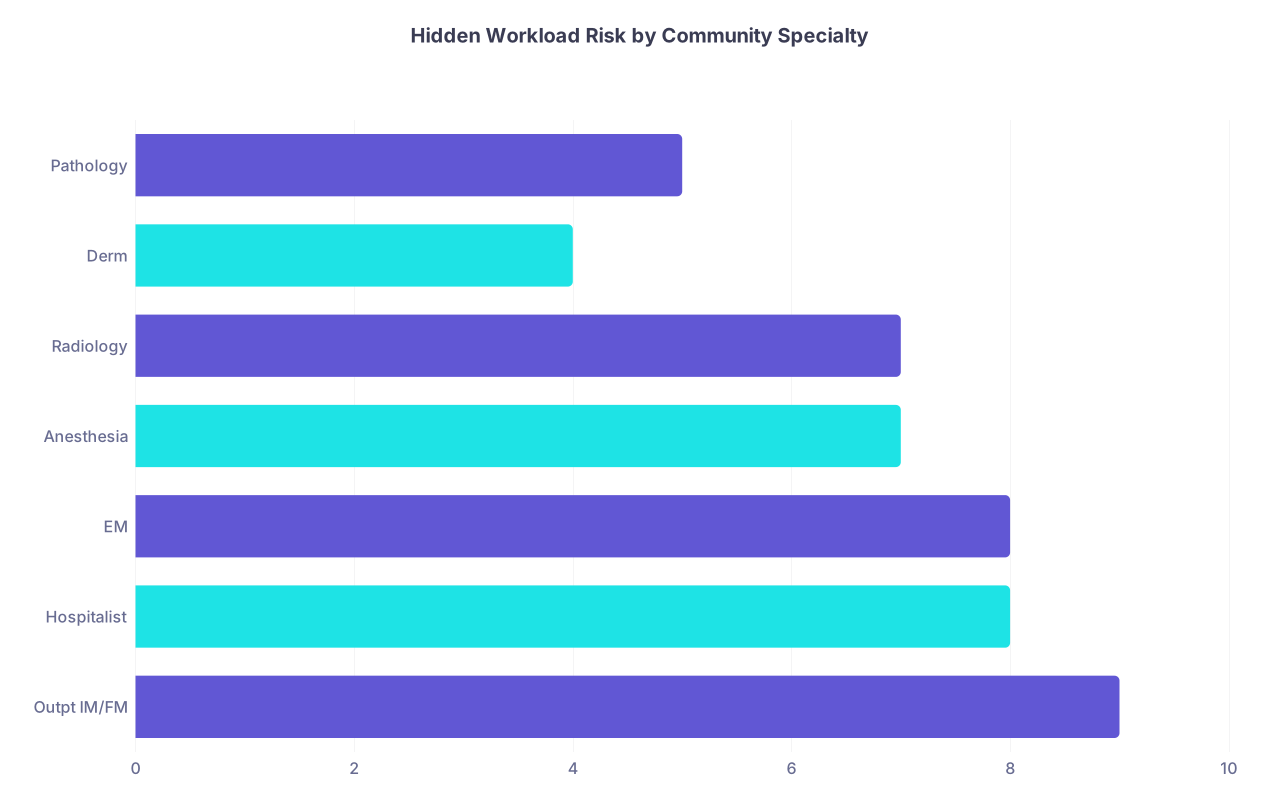
| Category | Value |
|---|---|
| Outpt IM/FM | 9 |
| Hospitalist | 8 |
| EM | 8 |
| Anesthesia | 7 |
| Radiology | 7 |
| Derm | 4 |
| Pathology | 5 |
(Scale 1–10: higher = more risk of hidden workload compared to what residents expect.)
Derm and path usually have fewer night calls and acute crises, yes. But even there, panel size, biopsy volume, lab staffing, and ownership models can wreck your day.
The honest pattern you see after talking to enough attendings across specialties is this: the group culture and system design matter more than the specialty label.
The Bottom Line
Three points and then I’ll stop:
“Community” does not mean “chill.” It means less academic overhead and often more raw service pressure with fewer buffers. Different problems, not fewer problems.
Lifestyle is not baked into a specialty or setting. It’s produced (or destroyed) by: workload per shift, schedule control, staffing stability, admin culture, and how you’re paid.
If you really care about a lifestyle-friendly job, stop chasing labels like “community” or “non-academic” and start interrogating the actual day-to-day reality. Ask for numbers. Talk to the mid-career docs. Read the call rules like your life depends on it—because frankly, your life outside medicine does.
Believe the stories, not the brochures.