
It is July 1st, PGY-3.
You are in clinic between patients, scrolling job postings. Every listing screams the same thing: “Full-time, 1.0 FTE, 5 days.” You want lifestyle. Four-day weeks. Maybe 0.7–0.8 FTE. But everyone around you keeps saying, “You have to do full-time at first. Pay your dues.”
They are wrong. Or at least, they are not telling you the whole story.
If you are in a lifestyle-friendly specialty (think outpatient IM, peds, psych, EM, anesthesia, radiology, derm, PM&R), you absolutely can design a part-time or four-day schedule in your first three years. The catch: you have to start planning this during residency, and you have to move deliberately and chronologically.
I am going to walk you from PGY-1 through the end of practice year 3, with specific “at this point you should…” moves. If you follow the timeline, by the end of year 3 you either:
- Are already at 0.6–0.8 FTE or a four-day week, or
- Have enough leverage and data to demand it.
We will assume you are in a relatively lifestyle-friendly field. I will call out specific nuances where it matters (EM vs outpatient vs procedure-heavy).
Big Picture: How FTE and Four-Day Weeks Actually Work
You cannot negotiate what you do not understand. Quick primer.
| Specialty | Typical Full-Time Definition | Common Reduced FTE Options |
|---|---|---|
| Outpatient IM | 36–40 clinic hrs / week | 0.6–0.8 FTE, 3–4 days |
| Pediatrics | 32–36 clinic hrs / week | 0.6–0.8 FTE, 3–4 days |
| Psychiatry | 32–40 patient hrs / week | 0.5–0.8 FTE, tele-psych |
| Emergency Med | 12–14 shifts / month | 8–10 shifts / month |
| Anesthesia | 40 hrs + calls | 3–4 days, share call |
You are not negotiating “part-time.” You are negotiating:
- FTE (0.5, 0.7, 0.8, etc.).
- Number of clinic sessions or shifts.
- Call responsibilities.
- RVU or salary targets that match reduced FTE.
And you are timing when you push for each piece.
PGY-1: Foundation and Reality Check (Months 1–12)
At this point you should not be asking for one clinic day a week and a yoga stipend. You are building credibility and getting real about money.
Months 1–3: Learn the Language of Workload
At this point you should:
- Start tracking your own “work capacity” mentally. How many half-days in clinic before your brain fries? 6? 8?
- Ask seniors how their attendings’ schedules actually look:
- “How many clinic half-days does Dr. X do?”
- “Who here works four days? How did they get that?”
In lifestyle-friendly departments, there is almost always that one attending who “only works three days and does yoga the rest.” Find them. Watch how respected they are. That tells you what is culturally normal.
Months 4–6: Talk to Faculty Quietly
At this point you should be:
- Setting up 2–3 brief mentorship meetings with faculty who:
- Are clearly not killing themselves with work, and
- Are still respected clinically.
Ask very specific questions:
- “When did you move to four days?”
- “Did you start at 1.0 FTE?”
- “What would you do differently your first two years out?”
You are not asking for a job. You are mapping the terrain.
Months 7–12: Start Building Your Leverage
Leverage = being good and being known.
At this point you should:
- Show up on time, be reliable, make your attendings’ lives easier.
- Get on at least one project or committee that puts you in front of leadership (clinic quality project, scheduling redesign, etc.).
- Pay attention to who controls schedules:
- In hospital-based specialties: department chair, scheduling chief.
- In outpatient: medical director, practice manager.
You are putting pins on the mental map. Who will you actually negotiate with in two years? Learn their names now.
PGY-2: Intentional Positioning (Months 13–24)
This is the critical planning year. You are still “just a resident,” but now you can start aligning yourself with the job you want later.
Months 13–18: Get Real About Finances
You cannot go part-time if your budget assumes full-time attending money.
At this point you should:
- Sit down with a spreadsheet and model:
- Your expected full-time salary in your specialty.
- Your take-home at 0.8 FTE and 0.6 FTE.
- Loan payments, childcare, housing.
If full-time is $260k and 0.8 FTE is $208k, can you live on that? If yes, your negotiation later is much easier because you will not be panicking about every dollar.
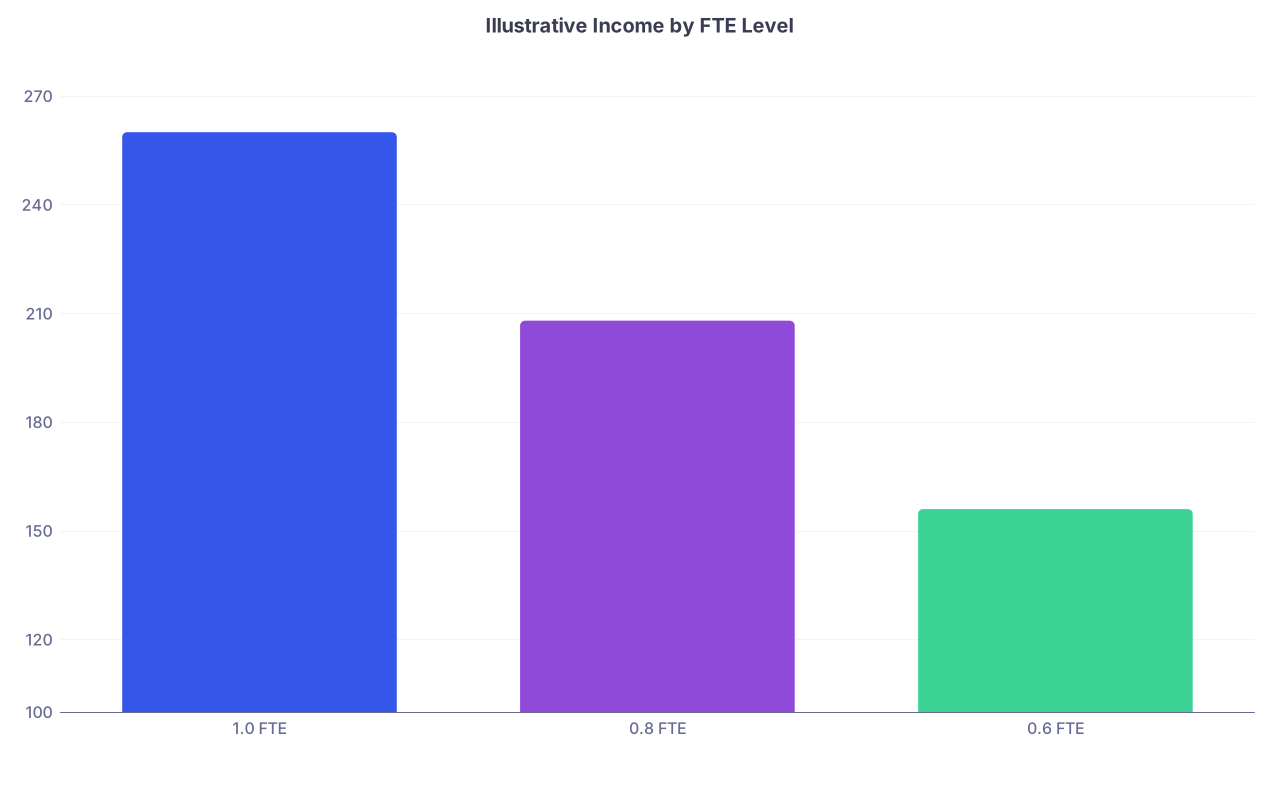
| Category | Value |
|---|---|
| 1.0 FTE | 260 |
| 0.8 FTE | 208 |
| 0.6 FTE | 156 |
Set a target floor for yourself: “I am comfortable going down to $X in exchange for four-day weeks.” Write that number down.
Months 16–20: Explore Practice Models with Flexibility
At this point you should be:
- Doing electives with private groups, hospital-employed clinics, and maybe telemedicine or urgent care if allowed.
- Asking pointed questions:
- “Do you have anyone at 0.6–0.8 FTE?”
- “How do you handle four-day weeks? Is there a standard template?”
- “Do new hires ever start less than full-time?”
Patterns by specialty:
- Outpatient IM/Peds/Psych: Often easiest to arrange 0.8 FTE or four-day weeks once the group trusts you. New hires can start 0.8 if they fill a real need (e.g., maternity coverage, extra panel demand).
- EM: FTE is shifts. New grads often get 12–14 shifts. A “part-time” EM doc might be 8–10. Much simpler mathematically, but group politics matter.
- Anesthesia/Radiology: Many groups require 1–2 years of full-time before cutting back, unless they are desperate for coverage in specific blocks.
You are figuring out where the friction will be.
Months 20–24: Decide Your Strategy Before Job Season
At this point you should be very clear on two decisions:
Do you need to start part-time immediately, or can you tolerate a ramp-down model?
- “I must start 0.8 or less day one” → you will be limiting your options.
- “I can do 1.0 for 12–18 months, then drop to 0.8 or three days” → many more options.
Are you willing to trade salary for schedule?
If you answer no, you are going to suffer. Because schedule is leverage, and employers know it.
By the end of PGY-2 you should have a default plan in your head:
- Example: “I will start 1.0 FTE outpatient IM, clinic four days plus one admin half-day, then drop to 0.8 FTE with one full day off by the start of year 3.”
PGY-3: Job Search with Lifestyle as a Non-Negotiable (Months 25–36)
This is where people blow it. They act like schedule is a “nice to have” instead of a design parameter.
Months 25–28: Early Conversations with Programs and Groups
At this point you should:
- Start informal discussions with your own department and any external groups.
- Bring up schedule early, but with nuance.
Wrong:
“I want to work part-time. Can you do that?”
Better:
“I am very interested in outpatient clinic here. Long term I am aiming for a four-day week or 0.8 FTE. How do new hires usually ramp down on FTE over the first few years?”
That phrasing does a few things:
- Signals commitment (“long term, here”).
- Makes flexibility sound like a standard pathway, not a special favor.
- Gives them room to say, “Most people do full-time for year one, then…”
Months 28–32: Interviews and Offers
This is the serious negotiation window.
At this point you should:
- Rank jobs based on structure, not just raw salary:
- Who already has 0.8 FTE physicians on staff?
- Who has explicit policies about reduced FTE?
- Who says “We do not really do that here”?
Watch for red flags:
- “We can probably work something out after you prove yourself.” Translation: maybe, maybe not. No promises.
- “No one has ever asked for that.” Translation: you will be fighting culture.
When you get an offer letter, you negotiate schedule the same way you negotiate salary.
Concrete approach:
Let them send the draft offer.
Then respond with something like:
- “I am excited about this position. Two things I would like to discuss:
- Moving to four-day weeks (0.8 FTE) by the start of year 3,
- And clarifying how that affects RVU targets and benefits.”
- “I am excited about this position. Two things I would like to discuss:
If you truly want to start less than full-time:
- “Is there any flexibility to start at 0.8 FTE from the beginning if volume supports it? I am comfortable with proportional reductions in salary and RVU expectations.”
Get this in writing. “We will revisit it later” without a timeline is how you end up working five days forever.
Months 32–36: Final Contract and Pre-Start Checklist
At this point you should refuse to sign a contract that is completely vague about FTE trajectory if lifestyle is important to you.
Bare minimum to lock in:
- Your starting FTE (1.0 vs 0.8).
- Your expected clinic days or shifts per month.
- A written review point: “FTE to be re-evaluated at 12 months with the option to decrease to 0.8 by mutual agreement.”
Is that perfect? No. But it gives you a documented checkpoint.
Practice Year 1: Proving Yourself and Setting the Hook
Once you start, the clock resets. You are now “new attending,” which changes the game.
Months 1–3 in Practice: Show Them You Are a Safe Bet
At this point you should:
- Be obsessively reliable. On time, notes done, no drama.
- Under-promise and over-deliver on productivity.
- Avoid asking for schedule favors (outside of true emergencies).
Your goal the first 90 days: make them think, “We cannot lose this person.” That is your leverage, not your last name or your fellowship.
Months 4–6: Quietly Start the Lifestyle Conversation Again
At this point you should:
- Request a formal check-in with your medical director or chair.
- Bring data:
- Your RVUs compared to expectations.
- Patient satisfaction or access improvements.
- Any side projects you have taken on.
Then say something like:
“When we signed, we talked briefly about long-term flexibility. My long-term goal is a four-day week or 0.8 FTE by year 3. I want to make sure I am on track in terms of performance and volume so that this is feasible for the group.”
You are not asking them to change anything yet. You are reminding them of the plan and tying it to your performance.
Months 7–12: Design the Actual Four-Day Template
This is where you move from vibe to calendar.
At this point you should:
- Sit with the scheduler or practice manager and literally sketch what 0.8 FTE looks like:
- Which day is off?
- How many clinic sessions per day?
- What happens to call rotation?
Many outpatient groups can do:
- 4 x 9-hour days,
- Same panel size with slightly tighter templates,
- Or a mix of in-person and telehealth to condense volume.
EM or shift-based specialties just cut shifts.
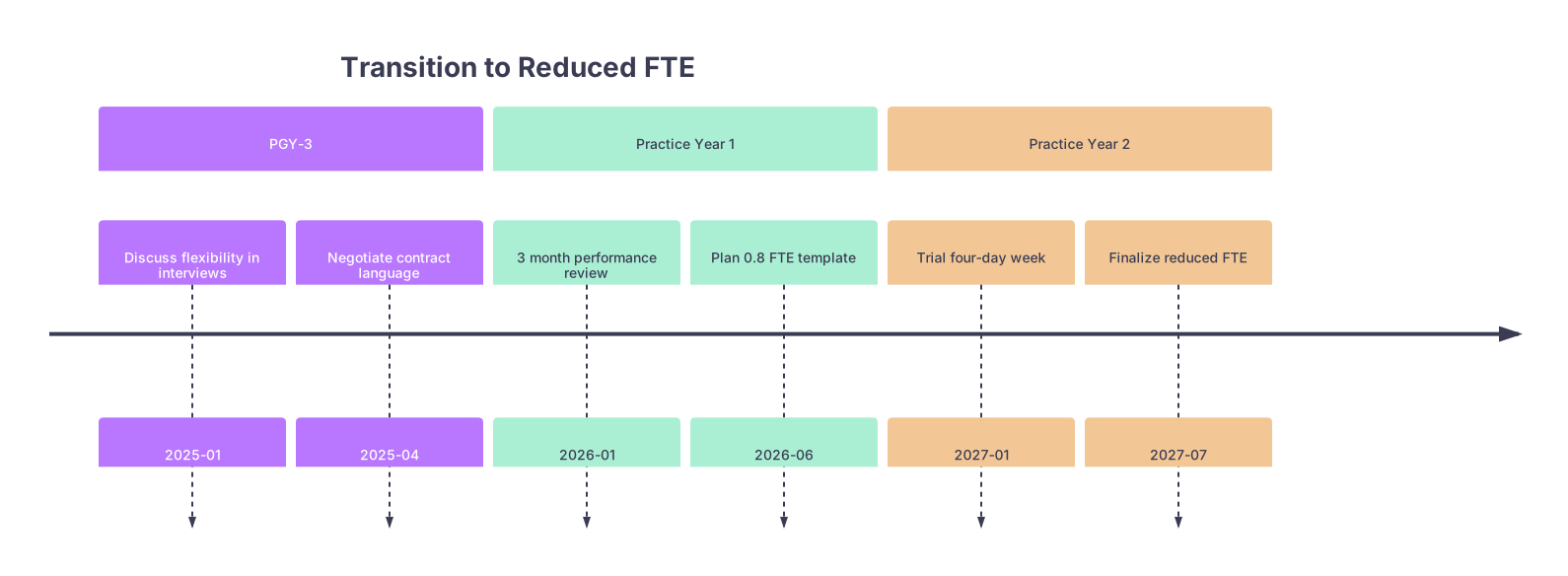
| Period | Event |
|---|---|
| PGY-3 - Discuss flexibility in interviews | 2025-01 |
| PGY-3 - Negotiate contract language | 2025-04 |
| Practice Year 1 - 3 month performance review | 2026-01 |
| Practice Year 1 - Plan 0.8 FTE template | 2026-06 |
| Practice Year 2 - Trial four-day week | 2027-01 |
| Practice Year 2 - Finalize reduced FTE | 2027-07 |
Aim to pilot a slightly lighter week near the end of year 1 if possible. Even one recurring day with fewer patients tests the system.
Practice Year 2: Execution and Adjustment
This is usually the best window to lock in a four-day week or genuine part-time.
Months 13–18 in Practice: Try, Measure, Adjust
At this point you should try some version of your desired schedule.
Common approaches:
Four full days, 0.8 FTE:
Same panel, fewer appointment slots. Expect:- Slightly longer wait times unless more providers are added.
- Pressure to squeeze in “urgent add-ons” on your off day. You need boundaries.
0.7 FTE outpatient:
Three full days plus one half-day. Works well for childcare schedules but can be choppy for continuity unless templates are smart.
On a three-to-six-month trial, track:
- Your RVUs vs target.
- Patient access metrics (next available appointment).
- Your own burnout indicators (sleep, errors, dread heading to work).
Then meet with leadership and review actual numbers, not vibes.
Months 18–24: Make It Official or Course-Correct
At this point you should either:
- Convert the “trial” schedule to a formal FTE change, or
- Decide the hit to income / career growth is not worth it and adjust.
Things people underestimate:
- Reduced FTE almost always means slower loan payoff, lower retirement contributions, and sometimes reduced leadership opportunities.
- On the other hand, if it keeps you from burning out and quitting medicine at 40, the math still favors lifestyle.
Be explicit:
“We have been operating at roughly 0.8 FTE for six months. My RVUs are at X% of the 1.0 target, which matches the FTE. Patient access is acceptable. I would like my contract updated to reflect 0.8 FTE and a four-day week as the long-term structure.”
If they still dodge, you have your answer about this group’s culture.
Practice Year 3: Refinement, Side Gigs, and Long-Term Design
By now you either have your four-day structure or you know you need to move.
Months 25–30 in Practice: Optimize Around Your Off Day
At this point you should:
- Guard your off day ruthlessly. If you let it become admin catch-up, you do not have a four-day week. You have unpaid overtime.
- Decide what that day is for:
- Family / caregiving.
- Health (your own, not just everyone else’s).
- A side gig that aligns with your values (teaching, telehealth, consulting).
Many lifestyle-friendly specialties pair very well with structured side work on your “off” day. Just be careful not to accidentally rebuild a five-day week.
Months 30–36: Reassess and Plan the Next 5 Years
At this point you should step back.
Questions to ask yourself:
- Is this schedule sustainable if life gets harder? (New baby, aging parents, health issues.)
- Are you happy with the trade-off between income and time?
- Do you want to stay purely clinical, or angle for leadership, which may pull you back toward full-time?
If your current group keeps creeping your FTE up without compensation, this is the window to either re-negotiate hard or start looking elsewhere armed with three years of experience and clear data about your productivity.
Specialty-Specific Quick Hits
Because not all “lifestyle-friendly” specialties behave the same.

Emergency Medicine
- FTE = shifts. You have the cleanest math.
- At this point you should:
- Negotiate a maximum shifts-per-month rather than “FTE.”
- Ask explicitly about part-time partners. Many groups have a “core” and “per diem” structure.
- Common ramp:
- Year 1–2: 13–14 shifts per month.
- Year 3: 9–10 shifts per month with adjusted benefits.
Outpatient IM / Peds / Psych
- Easiest fields for four-day weeks.
- At this point you should:
- Focus on panel management skills and efficient documentation. If you can maintain continuity and quality in four days, no one cares that you are not in clinic the fifth.
- Watch the fine print:
- Some groups call you 0.8 FTE but expect 90–95% of full-time RVUs. That is not part-time. That is cheap labor.
Anesthesia / Radiology
- Many private groups want you full-time initially for call and coverage.
- At this point you should:
- Ask, “How many partners are at reduced FTE, and when were they allowed to cut back?”
- Look for explicit partnership track language tied to FTE flexibility.
Three Things to Remember
- You do not “earn” lifestyle through suffering; you design it through early, specific, and repeated conversations tied to your performance and the group’s needs.
- The cleanest pathway is often: full-time for 12–18 months → trial reduced FTE for 6 months → formalize four-day weeks by the end of year 3.
- If a group’s culture fights you on schedule flexibility while your performance is solid, the problem is not you wanting balance. The problem is the group. And by year 3, you will have enough experience to leave.