
The way most physicians talk about “call” is unhealthy. It’s treated like a badge of honor instead of what it actually is for many mid-career docs: a slow, grinding erosion of your life.
If you’re mid-career and tired of call, you are not weak. You’re normal. And you have more options than your partners and training mentors probably ever mentioned out loud.
This is the playbook I wish more burned-out attendings had five years earlier.
Step 1: Get Honest About What You Actually Want Less Of
“Less intense” is vague. You need to be specific, or you’ll jump from one bad fit to another.
Ask yourself, in plain English, what is killing you right now:
- Is it overnight call specifically?
- Is it home call that’s never truly “home”?
- Is it unpredictability and last‑minute add‑ons?
- Is it emotional intensity (codes, crashing patients, constant bad news)?
- Is it volume/RVU pressure that pushes you into 60+ hour weeks?
You’re probably dealing with some mix of all of those. But rank them. Literally write:
- Overnight in-house call
- Home call with frequent pages
- Unpredictable late OR cases
- Emotional heaviness (ICU, codes)
- RVU/measured productivity pressure
Why? Because “less intense” can mean:
- Same specialty, different practice setting
- Same specialty, different role (non-clinical or hybrid)
- Adjacent specialty/boarded niche with minimal call
- Temporary bridge role while you reposition
Without clarity, you waste years “hoping next year is better.”
Step 2: Understand Where the Real Lifestyle Gains Usually Come From
Less intensity isn’t just “switch to derm or radiology.” That’s the premed fantasy.
By mid-career, the realistic levers are:
Setting
- Hospital-employed vs private practice
- Academic vs community
- Urban trauma center vs suburban/regional
Scope
- Inpatient vs outpatient
- Procedural vs cognitive
- Acute vs chronic
Structure
- Shift-based vs longitudinal panel
- Call vs no call
- Full-time vs 0.6–0.8 FTE
Call is mostly a structure problem, amplified by setting and scope. You fix structure first.
Step 3: Know Your “Lifestyle Friendly” Targets (Realistically)
Here’s where people lie to each other a lot. So I won’t.
Less intense roles cluster around a few patterns:
- Outpatient-only work with no hospital privileges
- Procedure-light or procedure-optional
- Shift-based urgent care / ED / tele roles with no home call
- Consultative services without primary admitting responsibility
- Non-clinical or heavily hybrid (50%+ non-clinical)
Let’s anchor with some examples.
| Path | Call Burden | Income Impact | Time to Transition |
|---|---|---|---|
| Outpatient-only in same specialty | Low | Mild ↓ | 3–12 months |
| Hospitalist (shift-based) | None (usually) | Neutral/Mild ↓ | 3–12 months |
| Urgent care / telemed | None | Mild–Moderate ↓ | 1–6 months |
| Clinical admin hybrid | Minimal | Neutral/Mild ↓ | 6–24 months |
| Full non-clinical role | None | Highly variable | 6–24+ months |
Now let’s get specific by broad specialty families, because the pathway looks different for a surgeon than for a pediatrician.
Step 4: If You’re Surgical and Breaking Under Call
You’re the group that’s usually the most stuck and the most quietly miserable.
The cultural script is: “You knew what you signed up for.” That’s garbage. What you “signed up for” at 25 is not binding at 45 with three kids and aging parents.
Realistic less-intense pathways for surgeons
Outpatient-only surgical practice
- Examples:
- General surgery → clinic-heavy breast surgery, wound care center, vein center, minor procedures only
- Ortho → sports medicine clinic, injections, bracing, non-op spine
- Call: Often zero if you drop hospital privileges or negotiate out of call pool.
- Tradeoff: Lower RVUs, sometimes a hit to identity (“not a real surgeon anymore”) that you’ll have to work through, not ignore.
- Examples:
Hospital employed, highly structured roles
- Example: Surgicalist / acute care surgeon with defined shifts and no home call.
- This can still feel intense during shifts, but you gain:
- True off days
- Predictability
- No pager at 2 am on your “off” nights
Transition to wound care, hyperbaric medicine, or occupational medicine
- Wound care centers love people with surgical backgrounds.
- Hyperbaric centers are almost always business-hour based.
- Emotionally much lighter. Rarely call.
Admin-heavy hybrid
- Surgery chair, quality director, service line lead, OR medical director.
- Usually:
- 0.4–0.6 FTE clinical
- 0.4–0.6 FTE admin
- Goal: Push more toward admin over 3–5 years.
If you’re surgical and want no call and no nights, you typically pay with:
- Reduced income, and/or
- Reduced OR time, and/or
- Moving out of high-prestige tertiary centers
You have to decide what you’re willing to surrender. Write it down. Prestige and misery are often best friends.
Step 5: If You’re in IM, FM, Peds and Drowning in Hospital Call
You actually have a lot of options. The problem is fear, not opportunity.
Path A: Outpatient-only (no nights, no weekends, no call)
Most internists, family med, and pediatricians can move into:
- Employed primary care clinics with hospitalists covering all inpatients
- Specialty clinics (HTN clinic, lipid clinic, obesity medicine, geriatrics)
- Multi-specialty groups that allow “no call” tracks at slightly lower comp
The move looks like:
- Stop pretending call will get better next year.
- Start tracking your actual hours and call burden.
- Start asking recruiters specifically: “Outpatient only, no call, FTE or 0.8 FTE positions.”
If you’re IM/FM and willing to relocate even one state over, the number of no-call outpatient jobs available to you is borderline ridiculous.
Path B: Hospitalist — when you hate “always on” but can tolerate intensity in chunks
If you’re in a practice where you’re on call, seeing clinic patients, and rounding in the hospital? That hybrid is brutal long-term.
Switching to pure hospitalist can actually improve lifestyle:
- 7-on/7-off or 10-on/10-off
- No pager when off
- Intensely busy days, but finite
This works if:
- Your family can handle you being “gone” on service
- You use your off weeks well (rest, projects, side work, not just recovering)
If you’re burned from chronic low-level call, hospitalist work can feel cleaner psychologically. On is on. Off is actually off.
Step 6: Emergency, Anesthesia, Radiology, OB – When the Pager Owns You
You’re already in “lifestyle” specialties, theoretically. Yet you’re exhausted. This is common.
The trick here is often not changing specialty, but changing how and where you practice.
ED physicians
If you’re mid-career in EM and the nights/weekends grind is killing you:
- Consider:
- Lower-acuity community EDs
- Free-standing EDs (depending on state)
- Urgent care chains (national or regional)
- Tele-urgent care / virtual triage roles
Where the intensity drops:
- Volume tends to be lower in smaller systems and urgent cares.
- Violence and high drama are less frequent outside big urban centers.
- Some urgent care models let you pick day shifts only (yes, you’ll make less).
Anesthesiologists
Anesthesia burnout is often:
- Chronic early mornings
- Unpredictable late add-on cases
- OB and trauma call
You can target:
Outpatient surgery centers (ASC)
- Typically daytime only, rare weekends.
- Sometimes call is limited to phone backup.
Pain management (if you have or can build the training)
- Clinic-heavy.
- Procedures are daytime.
- Often no call, especially if you drop hospital ties.
Office-based anesthesia (GI centers, dental, plastics)
- Predictable cases, predictable hours.
Radiologists
If you’re radiology and tired, it’s usually:
- Overnight reads
- Constant high-volume pressure
- Shifts bleeding longer and longer
Less intense options:
- Outpatient imaging centers with business-hour coverage
- Niche reads (MSK, breast, neuro) in daytime-only practices
- Telerad setups where you pick your shift windows and cap hours
The key in all of these: you probably do not need a new specialty. You need a new contract and new environment.
Step 7: Partial Clinical → Hybrid → Non-Clinical: The Quiet Exit Ramps
Some of you are not just tired of call. You’re tired of medicine as it’s currently practiced. Coding battles, inbox fatigue, constant “productivity” metrics.
You do not have to leap straight into a non-clinical role with no plan.
The hybrid model (what actually works in real life)
The best long-term “lifestyle” arrangements I’ve seen mid-career:
- 0.5–0.7 FTE clinical
- 0.3–0.5 FTE non-clinical (admin, informatics, education, quality)
Common mixes:
- Hospitalist + Associate CMIO (informatics)
- Outpatient IM + Medical Director of Quality
- EM + Telemedicine leadership
- Surgeon + OR/Periop Medical Director
These roles usually:
- Slash your call
- Give you more daylight hours
- Reduce emotional intensity (you’re not always “the doc” on the line)
And they give you skills that translate outside of clinical work if you want out later:
- Project management
- Leadership
- Data/informatics
- Policy, compliance, operations
Fully non-clinical — realistic landing zones
Real, recurring options mid-career physicians actually get:
- Utilization management / insurance medical director
- Clinical documentation improvement (CDI) lead
- Pharma MSL or medical director roles
- Health tech / startup roles (medical director, clinical advisor)
- Full-time leadership (CMO, service line director, etc.)
These almost always mean:
- No call
- More normal hours
- Different stress (meetings, politics, corporate nonsense)
If you’re even thinking about these, start now:
- Update LinkedIn with a real, detailed profile
- Take 1–2 targeted courses (informatics, leadership, healthcare quality)
- Get on at least one hospital committee and actually contribute
You’re not stuck; you’re under-networked.
Step 8: The Money Question You’re Probably Avoiding
Let’s be blunt: most true “lifestyle” moves cost money.
Not always, but usually.
The faster you get clear on how much money you truly need vs what you’re used to, the faster you can walk away from toxic call.
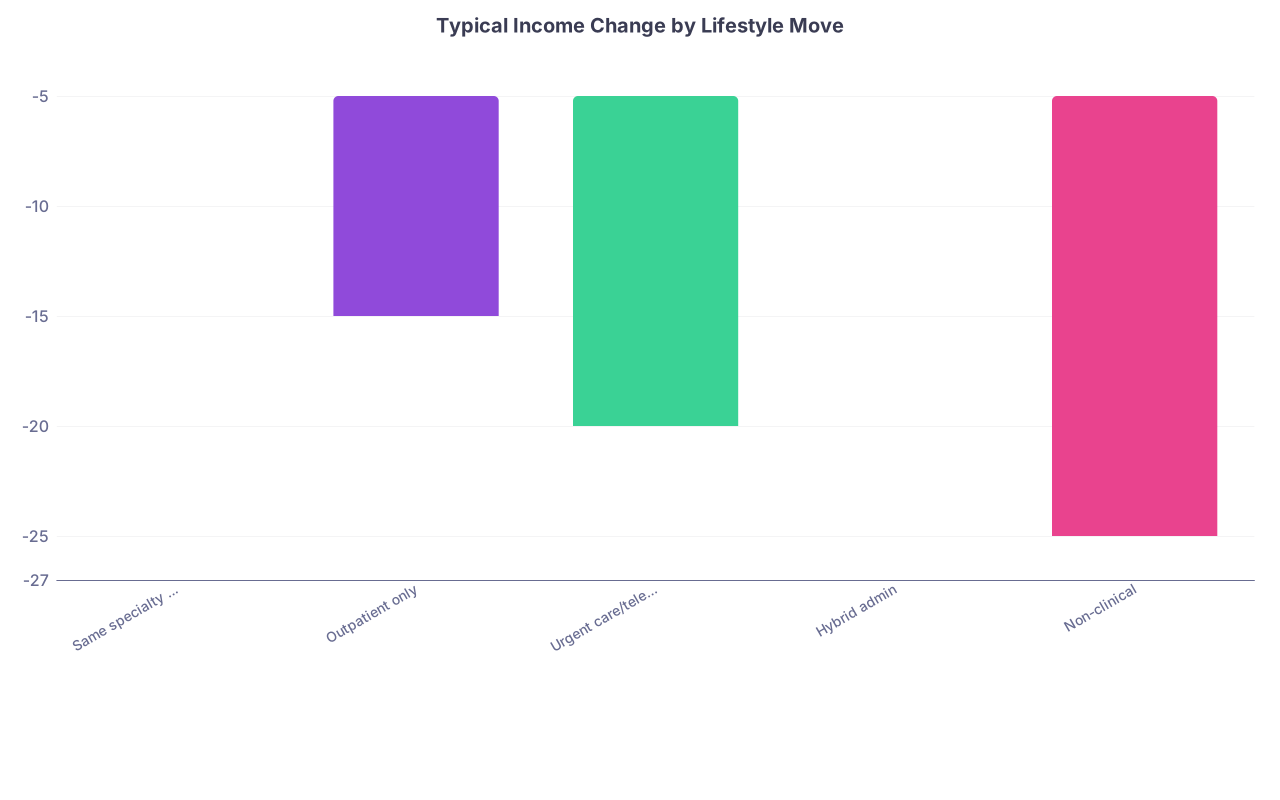
| Category | Value |
|---|---|
| Same specialty new setting | -5 |
| Outpatient only | -15 |
| Urgent care/telemed | -20 |
| Hybrid admin | -5 |
| Non-clinical | -25 |
These are very rough percentage estimates, but they match what I’ve seen:
- Same specialty, better structured job: −0–10%
- Outpatient only / no call: −10–20%
- Urgent care / telemed: −10–30%
- Admin hybrid: Neutral to −10% (sometimes ↑ long-term)
- Full non-clinical: Anywhere from −50% to +0%, occasionally more later
The real question you need to answer:
“What lifestyle change is big enough that I’d accept a 15–25% pay cut for it?”
Answer that honestly and you’ll know what roles to chase and which to ignore.
If your financial life is built around your highest-earning years never ending, your options shrink. Fix the finances, and your call problem becomes solvable.
Step 9: Tactical Steps to Start Moving in the Next 90 Days
Abstract ideas don’t change your life. Emails and conversations do.
Here’s a concrete, short-term action sequence.
Week 1–2: Clarity and data
- Log your last month of work:
- Hours on-site
- Hours on call
- Number of overnight calls/pages
- Rank your top 3 pain points:
- e.g., “Unpredictable nights,” “Never fully off,” “Volume pressure”
- Decide your non-negotiables:
- Example: “No in-house nights” or “No home call more than 1 weekend/month”
Week 3–4: Quiet intel gathering
- Talk to:
- One colleague who moved to a “cushier” job
- One recruiter (hospital-employed and one national firm)
- Ask specifically:
- “What outpatient-only no-call roles exist for my specialty within 2 hours of here?”
- “What 0.8 FTE or job-share options have you placed in my specialty?”
- Update your CV and LinkedIn. Stop pretending you’re not looking.

| Step | Description |
|---|---|
| Step 1 | Week 1 - Track hours and call |
| Step 2 | Week 2 - Define non-negotiables |
| Step 3 | Week 3 - Talk to 2 recruiters |
| Step 4 | Week 4 - Informal chats with 2 physicians |
| Step 5 | Week 5-8 - Apply selectively to 3-5 roles |
| Step 6 | Week 9-12 - Interview and negotiate call terms |
Month 2–3: Testing the market
- Apply to:
- 3–5 roles that match your non-negotiables. Not 30. Three to five carefully chosen ones.
- In interviews, ask these verbatim:
- “How many nights of call will I take in an average month?”
- “Who covers my patients when I’m off?”
- “Under what circumstances will I be called at home?”
- “How often do people here actually leave by 5 pm?”
- Refuse vague answers. “It depends” usually means “It’s bad, we don’t want to say.”
If you’re terrified to apply anywhere, that’s a red flag that your identity is over-attached to your current job. That’s fixable, but you have to face it.
Step 10: The Psychological Part Nobody Mentions
Leaving call-heavy roles is not just a logistical move. It’s an identity shift.
The fears show up like this:
- “My partners will think I’m soft.”
- “I trained all those years to do ‘real’ [insert specialty] and now I’m wasting it.”
- “What if I hate the new job and can’t go back?”
Here’s the reality:
- There is no prize for “Most Nights Spent Miserable On Call” at your retirement party.
- Your training doesn’t evaporate because you use it differently. You still know the medicine.
- Mid-career physicians successfully pivot all the time. You just don’t hear about it because they’re busy living their lives, not bragging at conference podiums.
The bigger risk at 40–55 is not “ruining your career” with a pivot. It’s waking up at 62 with health problems, a resentful family, and a highlight reel that consists mostly of Q3 call schedules.
Do not romanticize staying miserable.
A Brief Reality Check by Age and Stage
Your maneuvering room changes over time, but it never goes to zero.
| Stage | Flexibility Level | Common Moves |
|---|---|---|
| 5–10 yrs out | High | New specialty niche, academic ↔ community, big location moves |
| 10–20 yrs out | Moderate-High | Setting change, call reduction, hybrid roles, relocation |
| 20+ yrs out | Moderate | Outpatient-only, reduced FTE, locums, non-clinical |
Late 40s/50s?
- You’re actually ideal for:
- Leadership roles
- UM/CDI/insurance gigs
- Teaching-heavy positions
- You’ve got:
- Credibility
- Experience with systems, not just patients
- A story: “I’ve seen what doesn’t work. Here’s how we fix it.”
Don’t write yourself off.
Pulling It Together
Here’s the clean version:
- Define exactly what part of “call” you’re done with. Nights? Unpredictability? Emotional chaos?
- Decide what you’re willing to trade (money, prestige, geography).
- Target roles that structurally remove those pain points: outpatient-only, shift-based, hybrid, or non-clinical.
- Give yourself 90 days of real action: tracking, talking, applying.
- Treat this like a serious medical issue. Because it is. Chronic stress and sleep deprivation destroy lives.
You are not trapped by your residency choice from 15 years ago. You are only trapped if you let inertia and fear make your decisions.
Open your call schedule for the next 3 months and ask: “If this were my permanent life, would I stay?”
If the answer is no, send one email today—to a recruiter, a colleague in a cushier role, or your own future non-call self—and start the shift.