
If you rank programs on “prestige” and vibes instead of lifestyle reality, you are setting yourself up for burnout.
You can fix that. But you need a strategy, not vibes.
This is the playbook I wish more applicants used when they tell me, post-Match, “I love my specialty but I hate my life.” The problem usually is not the specialty. It is the rank list that ignored lifestyle in any systematic way.
You want:
- A lifestyle-friendly specialty
- A lifestyle-supporting program
- And a rank list that reflects your actual life priorities, not what sounds impressive on Reddit
Let’s go step-by-step.
1. Get Brutally Clear on What “Lifestyle” Means for You
“Lifestyle friendly” is not one thing. A cush EM schedule might be heaven for one person and hell for another. Same with outpatient-heavy psych, derm, or anesthesia.
You need a personal definition of lifestyle before you can build a rank list around it.
Start with four non-negotiable buckets:
- Time
- Control
- Environment
- Trajectory
1. Time: How much time do you want off the clock?
Define with actual numbers, not vague feelings.
Write down:
- Maximum average work hours per week you will tolerate in residency
- Minimum number of full days off per month you need to feel human
- Will you accept nights? If yes, how many per month feels okay?
- Are you willing to work most holidays for a few years?
Typical ranges you will see in lifestyle-leaning fields:
| Specialty | Typical PGY2–3 Hours/Week | Night Frequency (ballpark) | Clinic vs Hospital Skew |
|---|---|---|---|
| Dermatology | 40–55 | Rare | Mostly clinic |
| Psychiatry | 50–60 | Rotational, many home call | Mixed, more clinic later |
| PM&R | 50–60 | Limited | Mixed |
| Radiology | 55–65 | Variable, night float blocks | Mostly reading rooms |
| Anesthesiology | 55–65 | Early mornings, some nights | OR-based |
These are rough, but they give you a baseline. If your upper limit is 55 hours and you are ranking rads programs with notorious 70–80 hour “informal” expectations, you are lying to yourself.
2. Control: How much say do you want over your schedule?
Lifestyle is not just hours. It is predictability.
Score yourself:
- Need 9–5 style predictability?
- Okay with blocks of pain (e.g., a tough ICU month) if the rest is normal?
- Need geographic stability for partner/kids?
- Need some control of vacation timing for family obligations?
Write 1–3 sentences that look like this:
“I can handle periodic intense rotations, but I need overall predictability, minimal last-minute call changes, and at least one weekend fully off per month to recharge and maintain relationships.”
That sentence becomes a filter later.
3. Environment: What drains you faster than hours?
Some programs work “only” 55 hours a week but feel like 90 because the culture is toxic.
Identify:
- How you respond to hierarchy-heavy environments
- Your tolerance for malignant personalities
- Whether you prefer a chill, community feel or academic intensity
- Your need for being around co-residents who have lives outside medicine
Lifestyle-friendly specialties can still become miserable if the environment is bad. I have seen psych and derm residents absolutely fried in “prestige factories” that push endless research and perfection.
4. Trajectory: What do you want post-residency?
You rank for life beyond PGY4 too.
Decide roughly:
- Academic vs private vs hybrid
- Full-time vs part-time potential
- How important remote/hybrid work is (e.g., telerads, telepsych)
- Income goals that support life priorities (debt, kids, location)
You do not need a full 10-year plan. You do need to avoid selecting a track that blocks your likely future lifestyle.
2. Understand How Lifestyle Actually Plays Out by Specialty
You are in “MOST LIFESTYLE FRIENDLY SPECIALTIES” territory. Good. But even inside that bucket, programs vary a lot.
Let us cut through the brochure language and talk real differences.
The Lifestyle-Focused Usual Suspects
Here is how lifestyle tends to shake out in practice, not just theory:
| Specialty | Big Lifestyle Wins | Major Lifestyle Risks |
|---|---|---|
| Dermatology | Low call, regular hours, high pay | Competitive, heavy clinic volume, cosmetic hustle |
| Psychiatry | Flexible, telehealth options, lower acuity | Emotional burden, under-resourced systems |
| Radiology | High pay, telerads potential, shift work | Overnight shifts, isolation, productivity pressure |
| Anesthesiology | Clear start/end times, OR schedule | Early mornings, call, OR stress |
| PM&R | Team-based rehab, relatively controlled hours | Lower pay vs others, sometimes under-appreciated |
Notice something: lifestyle “win” does not mean “easy.” It means more control and sustainability if you choose well.
Also: location changes everything. A “lifestyle” psych job in an underfunded county hospital with chronically unsafe staffing and overflow beds? Rough.
So when you build your rank list, you are not just ranking specialty. You are ranking how each program implements that specialty.
3. Build a Lifestyle Scorecard Before You Rank Anything
If you do not quantify what you care about, you will default to name brand, faculty praise, or vague “fit.” That is how bad matches happen.
You are going to build a Lifestyle Scorecard. Then you will use it ruthlessly.
Step A: Choose Your Lifestyle Domains
Use 5–7 domains. More than that and you will drown. I recommend starting with these:
- Average work hours / workload
- Schedule predictability and fairness
- Call burden and nights
- Program culture (support vs malignant)
- Geographic/life fit (partner, kids, cost of living)
- Autonomy and respect for residents’ time
- Long-term career/lifestyle alignment (how grads actually live)
Step B: Assign Weights (This is where most people skip and regret it later)
Not every domain is equal. Someone with two kids and a working spouse will weight geography and predictability much higher than research support.
Example weighting (total = 100):
- Work hours / workload – 25
- Schedule predictability – 20
- Culture – 20
- Call burden / nights – 15
- Geographic / life fit – 10
- Autonomy – 5
- Career alignment – 5
If you are single, mobile, and debt-heavy, you might weight career/income potential higher and geographic stability lower.
Step C: Define a 1–5 Scale for Each Domain
You need concrete anchors, not vibes.
Example for “Work hours / workload”:
- 5 – Consistently 55 or fewer hours, multiple residents confirmed; no chronic scut dumping; appropriate ancillary support
- 4 – 55–60 hours, occasional spikes beyond; generally honest and controlled
- 3 – 60–65 hours, heavier services but not malignant
- 2 – 65–75 hours frequently, lots of “unofficial” expectations
- 1 – Consistently >75 hours or clear expectation to underreport hours
Do that for each domain.
Now you have a tool that you can apply across programs systematically.
4. Extract Real Lifestyle Data from Each Program (Not Just What They Say)
Recruitment season is a sales pitch. You need to get past it.
Here is the problem: almost nobody asks the right questions. And when they do, they accept the first polished answer.
You will do better than that.
Use Residents, Not PDs, as Your Primary Lifestyle Source
You are not asking the program director, “Do you respect work–life balance?” Of course they will say yes.
You are quietly interrogating residents.
Here is how.
Core Lifestyle Questions to Ask Residents
Ask these on interview day, socials, or 1-on-1 follow-ups. Vary the wording. Aim for specifics.
Hours and Workload
- “On your heaviest months, what are your actual typical hours? When do you normally get out?”
- “Do people regularly stay an hour or two past shift end? Or is that unusual?”
Call and Nights
- “How many nights did you do last block / last month?”
- “Does the night workload feel safe and manageable? Or like survival mode?”
Schedule Predictability
- “How far in advance do you know your schedule?”
- “How often do last-minute changes happen to cover gaps?”
Culture and Respect
- “How does the program respond when residents are struggling or burnt out?”
- “Have people actually used parental leave / medical leave without being punished?”
Geographic and Life Fit
- “Do most residents live close by? Have time for hobbies? Partners happy here?”
Red Flag Finder
- “If your best friend were ranking here, what is the main thing you would warn them about?”
You are listening for hesitation, inconsistency, and overly rehearsed positivity. When six different residents all say, “Hours are technically within ACGME but it can feel heavy,” you have your answer.
Cross-Check with Observable Data
Do not rely purely on testimonials. Use what you can actually see.
- Did they mention duty hour violations casually?
- How many residents showed up to the social? If only interns and a chief, everyone else might be too exhausted or disengaged.
- Do they talk about interests outside medicine without sounding like they are remembering a past life?
Then, after interview season, send 2–3 short follow-up emails to residents at your top candidate programs:
“I am ranking soon and trying to prioritize work–life balance. Can you share roughly how often you get two consecutive days off, and whether there is any hidden call burden or expectations that are not obvious on interview day?”
Residents who are actually happy tend to answer honestly. Burnt ones often let things slip in a way that tells you everything.
5. Score Each Program Objectively Using Your Scorecard
Once interviews are done, you will be tempted to rank on vague feelings: “That dinner was fun,” “The PD was nice,” “It is a big-name place.”
This is how you beat that temptation.
Step A: Fill Out the Scorecard for Each Program
For each program:
- Pull up your notes from the interview and socials.
- Assign a 1–5 score on each domain using your predefined anchors.
- Multiply by your weights.
- Sum to get a Lifestyle Score out of 100.
You might end up with something like this:
| Program | Workload (25) | Predictability (20) | Culture (20) | Call (15) | Geo Fit (10) | Career (5) | Total Lifestyle Score |
|---|---|---|---|---|---|---|---|
| Program A | 4 (100) | 5 (100) | 4 (80) | 4 (60) | 3 (30) | 4 (20) | 390 / 500 = 78 |
| Program B | 3 (75) | 3 (60) | 5 (100) | 3 (45) | 5 (50) | 4 (20) | 350 / 500 = 70 |
| Program C | 5 (125) | 4 (80) | 3 (60) | 5 (75) | 2 (20) | 3 (15) | 375 / 500 = 75 |
You will probably find some surprises. The place you “loved” might score lower than the one you initially dismissed.
Good. That is the point.
Step B: Separate Lifestyle Score from Prestige/Training Score
Do not pretend prestige does not exist. Just do not let it hijack your list unconsciously.
Create a separate 1–10 “Training/Prestige” score if you want. Then look at both:
- Program X: Lifestyle 82, Prestige 7
- Program Y: Lifestyle 63, Prestige 9
Now ask: is that prestige jump worth a 20-point lifestyle hit for you personally?
Sometimes the answer is yes. Often it is absolutely not.
6. Identify Your “No-Regret” Boundaries
Here is the harsh truth: most people who regret their rank list did not cross-check it with their dealbreakers.
You need hard lines, not just preferences.
Draft 3 Categories
Write programs into three columns:
- Green Zone – I would be content living this life for 3–5 years.
- Yellow Zone – I would tolerate this, but only if I do not match higher.
- Red Zone – I will resent waking up here every day. Not worth it.
If a program lives in your Red Zone, you do not rank it. I have had applicants tell me they “had to rank everything” and then match into misery at a place they knew they hated.
No. You do not have to rank everywhere. If you truly would rather SOAP or wait a year than go there, keep it off.
7. Order Programs Using a Rational + Emotional Hybrid
Now you have:
- Lifestyle scores
- Your Green/Yellow/Red zones
- A sense of your own future priorities
This is where you combine data with gut.
Step A: Rank Within the Green Zone
Inside your Green Zone, sort first by Lifestyle Score. Then adjust slightly for:
- Family / partner needs
- Unique opportunities that align with your long-term plan
- Major red flags you cannot quantify but cannot ignore
If two programs are neck-and-neck, ask:
“On an average Wednesday night, exhausted, which place would I rather walk into tomorrow morning?”
That answer counts.
Step B: Decide How Deep You Are Willing to Dip into Yellow
Yellow Zone programs are your risk management buffer. You likely still want to match this year. But you do not want to sacrifice your core lifestyle boundaries.
Be explicit:
- “I am willing to go down to Program K because the lifestyle hit is moderate.”
- “I am not willing to rank below Program M because those programs cross my hours/call/culture boundaries.”
This prevents panicked, last-minute “maybe I should rank everything” decisions.
Step C: Sanity Check Against Your Original Lifestyle Statement
Pull out what you wrote at the beginning:
“I can handle periodic intense rotations, but I need overall predictability, minimal last-minute call changes, and at least one weekend fully off per month…”
Now look at your top 5.
Does each realistically meet that bar? Based on what residents actually told you?
If not, adjust. Do not rationalize.
8. Avoid the 5 Most Common Lifestyle Rank List Traps
I see the same self-sabotage patterns every year. If you recognize yourself in any of these, correct course before you certify your list.
Trap 1: Overvaluing “Prestige” in Lifestyle Specialties
Derm at a toxic powerhouse vs derm at a mid-tier, resident-friendly program.
Psych at a big-name academic center with brutal call vs a community program where people actually have time to breathe.
For lifestyle-focused specialties, program culture and workload matter more than name brand for your long-term happiness. You will still get a job.
Trap 2: Believing “It Will Get Better Later”
If current residents tell you:
- “Intern year is hell, but it is fine later”
- “It used to be bad, they are working on it”
Translate that correctly: you might be the cohort suffering through the “working on it” phase.
Improvements do not magically implement on July 1 just because you showed up.
Trap 3: Assuming You Will Just Tough It Out
Residents are some of the toughest people I know. Burnout still eats them alive.
If you are already exhausted at the end of med school, do not tell yourself, “I will power through anything; lifestyle is a bonus.” You will not. You will break or become numb.
Trap 4: Ignoring Your Partner or Family Reality
If your partner needs a specific city or has zero flexibility, that is not a side factor. It is central.
I have watched residents split up because they downplayed this phase and overprioritized “the best program.” You can recover from a non-ideal program. Relationship fallout is harder.
Trap 5: Trusting Vibes over Patterns
Everyone is charming on interview day.
Instead of “The chief seemed nice,” look at patterns:
- What do interns say vs seniors?
- Any consistent theme about being “exhausted,” “short-staffed,” or “always pivoting”?
- How many residents openly talked about hobbies vs “I used to [x] before residency”?
Patterns > one-off impressions.
9. Use Data to Calm the Post-Match Anxiety
Even if you do everything right, you will question your list after submitting it. Totally normal.
Here is where your method pays off.
You can tell yourself:
- “I defined lifestyle clearly.”
- “I built a scorecard that matched my priorities.”
- “I interrogated programs beyond the sales pitch.”
- “I refused to rank places that crossed my hard lines.”
So even if you match lower than you hoped, you did not sell out your core needs. You ranked for sustainable life plus good training, not ego.
That is how you avoid long-term regret.
10. Quick Implementation Blueprint
You do not need to turn this into a 3-week side project. Condense it.
Here is a simple week-long execution plan if you are already in interview season or just finished it:

| Step | Description |
|---|---|
| Step 1 | Day 1 - Clarify lifestyle priorities |
| Step 2 | Day 2 - Build scorecard and weights |
| Step 3 | Day 3-4 - Re-review interview notes |
| Step 4 | Day 4-5 - Email top programs residents |
| Step 5 | Day 5-6 - Score each program |
| Step 6 | Day 6 - Sort into Green Yellow Red |
| Step 7 | Day 7 - Finalize and certify rank list |
If you are early in the game (still choosing specialties or planning third-year rotations), use the same framework:
- Start asking residents in each field these lifestyle questions.
- Track what you hear in a simple spreadsheet.
- Use that to choose rotations, mentors, and ultimately your specialty.
11. Lifestyle Reality Check: What Residents Actually End Up With
Just to ground this, here is what many residents in lifestyle-friendly fields actually report when things go reasonably well:
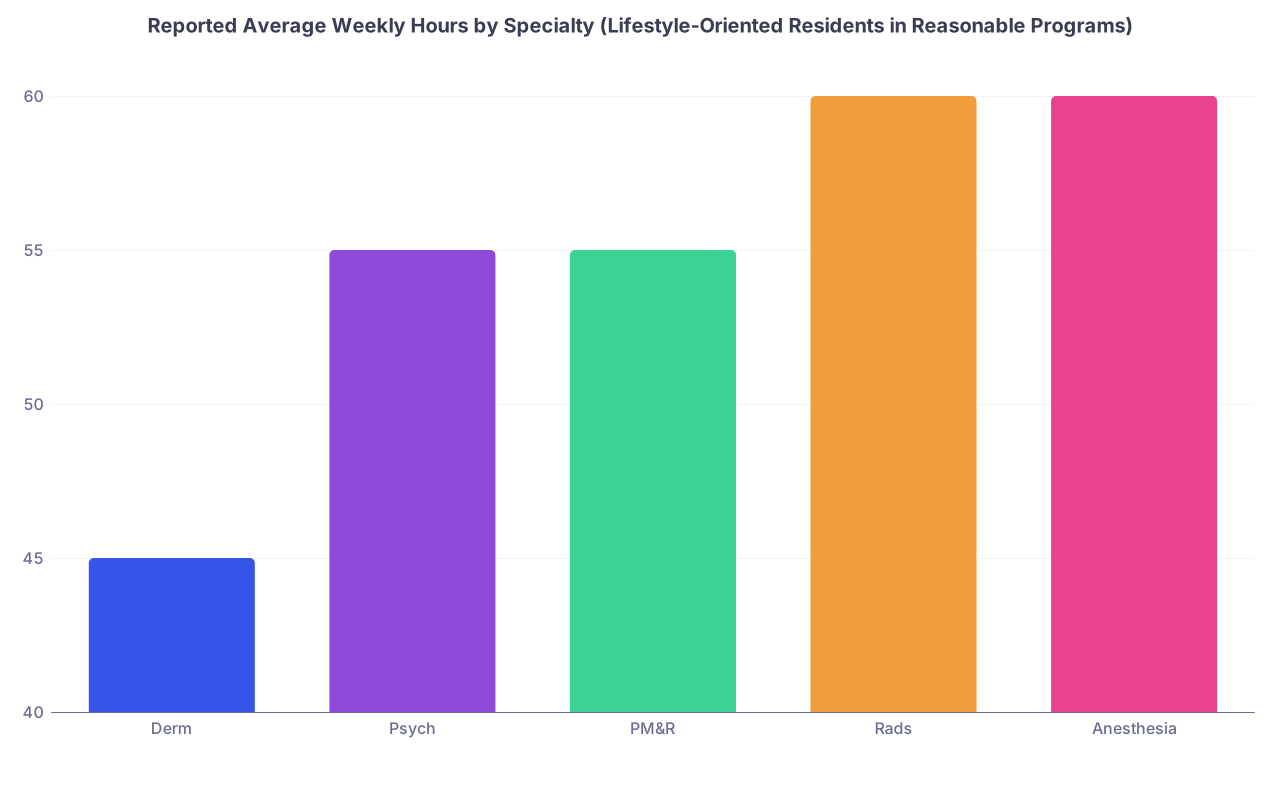
| Category | Value |
|---|---|
| Derm | 45 |
| Psych | 55 |
| PM&R | 55 |
| Rads | 60 |
| Anesthesia | 60 |
These numbers are not “cush.” They are simply sustainable compared with 70–80 hour surgical or IM workloads.
Your job is not to chase a fantasy 35-hour resident week. It is to pick the specialty and program where:
- Your hours are honest
- Your time is respected
- Your environment is non-toxic
- Your life outside the hospital still exists
You can absolutely achieve that. But only if you rank like you mean it.
Do this today:
Open a blank document and write three sentences:
- How many hours per week you can sustain without burning out.
- How much schedule predictability you need to protect your life outside medicine.
- One thing you absolutely refuse to sacrifice for residency (relationship, mental health, location, etc).
Then, pull up your current tentative rank list and ask:
“Does every program in my top 5 realistically support these three statements, based on what residents told me?”
If the answer is not a clear yes, your list is not done.