
The prestige trap ruins more careers than “bad Step scores” ever will.
If you’re sitting here thinking, “What if I regret picking a lifestyle specialty instead of cards, ortho, derm, neurosurg, whatever?”, you’re not crazy. You’re just honest enough to say out loud what a lot of residents and med students quietly obsess about.
Let me just say it bluntly: the fear of future regret is one of the biggest reasons people stay miserable in the wrong field. Or panic-apply to something that doesn’t fit them. Or spend half of residency stalking other people’s careers on Reddit and Doximity.
Let’s unpack this like two people on post-call brain mode, because the anxiety spiral you’re in? I know it well.
The Regret Fantasy vs. The Reality
You’re probably playing some version of this mental movie:
- You match into a “lifestyle” specialty (FM, psych, PM&R, anesthesia, radiology, EM, path, maybe heme/onc-lite outpatient life later).
- Fast forward 10 years.
- Your surgery friend is “saving lives,” posting dramatic OR pics, speaking at national conferences.
- You’re leaving clinic at 4:30 to go to your kid’s recital or the gym.
- And suddenly you’re crushed by this thought: Did I sell out? Am I wasting my potential?
Here’s the uncomfortable truth nobody likes to say out loud:
You will have regret thoughts. No matter what you choose.
Pick neurosurgery? You’ll wonder what life would’ve been like if you weren’t wiped out all the time.
Pick radiology? You’ll wonder what it’d feel like to have a patient cry and thank you in person.
Pick EM? You’ll question your sanity every time you walk into a night shift at 2 am.
There is no specialty escape route where your brain stops asking, “What if…?” That’s not a specialty problem. That’s a human brain problem, especially in ambitious people.
The question isn’t, “How do I pick a field I never regret?”
It’s, “Which set of trade-offs can I live with on a random Tuesday in February when nothing is Instagram-worthy and I’m just… working?”
The Prestige Illusion (and Why It Feels So Loud)
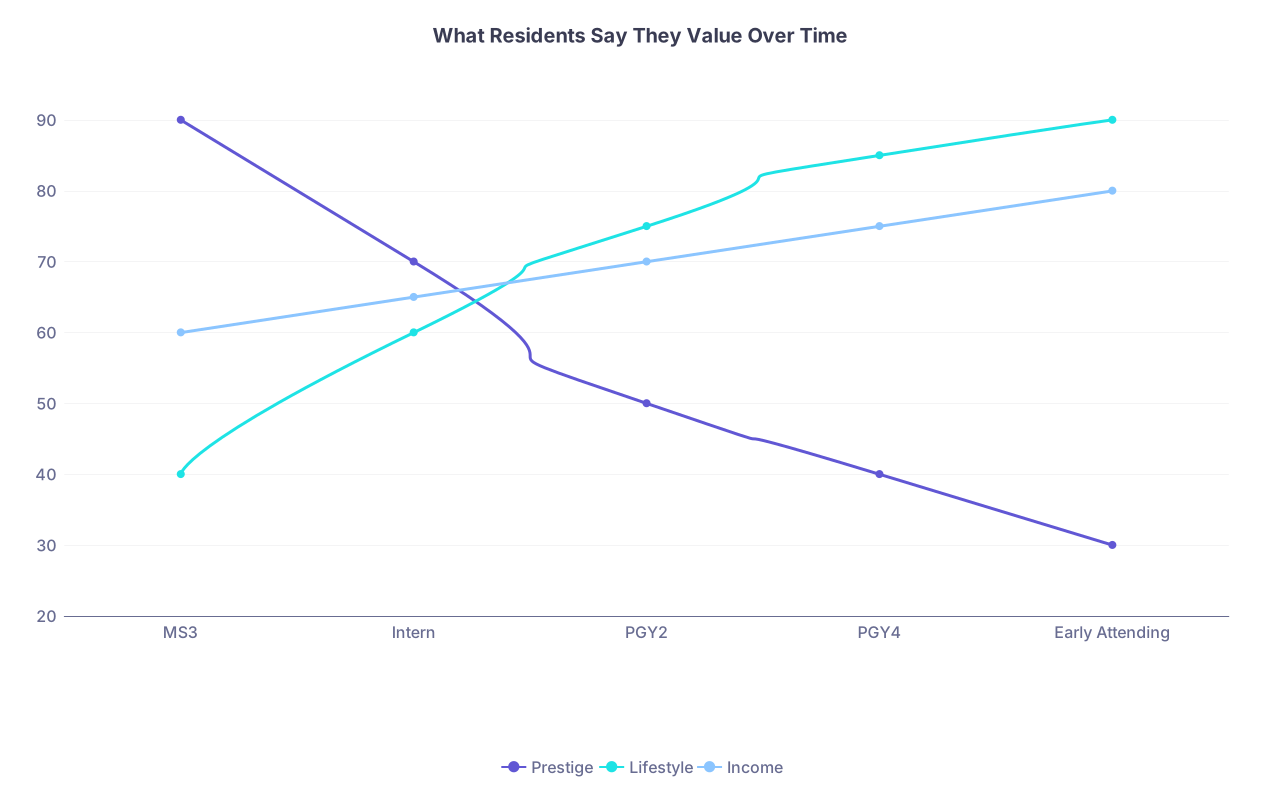
| Category | Prestige | Lifestyle | Income |
|---|---|---|---|
| MS3 | 90 | 40 | 60 |
| Intern | 70 | 60 | 65 |
| PGY2 | 50 | 75 | 70 |
| PGY4 | 40 | 85 | 75 |
| Early Attending | 30 | 90 | 80 |
In med school, prestige feels massive. Like oxygen. You’re marinating in:
- “Wow, she’s going into CT surgery, she’s so smart.”
- Attendings casually flexing fellowship pedigrees.
- People whispering USMLE scores like it’s a caste system.
- The unspoken ranking: neurosurg > ortho > CT > cards > GI > everything else.
So if you’re leaning toward something considered “lifestyle” or “non-prestigious,” your brain goes: Am I just being lazy? Am I not pushing myself? Will people think I couldn’t cut it?
Here’s what actually happens in real life once training is over:
Most non-medical people don’t know the difference between an interventional cardiologist and a hospitalist.
Your family just knows you’re “the doctor.”
Your patients care if you listen, fix their problem, and don’t seem rushed or miserable.
The obsession with “prestige” is loudest in:
- Med school
- Early residency
- Within weirdly insular hospital microcultures
It gets a lot quieter when:
- Your co-residents are divorcing
- You’ve been post-call driving home half-awake too many times
- You miss your third family holiday in a row
- You realize no one at your kid’s school cares what fellowship you did
Prestige is currency in a very narrow economy. Lifestyle is currency in the rest of your life.
What Regret Actually Looks Like (I’ve Seen Both Sides)
This is the part you’re really asking: Who ends up more miserable — the “prestige” people or the “lifestyle” people?
I’ve seen two main types of regret:
1. The “I Chased Prestige and Lost Myself” Regret
This is the surgical subspecialty attending who:
- Can’t remember the last time they had dinner with their family three days in a row.
- Has chronic back/neck pain and needs injections just to operate.
- Is quietly counting RVUs and admin politics like a second job.
- Feels trapped because they did 7–10 years of training and can’t emotionally tolerate “wasting” it.
They’ll say things like:
- “If I could go back, I’d do anesthesia.”
- “I should’ve done radiology. My life would be totally different.”
- “I wish I could just work 0.8 FTE and nobody would notice.”
Their external life looks impressive. Internally, a lot of them are bleeding out slowly.
2. The “Did I Aim Low?” Lifestyle Regret
Then there’s the outpatient FM / psych / radiology / PM&R / anesthesia folks who have… time. And brain space. And flexibility. But they slow down long enough to hear the insecurity in their own head.
Their worries sound like:
- “Should I have done something more intense? Did I wimp out?”
- “Could I have been a surgeon if I’d really pushed?”
- “Do people silently judge my specialty choice?”
And here’s the twist: they still go home at 5, have hobbies, and can switch jobs or tweak their niche if they really want more challenge.
One group feels stuck in a high-cost identity.
The other group sometimes feels under-validated but has room to adjust.
Both groups have occasional 3 am “what if” spirals. The difference is who has the flexibility to actually do something about it.
How Flexible Are “Lifestyle” vs “Prestige” Fields Really?
Let’s be uncomfortably practical for a minute.
| Specialty | Lifestyle Label | Job Flexibility | Hours Control | Easy to Go Part-Time? |
|---|---|---|---|---|
| Family Med | Lifestyle | Very High | Moderate | Yes |
| Psych | Lifestyle | Very High | High | Yes |
| Anesthesia | Lifestyle-ish | High | Moderate | Often |
| Radiology | Lifestyle-ish | High | High (outpt) | Often |
| Ortho | Prestige | Moderate | Low | Harder |
| Neurosurg | Prestige | Low | Very Low | Extremely Hard |
Lifestyle specialties (FM, psych, radiology, anesthesia, PM&R, path, many outpatient-focused fields) usually give you:
- Multiple practice settings (academic, private, telehealth, outpatient-only, locums).
- Easier exit ramps: part-time, admin roles, non-clinical work, niche clinics.
- Ability to dial up prestige later (leadership, subspecialty clinics, research, teaching) without wrecking your life.
Prestige-heavy, procedure-heavy fields (neurosurg, CT surgery, ortho, some interventional fields) often:
- Lock you into a narrower skill set that’s harder to downshift.
- Tie your identity very tightly to your role in the OR/cath lab.
- Make part-time work or big lifestyle changes much more complex and politically charged.
If you wake up at 40 in a lifestyle specialty and want more academic clout or challenge, you can often add:
- Teaching roles
- Leadership roles
- Niche subspecialty focus
- Research (especially clinical, QI, outcomes)
If you wake up at 40 in a prestige specialty and want significantly less intensity… that transition tends to be uglier.
But What If I Really Am Wasting My Potential?
Here’s the thought that stings the most:
“I could do that harder field. I have the scores, the work ethic. Am I just… chickening out?”
Let’s be direct.
Raw capability isn’t the bottleneck for most people. Capacity is.
Capacity = skills + time + mental health + relationships + physical health + basic joy in being alive.
I’ve watched absolutely brilliant people:
- Crush Step 1/2 with >250s
- Impress the hardest-core attendings
- Then get obliterated by a malignant surgical residency, end up depressed, divorced, or stepping away from medicine altogether.
That’s not because they were “too weak.” It’s because they loaded their life with constant high acuity, high hours, high stakes, and zero margins. Eventually something breaks.
You choosing a lifestyle specialty when you could survive a prestige one isn’t weakness. It’s you saying:
“I don’t want my whole identity to be my job. I want enough left of me for the rest of my life.”
If that sentence makes you feel guilty, that’s not your conscience talking. That’s conditioning.
The Real Question: What Hurts More to Imagine?
You’re overthinking the wrong scenario.
Instead of asking:
- “Will I regret not being able to flex a fancy fellowship title forever?”
Ask:
- “Which regret would hurt more?”
Scenario A:
You at 45. You did the prestige field. You have the title. You did the fellowship. People in the hospital know your name. You also:
- Work 60–80 hours most weeks
- Miss a huge chunk of your kids’ lives (if you want kids)
- Constantly negotiate call, case load, and hospital politics
- Daydream about walking away but feel trapped by sunk cost
Scenario B:
You at 45. You picked a lifestyle field. You:
- Make good money (often still 200–400k+, sometimes much more depending on specialty/setting)
- Have time to actually enjoy it
- Occasionally feel a sting when someone says, “Oh wow, neurosurgery, that must be so intense” and you’re like, “I… do outpatient psych”
- But you’re present in your own life
Which of those makes your chest tighter?
Most anxious applicants secretly know the answer. They just don’t like that it isn’t the hyper-heroic story they thought they were supposed to live.
A Quick Reality Check on “Lifestyle” Specialties
Let’s kill a myth: lifestyle specialties are not:
- Easy
- Boring
- For people who “couldn’t hack it”
You will still:
- Make hard calls (psych holds, anesthesia airways, radiology misses, FM emergencies).
- Be on the receiving end of patient anger, system failures, endless documentation.
- Burn out if you take every job with your eyes closed and say yes to everything.
But the ceiling on how bad the lifestyle gets is usually lower. And the number of levers you can pull to fix it is higher.
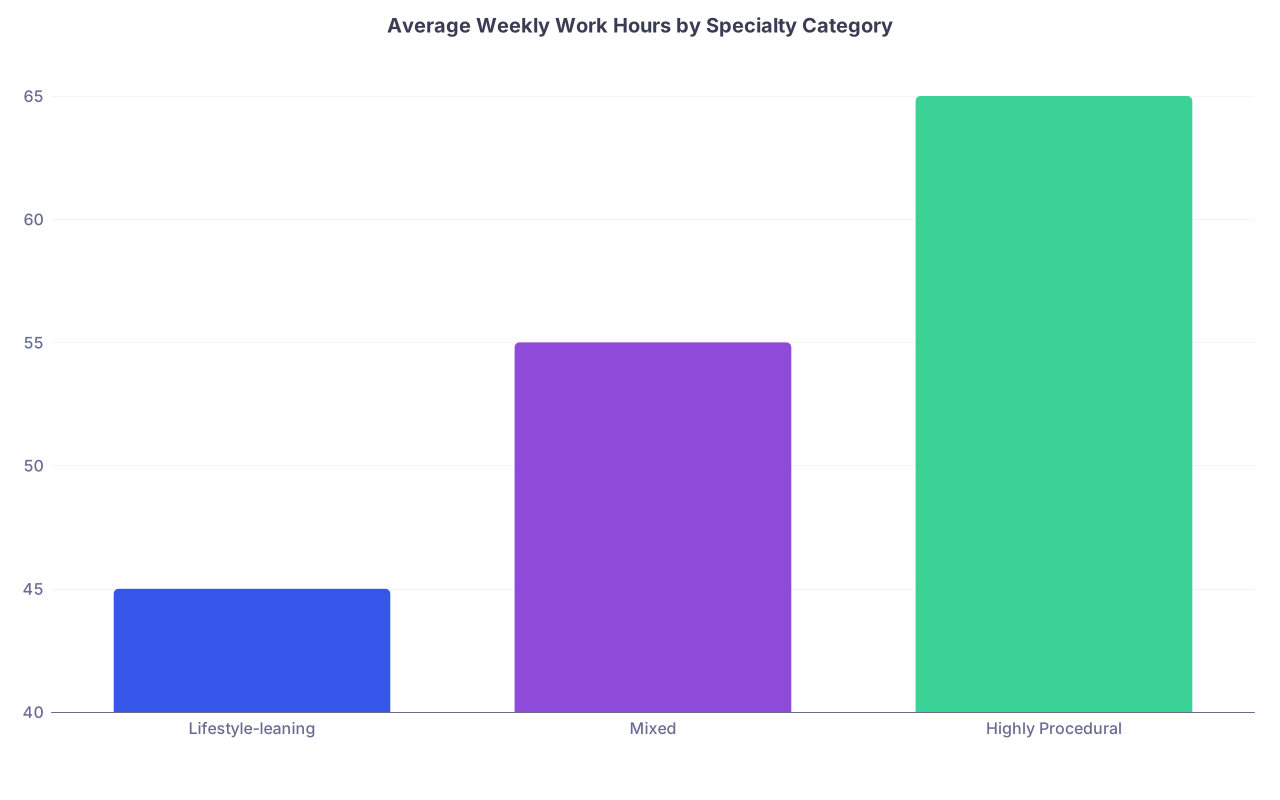
| Category | Value |
|---|---|
| Lifestyle-leaning | 45 |
| Mixed | 55 |
| Highly Procedural | 65 |
Does every lifestyle person work 40 hours and go home smiling? No.
Does every prestige person work 80 hours and hate life? Also no.
But if you look at probabilities rather than exceptions, the risk of chronic life squeeze is higher in the “prestige at all costs” club.
How to Calm the Spiral Right Now
Let’s make this actually useful and not just a philosophy rant.
1. Write down your worst-case fear
Literally one sentence. For example:
- “I’m scared that if I pick psych, I’ll always feel like I was too weak to do surgery.”
- “I’m scared that if I pick anesthesia, my IM friends will secretly think I sold out.”
- “I’m scared I’ll hit 50 and wish I’d been ‘more important.’”
Seeing it on paper shrinks it from this giant fog into a defined problem.
2. Then ask: “What would 40-year-old me actually say about that?”
Picture the version of you who:
- Has a partner or doesn’t; knows which one they prefer
- Maybe has kids or decided no and is at peace with it
- Has had a couple of health scares themselves or in loved ones
- Is tired of performative nonsense
Would that version of you say, “God, I really wish we’d picked something more prestige so strangers respect us more”?
Or would they say, “I wish I’d protected my body, my sleep, my relationships better”?
3. Talk to actual attendings, not just residents
Residents are in survival mode. Their perspective is skewed. Find 3–5 attendings in both:
- Lifestyle-ish fields
- Prestige-heavy fields
Ask them:
- “What do you regret about your specialty choice, if anything?”
- “If your kid wanted to go into your field, what warnings would you give them?”
- “What would surprise MS4 you about your current life?”
You’ll hear a pattern. It might scare you. Or it might give you enormous relief. Either way, that data is a hell of a lot better than your brain’s Netflix of disaster scenarios.
You’re Not Locking Yourself Into a Prison
This is the last thing I’ll say, because you’re probably wondering if picking lifestyle now means you can never chase challenge or subspecialty prestige later.
You absolutely can build:
- Academic reputation
- Leadership roles
- Subspecialty clinics
- Teaching influence
- Research portfolios
…from inside a so-called “lifestyle” field.
You can add intensity and prestige to a lifestyle foundation way more easily than you can subtract them from a hyper-prestige, hyper-demanding one.

| Step | Description |
|---|---|
| Step 1 | Choose Lifestyle Specialty |
| Step 2 | Solid Work Life Balance |
| Step 3 | Room for Extra Roles |
| Step 4 | Teaching or Academic Work |
| Step 5 | Leadership or Admin |
| Step 6 | Option to Increase Intensity |
| Step 7 | Choose Prestige Specialty |
| Step 8 | High Intensity Baseline |
| Step 9 | Harder to Reduce Hours |
You’re not weak for wanting that baseline to be humane.
You’re just refusing to sacrifice your entire future self to impress a handful of people in one narrow stage of your life.
FAQ (Exactly 5 Questions)
1. What if I match into a lifestyle specialty and then realize I really do want a prestige surgical field? Did I ruin everything?
Not automatically. Switching into something like surgery, ortho, or neurosurg after doing a year or two in a different specialty is hard, but it’s not impossible if you move early and take some pain. You’d have to: talk to program leadership, reapply, accept starting over, potentially move cities. It’s disruptive. But I’ve seen people go FM → EM, IM → anesthesia, prelim surgery → radiology. The rarer the field and the more competitive it is, the harder the switch. But you’re not doomed on Day 1. The bigger mistake is rushing into a prestige field you’re not actually aligned with just to avoid that uncertainty.
2. Will other doctors secretly look down on me if I choose something like FM, psych, or PM&R?
Some will. Let’s not sugarcoat it. There are attendings and residents who buy into the hierarchy so hard they can’t see past it. But here’s the blunt truth: the ones who sneer at “lesser” fields are usually compensating for their own dissatisfaction. In real practice, the colleagues people respect tend to be: competent, kind, reliable, and not unbearable to work with. Your field matters way less than your actual behavior. Also, you won’t be forced to hang out with the prestige-obsessed people forever. You can choose your environment later.
3. What if my family is already bragging I’ll be a surgeon/cardiologist and I’m scared to disappoint them?
Then you’re carrying their ego, not your own goals. I’ve seen students drag themselves through brutal residencies just to avoid one uncomfortable conversation with their parents. You’re the one who has to wake up at 4 am for cases, not them. You can say something like, “I learned a lot on rotations and realized I’m happiest in [X field]. I’ll be a better doctor and a better human there.” They might pout. They might not understand. But their fantasy career for you doesn’t have to become your actual life.
4. Won’t I get bored in a lifestyle specialty long-term? I like being challenged.
You probably will get bored if you pick any field and then just coast. That’s not a lifestyle issue; it’s a stagnation issue. Most lifestyle specialties have deep, complex subspecialty paths: interventional pain in PM&R, addiction or forensics in psych, sports in FM, IR-lite roles in rads, complex periop in anesthesia. You can add layers of difficulty, complexity, teaching, research, or leadership as you go. The nice thing? You get to choose when and how much to turn that dial, instead of living at max intensity forever by default.
5. If lifestyle really matters so much, why do so many people still chase prestige specialties?
Because in med school and early training, you’re graded, ranked, and praised. Your brain gets hooked on being “top of the class.” Prestige specialties feel like the continuation of that game. Also, we massively underexpose students to what fully trained attendings’ lives actually look like. You see the cool cases and hero moments, not the midnight charting, marital strain, admin meetings, and chronic exhaustion. By the time people realize the cost, they’ve already sunk years in and feel trapped. You’re asking these questions early, which is uncomfortable now, but might save you a lot of pain later.
Open a blank page and write two headings: “What I Actually Want My Life to Look Like” and “What I’m Afraid People Will Think.” Fill both. Then ask yourself which list you’re willing to sacrifice more for.