
Locum tenens can absolutely support an academic career—if you treat it like a strategy, not a side hustle.
Most people think locums is the opposite of academia. They picture endless travel, random shifts, no continuity, and zero scholarly work. That’s lazy thinking. Used correctly, locum tenens can buy you the two things academic physicians never have enough of: time and control.
Here’s how to make locums work for teaching and research instead of against it.
1. The Real Question: Time, Money, and Control
You’re not really asking, “Can locums support academic teaching and research?”
You’re asking three questions:
- Can I stay academically relevant while doing locums?
- Can I still teach learners and build a CV that doesn’t look like I “checked out”?
- Can I keep (or build) a research portfolio without a standard faculty job?
My answer to all three: yes, but only if you’re intentional about:
- Picking the right type of locum work
- Structuring your schedule around academic output
- Protecting your research infrastructure (data access, collaborators, IRB, etc.)
If you jump from random contract to random contract and just “see what happens,” your academic life will die in about 6–12 months. Not because you’re lazy. Because the system will eat every unprotected hour.
2. How Locums Can Actively Help an Academic Career
Let’s break down the three pillars: teaching, research, and promotion/CV building.
A. Teaching: Yes, You Can Still Teach Doing Locums
You don’t need a full-time academic appointment to teach. You need learners and a structure.
Here are realistic ways locums can support teaching:
Hybrid setup with an academic home base
This is the cleanest option post-residency:- 0.6–0.8 FTE academic appointment (hospitalist, EM, IM, etc.)
- 0.2–0.4 FTE locums on the side (or clustered weeks) The academic job gives you:
- Residents and students to teach
- A title (Assistant Professor, Clinical Instructor)
- Access to IRB, library, and research infrastructure
The locums work gives you: - Extra income
- The ability to buy down clinical time or fund unfunded research time
Teaching at community sites that use locums
Some community hospitals with residency or student rotations use locum physicians heavily. If you’re selective:- Look for sites with family medicine, IM, EM, or surgery residencies
- Ask explicitly: “Will I be supervising residents or students?”
- Confirm that teaching is explicitly included in the contract (not just “optional”)
You can absolutely list “Clinical Instructor” roles at affiliated residency sites and teaching hours on your CV. Program directors don’t care if your paychecks say Locums Agency X; they care what you did.
- Remote and asynchronous teaching
You can stack teaching even if your clinical work is 100% locums:- Online small groups for med students or PA programs (many need adjuncts)
- Guest lectures for your former residency program via Zoom
- OSCE examiner, MMI interviewer, simulation faculty on contract
- CME speaker or workshop instructor
You build a teaching portfolio; you don’t need one employer to hand it to you.
B. Research: This Is Where Most People Either Win or Completely Flame Out
Research on top of full-time clinical work is brutal. Locums can give you something you don’t get in a traditional attending job: blocks of uninterrupted time.
That’s a huge advantage—if you protect those blocks for academic work and not Netflix.
Here’s what works:
- Block-scheduling your year around research milestones
Use locums to intentionally free up time. For example:
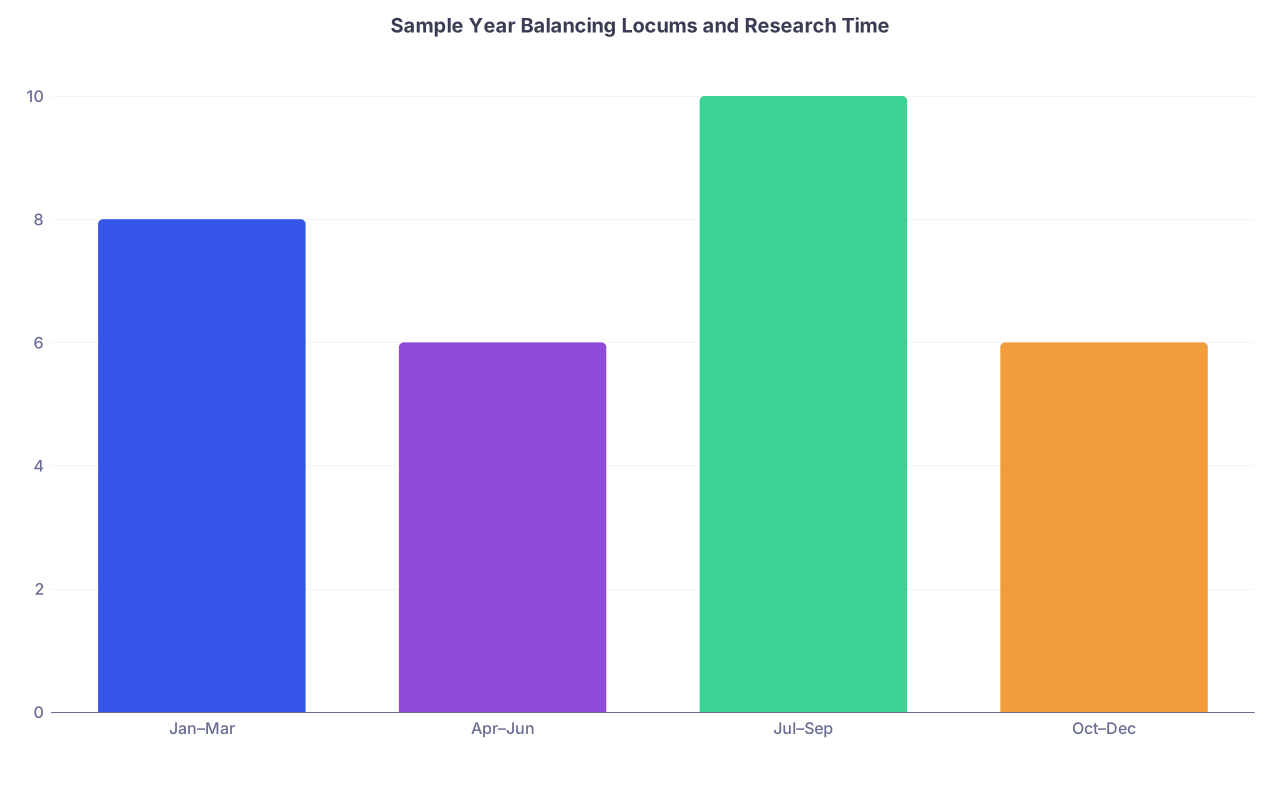
| Category | Value |
|---|---|
| Jan–Mar | 8 |
| Apr–Jun | 6 |
| Jul–Sep | 10 |
| Oct–Dec | 6 |
Think of those numbers as clinical weeks. The rest can be pure research/teaching.
- 7-on/7-off hospitalist or EM locums? Great. Use the off weeks like mini-sabbaticals.
- Cluster 2–3 months of intense locums, then take 4–6 weeks with no clinical work to:
- Finish analyses
- Write manuscripts
- Submit grants
Balancing guideline: if you’re early-career and serious about research, you should have at least 20–30% of your total work hours protected for academics. Locums can literally pay for that 30%.
- Keep an academic affiliation for infrastructure
Trying to do real research with zero institutional base is miserable. You’ll struggle with:
- IRB access
- Data use agreements
- Secure computing environments
- Statistical support
- Letter writers for grants
Solution: maintain a part-time or adjunct academic appointment while doing locums mainly for income. Negotiate:
- 0.1–0.3 FTE unpaid or low-paid “Research Faculty” or “Clinical Faculty with Research”
- Explicit access to:
- IRB
- Biostats support (even if limited)
- Library and software (EndNote, SPSS, etc.)
- A mentor or division chief who’ll back your work
Your clinical work can be predominantly locums; your academic identity lives at your home institution.
- Choose research that fits a locums lifestyle
Certain types of research play well with a locums schedule. Others are a nightmare.
Good fits:
- Secondary data analyses using:
- National databases (NSQIP, NIS, SEER, etc.)
- Institutional data pulled once
- Systematic reviews / meta-analyses
- Education research (surveys, curriculum development, assessment projects)
- Quality improvement projects with remote collaboration
Terrible fits for pure-locums people:
- Longitudinal clinical trials requiring constant on-site presence
- Wet lab or bench science where you need daily lab time
- Anything where you’re the only person who can enroll/consent subjects
Be honest about this. If you want serious lab science, you either:
- Pair locums with a substantial academic appointment, or
- Use locums only briefly (e.g., pay down loans) and then commit to a research-heavy faculty job.
3. Picking Locum Tenens Roles That Don’t Kill Your Academic Life
Not all locum gigs are compatible with academic ambitions. Some will quietly suffocate them.
Here’s what to look for and what to avoid.
A. What to Actively Look For
- Predictable block schedules
7-on/7-off, 14-on/14-off, or “one week per month” are your friends. They allow you to say:
- “These weeks are clinical. These weeks are academic.”
Chaotic “random three shifts this week, five next week” patterns destroy research consistency.
- Reasonable intensity / call
If you’re doing 24-hour in-house call every other day, those “off” days are just recovery. Choose gigs where:
- Night call is manageable
- Documentation isn’t a disaster
- You’re not drowning in uncompensated admin work
Ask upfront:
- Do you have residents or students on site?
- Will I be expected or allowed to teach and supervise?
- Are there standing QI or committee projects I can plug into?
You want places where you can plausibly generate:
- Teaching evaluations
- QI project involvement
- A letter from a local leader who can speak to your academic value
- Gigs near your academic base (if possible)
If your home institution is in City A, doing locums 45 minutes away is very different from doing locums three flights away.
Less travel = more real academic time, not just theoretical.
B. What to Avoid if You Care About Academics
Here’s the stuff that tends to kill research and teaching momentum:

- Permanent “crisis coverage” gigs where the hospital is chronically understaffed
- Schedules that change week to week with no long-term pattern
- Contracts that ban teaching or academic activity (yes, some exist)
- Roles that require punishing commutes or flights for short stretches of work
If this is your entire year, your odds of meaningful academic output are near zero.
4. Building a CV That Still Looks Academic
You’re probably wondering what this all looks like on paper. Fair concern. You don’t want future promotion committees or fellowship PDs thinking you just peaced out for a few years.
Here’s how to structure it.
A. Employment section
You can list both:
- Locum positions (grouped smartly, not 10 separate line items for 10 hospitals)
- Academic or adjunct appointments
Example:
| Section | Example Entry |
|---|---|
| Academic Title | Clinical Assistant Professor, Department of IM |
| Academic Role | 0.2 FTE, education and research focus |
| Clinical Work | Locum Tenens Hospitalist, multiple sites |
| Teaching | Resident supervision, med student small groups |
| Research | Health services projects, meta-analyses, QI work |
Group locums under one heading like “Locum Tenens Hospitalist, Multiple Sites (State X, State Y)” with a brief description.
B. Teaching section
Don’t undersell this. For each role, document:
- Learner level (MS3, PGY-1, PA students, etc.)
- Type of teaching (bedside, lectures, skills workshops)
- Any leadership roles (clerkship small group leader, simulation instructor)
Keep your own log. Most people don’t. That’s why their CV looks thin.
C. Research and scholarship
Your goal isn’t perfection. It’s continuity. A promotion committee wants to see that you didn’t shut your brain off for 5 years.
Aim for:
- 1–2 publications or serious projects per year, minimum
- A visible theme or focus area
- At least one mentor or senior collaborator still attached to you
Locums can fund the time to make that happen.
5. Common Pathways: How People Actually Do This
Let me show you a few realistic models I’ve seen work.

| Step | Description |
|---|---|
| Step 1 | Finish Residency |
| Step 2 | High volume locums 1-3 years |
| Step 3 | Hybrid academic + locums |
| Step 4 | Save cash and buy time later |
| Step 5 | Build steady teaching and research |
| Step 6 | Negotiate research heavy faculty role |
| Step 7 | Need loans paid fast? |
Model 1: “Loan Attack, Then Academic Push”
- 2–3 years of high-intensity locums (hospitalist, EM, anesthesia, whatever)
- Live below your means, crush debt/build savings
- Throughout those years:
- Maintain an adjunct academic appointment
- Contribute to 1–2 projects per year
- Then pivot:
- Use financial freedom to accept an academic job with lower pay but protected time
This works well if you’re okay with a temporary hit to pure academic intensity.
Model 2: “Hybrid From Day One”
- 0.5–0.7 FTE academic appointment
- 0.3–0.5 FTE locums
- Teaching and some research at the home institution
- Locums income fills the pay gap
This works if you’re disciplined with time and okay being “busy but balanced.”
Model 3: “Nontraditional but Academic-Adjacent”
- Full-time locums clinically
- 0.1–0.2 FTE adjunct role strictly for:
- Collaborations
- Education projects
- IRB access
- Research is mostly:
- Education
- QI/operations
- Secondary data/remote-friendly projects
You won’t look like a pure R01-track investigator, but you can absolutely be a credible clinician–educator or health services researcher.
6. Hard Truths You Should Know Up Front
Let me be blunt about the downsides.
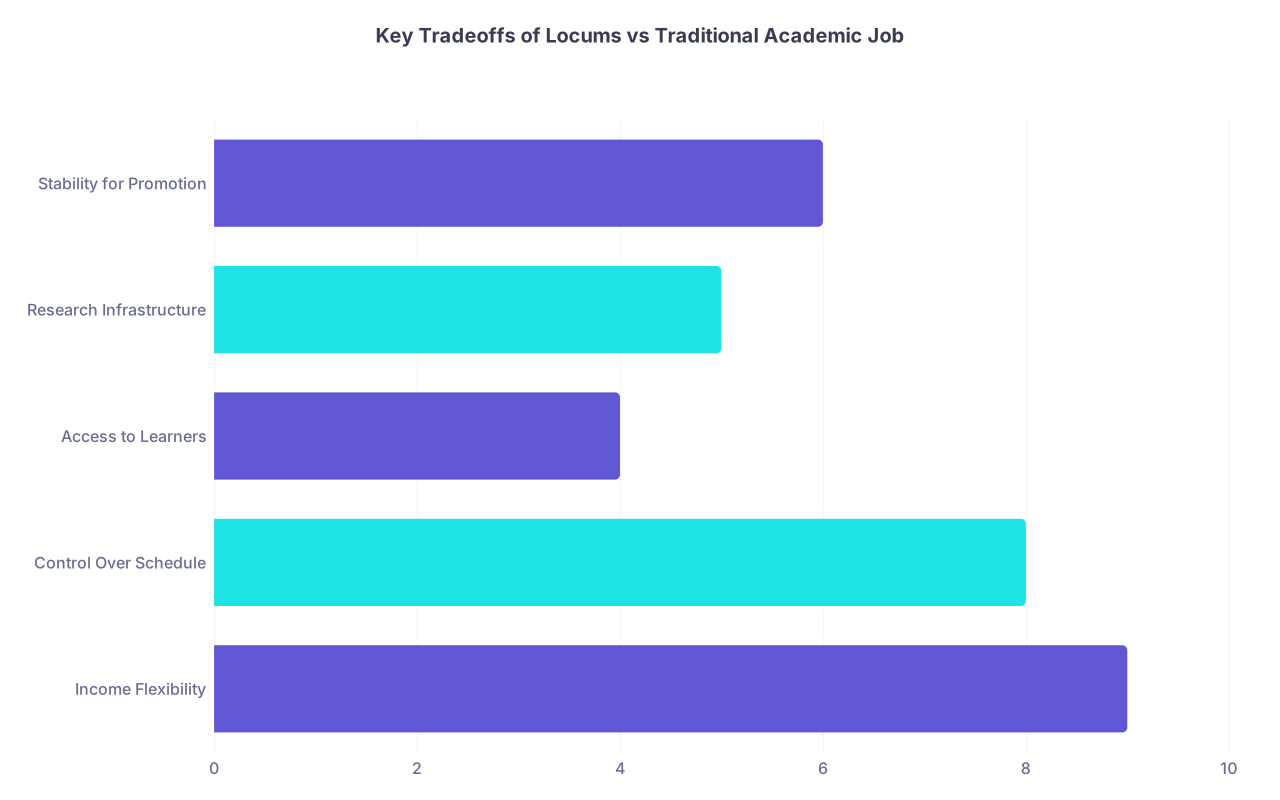
| Category | Value |
|---|---|
| Income Flexibility | 9 |
| Control Over Schedule | 8 |
| Access to Learners | 4 |
| Research Infrastructure | 5 |
| Stability for Promotion | 6 |
On a 1–10 scale (rough feel, not data):
- Income flexibility is outstanding.
- Control over your schedule is good if you say no to bad contracts.
- Access to learners and infrastructure is lower unless you engineer it with an institution.
- Promotion stability is better in a traditional academic job, but you can absolutely get promoted from a hybrid model if you’re productive.
Biggest risks:
- Burnout from too much travel / nights / money-chasing
- Isolation from academic peers
- Losing momentum; telling yourself you’ll “get back into research later,” and then it’s 5 years later
You avoid those by:
- Committing to a real academic plan on paper
- Saying no to contracts that blow up your protected time
- Keeping at least one foot in the academic world via an official affiliation
7. Practical Action Plan (What You Should Do Next)
If you’re post-residency and trying to decide if you can mix locums with academics, here’s the short version of your to-do list:

| Step | Description |
|---|---|
| Step 1 | Clarify goals |
| Step 2 | Choose main model |
| Step 3 | Secure academic affiliation |
| Step 4 | Define protected research blocks |
| Step 5 | Select compatible locums gigs |
| Step 6 | Track teaching and research output |
Decide your priority
- Are you primarily trying to pay off debt fast?
- Or primarily trying to build an academic career and just need income flexibility?
Secure or maintain an academic affiliation
Reach out to:- Former residency program
- Past mentors
- Local medical school
Ask about: - Adjunct or part-time clinical faculty roles
- Unpaid titles with access to research resources
Pick research that matches your lifestyle
Focus on:- Projects that are “batchable” during off weeks
- Work that doesn’t require you to be onsite daily
Be ruthless about your schedule
Protect:- 1–2 full days per off-week for pure academic work
Or - Several blocks per year that are 100% non-clinical
- 1–2 full days per off-week for pure academic work
Track everything
- Teaching hours
- Projects
- Presentations
- Committees / QI involvement
You’ll need it when you apply for promotion or your next academic role.
FAQ (Exactly 7 Questions)
1. Will doing a lot of locums right after residency hurt my chances at an academic job later?
It can, if you disappear completely from any academic affiliation and stop producing anything scholarly. If you maintain a part-time academic appointment, keep publishing occasionally, and show consistent teaching, most departments won’t care that your primary income was locums for a few years. They’ll care about your trajectory and productivity, not the exact source of your paycheck.
2. Can I be PI on research if I’m mostly a locums physician?
You usually need an institutional home to formally serve as PI for most IRB-approved projects. That’s where adjunct or part-time faculty appointments matter. You can do a lot as co-investigator or collaborator with other PIs if you lack a formal base, but long term, you’ll want at least one institution that lists you as faculty for serious PI-level work.
3. Are there locum agencies that specifically cater to academic-minded doctors?
Most agencies don’t brand themselves that way, but individual recruiters absolutely know which hospitals have residents, students, or academic affiliations. Ask them directly for: sites with teaching opportunities, programs with QI committees, and predictable block schedules. Then you verify it with the site itself, not just the recruiter’s sales pitch.
4. How much research output is “enough” if I’m part-time academic and part-time locums?
For early-career clinician–educators or clinician–researchers, a realistic bar is roughly 1–3 peer-reviewed papers or equivalent major projects per year. That can be original research, substantial QI work, or high-quality educational scholarship. You don’t need 10 papers a year, but you do need continuity—no long, unexplained gaps.
5. Can I teach residents or students at a hospital where I’m only doing locums?
Often yes, but it depends on the site. Many community programs use locums as attending coverage and expect them to round with and supervise residents. The key is making sure it’s allowed, defined, and recognized—ideally with access to evaluations or some documentation that you actually taught, so you can use it for your CV and promotion packets.
6. Is pure remote research realistic if my clinical work is 100% locums and travel-heavy?
It’s possible, but it’s harder than people think. Traveling constantly and switching time zones kills deep-focus work. If you’re serious about research, design your locums schedule to include real off-blocks at home where you’re not flying in and out. Then build your research around analyses, writing, and collaboration that can be done remotely.
7. If my long-term goal is a traditional academic job, should I skip locums altogether?
Not necessarily. Short, intentional locums periods can be incredibly useful: pay down debt, buy you time to write grants, or allow you to say no to bad full-time jobs. The key is not letting “temporary” become “directionless.” If you know you want to end up in academia, keep at least one foot in that world the entire time you’re doing locums.
Key takeaways:
Use locum tenens as a tool, not an identity. Keep an academic home base for infrastructure and credibility. Protect real, non-negotiable time for teaching and research, and pick locums gigs that don’t crush that time.