
You’re three years out of residency. Your first employed job went sour at 18 months. You walked away, did 9 months of locums while figuring out your next move, and now you’re staring at your CV thinking:
“Is this going to look like I got fired three times in one year?”
Here’s the answer: locum gaps can look totally fine—or like a disaster. The difference is how you document them, how coherent your story is, and whether your choices line up with your specialty and career stage.
Let’s go straight at what you need to do.
1. Do Locum Gaps Look Bad on a CV?
Short version: by default, no. Sloppy or unexplained gaps look bad. Structured, clearly documented locums generally look savvy.
Most medical directors have seen this pattern:
- Full‑time job #1
- Burnout / toxic group / family move
- 6–18 months of locums across a few sites
- Then a more thoughtful, longer‑term position
That doesn’t scare them. What does raise eyebrows:
- Chronology that doesn’t add up
- Multiple “1–3 month” stints in the same city with no explanation
- Big gaps (6+ months) with nothing written at all
- A CV that looks like it was thrown together from timesheets
So stop worrying about the word “locum.” Worry about clarity and consistency.
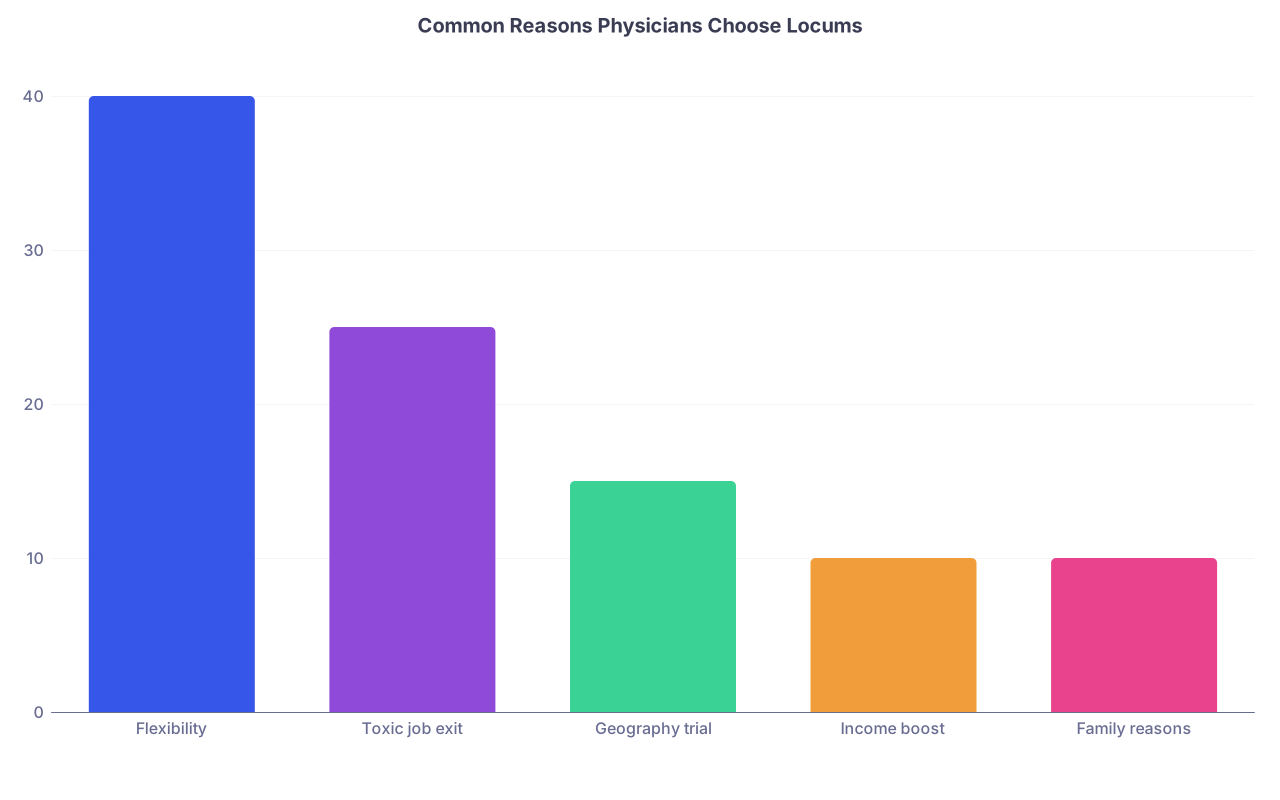
| Category | Value |
|---|---|
| Flexibility | 40 |
| Toxic job exit | 25 |
| Geography trial | 15 |
| Income boost | 10 |
| Family reasons | 10 |
How programs/employers usually interpret locum gaps:
- 3–6 months: Normal, especially post‑residency or after a bad fit
- 6–18 months: Fine if the story is coherent and skills stayed sharp
- 2+ years of scattered short gigs: They will ask “Why no stability?” and “Are you hard to work with?”
Your job is to make sure your CV answers those questions before they’re asked.
2. How to List Locum Tenens on Your CV (Without Creating “Gaps”)
The biggest mistake I see: people list every 4‑week site as a separate “job.” That screams instability, even when the work was actually consistent through an agency.
Here’s a better structure.
Core rule: anchor your locums to a single “position”
Use the locums agency (or “Independent Contractor”) as the main employer, then list sites underneath as bullets.
Example:
Professional Experience
Locum Tenens Hospitalist, Independent Contractor
Various sites via CompHealth and Locum Leaders | 08/2021 – 04/2023
- Mercy Hospital, Columbus, OH – 7-on/7-off, ~14 weeks total (2021–2022)
- St. Luke’s Community Hospital, Boise, ID – holiday and summer coverage (2022)
- Rural Critical Access Hospital, MT – 2 intensive blocks (2023)
You just turned 3–5 mini‑stints into one coherent line item. No “job‑hopping” optics.
If you had one main locums site with a lot of time there, you can break it out as its own line under the same employer, but do not turn every 10‑day coverage gig into a separate job.
3. What About Actual Gaps Between Locum Assignments?
You’re not on shift every day. There will be “off” stretches of weeks to months. The question is what shows up as an unexplained void.
A 3‑week break between assignments? Fine. No one cares.
A 5‑month stretch after you left a toxic job with nothing documented? That will get attention.
Here’s how to handle gaps so they don’t look like dead space:
Use month/year consistently
Do not use only years. That hides gaps and makes people suspicious. Format like this: 08/2020 – 10/2021.Bundle locums time across sites into continuous employment
If you were generally working during a period (even if not every week), keep the dates continuous under the “Locum Tenens, Independent Contractor” role.Fill big gaps with real activities or leave them obvious but explainable
Examples that are acceptable if true:- “Family caregiving and independent CME coursework”
- “Relocation and licensing for new practice region”
- “Maternity/paternity leave and part‑time urgent care shifts (prn)”
If you truly took 6–12 months off and didn’t practice, own it
Don’t fabricate. Note it briefly in a cover letter or, if you must, one discreet CV entry.

| Step | Description |
|---|---|
| Step 1 | Finished residency or job |
| Step 2 | Covered within locum dates |
| Step 3 | Group as part time or locum role |
| Step 4 | Create single gap entry with honest reason |
| Step 5 | Explain succinctly in cover letter |
| Step 6 | Gap more than 3 months |
| Step 7 | Did you work clinically at all |
4. Concrete CV Formatting: Locums After Residency
Scenario: You finished residency in 06/2022. Did full‑time locums for a year. Now you’re applying for a permanent job.
You want it to look like this:
Education
Internal Medicine Residency – University of X | 07/2019 – 06/2022
Professional Experience
Locum Tenens Hospitalist, Independent Contractor
Multiple sites via Weatherby and Vista | 07/2022 – 08/2023
- 7-on/7-off schedule at two community hospitals (TX, CO)
- Average 14–16 shifts/month, mix of days and nights
- Led sepsis initiative at primary locum site, helped ED reduce door‑to‑antibiotics time
Notice a few things:
- No missing months between residency and work
- Locums presented as a single, full‑time practice choice
- Responsibilities mirror a “real” job: patient volume, leadership, teaching, QI
If you flipped between locums and a short employed job, that’s fine. Just keep the chronology clean:
Hospitalist, ABC Medical Group – 09/2022 – 02/2023
Locum Tenens Hospitalist, Independent Contractor – 03/2023 – Present
Do not try to hide the dates. They will ask anyway.
5. How Hiring Committees Actually Read These Sections
Let me be blunt: most reviewers spend under 60 seconds on your CV the first pass. They’re scanning for:
- Training pedigree and board status
- Obvious red flags (big unexplained gaps, multiple terminations)
- Evidence you can handle their clinical environment
Locums entries help you if they show:
- Volume and acuity comparable to their setting
- Comfort with different EMRs and workflows
- No long gaps where you were clinically idle without explanation
They hurt you if they look:
- Chaotic (8 sites in 10 months, all listed separately)
- Thin (no patient volume, no sense of schedule)
- Defensive (weird euphemisms instead of just “locum tenens”)
So write your locums section like you’re proving, in 3–4 bullets, that you’ve been functioning as a fully independent attending, not floating between shifts because you can’t stick anywhere.
| Pattern | How It Usually Looks |
|---|---|
| 6–18 months, 1–3 main sites | Neutral to positive |
| 2+ years, mostly 1 primary site | Almost like a job |
| Many 1–4 week gigs, no explanation | Unstable / risky |
| Clear gap with reason documented | Acceptable |
6. How to Explain Locum Gaps in Interviews (Without Sounding Sketchy)
Your CV gets you to the call. Your story gets you the offer.
You need a one‑sentence summary of your locums period and any gaps that:
- Sounds intentional
- Highlights what you gained
- Doesn’t trash previous employers (even if they deserved it)
Examples:
“After my first job ended earlier than expected, I did a year of full‑time hospitalist locums across two systems. It let me keep my volumes high, see different models, and confirm I prefer a medium‑sized community hospital like yours.”
“I took 5 months to relocate for family reasons, take my boards, and complete state licensing. During that time, I kept up CME and then moved into locums work to stay clinically active while finding the right permanent fit.”
If you had a truly bad separation:
“I left my first job when it became clear the call expectations were much higher than what was represented. I did not take that lightly. I chose locums for a year after to continue practicing while I looked for a better long‑term environment.”
Short. Calm. No lawsuits in your tone.
7. Advanced Documentation Tips That Make Locums Look Strong (Not Second‑Best)
If you want your locums time to look like a smart career move, not a backup option, do these things on your CV:
Quantify your work
- “Average 15–18 shifts/month across two hospitals”
- “Managed 12–16 inpatients per day, including stepdown”
- “ICU co‑management with vents and pressors” (if true)
Name EMRs and practice environments
Shows versatility. “Epic, Cerner, Meditech; both academic and rural critical access.”Highlight leadership or system contributions
Even as a locum, you might have:- Led a sepsis education session
- Helped design a new admission order set
- Mentored a new PA/NP
Avoid fluff
Every CV on earth says “committed to patient‑centered care.” Hiring chiefs skim right past it. Use your space to show function, not slogans.

| Category | Value |
|---|---|
| Chronology & gaps | 35 |
| Volume/skills | 35 |
| Training/boards | 20 |
| Research/teaching | 10 |
8. When Locum Gaps Really Do Start to Hurt You
There is a point where even well‑framed locums start to raise concern.
Signals that you need to be careful:
- 3+ years post‑residency, no job longer than 12 months
- Repeated “left for better fit” stories with no solid anchor
- References that are all locums site directors rather than a stable group partner or department chief
- Skill atrophy in procedural specialties (EM, anesthesia, surgery) if volumes are low or inconsistent
At that point, you must:
- Show a clear plan: “I’m now looking for a 5+ year home in X setting.”
- Provide excellent references who can speak to your professionalism and teamwork.
- Be honest with yourself: are you avoiding commitment, or has the market/geography been tough?
Locums is a tool. It’s not a permanent excuse to never settle unless you’re intentionally building a long‑term locums career—and if you are, your CV should say that too.

9. Quick Do/Don’t Summary for Locum Gaps on Your CV
Do:
- Group locums under one “Locum Tenens / Independent Contractor” header.
- Use month/year and avoid unexplained 6+ month gaps.
- Show volume, scope, EMRs, and practice settings.
- Have a crisp interview story for why you did locums and what you want now.
Don’t:
- List every 2–4 week gig as a separate job line.
- Try to hide dates or fudge timelines. People notice.
- Stuff your CV with generic fluff instead of concrete work details.
- Panic. Locums is common and often seen as a rational move.

FAQ: Locum Gaps on a CV
1. Should I label the role “Locum Tenens” or something softer like “Consultant Physician”?
Label it honestly as “Locum Tenens” or “Locum Tenens / Independent Contractor.” Everyone knows what that means. Trying to euphemize it as “consultant” looks evasive and invites more questions, not fewer.
2. If I was credentialed at 6 hospitals through one agency, do I list all 6?
List the major ones where you actually worked substantial time. For the rest, you can say “Additional short‑term coverage at regional hospitals (per‑diem).” No one needs a blow‑by‑blow of every 4‑day weekend shift, but they do want an accurate sense of where you really practiced.
3. I have a 9‑month gap with no clinical work; can I just stretch my locum dates?
No. Do not fabricate dates. You can group locums dates continuously if you truly worked off and on during that period. If you did not practice at all for 9 months, create a short entry (e.g., “Family caregiving and relocation”) and be ready with a clean explanation in your cover letter and interview.
4. How much detail about schedule and volume should I include for locums work?
A couple of pointed bullets is enough. Example: “7-on/7-off schedule, 15–18 patients per day, open ICU with intensivist backup.” Do not write a paragraph. Just enough detail so a hiring chief can see that your work matches their environment.
5. Do locum gaps hurt more in some specialties than others?
Yes. Procedure‑heavy and ultra‑competitive fields (EM, anesthesia, surgery subspecialties) scrutinize gaps more, because skill atrophy and privileging are real concerns. In primary care, hospital medicine, psych, and peds, 6–18 months of locums is often neutral or even positive if you stayed clinically busy.
6. Can long‑term locums be a permanent career without hurting future prospects?
They can, if you’re deliberate. If you do 5 years of high‑volume locums at a couple of stable sites and frame it honestly as “long‑term locum career,” some employers will respect the experience. Others will always prefer traditional employment histories. If there’s any chance you want a stable employed job later, keep your documentation tight and your references strong from the beginning.
Key points to walk away with:
- Locum gaps themselves are not the problem; unclear timelines and weak stories are.
- Group locums under one role, use month/year dates, quantify your work, and fill big gaps with honest, succinct explanations.
- Be ready with a calm, one‑sentence narrative of why you did locums and what stable role you want now.