The biggest lie about emergency medicine locums is that it is “just the same job, different badge.” It is not. Locums amplifies everything: volume, acuity, autonomy. If you do not understand how those three interact, the job will eat you alive or quietly trash your risk profile over a few years.
Let me break this down specifically, the way attendings talk about it in the workroom when you are not around.
The Three Variables That Actually Matter
Forget the glossy recruiter pitch about “flexibility” and “competitive rates.” For emergency medicine locums, the real calculus is a three‑variable equation:
- Volume – how many patients per hour you touch
- Acuity – how sick they are and how many real decisions you make
- Autonomy – how alone you are when things go sideways
You can “afford” two of these to be high. Sometimes. All three at once, as a locums doc, in a place you do not know well, with systems you barely understand? That is how people end up in lawsuits, board complaints, or early burnout.
Here is the mental model I use when I look at a new EM locums gig:
, Low volume, moderate acuity, solo coverage](https://cdn.residencyadvisor.com/images/articles_svg/chart-risk-load-by-volume-acuity-autonomy-pattern-2478.svg "Risk Load by Volume–Acuity–Autonomy Pattern")
| Category | Value |
|---|---|
| High volume, low acuity, shared coverage | 25 |
| Moderate volume, high acuity, solid coverage | 45 |
| High volume, high acuity, [solo coverage](https://residencyadvisor.com/resources/locum-tenens-guide/the-on-call-expectations-locum-doctors-forget-to-negotiate) | 95 |
| Low volume, moderate acuity, solo coverage | 40 |
That third row – high volume, high acuity, solo coverage – is where a lot of rural locums “opportunities” quietly live. That is the one you need to dissect mercilessly before you sign anything.
Understanding Volume: It Is Not Just “Patients per Hour”
People love to simplify volume to “pph.” Recruiters will say, “We average 1.8–2.2 patients per hour, very manageable.” That sentence is basically meaningless unless you unpack it.
What volume actually feels like on shift
A 2.0 pph shift can be:
- A level 2 trauma center with a full team, residents, and a PA screening the fast track. Or
- A 10‑bed rural ED where you are the only physician, no midlevels, no in‑house RT, one new grad nurse, and EMS drops off everything in a 60‑mile radius.
Same pph. Completely different cognitive load.
The things I care about when someone quotes volume:
- Annual census. Under 12–15k? That is small. 15–30k? Mid. Over 40k with thin staffing? You will feel it.
- Distribution by time of day. Are they averaging 0.6 pph from 3–7 a.m. and 3.2 pph from 3–11 p.m.? That matters more than “average 2.0.”
- How many providers on at peak. Single doc at 45k+ visits per year is a no from me. I have seen those charts; the notes are thin and the door‑to‑doc times are ugly.
| Site Type | Annual Census | Typical Providers per Peak Shift | Realistic PPH per Doc |
|---|---|---|---|
| Small rural | 8k–15k | 1 MD | 0.5–1.2 |
| Community 1‑2 MD | 25k–35k | 1 MD + 1 APC | 1.8–2.4 |
| Busy community/trauma | 45k–70k | 2 MD + 1–2 APC | 1.8–3.0 |
If a 12k volume site claims “average 2.5 pph,” what it often means is the night doc is getting crushed by EMS transports and boarding while days are quiet. Ask for the hourly arrival curve. If they cannot or will not give it to you, assume the worst.
How volume interacts with throughput
Volume only matters in context of throughput bottlenecks. I have worked low‑volume sites that felt more painful than major centers because:
- Lab turnaround was 2 hours
- CT was on call and “30 minutes out” actually meant 90
- Only one nurse was comfortable with drips or RSI
So at the bedside you are doing: more serial reassessments, more phone calls to consultants, more documentation to justify every transfer. That is hidden volume. No one counts it. You feel it.
Low measured volume + bad throughput = fake “easy” gig.
Acuity: Be Honest About What You Want
A lot of new grads say they like “high acuity.” Then they hit their first true solo shift at a critical access hospital when a septic shock and a STEMI roll in 10 minutes apart and the nearest accepting tertiary care center is on divert.
High acuity in locums has a few distinct flavors.
Structural drivers of acuity in locums sites
Locums gigs cluster at certain types of hospitals:
- Rural critical access EDs – limited specialists, long transfer times, you own stabilization.
- Struggling community hospitals – under‑resourced, high boarding, fragmented consultants.
- Transitioning groups – high turnover, burned‑out core staff.
Each of these amplifies acuity differently.
In a rural ED, the numerical acuity (ESI mix) might not look extreme, but the functional acuity is high because you are the end of the line for initial management. No neurosurgery, no cath lab, sometimes no OB backup. You do the first 2–3 hours of care on everything.
In a busy community shop with poor inpatient capacity, acuity is high because the department fills with borderline ICU patients “waiting for beds.” You are doing ICU‑level care in the ED, often for many hours.
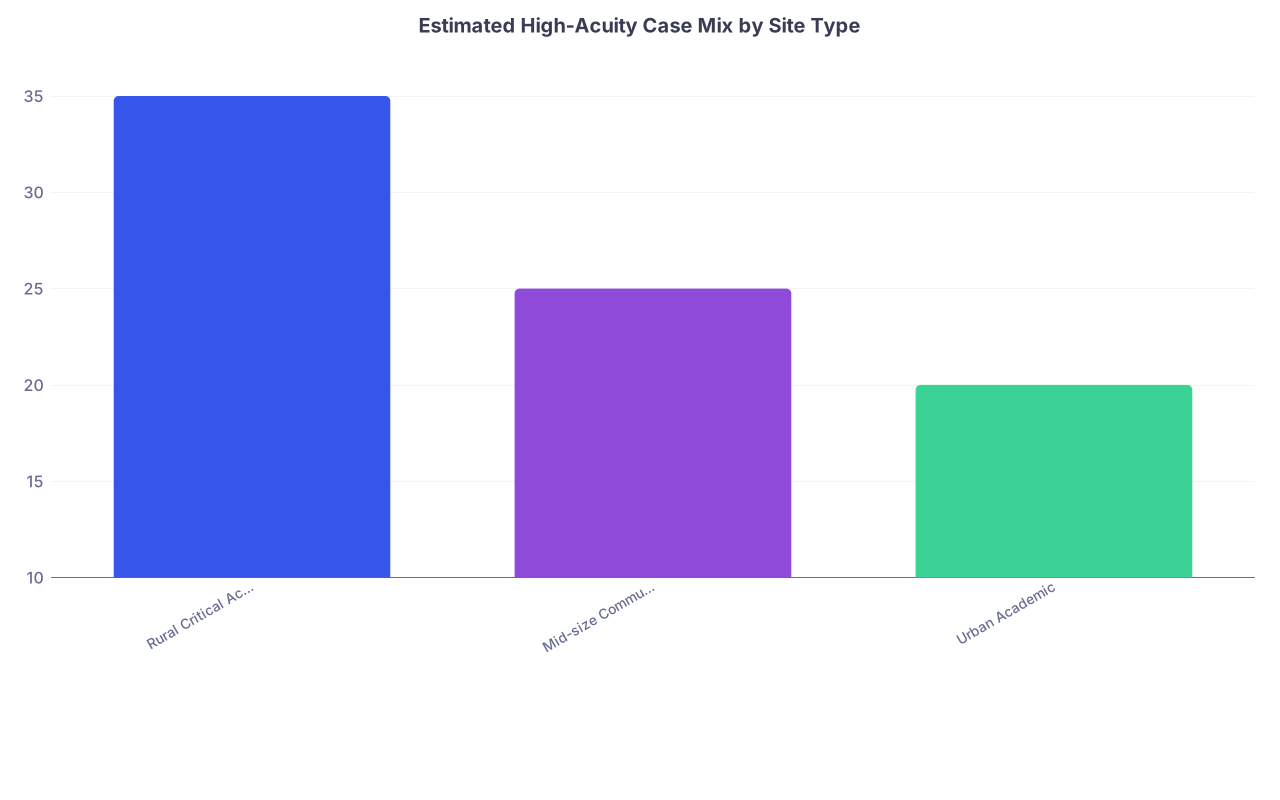
| Category | Value |
|---|---|
| Rural Critical Access | 35 |
| Mid-size Community | 25 |
| Urban Academic | 20 |
High‑acuity percentage here is not just trauma codes and ECMO. It is any case where your decision making significantly alters trajectory – intubations, vasopressors, chest tubes, difficult airway, complex sepsis, bad pediatrics.
What you must ask about acuity
When a recruiter says “moderate acuity,” I translate that into questions like:
- Trauma designation? If none, who handles major trauma? How often is EMS bypassing you for big stuff?
- Pediatric volume, and how sick? Any pediatric ICU within 60–90 minutes?
- Do they routinely hold ICU‑level patients in the ED with you as attending of record?
- What is the typical transfer distance and time for: STEMI, stroke, neurosurgery, pediatrics, OB complications?
I want exact examples. “Last month we had a ruptured AAA, intubated GI bleed, and septic shock on pressors all being held with one doc and two nurses for 4 hours waiting on a transfer,” is a very different environment than “we send out most major stuff within 30–60 minutes.”
If leadership cannot reliably describe the last few bad nights, that is actually a red flag. It means no one is tracking risk.
Autonomy: The Locums Multiplier
Autonomy is where locums diverges hard from your residency experience.
In residency, you lived in a cocoon of supervision, team familiarity, and institutional memory. You knew who the “good” ICU fellow was. You knew exactly how to get a rapid CT. You knew which nurse could run a trauma bay blindfolded.
As locums, you drop into a system cold.
Forms of autonomy that matter
Autonomy is not just “no direct supervision.” It comes in layers:
- Clinical autonomy – You are the final word. No attending backup, sometimes no second physician in house at all.
- System autonomy – You are expected to know or figure out the entire flow: who to call, which forms to complete, where the ultrasound is hidden, how to initiate a transfer.
- Cultural autonomy – You are outside the hospital’s political structure. Sometimes that is freedom. Sometimes it means no one protects you when something goes wrong.
A solo‑coverage rural ED midnight shift is clinical autonomy to the max. A big suburban ED with double coverage and robust policies still gives you autonomy, but with scaffolding.
The trap is high autonomy in a hospital with weak systems. A lot of locums jobs sit right there.
The Interplay: Getting the Balance Right
You cannot optimize all three variables at once. You choose your poison.
Broadly, these are the common patterns I see EM locums physicians fall into:
- High volume, low autonomy, moderate acuity – Think busy community with multiple docs and PAs, heavy protocols, lots of guardrails. Feels like a “normal” job, just temporary.
- Low volume, high autonomy, moderate acuity – Classic rural locums. Long stretches of quiet, punctuated by high‑stakes events where you are it.
- Moderate volume, moderate autonomy, high acuity – Regional referral centers that rely on locums to fill schedule gaps. Intense but well‑resourced.
- High volume, high autonomy, high acuity – The “we keep losing docs” nightmare sites. This is where you must be extremely cautious.
That last category is where the litigation comes from. It is also where recruiters push hardest because the pay looks fantastic on paper.

How to choose your zone
For a new grad doing locums immediately after residency, I am blunt:
- Start with medium‑volume, shared coverage sites. Learn how to be attending without adding solo rural pressure.
- Avoid true solo coverage at high‑acuity rural sites for at least the first 6–12 months out. Your pattern recognition and risk tolerance are still calibrating to being the final sign‑off.
- Once you know your comfort with real‑world risk and your speed as an attending, then consider sprinkling in low‑volume, high‑autonomy rural work if that interests you.
Experienced attendings 5–10 years out can flex more. But even then, I still tell people: do not stack all three dials to max.
Due Diligence: How to Interrogate a Locums Offer
If you treat locums like AirBnB (“looks nice, decent reviews, good price”), you will get burned. You have to interrogate these jobs like you are joining the staff, even though you are not.
Here is the process I walk through.
Step 1: Hard data from recruiter and group
Ask for:
- Annual census and visit growth over last 2–3 years
- Provider coverage grid (hour by hour)
- APC utilization – what they see vs what you see
- Admission rate and boarding time averages
- Trauma level and transfer destinations
Then I cross‑examine:
- “Average 2.0 pph” – How is that distributed by hour?
- “We have APC support” – Are they seeing low‑acuity only, or are they functioning as independent providers with you responsible for co‑signs?
- “Good specialist backup” – In house or call only? Response time? Can they refuse ED consults?
If they dodge specifics, they either do not know or do not want you to know.
Step 2: Talk to a current or recent locums doc
Non‑negotiable. I ask to speak with:
- A current locums physician who has been there >6 months
- If possible, someone who recently left and is willing to be candid
Questions I actually ask:
- “What is the worst shift you have had there? Walk me through it.”
- “How many times per month do you feel truly unsafe clinically?”
- “On a busy night, what are you realistically running – number of rooms, active critical patients?”
- “How does nursing handle a crashing patient? Are there 1–2 strong nurses or are you teaching basic ALS while resuscitating?”
You will learn more from those 10 minutes than any recruiter one‑pager.
Step 3: Assess systems and support
On your first shift, before you even see a patient, you need to know:
- Where the RSI drugs are and how they are stored
- Whether you have blood available or everything is “on call from the neighboring town”
- Whether there is a standardized sepsis, stroke, STEMI pathway, or everything is bespoke phone calls
- Who handles transfers at 2 a.m. – you, house supervisor, or a dedicated transfer center
If that sounds excessive, I have watched locums docs get trapped in 90‑minute transfer nightmares because they had no idea there was a pre‑existing transfer agreement with a larger system.

| Step | Description |
|---|---|
| Step 1 | Arrive to ED |
| Step 2 | Meet charge nurse |
| Step 3 | Confirm RSI and airway setup |
| Step 4 | Identify code and trauma protocols |
| Step 5 | Clarify transfer process |
| Step 6 | Review consultant on-call list |
| Step 7 | Check documentation system |
| Step 8 | Start seeing patients |
This five‑minute walk‑through at the start of every new assignment dramatically lowers your risk when autonomy is high.
Protecting Yourself Clinically and Medico‑Legally
Locums amplifies autonomy. Autonomy amplifies liability if you are sloppy.
You do not have the same institutional goodwill as core staff. If a bad outcome hits the fan and someone wants a scapegoat, the temporary doc is an easy choice.
Documentation rules I do not bend
I am not talking about writing novels. I am talking about targeted, defensive documentation that reflects actual thought process.
There are a few scenarios where I always slow down and write more:
- Atypical chest pain I am discharging
- High‑risk abdominal pain with negative CT
- Kids <3 months with fever that I am not admitting
- Patients leaving AMA or refusing key interventions (CT head, LP, admission, blood products)
You know the list from M&M. With locums, the stakes are just higher.
I make sure:
- Clinical decision rules are explicitly mentioned (HEART score, Wells, PERC, PECARN, etc.).
- Shared decision‑making is not just implied but quoted: “We discussed the small but non‑zero risk of missed ACS despite negative workup; patient understands and prefers discharge with close follow‑up.”
- In AMA cases, I document capacity assessment, risks explained, alternatives offered, and that the patient was invited to return any time.
This is boring, yes. It is also how you still have a license and insurability in 10 years.
Transfers and high acuity in resource‑poor sites
In high‑autonomy, high‑acuity locums gigs (especially rural), transfer documentation is where people get killed in deposition.
You want:
- Exact times: recognition of need for transfer, first call, acceptance, EMS request, departure
- Names of accepting physicians and facilities
- Clear description of interim management – what you did to stabilize while waiting
I have been in the room when plaintiff attorneys read through ED notes line by line. “Doctor, I see no documentation that you escalated when the nurse reported the blood pressure dropping from 100 to 70 over 45 minutes.” That is what you are defending yourself against.
Lifestyle and Burnout: The Hidden Side of Autonomy
Everyone talks about the rate per hour. Fewer talk about the recovery time required after certain types of shifts.
High‑volume, low‑acuity urgent care style ED shifts? You may feel bored, a little annoyed, but you go home and sleep fine.
Solo coverage, moderate volume, unpredictable acuity in a rural ED? Different beast. Those nights take something out of you. Even with only 10–12 patients, the cognitive “continuous readiness” and the knowledge that you are the only airway for 40 miles is draining.
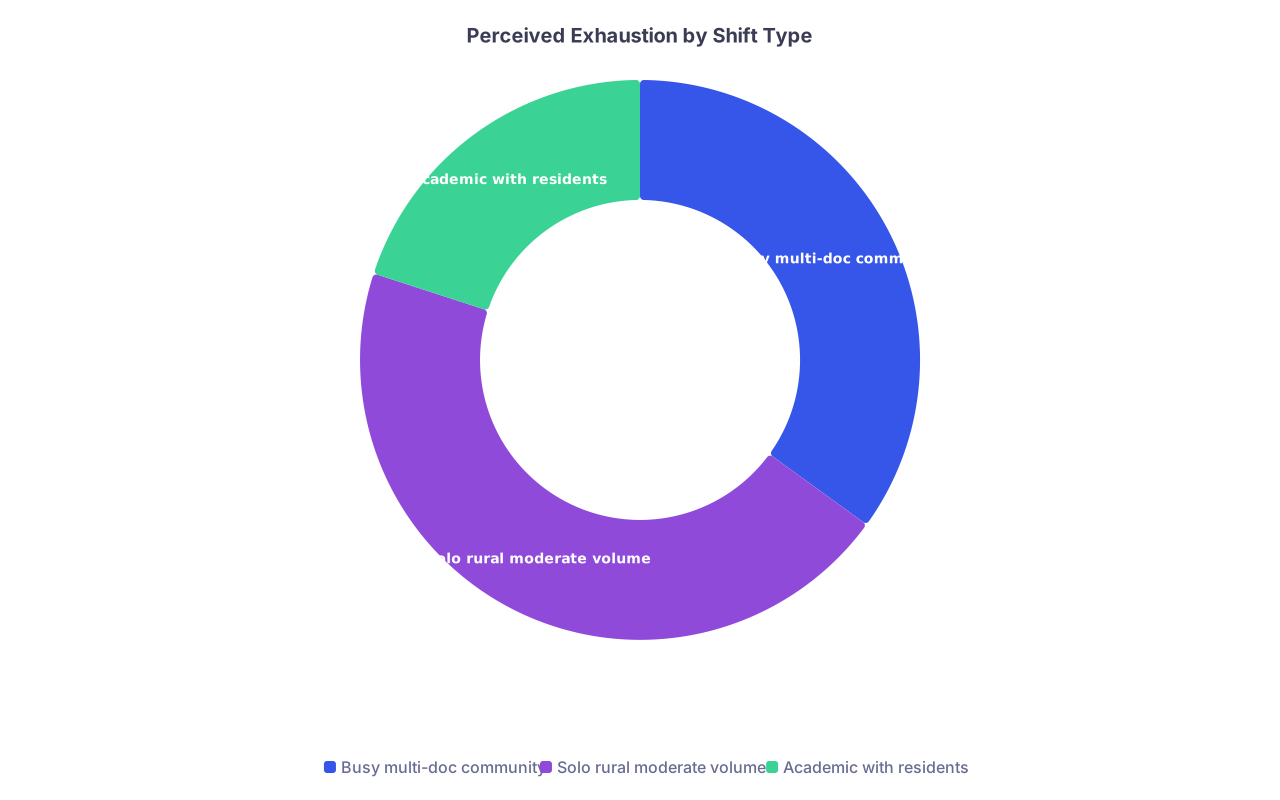
| Category | Value |
|---|---|
| Busy multi-doc community | 35 |
| Solo rural moderate volume | 45 |
| Academic with residents | 20 |
Giving yourself autonomy is great. Just remember: autonomy includes the autonomy to say no.
- No, I will not take 7 consecutive solo overnights even if the rate is amazing.
- No, I will not work at a place that has one nurse, no RT, and zero written protocols while expecting me to manage traumas and active MI.
- No, I will not co‑sign 40 PA charts per shift where I did not actually supervise care.
You are not a savior. You are a physician with finite bandwidth and a long career ahead.
Negotiation: Getting Paid for the Risk You Are Actually Taking
Let me be blunt: a lot of locums rates are mispriced because the people setting them do not understand clinical risk. Or they do, and they are betting you will not.
- Volume increases
- Acuity increases
- Autonomy (especially solo coverage) increases
- Support systems degrade (no in‑house CT, no specialists, long transfers)
If a rural, solo‑coverage, true 24/7 ED 60+ minutes from the next facility is paying you the same rate as a suburban community ED with double coverage and full specialties, something is wrong.

You should be asking:
- Is this rate base plus travel, or is travel baked into the number (effectively cutting your hourly)?
- Are you being paid differently for nights, weekends, holidays, or is it flat? It should not be flat if nights are solo and wild.
- Any incentives for picking up last‑minute shifts or covering gaps?
- Malpractice coverage: occurrence vs claims‑made, tail provided or not? Limits at least 1M/3M?
If a site is a clear high‑risk, high‑autonomy environment and the rate is only marginally better than a low‑risk site, I walk away. There is no surcharge high enough to justify a terrible medico‑legal environment, but there should at least be recognition in the pay.
Building a Sustainable EM Locums “Portfolio”
You should think of your locums life like building a portfolio of different shift types. Mix and match volume, acuity, and autonomy in a way that keeps you sharp but not destroyed.
One pattern that works:
- Anchor site: a mid‑volume, well‑run community ED where you pick up most of your shifts. Volume moderate, acuity moderate, autonomy shared. Low drama.
- Challenge site: 2–4 shifts a month at a higher‑acuity center with strong backup. You keep your critical care and trauma skills sharp without being alone.
- Optional rural site: only if you genuinely like it and you have vetted the hell out of the systems. Use this for occasional change of pace and meaningful work, not your main income.
| Site Role | Volume | Acuity | Autonomy | Shifts/Month |
|---|---|---|---|---|
| Anchor site | Moderate | Moderate | Shared | 8–10 |
| Challenge site | High | High | Shared | 2–4 |
| Rural site | Low–Mod | Moderate | High (solo) | 1–3 |
This blend keeps you clinically rounded, prevents stagnation, and avoids stacking too much risk in any one environment.
You also want to be intentional seasonally. Many locums EM docs burn themselves out doing insane stretches of winter coverage in rural upper Midwest sites, then crash in the spring. Build in true off‑time. Autonomy without boundaries is just self‑exploitation.
The Bottom Line: Use Locums to Grow, Not to Gamble
Emergency medicine locums can be fantastic. It can give you:
- Freedom from toxic groups and broken partnership promises
- Geographic flexibility for partners, kids, or side projects
- A chance to see how different EDs really work under pressure
But the price of that freedom is that you must think like an attending CEO, not like a resident employee. You are the risk manager, the medical director of your own practice, and the only one sitting in the deposition chair if things go badly.
So when you look at a new locums offer, stop asking “What is the rate?” first. Ask:
- What is the true volume, hour by hour?
- How intense is the real acuity, given resources and transfer times?
- How alone am I here – clinically, systemically, politically?
Then decide whether the combination of volume, acuity, and autonomy makes sense for where you are in your career and life.
If you get that balance right, EM locums is not just tolerable. It is one of the most interesting ways to practice this specialty, because you will see every flavor of emergency medicine, from quiet frontier nights to humming urban war zones.
And once you have that dialed in, the next step is learning how to build multi‑state licensure and a stable panel of anchor sites so you are never desperate for work again. But that is a strategy conversation for another day.