
It is 2:07 a.m. You are three weeks out of residency, standing in a two-room ED of a 12-bed critical access hospital. The nurse just said, “Doc, EMS is five minutes out with a rollover, unresponsive, hypotensive. Also, Mrs. K is back with her COPD. Again.” There is no in-house RT. The CT tech went home at 11 p.m. Helicopter is grounded for fog.
This is the moment every brochure about “rural adventure locums” forgets to describe.
You are considering rural locum tenens. Maybe as a bridge job after residency. Maybe as a semi-permanent lifestyle with high pay and long stretches off. The selling points are obvious: money, flexibility, low admin. The real question is: what exactly are you trading for that? Clinically. Logistically. Psychologically.
Let me break it down specifically.
1. What “Rural Locums” Actually Means (Not the Marketing Version)
“Rural” is vague. So is “locums.” Those two words cover a huge range of realities.
On the ground, you are usually talking about one of these setups:
- Critical access hospitals (CAHs) with:
- 10–25 beds
- 24/7 ED, but low volume (maybe 8–20 visits per day)
- Minimal in-house specialties (often just FM, IM, maybe general surgery or OB if you are lucky)
- Rural health clinics attached to those hospitals
- Stand-alone family medicine / primary care clinics, often with some urgent care function
- Occasional Indian Health Service or tribal clinics, which are their own ecosystem
And on the locums side, typical patterns:
- 24-hour ED call shifts, sometimes in-house, sometimes “sleep in the call room…if you can”
- 7-on/7-off or 14-on/14-off hospitalist blocks
- Primary care clinic weeks, 8–5 with call coverage
- Hybrid roles: clinic + ED + inpatient (the true “rural generalist” setup)
If you are picturing a cushy “low acuity, low stress” gig with high pay, that can be true from 9 a.m. to 4 p.m. on a Wednesday. At 3 a.m. with a crashing trauma or septic shock and no backup, the vibe changes abruptly.
The core reality: rural locums amplifies both sides of the job.
- Breadth goes up.
- Support goes down.
- Autonomy skyrockets.
- Guardrails thin out.
That is the tradeoff axis you are actually playing on.
2. Clinical Breadth: What You Will Actually See and Do
If you want narrow, protocol-driven, “call cardiology, call GI, call IR” medicine, stay in the city. Rural locums is the opposite.
Emergency / Hospital-Based Roles
You will see:
- Bread-and-butter ED stuff (but with fewer consultants):
- Chest pain, dyspnea, abdominal pain, minor trauma, lacerations, fractures, psychiatric emergencies, alcohol withdrawal, nursing home transfers
- Higher acuity than the volumes suggest:
- Septic patients with very delayed presentations
- STEMIs 90 minutes from the nearest cath lab
- COPD and CHF exacerbations where the “baseline” is already terrible
- Trauma without a trauma team (ATVs, farm equipment, logging, road accidents)
You will be doing:
- Procedural work that might have been turf in residency:
- More frequent central lines, IOs, ultrasound-guided IVs
- Intubations without anesthesia backup
- Chest tubes if the region has a lot of trauma
- Procedural sedation with fewer personnel than you are used to
- Resource-driven decisions:
- Who really needs transfer vs who can stay
- What imaging is actually necessary when CT or ultrasound access is limited
- Antibiotic choice with a sparse formulary, often with older or non-ideal options
I have watched new grads walk into a “low volume” ED and get their procedural numbers up faster than any urban colleague, simply because every tube, every central line, every real resuscitation defaults to “you.”
On the inpatient side (hospitalist or FM with inpatient):
- You keep more things that tertiary centers would admit to subspecialty teams:
- DKA (mild to moderate)
- Pneumonia with some oxygen requirements
- CHF with IV diuresis
- Uncomplicated GI bleeds after initial stabilization
- You learn to manage a higher proportion of cases with limited specialty input:
- Tele-neurology for stroke
- Tele-ICU if the hospital has it
- Phone consults with cardiology / ID / nephrology at the referral center
Primary Care / Clinic-Based Roles
Rural primary care via locums is where breadth really explodes.
You see:
- Full-spectrum age: newborns to 95-year-olds
- High mental health burden: depression, anxiety, bipolar, PTSD, substance use
- A lot of “no one else for 50 miles” care:
- Chronic pain management
- Basic women’s health (Pap smears, contraception, early pregnancy)
- Men’s health, including testosterone management (often poorly done before you arrive)
- Peds that would go to specialists in cities (ADHD, asthma, mild developmental issues)
You are also much more likely to be doing small procedures in clinic:
- Skin biopsies, I&Ds, joint injections, basic wound care
- Nexplanon insertions, IUDs if trained and the site has equipment
- Toenail removals, foreign body removals
Breadth is the upside. Also the trap. You can easily drift outside your real comfort zone under the pressure of “but there is no one else.”
3. Resource Limits: What You Do Not Have (And How That Changes Your Medicine)
This is the part recruiters soft-pedal. They will say “limited resources” the way airlines say “minor delay.”
Let me be specific about the usual constraints.
Diagnostics
You may be missing:
- 24/7 CT
- On-site ultrasound techs overnight
- Advanced imaging like MRI entirely
- On-site echo outside of business hours
- Immediate lab panels (coags, Troponin high-sensitivity, lactate) depending on the facility
So your practice shifts:
- More reliance on physical exam and pattern recognition
- Serious decisions with incomplete data:
- Example: No CT after midnight → do you transfer that older patient with vague abdominal pain and mild tenderness, or keep and observe?
- More frequent “treat and transfer” scenarios:
- Load with antibiotics, fluids, maybe vasopressors, then send out
Manpower
Common patterns:
- One nurse in the ED at night. One on the floor. That is it.
- No respiratory therapist after hours.
- No phlebotomy overnight. Nurses draw labs.
- Often one or two ambulance crews for the entire county.
Meaning:
- You cannot order big, labor-intensive protocols casually. Sepsis bundle is not plug-and-play if you only have two nurses for the whole building.
- You do more hands-on work yourself in resuscitations and procedures.
- Transfers are fragile:
- If the only EMS crew is running a transfer 90 minutes away, you basically have no ambulance for your next emergency.
Pharmacy and Formulary
You will face:
- Limited formulary: maybe one antipsychotic, a few antibiotics, few IV options for various drug classes
- Pain control restrictions: some rural places are very conservative or have specific opioid policies after bad experiences
So you need to:
- Actually know substitution options:
- No ceftriaxone? Maybe cefotaxime or levofloxacin instead.
- No fancy DOAC selection? Warfarin or one cheaper DOAC only.
- Think twice before starting exotic chronic meds when there is no follow-up or no ability to monitor safely.
Specialty Access
Realistic expectations:
- No in-house cardiologist, neurologist, intensivist, GI, ID, etc.
- Maybe one surgeon who covers a huge area and is not always available
- Telemedicine is variable: some have good tele-neuro and tele-ICU; some have nothing
Practically, this means:
- You will do risk–benefit calculus constantly:
- Admit vs transfer
- Tele-consult vs full transfer
- Push your comfort zone vs insist “this must go”
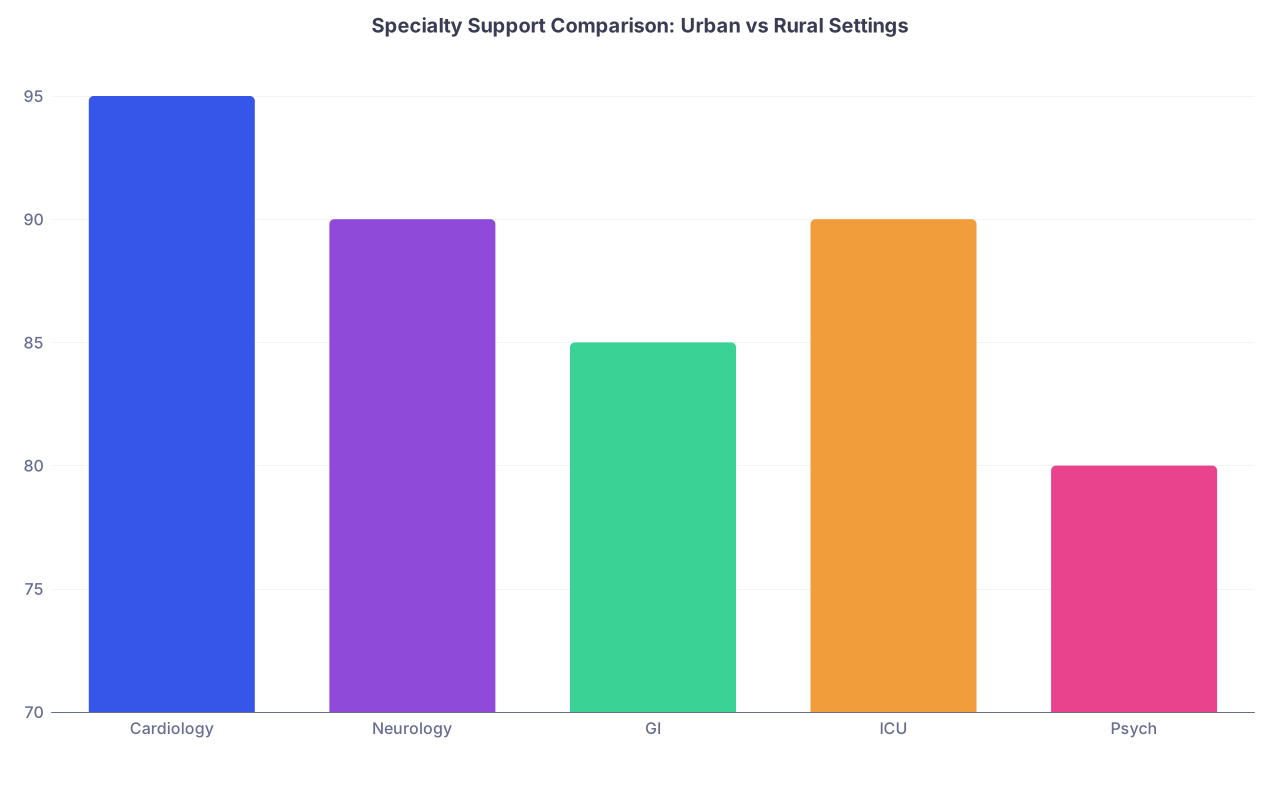
| Category | Value |
|---|---|
| Cardiology | 95 |
| Neurology | 90 |
| GI | 85 |
| ICU | 90 |
| Psych | 80 |
(Interpret that as: in an urban center, most of these specialties are one call away. In many rural hospitals, they are hours and multiple phone calls away.)
4. The Real Tradeoffs: Money, Skill Growth, Risk, Lifestyle
You are not choosing between “good and bad.” You are choosing which problems you want to own.
Clinical Skill vs Clinical Risk
Upside:
- Faster independent decision-making skills
- Broader procedural competence
- Better clinical judgment under uncertainty
I have seen EM and FM docs do a year of rural locums and come back dramatically more confident. They stop fidgeting when CT is delayed. They stop reflexively calling consults for every borderline case. They learn to think clearly in chaos.
Downside:
- More malpractice exposure on each decision, because:
- You are often the only physician on the chart
- You are making transfer vs keep calls that can go either way in retrospect
- Delays and resource gaps are easy fodder for plaintiff attorneys
Risk is not a reason to avoid rural. But you do need top-tier malpractice coverage (occurrence-based if possible, high limits, tail covered) and you need to document your decision-making very clearly.
Income vs Stability
Most rural locums pay very well relative to the workload on “average” days.
- ED rural locums:
- Daily rates can be 1.2–2x urban rates
- 24-hour shifts with both ED + inpatient are paid correspondingly higher
- Hospitalist:
- 7-on/7-off can net strong monthly income with housing and mileage covered
- Clinic:
- Less dramatic pay bump, but often still better than employee PCP roles
Tradeoff:
- You are a contractor. You can be dropped.
- Volumes can fall; budgets get cut; new permanent hires arrive.
- Credentialing delays and state licenses create gaps in income.
You are swapping “job security” for “income flexibility.” If you manage money well, that is a fair trade. If you live paycheck to paycheck, it is a problem.
Lifestyle vs Isolation
Rural locums offers:
- Big chunks of time off between assignments
- Potential for creative schedules:
- 7 days on, 21 days off
- 10–14 day stretches then a month off
- Geographic variety: Upper Midwest in summer, Southwest in winter, etc.
But also:
- Social isolation if you are in a tiny town with no built-in community
- Travel fatigue: repeated flights, drives, rental cars
- Emotional burden of being the outsider:
- Patients and nurses may view you as “the temp doc”
- You lack long-term continuity and community relationships
Some people love the “fly in, do the work, leave” model. Others burn out on small-town loneliness very quickly.
5. How Rural Locums Changes Your Day-to-Day Practice
Let me sketch what a typical day might actually look like. Not the abstracted version.
Example: 24-Hour ED + Inpatient Shift at a Critical Access Hospital
06:30 – You walk in. Night doc gives sign-out:
- 4 inpatients: pneumonia on O2, CHF diuresing, UTI, COPD.
- One ED hold waiting transfer for small bowel obstruction.
07:00–10:00 – Mix of:
- ED visits: laceration, URI, fall in an elderly patient
- Round on inpatients, adjust meds, arrange echo for heart failure patient (but echo tech only here 10–14).
10:00–18:00 – Quiet, then not:
- Clinic add-ons filtered through ED as “quick checks” because clinic is full
- One chest pain that probably needs transfer; you call cardiology at the referral center, arrange transport
- Inpatients’ families want long updates. You are the only physician voice.
18:00–23:00 – Things slow, then spike:
- You do notes, call families, adjust diuresis, order sleep meds.
- At 22:45, EMS calls: rollover MVC, unresponsive, ETA 10 minutes.
23:00–02:00 – Chaos:
- Trauma arrives: hypotensive, GCS 7, obvious femur fracture, possible abdominal bleed.
- You intubate, place central line, start blood (if the hospital has limited units, you think about that too), call trauma surgeon at regional center, argue for immediate acceptance.
- Flight is grounded due to weather. Ground ambulance is 60–90 minutes away.
You now manage a level of trauma you would have barely touched as primary in residency. You make decisions while simultaneously thinking “what if they crash during transport.”
02:00–07:00 – It might be dead quiet. Or you get a septic nursing home resident and a COPD exacerbation back to back.
The point: your day is not “busy all the time.” It is stretches of boredom punctuated by very intense, high-stakes work with limited backup. That contrast is mentally exhausting in its own way.
6. Who Does Well in Rural Locums (And Who Probably Should Not)
Let me be blunt.
You will likely do well in rural locums if:
- You are reasonably comfortable without constant subspecialty input.
- You like procedures, or at least are not terrified of them.
- You can tolerate ambiguity and incomplete data.
- You are willing to say “I do not do that” and transfer rather than winging it unsafely.
- You actually enjoy solving logistics problems: transfers, EMS coordination, bed placement, follow-up arrangements.
You will struggle if:
- You freeze under pressure without backup.
- You need a lot of collegial support and “hallway consults” to feel confident.
- You hate night work and long shifts. Many rural gigs are heavy on nights and 24s.
- You are extremely risk-averse but also reluctant to transfer aggressively. That combination is dangerous.
Age and stage matter:
- Fresh out of residency:
- Upside: skills and guidelines very current, flexibility high
- Downside: minimal independent experience, easy to be overwhelmed
- My view: doable, but pick supportive sites, ask hard questions, and do not solo-cover triage-heavy EDs from day one.
- Mid-career:
- Often ideal: you have seen enough to make good independent calls, but are not so rigid that you cannot adapt.
- Late career:
- Can be great if you like lower average volumes and broad-spectrum care, but energy for 24s and solo nights may be a limiting factor.
7. Choosing Assignments: How to Separate Safe From “Nope”
This is where people make the biggest mistakes. They choose based on pay alone.
You need to interrogate each potential site. Aggressively.
| Domain | Critical Question |
|---|---|
| Coverage Model | Am I ever the only physician on site? |
| Procedures | Who is expected to intubate and place central lines? |
| Transfer Support | Typical transfer times and backup hospitals? |
| Imaging | Is CT/US available 24/7 or limited hours? |
| Night Resources | RN/RT coverage overnight and lab availability? |
You also want specifics:
- Average daily ED volume, and high-end days
- Admission rate and ICU-level care capacity (if any)
- Telemedicine access: neuro, psych, ICU?
- Nurse experience level: lots of new grads vs seasoned rural RNs
- Procedure expectations: do they expect you to stabilize trauma, or mostly “treat and ship”?
If a recruiter cannot answer these within 1–2 calls, that is a red flag. If the medical director cannot answer clearly, bigger red flag.
8. Practical Strategies to Survive and Actually Grow From Rural Locums
You are not just choosing a job. You are choosing a training environment for your early independent years.
Here are specific moves that make a difference.
Front-Load Your Learning
Before you ever walk into that ED or clinic, refresh:
- Airway:
- Video laryngoscopy use, backup supraglottic devices, cricothyrotomy indications
- Sepsis and shock:
- Pressor choices with limited pharmacy (often just norepi, dopamine, maybe phenylephrine)
- Trauma basics:
- ATLS sequence, pelvic binders, chest trauma management, spinal precautions
- Chest pain:
- Transfer thresholds without immediate PCI access
If you are FM/IM doing rural hospitalist/ED hybrid, take this seriously. Urban residency may not have given you enough true solo-resuscitation reps.
Set Clear Personal Limits
Decide in advance:
- What you will treat locally vs automatically transfer:
- Polytrauma
- Subarachnoid hemorrhage suspicion
- Potential surgical abdomens with no surgeon on site
- What outpatient things you simply will not manage as a locum:
- High-dose chronic opioids in poorly documented histories
- Advanced, poorly controlled bipolar or schizophrenia without psych support
- Complex anticoagulation cases without lab support
Then stick to those lines. Every time you cross them “just this once,” you are betting your license on a patient you have just met in a town you will leave in two weeks.
Optimize Your Documentation
You need documentation that protects you without being a novella.
Focus on:
- Decision points:
- Why you kept vs transferred.
- Which resources were and were not available.
- Timing: “CT not available until 07:00, decision made to transfer instead.”
- Risk–benefit reasoning in borderline cases.
- Clear communication notes: whom you spoke with at the receiving center, what they recommended.
In rural, the record often is your only ally if something goes badly. There may be no other consultant notes to share responsibility.
Build Micro-Relationships Fast
You are a temp, but you still need a team.
- Learn the names of:
- The charge nurse
- The most experienced RT (if there is one)
- The transfer coordinator
- The EMS lead
- Ask them early:
- “What’s the worst night you have had here in the last year?”
Their answers tell you what is realistic. - “When things get really bad, what usually goes wrong?”
That tells you where to focus your preventive energy.
- “What’s the worst night you have had here in the last year?”
You can compress months of “getting to know the system” into 2–3 days if you ask the right questions and actually listen.
9. How Rural Locums Affects Your Long-Term Career
This is not just about the next year’s income.
Skill Profile
Rural locums pushes you toward:
- Strong generalist skills
- High comfort with uncertainty
- Better crisis leadership and triage
That plays very well if:
- You later apply to:
- EM groups
- Hospitalist roles
- Academic jobs that value “teachers who know real-world medicine”
- You want:
- Administrative or leadership roles in smaller systems
- Future rural or semi-rural permanent positions
Where it may be less directly helpful:
- Hyper-subspecialized academic tracks that want narrow research focus
- Ultra-procedural specialties with complex tech (interventional, EP, etc.), unless you trained in them already
Lifestyle Arc
A common pattern I see:
- Years 1–3 post-residency: Heavy rural locums, high savings rate, loans crushed.
- Years 4–7: Some migrate to a hybrid model: 0.5–0.7 FTE permanent job + a couple weeks of locums per year.
- Years 8+: Either:
- Settle into one community permanently, drawing on rural experience for leadership, or
- Become career locums, picking only the best sites and dictating terms.
The pivot point is usually when personal life (partner, kids, aging parents) needs more geographic stability.
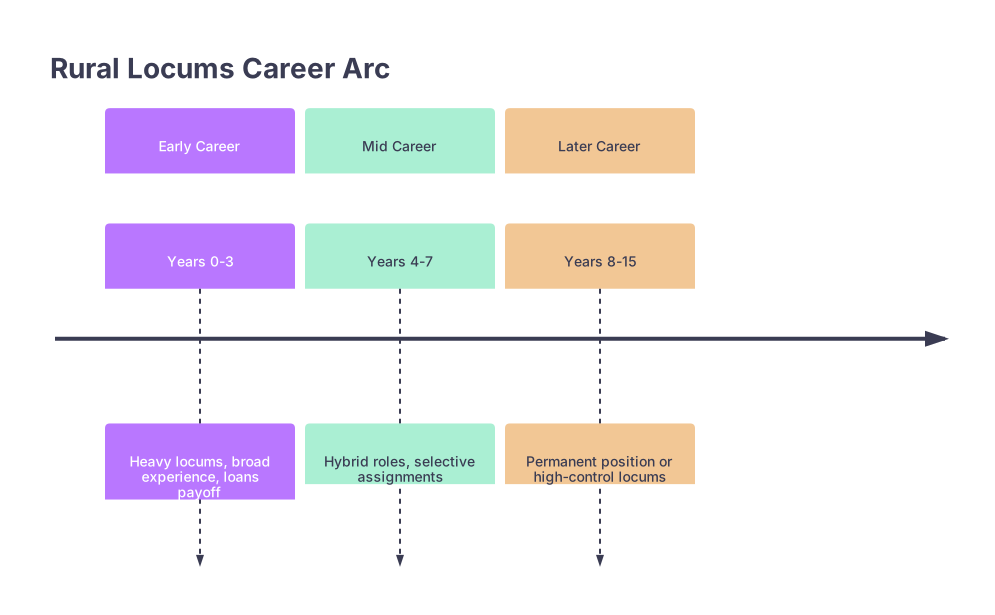
| Period | Event |
|---|---|
| Early Career - Years 0-3 | Heavy locums, broad experience, loans payoff |
| Mid Career - Years 4-7 | Hybrid roles, selective assignments |
| Later Career - Years 8-15 | Permanent position or high-control locums |
10. Red Flags That Should Make You Walk Away
You will be tempted to ignore these for a high rate. Do not.
Watch for:
- Vague answers about:
- Support staff
- Transfer times
- Night coverage
- “We had some issues with the last few docs” with no clear explanation
- No orientation or “you will just figure it out” attitude
- Unrealistic expectations:
- FM doc expected to run a full ED solo with frequent major trauma and no EM backup
- Chronic understaffing:
- One RN for ED + inpatient overnight with volumes that really need two or three
If something feels off on the phone, trust that. It is usually worse in person.
11. The Bottom Line: Is Rural Locums Actually Worth It?
For many physicians, yes. Clearly yes.
Rural locum assignments can:
- Accelerate your clinical growth more than any urban job in the same time frame
- Put real money in the bank fast
- Give you unusual autonomy and professional satisfaction when things go right
They also can:
- Expose you to higher-stakes decisions with less backup
- Drain you mentally if you stack too many 24s and high-acuity nights
- Create legal and reputational risk if you work in poorly supported systems
If you go in with clear eyes, good questions, a hard line on your limits, and proper malpractice coverage, rural locums can be one of the best early-career laboratories you will ever have.
Key Takeaways
- Rural locum work trades breadth and autonomy for thinner resources and higher individual responsibility. That is the core exchange.
- Your outcomes—clinical, financial, and psychological—depend far more on site selection and your personal practice limits than on the hourly rate.
- Used deliberately, 1–3 years of well-chosen rural locums can rapidly sharpen your skills, pay down debt, and set you up for either a strong permanent role or a sustainable long-term locums career.