
Telemedicine locums is the most under-explained, over-mythologized corner of the post-residency job market. People either romanticize it as “work from Bali on your laptop” or dismiss it as low-paid checkbox medicine. Both views are shallow. The truth sits in the details: licensure, documentation, and workflow. If you do not master those, tele-locums will eat you alive.
Let me walk you through how this actually works in practice, not in theory.
1. The Real Structure of Telemedicine Locums
Telemedicine locums is not one thing. It is several very different business models hiding under a single label. If you do not understand which one you are signing up for, you will be blindsided by expectations and workload.
At a high level, you see three broad models:
High-volume, low-complexity direct-to-consumer (DTC)
Think 5–8 minute visits. URI, UTI, contraception refills, simple dermatology, travel meds, COVID, “I need a work note.”Scheduled virtual clinics for systems or groups
15–30 minute visits. Chronic disease management, follow-ups, post-discharge, primary care continuity, psych med management.Asynchronous care (chart review, messages, e-consults)
Reviewing cases sent by other clinicians or patients. Often paid per case, not per hour.
Most “telemedicine locums” platforms push you into #1 or #3. Hospital-based virtual clinics are more often traditional locums agreements, just remote.
Why this matters: licensure, documentation burden, and workflow intensity look completely different in each model. A physician doing 30 quick DTC visits per hour needs a totally different setup than someone doing 5 complex virtual IM visits per hour for a health system.
2. Licensure: Where Telemedicine Locums Actually Lives or Dies
Licensure is not a minor admin detail. It is the main constraint on your earning potential and your scheduling flexibility. Ignore the recruiter who handwaves it with “we’ll help you get licenses.” That sentence has buried a lot of doctors.
The basic rule everyone forgets
You practice medicine where the patient sits, not where you sit.
If the patient is physically in Ohio, you are practicing in Ohio. You need an Ohio license, even if you are in Texas on your couch.
There are a few edge exceptions (federal systems like VA, DOD, some cross-border arrangements), but for commercial telemedicine, assume: patient’s state = required license.
The Interstate Medical Licensure Compact (IMLC): Helpful, not magic
The IMLC is heavily marketed to doctors but misunderstood. It does not give you a “national license.” It gives you an expedited path to multiple state licenses if your “state of principal license” participates and you meet certain criteria (board certification, clean record, etc.).
What it does do:
- Speeds background checks
- Reduces duplicate paperwork
- Lets you add multiple states off a single core packet
What it does not do:
- Waive state fees
- Make renewals automatic or synchronized
- Cover every state (big ones like New York and California are not in as of my last update)
For tele-locums, you use it to build a strategic cluster of licenses, not shotgun 20 random states.
Here is what actually works in practice:
| License Set | States Included | Typical Use Case |
|---|---|---|
| East Core | NY, NJ, PA, MA, VA | Northeast + Mid-Atlantic DTC |
| South Core | FL, TX, GA, NC, TN | High-volume DTC, retiree care |
| Midwest | IL, OH, MI, WI, MN | Systems-based virtual primary care |
You do not need all of this at once. But building a coherent region gives you:
- Larger patient pool on each platform
- More shift options
- Less dead time when one state has lower demand
How many licenses do you actually need?
Blunt answer: fewer than platforms will tell you, more than residency prepared you for.
Typical patterns I see that work:
- Starting out: 1–2 states (often your home state plus one tele-heavy state like FL or TX)
- Serious part-time tele-locums: 4–7 states
- Full-time, high-volume tele-locums: 8–15 states, obtained over 12–24 months
Beyond ~15, you drown in renewals unless you have a personal assistant or use a professional licensing service. And those services are not cheap.
Practical licensure timeline and sequencing
Do not let a platform dictate all your licensure sequencing. They want coverage everywhere. You need depth where you will actually work.
Use a simple, ruthless filter when choosing initial states:
- High telemedicine utilization
- Reasonable license processing times (<90 days)
- Not absurdly expensive (look at fees + required CME)
- Platform actually has volume there (ask directly: “What % of your visits are from X state last quarter?”)
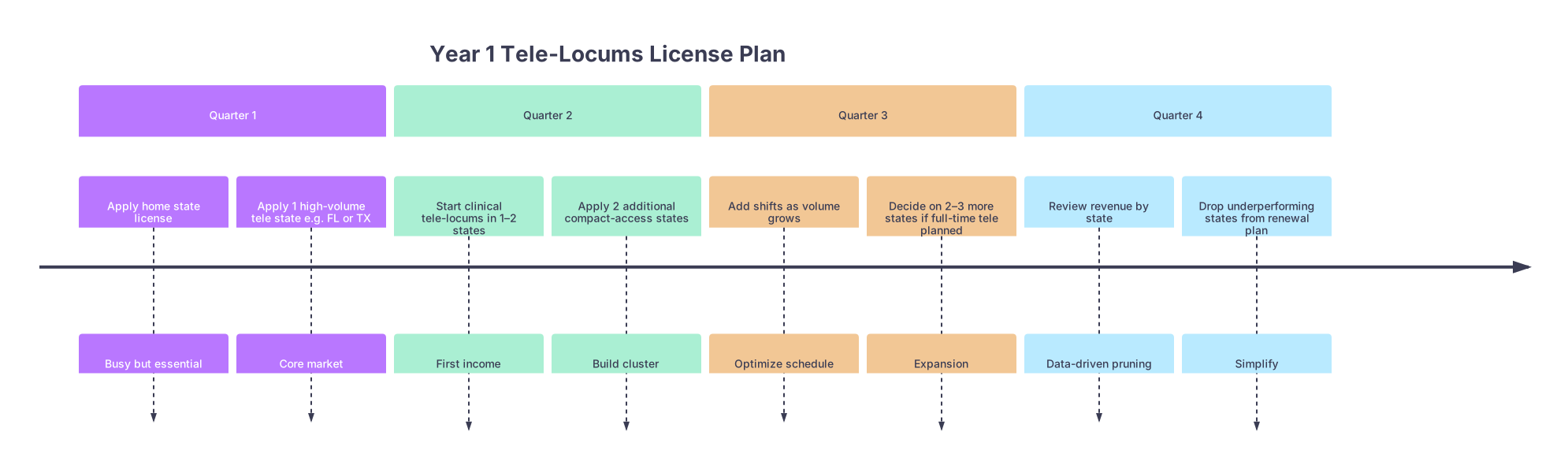
For tele-locums starting post-residency, a realistic rollout can look like this:
| Period | Event |
|---|---|
| Quarter 1 - Apply home state license | Busy but essential |
| Quarter 1 - Apply 1 high-volume tele state e.g. FL or TX | Core market |
| Quarter 2 - Start clinical tele-locums in 1–2 states | First income |
| Quarter 2 - Apply 2 additional compact-access states | Build cluster |
| Quarter 3 - Add shifts as volume grows | Optimize schedule |
| Quarter 3 - Decide on 2–3 more states if full-time tele planned | Expansion |
| Quarter 4 - Review revenue by state | Data-driven pruning |
| Quarter 4 - Drop underperforming states from renewal plan | Simplify |
Licensure is capital. Treat it that way. You do not buy every stock.
3. Credentialing, Enrollment, and the Boring Stuff That Delays Your First Dollar
You can have 10 licenses and still not bill a single visit if you are not credentialed with payers and the platform.
There are three overlapping processes you have to care about:
- State license (we covered)
- Platform or group credentialing
- Payer enrollment (commercial plans, Medicare/Medicaid)
How this plays out in tele-locums:
Pure DTC, cash-pay platforms:
Minimal payer enrollment. They bill the patient, you get an hourly or per-visit rate. Credentialing focuses on checking your licenses, DEA, NPDB, malpractice history.Insurance-based telehealth companies:
Heavier credentialing. They may panel you with multiple insurers in each state. That takes months, and your volume in a new state will be limited until payer enrollment matures.Health system virtual clinics:
Traditional hospital credentialing committees, privileges, sometimes medical staff interviews. Timelines similar to on-site locums.
From your side, you need to:
Keep a clean, updated CV in the exact format credentialing teams prefer (reverse chronological, no gaps, all license numbers, DEA, NPI, malpractice with coverage dates and limits).
Maintain a detailed “credentialing packet” ready to send:
- CV
- Copies of all licenses
- DEA certificates (main + any state-specific)
- Board certification certificates
- CME summary if required
- Malpractice face sheet
You do this once, then update. If you redo it every contract, you are wasting time and inviting errors.
4. Documentation in Telemedicine Locums: The Part Everyone Underestimates
If you think telemedicine means lighter charting, you are not paying attention to what payers and regulators are doing.
Telehealth charts need to do three things simultaneously:
- Prove the visit was clinically appropriate.
- Prove the visit was legally compliant (state rules, modality, prescribing).
- Justify the billed level (especially if using E/M codes with time or MDM).
In locums, you have almost no institutional memory to protect you. If your charts are sloppy, and something goes sideways, the platform will jettison you long before they litigate for you.
Core elements every telemedicine note must have
Here is the skeleton I teach residents who are transitioning into tele-locums:
Patient location and your location
- “Patient physically located in Ohio at time of visit.”
- “Provider located in Illinois.”
This matters for licensure and cross-state rules.
Modality
- Video vs audio-only vs asynchronous.
- Some states restrict what you can prescribe on audio-only.
Consent for telehealth
- Some platforms have e-consent. Document: “Verbal consent to telehealth obtained.”
- In some states, you must discuss limitations and alternatives.
Identity verification
- Especially DTC: “Patient identity verified with name, DOB, and address.”
Limitations of the exam
- You are not doing a full neuro exam by video. Say so.
- “Physical exam limited by telehealth format; no in-person vitals available.”
Clinical reasoning
- One or two sentences explaining why you think it is X and not Y.
- “Low suspicion for pneumonia given lack of dyspnea, normal respiratory effort on video, no focal symptoms, and overall well appearance.”
Safety netting
- Clear ED/urgent care triggers.
- Instructions on follow-up and red flags.
Those elements are not optional. They are your malpractice airbag.
Templates: Your real productivity multiplier
Tele-locums lives or dies on speed. You cannot write a bespoke essay for every URI or rash. But you also cannot rely on one generic note for everything; that looks copy-pasted and will burn you in an audit.
The sweet spot is building very specific templates inside the EMR or in an external text expander.
For example, for a classic DTC UTI visit, your template might pre-populate:
- Telehealth boilerplate (location, consent, modality)
- Focused ROS
- Typical physical exam phrases adapted for video
- Standard safety netting phrases
You then edit:
- Age, sex, pregnancy status
- Symptom duration and associated features
- Allergies, prior resistance patterns if known
- Local antibiotic resistance logic if platform provides it
You want 20+ micro-templates, not 3 generic ones. URI, UTI, conjunctivitis, COVID, rash, back pain, med refill, ER follow-up, psych med follow-up, etc.
If the platform’s EMR makes this hard, use a text expander (PhraseExpress, TextExpander, AutoHotkey scripts, whatever). The difference between typing 600 characters vs 60 is your sanity over a 4-hour shift.
5. Workflow: How a Tele-Locums Shift Actually Runs
This is where glossy marketing materials lie the most. A “4-hour telemedicine shift” can feel like 90 minutes of work or like being shotgun-blasted with 60 patients. Depends entirely on the platform’s model and how you structure yourself.
Let me break down the main workflow models you will see.
Model 1: On-demand queue (high-volume DTC)
You log into the platform, toggle “available,” and patients appear in your queue. You may:
- See a new patient appears as soon as you clear the prior one
- Have some ability to “snooze” or pass certain cases
- Have a time limit to pick up each new arrival before it routes to someone else
A typical “busy” shift might be:
- 20–30 visits in 4 hours for relatively quick cases
- Each visit 5–8 minutes of face time, 2–3 minutes of documentation
The trap: if you chart entirely after the visit, you will fall behind by the second hour.
The better pattern:
- Document in real time, with patient still on screen, using templates.
- Use your last 30–60 seconds of the encounter to summarize plan while clicking through orders.
- When you click “end visit,” the note is 90% done.
Anything beyond 10 minutes of post-shift charting per hour of clinical time is a red flag that your workflow is inefficient or the platform is dumping higher complexity than advertised.
Model 2: Scheduled clinic blocks (systems, group practices)
Here, you have pre-booked patients, usually 15–30 minute slots. Types:
- Virtual primary care
- Virtual urgent care linked to a system
- Psych / psych NP supervision
- Endocrine, rheum, or other niche follow-up tele-clinics
Pros:
- Predictable volume
- Better pre-visit data (prior notes, meds, labs)
- Complex but satisfying clinical work
Cons:
- Documentation looks more like standard outpatient notes
- You may have inbox messages, refill tasks, orders to reconcile
- Less flexibility to “log off” if you are tired
For locums, ask explicitly: “Am I responsible for inbox / refills / lab results outside of my scheduled patient visits?” Too many people skip this question and then spend unpaid hours chasing labs and messages.
Model 3: Asynchronous work (e-consults, messaging, chart review)
These are cases where you:
- Review a chart and answer a clinical question
- Respond to secure patient messages with treatment plans or advice
- Provide e-consults for PCPs about specialty questions
These are often paid per case, not per hour. For example:
- $10–$25 per message or low-complexity case
- $30–$75 per complex e-consult
The mistake: physicians underestimate how long some cases will take. A “simple” dermatology photo review can metastasize into reviewing 3 years of treatment history and writing a detailed rec.
Track your time per case type. Ruthlessly. If a platform’s “average” rate works out to $80/hour but your reality is $35/hour, drop it.
6. Technology Stack and Physical Setup: This Is Part of Your Workflow
If you are working tele-locums on a single small laptop from your couch, you are handicapping yourself. This is not glam, it is ergonomics.
Minimum viable setup I’d consider “professional”
Dual monitors
- One screen for video + EMR
- Second for references, protocols, and messaging
Wired internet or very stable high-speed WiFi
- Video visits die fast on unstable bandwidth
- If your connection repeatedly drops, platforms will stop offering you prime shifts
Quality headset or microphone
- Patients will forgive slightly grainy video faster than they will forgive choppy, echoing audio.
Clean, neutral background and lighting
- You are still “the doctor.” Sitting in a dark bedroom corner cheapens that fast.
Secure environment
- No roommates walking behind you, no PHI on screen visible to others.

Software and logins
You will quickly accumulate:
- 1+ EHR logins per platform
- Separate prescribing platforms (eRx, PDMP portals)
- Internal messaging tools (Teams, Slack, proprietary chat)
Do not store passwords on sticky notes or in your phone photos. Use a proper password manager with 2FA.
The other hidden time sink: PDMP (prescription monitoring) queries. Some states require PDMP checks before prescribing controlled meds, even via tele. You need logins for each relevant state PDMP and a way to access them fast.
7. Malpractice, Prescribing, and Risk Management Details
Telemedicine malpractice is not fundamentally more dangerous than in-person, but it is different. The biggest risks cluster in a few predictable areas:
- Missed serious infections because you trusted reassuring video vitals
- Inappropriate antibiotic prescribing patterns flagged by payers
- Controlled substance prescribing across state lines with patchwork rules
- Mental health crises poorly triaged by video
Malpractice coverage in tele-locums
You want:
- Claims-made or occurrence policy that explicitly covers telehealth in all states you practice
- Adequate limits (commonly 1M/3M, sometimes 2M/4M depending on environment)
- Tail arrangements clearly stated for claims-made coverage
Many telehealth platforms provide coverage. Read the policy summary. Specifically:
- Are you covered for care delivered to out-of-state patients when you are not physically in that state? (You should be, but confirm.)
- Are there carve-outs for controlled substances or mental health?
- What is your obligation to notify them of potential claims or board complaints?
Do not rely on vague assurances like “we cover you.” Ask for the certificate and summary.
Prescribing: where people get themselves in trouble
Controlled substances are the minefield. Rules have been a moving target with COVID-era waivers and then partial rollbacks.
General principles:
- Assume you need a DEA registration for each state you prescribe controlled substances in, unless a very specific tele-exception applies and you have confirmed it with the platform’s compliance team.
- Some states have explicit prohibitions on initial controlled-substance prescriptions via tele alone, or require an in-person evaluation within a certain timeframe.
- For psych telehealth, confirm whether you are expected to prescribe stimulants, benzos, or only certain classes. Many platforms now restrict full-schedule prescribing because they do not want the regulatory heat.
For antibiotics and “simple” meds, your main risk is pattern-based:
- If an insurer or regulator sees that 95% of your URI visits get azithromycin, you will be on someone’s radar.
- Many platforms now provide internal guidelines and antibiotic stewardship prompts. Follow them unless you have a very clear reason not to, and document that reason.
8. Time, Money, and Reality: How Tele-Locums Fits into a Post-Residency Career
Telemedicine locums can:
- Replace a full-time job
- Supplement a part-time clinical role
- Serve as a bridge between positions
- Provide geographic flexibility for two-physician households
What it should not be is a financial mystery.
You must be able to answer one question:
“On platform X, with licenses A/B/C, working Y hours per week, what is my realistic hourly effective rate including documentation time?”
To get there:
Track a representative week
- Total clinical hours logged in the platform
- Total patients seen, per state if possible
- Total after-hours / post-shift documentation time
Calculate:
- Revenue (platform pay, flat hourly or per-visit)
- Divide by total time (clinical + documentation) = effective hourly rate
Re-evaluate every 3–6 months and adjust:
- Drop low-yield platforms
- Drop underutilized licenses on renewal
- Shift toward the model (DTC vs scheduled vs async) that gives you the best mix of income and sanity
| Category | Value |
|---|---|
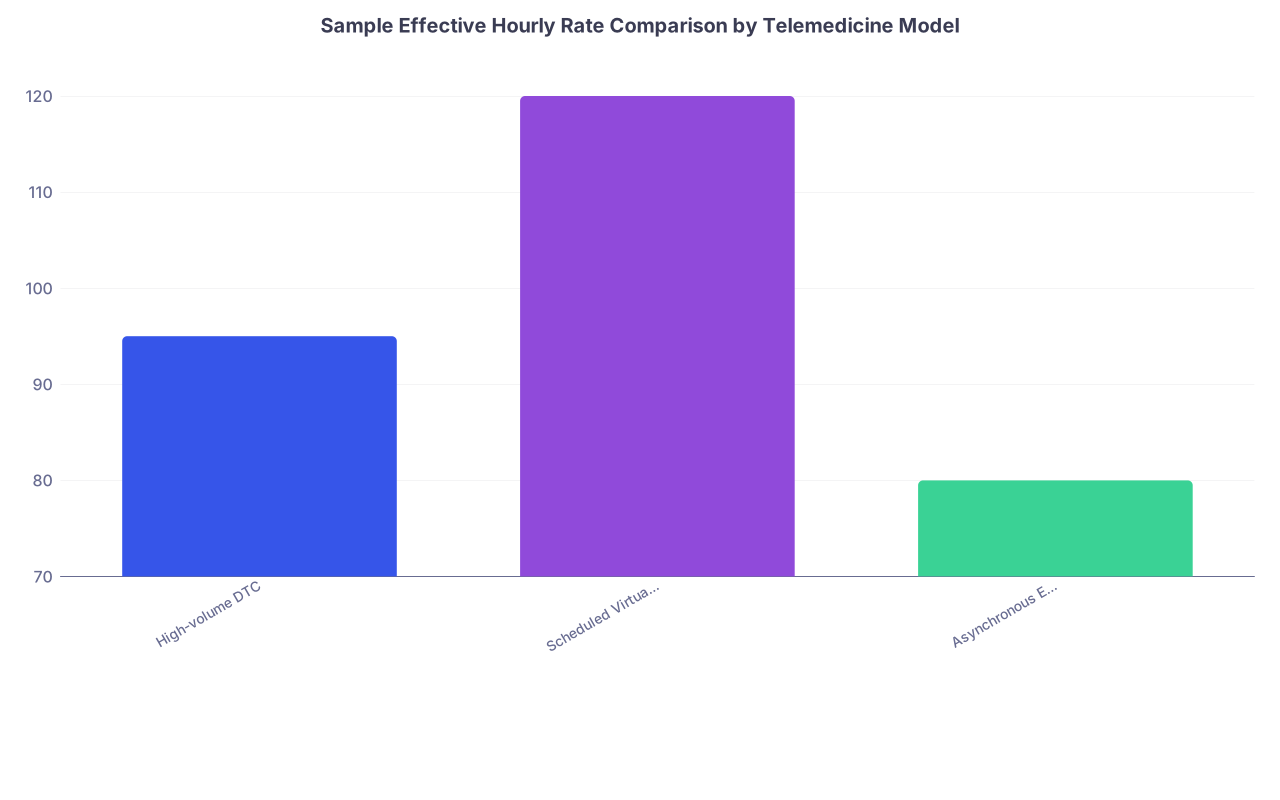
| High-volume DTC | 95 |
| Scheduled Virtual Clinic | 120 |
| Asynchronous E-Consults | 80 |
Those numbers are examples, not promises. I have seen ranges from $50/hour net (after reality adjusts your “20 visits per hour” fantasy) up to $200+/hour in niche subspecialty tele-consults.
9. Putting It All Together: Building a Functional Tele-Locums System
Let me give you a clean mental checklist. If you cover these, you are already ahead of most people jumping into tele-locums blind.
Licensure and credentialing:
- 3–7 strategically chosen states to start, expanding only if volume and pay justify it
- IMLC used surgically, not as a vanity project
- Centralized credentialing packet kept updated quarterly
Documentation:
- Standard telehealth boilerplate in every note (location, modality, consent, limitations)
- 20+ targeted templates or text snippets for common visit types
- Charting done in real time, with minimal post-shift backlog
Workflow and setup:
- Dual-monitor workstation, decent audio, stable internet, neutral background
- Password manager and fast access to PDMP + reference tools
- Clear understanding of whether shifts are queue-based or scheduled, and what “full” really looks like in visit volume
Risk and prescribing:
- Malpractice coverage that explicitly covers telehealth in all your licensed states
- Explicit boundaries on controlled-substance prescribing, written down and adhered to
- Antibiotic and high-risk medication patterns that would look reasonable to an auditor
Career and finance:
- Actual tracked effective hourly rate per platform
- Periodic pruning of low-yield states and contracts
- A written plan for how tele-locums fits with (or replaces) traditional clinical roles

Three points to leave with:
Telemedicine locums is not casual side-gig work; it is a system. Licensure, credentialing, documentation, and workflow have to be designed, not improvised.
Your real leverage is not downloading more apps. It is building tightly honed documentation templates, a ruthless license strategy, and a physical setup that lets you work fast without cutting corners.
If you treat the details with respect from day one, tele-locums can be a flexible, high-control part of your post-residency career instead of an exhausting, low-margin grind. The difference is not luck. It is workflow.