
The biggest mistake locum physicians make is treating “academic” and “community” as meaningless labels. They are not. They determine your teaching load, research expectations, and how ugly your call nights get.
Let me break this down specifically, because this is where post‑residency locums either design a great life—or get chewed up.
1. What “Academic” vs “Community” Locum Actually Means
Most recruiters throw these words around like marketing buzz. You cannot afford to do that.
Here is the functional definition that matters for you as a post‑residency locum:
- Academic locum: You are plugging into a teaching service at a university‑affiliated hospital or large academic center. Residents and students around. Conferences on the schedule. Research infrastructure in the background, whether you care or not.
- Community locum: You are covering clinical service at a non‑academic or minimally academic hospital or clinic. Teaching is limited or optional. The focus is throughput, coverage, and service lines staying open.
That sounds obvious, but here is the subtle truth: the same specialty in those two environments feels like two different jobs.
| Aspect | Academic Locum | Community Locum |
|---|---|---|
| Main focus | Teaching & complex care | Volume & access |
| Research | Available, rarely required | Rare, usually absent |
| Call style | Often in-house, teaching-based | Home call or solo coverage |
| Documentation | Teaching notes, longer | Short, billing-focused |
| Autonomy | Moderate, team-based | High, often solo or small team |
You are not choosing “type of hospital.” You are choosing:
- How many people watch and question your decisions.
- Whether “call” means sleeping with a pager or running a code with a swarm of learners watching you.
- Whether your nights are about stabilizing high‑acuity referrals, or cranking through 20 low‑acuity ED consults for dispo.
This is not philosophical. It is about how your day and night actually feel.
2. Teaching: What You Really Do (and Do Not Do) In Each Setting
Everyone says they “like teaching.” Then they get to an academic locum gig and discover what that sentence costs at 7:30 AM.
Academic Locum: Teaching Is Built Into Your Day
If you sign on to an academic locum, assume you are stepping into a teaching role by default. Even if the recruiter says, “You’re mostly just clinical.”
Here is what that usually translates to:
Morning:
- Pre‑round on complex patients yourself or skim the list.
- Sit through or lead a formal workroom table round with residents, interns, medical students.
- Answer “why” questions every 5 minutes. If you hate explaining your thought process out loud, you will suffer.
Midday:
- Bedside teaching on 1–3 key patients.
- You will often be the one demonstrating tough conversations, complex physical exams, or decision‑making tradeoffs.
- Students and interns trail behind you, taking notes, then writing their own documentation which you must correct and co‑sign.
Afternoon:
- Case discussions.
- Maybe noon conference; you attend, sometimes you are voluntold to present if the locum stay is long enough.
- Endless “can I run this by you real quick?” hallway consults from residents.
What this means pragmatically:
- Your patient‑per‑day load can look lighter on paper (say 10–14 instead of 16–20 for hospitalist), but your time‑per‑patient is higher because of teaching overhead.
- Your documentation is a mix of your own attending notes + reviewing and editing resident/student notes. That takes cognitive energy.
- You will occasionally be the “bad cop” and tell learners to move faster, or to drop nonessential details from presentations. That is part of the job.
If you thrive in that environment—if you like explaining why you are stopping a medication or changing an antibiotic—academic locums can be incredibly satisfying. You are not just churning; you are shaping how medicine is practiced.
If you are burned out from residency and want silence and autonomy? This is the wrong sandbox.

Community Locum: Teaching Is Opportunistic or Nonexistent
Community locum work, by contrast, usually treats teaching as a side effect, not the main product.
Common patterns:
No formal trainees: Many small community hospitals do not have residency programs. You are teaching nurses, APPs, maybe a new grad PA—informally and quickly.
Hybrid sites: Some “community teaching hospitals” have a family medicine or transitional year program. Teaching then looks like:
- Quick case reviews instead of long bedside teaching.
- Occasional noon talk if you are there long enough.
- Supervision of 1–2 residents who mainly function as extenders.
Clinic‑based locums: If you are in outpatient IM/FM/EM urgent care:
- Teaching is minimal. Maybe a student shadows for a week.
- Your value to the site is volume and access, not education.
Now the trade‑off that matters to you: community locums usually pay more per unit of effort for the same or less teaching.
In a pure community hospitalist locum, you might:
- See 16–20 patients per day
- Have no structured teaching obligations
- Spend your brainpower on clinical decision‑making and logistics, not on pedagogy
For someone just out of residency who is already exhausted from endless chalk talks and evaluations, community locums can feel like a relief. Straightforward: see patient, document, dispo, go home.
The risk: if you like teaching and you let that muscle atrophy for 2–3 years of pure community locums, it is harder to pivot back to academic jobs. Chairs will wonder what you have been doing besides billing.
3. Research: The Reality for Locum Physicians (Not the Fantasy)
If you think choosing academic locums automatically plugs you into serious research, you are overestimating how much institutions invest in temporary physicians.
Academic Locum: “Research Opportunities” Are Mostly Optional and Light
What actually happens in most academic locum gigs:
- Your contract explicitly says: no formal research requirement.
- Because you are temporary. They cannot build core trials or grants around someone who might leave in three months.
- You may have:
- Access to IRB infrastructure
- Access to statisticians and databases
- Students or residents eager for projects
But nobody is forcing that on you.
The typical academic locum research reality:
Short‑term case reports or small QI projects:
- Example: “Recurrent GIB in LVAD patients” case series you help a fellow polish.
- Or you help residents write up an interesting case you saw together.
Author by association:
- If you stay >6 months, you might get pulled into an ongoing project as a co‑author.
- Your role is often data collection, chart review, or minor drafting.
No protected time:
- True FTE academic attendings negotiate 10–40% protected time for research.
- As a locum, 99% of the time you are 100% clinical. Any research is after hours or squeezed between notes.
So, academic locums can keep your CV alive—abstracts, posters, case reports—but it will rarely give you heavy‑duty, grant‑driven research unless you negotiate a custom, long‑term contract. And those are rare.
If you are thinking, “I want to be R01‑funded faculty,” locums is the wrong primary pathway. Use academic locums as a bridge year, not a research career base.
Community Locum: Research Is Mostly Off the Table
Community facilities occasionally advertise “quality improvement” or “clinical research,” but for locum physicians, that is usually smoke.
The community locum research reality:
- No IRB structure you can tap easily.
- No time. Service coverage is why you are there.
- If there is any research, it is often:
- Industry‑sponsored device or drug trials run by a permanent specialist.
- Your role? Maybe signing an order, following a protocol, but not designing or publishing.
For most post‑residency physicians, this is fine. Many of you are done with research.
But be honest with yourself: if you plan to return to a research‑heavy academic job in 2–3 years, a pure community locum stretch will leave a multi‑year hole in your scholarly output. Hiring committees notice.
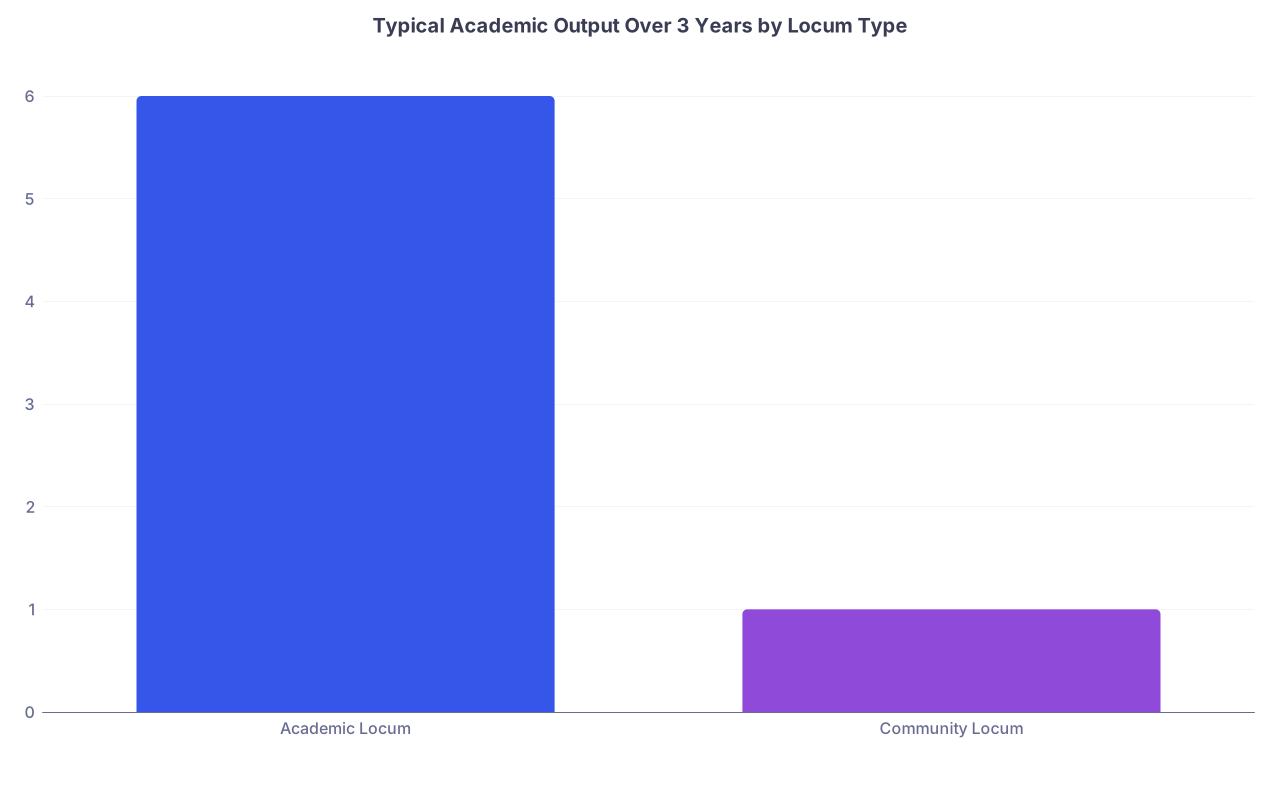
| Category | Value |
|---|---|
| Academic Locum | 6 |
| Community Locum | 1 |
Interpret that: over a 3‑year period, a serious academic‑minded locum in an academic hospital might help with a handful of posters/abstracts/case reports. A pure community locum might get one piece out—or none—unless you hustle independently.
4. Call: The Part Everyone Underestimates
Call will make or break whether you actually enjoy a locum assignment. The way call is structured in academic vs community settings is not the same.
Academic Locum Call: High‑Acuity, Team‑Based, Often In‑House
When you hear “academic call,” think of three core patterns:
In‑house call as supervising attending
- You are physically present in the hospital overnight.
- Residents or fellows are the first line.
- You are called for:
- ICU admissions
- Complex codes
- High‑risk decisions (pressors, intubations, surgical emergencies)
It can be brutally busy in high‑acuity centers. But you are not alone. There is usually:
- Backup in other specialties
- Residents who can do procedures
- A culture of asking for help
Home backup call with resident frontline
- You sleep at home, but residents cover the floor or ED.
- You come in for:
- Big decompensations
- Complex admissions that need attending presence
- Procedural backup
This feels lighter, but remember: academic hospitals get the sickest regional cases. When they call you at 2 AM, it is not for a simple UTI.
Subspecialty call (cards, GI, pulm, neuro, etc.)
- Fellows may be involved, or not, depending on program.
- You frequently take shift‑style call:
- 24‑hour call with in‑house fellow, you at home.
- Or night float attending shifts covering certain services.
The upside:
- More hands. More brains. Residents, fellows, RT, NICU/PICU/ICU teams.
- Teaching call: you walk through cases with learners, which can be intellectually satisfying.
The downside:
- Sleep can be garbage, especially at high‑volume quaternary centers.
- You answer “why” at 3 AM, not just “what.”
- You may still have clinic or full service the next day. Some academic sites are atrocious about post‑call relief for locums.
Community Locum Call: More Autonomy, More Silence—or More Isolation
Community call looks simpler on paper and much more brutal in practice if you are not prepared.
Common setups:
Home call with solo responsibility
- You cover the whole small hospital at night.
- No residents. Maybe one PA or NP if you are lucky.
- You answer:
- All floor calls
- ED admits
- Codes
- Sometimes cross‑cover for multiple services (yes, it happens)
In‑house call as the only in‑house doc for your service
- Example: community OB/GYN locum on L&D alone at night with CNMs or nurses.
- You do:
- All emergent surgeries
- All deliveries needing physician involvement
- All emergencies with no subspecialist backup
-
- You are the ED.
- No residents. Occasionally an APP.
- Community call here is volume + resource limitation:
- Limited imaging
- No in‑house CT tech after midnight
- No MRI period
- Transferring out strokes or STEMIs
For some physicians, this is ideal. Maximum autonomy. Clean decision‑making. No endless discussions with a giant team.
But there are real risks:
- Clinical risk: fewer resources, fewer backups.
- Medicolegal risk: tough transfers, poor follow‑up infrastructure.
- Personal risk: extreme fatigue if post‑call days are not protected.
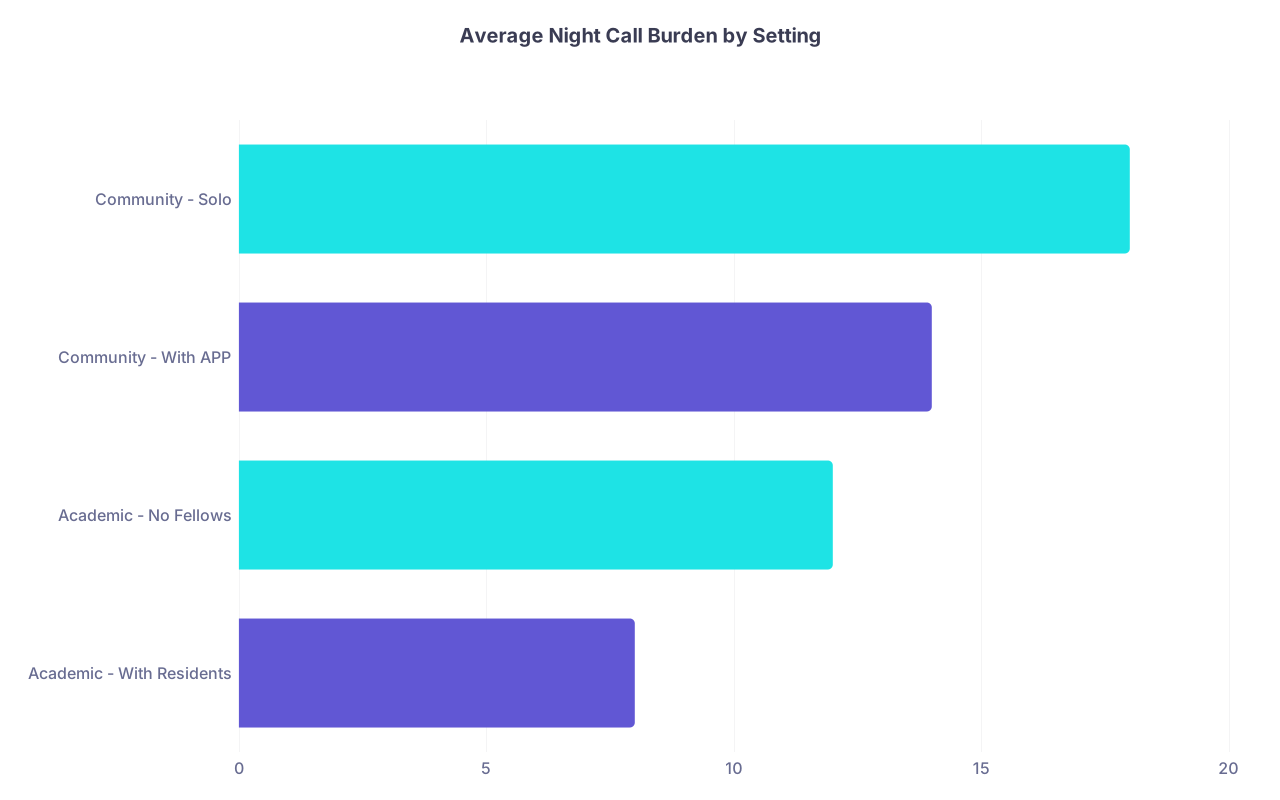
| Category | Value |
|---|---|
| Academic - With Residents | 8 |
| Academic - No Fellows | 12 |
| Community - With APP | 14 |
| Community - Solo | 18 |
Interpret that as “average significant overnight contacts / tasks.” A solo community call can easily be double the actual labor of a resident‑buffered academic call, even if the case mix is “simpler.”
5. How These Differences Shift Pay, Lifestyle, and Skill Maintenance
You are not just choosing environment. You are choosing which skills you sharpen, which you neglect, and how much you get paid to do it.
Pay: Why Community Usually Wins, and When Academic Competes
In raw numbers, community locum work typically pays more per hour or per shift.
Why:
- Community hospitals are desperate for coverage.
- They cannot lure fellows and academics easily.
- Many are in less desirable locations.
| Specialty | Academic Locum | Community Locum |
|---|---|---|
| Hospitalist | $1,200–1,800 | $1,600–2,500 |
| General IM clinic | $900–1,300 | $1,200–1,800 |
| EM (mid-volume) | $180–230/hr | $220–320/hr |
Exceptions where academic can compete or beat community pay:
- Niche subspecialties (interventional cards, EP, IR, neurosurg).
- High‑acuity academic ICUs that cannot staff enough intensivists.
- Short‑notice coverage for large teaching services before accreditation visits.
But in broad strokes: if your top priority is maximizing income quickly post‑residency, pure community locums win most of the time.
Lifestyle and Burnout Risk
Academic:
- Cognitive load: high.
- Emotional load: explaining, mentoring, grading, feedback.
- Support: strong (teams, consultants, resources).
- Burnout risk: comes more from politics and constant teaching than from sheer isolation.
Community:
- Cognitive load: depends on case mix; often lower acuity but more volume.
- Emotional load: can be heavy due to moral distress—limited resources, unsafe discharges, social issues with no easy fix.
- Support: can be thin, especially at night.
- Burnout risk: comes from isolation and feeling like the system is papering over staffing problems with your presence.
You will also maintain different skill sets:
Academic locum:
- Up‑to‑date with guidelines.
- Comfortable managing rare and complex cases.
- Excellent at explaining reasoning, leading teams.
Community locum:
- Fast, efficient decision‑making with limited info.
- Pragmatic “what is safe enough” judgment.
- Comfortable working without much backup.

Neither is “better.” But they are very different careers over five years.
6. How to Choose: Matching Your Goals to the Right Locum Environment
You are post‑residency, staring at job boards, half‑annoyed, half‑exhausted. Here is how I would match goals to roles if you were sitting across from me.
If You Want a Future Academic Career
You should lean toward academic locum roles if:
- You plan to apply for a faculty position in 1–3 years.
- You enjoy teaching enough that it energizes rather than drains you.
- You want at least a trickle of scholarly output during your locums years.
What to prioritize in contracts:
- Long enough assignments (3–6 months blocks) to build relationships and maybe join small projects.
- Explicit expectation that you will be involved in teaching residents/students.
- Clarify:
- Whether you can attend/teach conferences.
- Whether you can co‑author work with residents.
- How complex the call will be and what post‑call looks like.
Academic chairs looking at your CV will care that:
- You stayed connected to teaching.
- You did not disappear from all scholarly work.
- Your references mention you as a strong clinician‑educator, not just “showed up, did shifts, left.”
If You Want Income, Flexibility, and Less Academic Overhead
Go community locum if:
- You want to pay off loans fast.
- You are tired of academic politics and evaluations.
- You are okay with largely stepping away from research and formal teaching.
What to prioritize:
Clear call structure spelled out in writing:
- Number of nights per month
- In‑house vs home
- Expected census and admit volume
- Post‑call days off or not
Realistic patient caps. “We usually see 14–16” often means 18–20 on bad days.
Documentation expectations:
- Are you writing everything yourself?
- Any scribes or APP support?
If you think you might return to academic medicine later, be intentional. Maintain minimal academic activity:
- Help with one multi‑center paper remotely with an old mentor.
- Present a virtual grand rounds.
- Keep some evidence you still function in an academic mindset.
If You Are Truly Unsure
The smartest move for the first 12–18 months post‑residency is often hybrid exposure:
- 1–2 academic locum assignments (3 months each)
- 1–2 community locum assignments (4–8 weeks each)
Then compare honestly:
- Where did you feel less dread driving into work?
- Where did you feel like you were using your best skills?
- Which call structure wrecked you, and which felt sustainable?

| Step | Description |
|---|---|
| Step 1 | Start - Post residency |
| Step 2 | Prioritize academic locum |
| Step 3 | Prioritize community locum |
| Step 4 | Community or hybrid roles |
| Step 5 | Clarify teaching and call expectations |
| Step 6 | Future academic career? |
| Step 7 | Need maximum income? |
| Step 8 | Value teaching? |
Do not let a recruiter decide this for you by “what is available.” Your first locum year imprints your habits and expectations more than you think.
7. Red Flags and Green Flags When Reviewing Locum Postings
This is where people get burned because they did not read between the lines.
Academic Locum Red Flags
“You will supervise residents” with no mention of support:
- Who backs you up?
- Is there an ICU attending at night?
- Are there fellows, or are you de facto tri‑subspecialist?
“Educational commitment” without specifics:
- Does this mean one noon talk per month or weekly lectures?
- Are you responsible for evaluations?
- Are you part of CCC or promotions committees? (You should not be as locum.)
“Strong research culture” + pressure to take on projects:
- Fine if you want it.
- A trap if you are there for 3 months and have no protected time.
Community Locum Red Flags
“Reasonable call” without numbers. Always pin this down:
- How many new admits per night?
- Average number of pages?
- Code volume?
- On busiest nights in last month, what did call look like?
“We are like a family” at a hospital that has cycled through multiple locums in one year. Translation: boundary problems, poor staffing, or toxic culture.
“You are the only doctor in house at night” with no mention of tele‑ICU, tele‑stroke, or backup.

Green flags, regardless of setting:
- They can tell you exactly who is on with you at night by role and number.
- They answer questions about worst‑case nights honestly.
- They are clear that as locum, you are not being shoved into long‑term committee or admin roles.
8. Putting It Together: Designing a Locum Path That Actually Makes Sense
The point is not that academic is “good” and community is “bad,” or vice versa. The point is misalignment.
Typical mismatch scenarios I have seen more times than I like:
New graduate who craves income and quiet signs up for an academic hospitalist locum at a big center.
- They burn out on endless rounds, late‑running table talk, and tough call.
- They wonder why they are still making only mid‑range pay with high stress.
Resident who loved teaching and thought they wanted to be faculty signs pure community locums for the higher rate.
- Two years later, CV is thin on teaching and empty on research.
- They struggle to land the faculty job they originally wanted.
EM doc who loved fast decision‑making but trained at a high‑resource academic shop jumps into understaffed rural ED locums with no backup.
- They feel unsafe transferring critical patients with limited ICU, no specialists.
- They are clinically capable but hate the constant resource battles.
You do not need to guess. You can structure locum work deliberately:
Define your 3–5 year goal:
- Pure income?
- Transition to faculty?
- Geographic flexibility and lifestyle?
Choose academic vs community locum dominant mix based on that.
Within that, drill every posting about:
- Teaching load (students? residents? conferences?).
- Research expectations (none vs optional).
- Call structure (who, where, how often, worst night story).
Test and adjust. If your first assignment is a mismatch, finish the contract, learn from it, change course. Do not double down out of inertia.
Locum work can be an escape hatch, or it can be a launchpad. The distinction often comes down to whether you understand exactly what “academic” and “community” really entail in teaching, research, and call—before you sign.
You have the basics now. The next step is more tactical: how to dissect an actual locum contract line by line, and push back on the terms that quietly wreck your nights and your future options. But that is a story for another day.