It is 02:37 on a Tuesday. You are in a call room that is not really a room—more like a storage closet with a bed. You are the locum intensivist covering a 24‑bed mixed med-surg ICU in a hospital you have worked in exactly one other time. The nurse calls: “Hey doc, bed 12 just dropped their pressure, MAP in the 40s, pressors already maxed, family is here and wants to talk. Also, can you come pronounce in bed 5?”
This is the reality you are walking into with locums critical care work. It is not abstract. It is bodies in beds, unfamiliar EMRs, half-known nurses, and almost always, some version of “we are short-staffed; thanks for coming.”
Let me break this down specifically: if you are thinking about locum intensivist work post-residency or post-fellowship, you must understand three things in painful detail:
- How different ICU staffing models actually function when you are the outsider.
- What “night coverage” really means in each model—who is in-house, who is at home, and who is drowning.
- How risk shifts onto you—clinical risk, legal risk, reputational risk—with each combination of model, coverage pattern, and hospital culture.
We are going into all three. Deeply.
The Core ICU Staffing Models You Will See as a Locum
The advertisement never says: “We have a chaotic, unsafe hybrid ICU model and we need you to plug the holes so we do not get sued.” It says: “24‑bed ICU, collegial group, APP support, competitive compensation.”
Under that fluff live a small handful of real models. If you cannot recognize them from the interview and contract, you are volunteering to be surprised at 3 a.m.

1. Closed ICU with 24/7 Intensivist Coverage
This is the cleanest model on paper.
Definition: All ICU patients are under the intensivist service as attending of record. Primary teams (medicine, surgery, etc.) may follow, but orders and minute-to-minute management are controlled by the ICU team.
Variants:
True 24/7 in-house intensivist:
Typically academic or large tertiary centers.
Day: 1–2 intensivists plus fellows/APPs.
Night: 1 intensivist in-house, sometimes with residents or APPs.Daytime intensivist + in-house nocturnist NP/PA with intensivist on home call:
Community, “semi-closed.” Intensivist signs out to NP/PA, available by phone, may or may not come in for procedures or deteriorations.
As a locum:
- You may be the day doc (rounder) or the night doc (solo or supervising APPs).
- Expectations are usually pretty specific: census caps, admitting responsibilities, consults from ED/wards.
Upsides:
- Clear lines of authority—everyone knows the ICU owns the patient.
- Usually protocols: sepsis bundles, vent weaning, sedation, etc.
- Documentation and workflows are standardized.
Downsides:
- High volume and acuity. You are managing everything.
- If you are nights, you may be hit with constant cross-coverage and all new admits.
- The “closed” label sometimes hides heavy cross-cover (e.g., overflow step-downs, post-ops).
Risk angle:
- Better for clinical safety if staffed properly because ownership is clear.
- Your name is on all of it, though, so if it is understaffed, you own that too.
2. Open ICU
Definition: Primary teams (hospitalist, surgeon, cardiologist, etc.) retain attending status and write orders. Intensivist is a consultant—sometimes strictly consultative, sometimes “quasi-managing” via soft pressure.
Variants you see:
- “Consult on all ICU patients, but we keep attending of record.”
- “We only call you for vented or ‘sick’ patients.”
- “You round with us but we sign and bill.”
As a locum intensivist:
- You often get pulled into messy situations: “Doc, can you just clean this up?”
- You may be asked to perform procedures only, with minimal say in overall care.
- You may be consulted late, after they have already made several missteps.
Upsides:
- Fewer patients are formally “yours.”
- Sometimes less documentation burden—shorter consult notes, fewer progress notes.
Downsides:
- Fragmented care. Conflicting orders.
- Surgeons who do not want their vent weaned or their pressors touched.
- Hospitalists who are uncomfortable but won’t relinquish control.
Risk angle:
- High medico-legal risk if your recommendations are ignored or partially implemented.
- Documentation is your shield: clear, time-stamped, and specific.
- You carry “apparent authority” if staff think “the ICU doc saw this” even when you were sidelined.
3. Hybrid / Semi-Closed ICU
This is the most common and the most misrepresented.
Definition: Some patients are under ICU service (vented/very sick), others remain with primary teams but are physically in the unit. The ICU may or may not be automatically consulted.
Examples:
- Post-op surgical patients stay under surgery; ICU only manages vents and pressors “informally.”
- Neuro or cardiology keeps certain patients; ICU covers the rest.
- Step-down or “progressive care” beds embedded within the ICU footprint, sometimes under hospitalist control.
As a locum:
- You constantly ask: “Whose patient is this?”
- Nurses call you because you are physically present, even when you are not the attending.
- Boundaries blur: you are asked for curbside advice that becomes “ICU recommended X.”
Upsides:
- Slightly lower census under your direct care (in theory).
- May allow you to prioritize the sickest and leave stable post-ops alone.
Downsides:
- Confusion at 2 a.m. when the crashing patient technically “belongs” to someone at home.
- Moral distress when you see bad plans but have limited authority.
- Chaos during high volume situations (multiple codes, RRTs).
Risk angle:
- Documentation and communication become everything.
- You must explicitly define your role for each patient in the note and in sign-out:
“Consultative role only—primary team retains orders and disposition.”
What “Night Coverage” Actually Means
The phrase “night coverage” in a locums ad is almost meaningless. You have to dissect it.
 only, no onsite intensivist](https://cdn.residencyadvisor.com/images/articles_svg/chart-common-icu-night-coverage-models-2383.svg "Common ICU Night Coverage Models")
| Category | Value |
|---|---|
| In-house intensivist | 35 |
| In-house APP, intensivist at home | 30 |
| Cross-cover hospitalist with intensivist backup | 20 |
| [Tele-ICU](https://residencyadvisor.com/resources/locum-tenens-guide/telemedicine-locums-licensure-documentation-and-workflow-details) only, no onsite intensivist | 15 |
That chart is roughly what I see in the U.S. market now: a spectrum from well-staffed academic centers to “please God send us anyone who can manage a vent.”
1. True In-House Night Intensivist
You are in the building. That matters.
Setup:
- You admit new ICU patients from ED/OR/ward.
- You cross-cover existing ICU patients.
- You may supervise residents, fellows, or APPs.
- Sometimes you also cover step-down or floor RRTs.
Red flags:
- “You are the only doc in the whole hospital at night.”
- “We do about 15 admissions on a busy night.”
- “The ICU is technically 24 beds, but we flex up to 32 with hallway beds.”
What it feels like:
- Busy, but you at least know you are the decision-maker.
- Nurses call you first rather than playing phone tag with 5 different teams.
- You see deterioration earlier because you are rounding or at least hovering.
Risk profile:
- Favors safety when census is sane and staffing is adequate.
- Becomes dangerous if:
- You have 20–25 vented patients,
- Plus 10–15 unstable step-downs,
- Plus all codes and RRTs hospital-wide.
Here, your malpractice risk is volume- and support-dependent. Same expertise, different risk at 10 patients vs 30.
2. In-House APP + Intensivist at Home
Very common in community and “cost-conscious” systems.
Setup:
- Night APP (NP/PA) is in-house.
- Intensivist is on home call, expected to be available by phone and to come in “as needed.”
- Admissions and cross-coverage mostly handled by APP; you co-sign, sometimes next day.
As a locum intensivist:
- You might be:
- The day person only (APP handles most nights, you are backup).
- The night APP substitute (if they cannot staff their own APPs).
- The at-home call doc, which is a special kind of nightmare if volume is high.
Key questions (and I mean you literally ask these on the phone interview):
- How many ICU patients are normally on the census at night? Typical and peak.
- How many APPs? Experience level? Can they place lines, intubate?
- How often does the at-home intensivist actually come in? “Once a month” vs “every other night.”
- Response time expectation when called in? 20 minutes? 45?
Red flags:
- “Our APPs are new but enthusiastic.” Translation: you will be coming in a lot.
- “We only bring the intensivist in for really critical issues.” Whose definition of “critical”?
- “Our night APP also covers the step-down and sometimes the ED holds.” Great, so no one actually sees the crashing patient in real time.
Risk profile:
- Relies heavily on APP competence and nurse triage.
- You can be blamed for delayed intervention even if you were not called early.
- Documentation of phone calls, recommendations, and “was not called about event X” becomes crucial.
3. Cross-Coverage by Hospitalist / Surgeon / Anesthesiologist
You will see this in smaller or rural hospitals where intensivist presence is only daytime, and at night “everyone pitches in.”
Setup:
- Daytime: intensivist rounds, tidies up, sets plans.
- Nighttime: generalist hospitalist cross-covers ICU + multiple floors. Intensivist at home, sometimes not officially on call.
- Nurses call the hospitalist first, intensivist only as escalation.
As a locum:
- You might be the day person cleaning up and trying to “pre-plan” for overnight.
- Occasionally you might be asked to do nights in this model, which you should think very hard about.
Red flags:
- “Our hospitalists are comfortable with vents.” Usually not.
- “Our anesthesiologists will intubate at night if needed.” But no one manages the nuanced ARDS, sepsis, or cardiogenic shock until morning.
- “We only call the intensivist if the hospitalist is uncomfortable.” That will be after hours of deterioration.
Risk profile:
- High risk for you if you are the daytime intensivist whose name is on orders but coverage is weak at night.
- You can be dragged into cases retrospectively: “why did you not anticipate this?”
- Hospitals love this setup because it is cheaper; they do not fully grasp the risk until they have a bad case.
4. Tele-ICU and Hybrid Remote Coverage
Tele-ICU is expanding; locums are now asked to plug onsite gaps in systems that rely heavily on remote intensivists.
Setup:
- Onsite: hospitalist or APP in-house.
- Offsite: Tele-ICU intensivist covering multiple hospitals.
- Cameras and remote documentation; onsite staff call tele-ICU for guidance.
As a locum:
- You may be:
- The onsite “procedures + presence” intensivist with tele-ICU backup.
- The tele-ICU doc covering many sites from a remote center.
Key issues:
- Role clarity: who writes orders? Who is primarily liable?
- Latency: delays in recognition, response, and implementation.
- Split responsibility between you (onsite) and someone remote who has never laid eyes on the patient physically.
Risk profile:
- Highly dependent on system sophistication and nurse staffing.
- Risk sky-rockets when tele coverage is thin and onsite providers are inexperienced.
Risk: Clinical, Legal, and Reputational
You are not just trading time for money. You are trading risk for money. If you do not explicitly think this way in locums critical care, you are at a disadvantage.

Clinical Risk: Understaffing and System Failure Land on You
A few recurrent patterns I have seen:
Thin nursing ratios
- On paper: 1:2 ICU ratio.
- Reality: 1:3–1:4 with travel nurses rotating every 8 weeks.
- Consequence: Subtle deterioration goes unnoticed until catastrophic.
As a locum intensivist, you cannot “fix” ratios. What you can do:
- Push for higher thresholds of monitoring and earlier escalation.
- Write clear orders: frequency of vitals, MAP goals, when to call.
- Document: “High nursing ratio; recommended closer monitoring.”
No respiratory therapist at night or spread too thin
- Single RT covering whole hospital, multiple floors and ED.
- Vent checks infrequent; advanced modes rarely used correctly.
Mitigation:
- Keep vent strategies simple and safe given local capability.
- Lower threshold to adjust orders in daylight when you can physically assess all vents.
- Clearly specify vent and weaning orders; avoid “PRN RT adjust.”
Weak escalation culture
- Nurses or APPs afraid to call the doc at night.
- Hierarchy issues: “We usually call the hospitalist first,” “Surgeon does not like to be woken up.”
Your defensive move:
- Explicit standing statement during sign-out and in your first note:
“Nursing and APP staff instructed to contact intensivist directly for any acute change in hemodynamics, mental status, or respiratory status.” - Tell them to their face: “Call me early. I do not care if you wake me up.”
Legal Risk: Locums Are Not “Shielded”
Misconception: “If I am a locum, the hospital and agency will take the fall.” No.
Reality:
- You are individually named in lawsuits.
- You carry your own malpractice or use the agency’s; policy limits matter.
- The fact that “I was new” or “I did not know their system” carries zero weight in legal analysis.
| Factor | Lower Risk Scenario | Higher Risk Scenario |
|---|---|---|
| ICU Model | Closed, clear intensivist ownership | Hybrid/open with ambiguous responsibility |
| Night Coverage | In-house intensivist with support | Remote-only or cross-cover hospitalist |
| Nursing/RT Staffing | Stable, experienced, good ratios | High turnover, travel-heavy, poor ratios |
| Documentation Culture | Standardized templates, daily notes | Sparse notes, inconsistent consult entries |
| Credentialing/Orientation | Structured onboarding, ICU-specific EMR | “Show up and figure it out” |
Patterns that pop up in real malpractice cases:
- Delayed response to hypotension or desaturation.
- Poor communication between ICU and primary team (especially in open/semi-closed units).
- Inadequate documentation of decision-making—no record of discussions about goals of care, high-risk procedures, or consultant recommendations.
Your best tools:
- Aggressive, clear documentation.
- Explicit handoffs with names and times.
- Limiting your acceptance of structurally unsafe setups (this is where saying “no” is a skill).
Reputational Risk: The Market Has a Memory
This part nobody tells you.
Locums agencies talk. Medical directors talk. Credentialing offices talk.
Patterns that stick to you:
- You cancel assignments at the last minute more than once.
- You accept high-risk work, then complain nonstop, leave early, or refuse to see patients.
- Your documentation is chronically late or incomplete; billing and compliance hate that.
- Nurses describe you as “never around at night,” “hard to reach,” or “not comfortable.”
On the flip side, if you are the locum who:
- Shows up on time,
- Adapts quickly to EMR,
- Is visible in the unit, and
- Has zero drama with nursing or primary teams,
you get invited back, and program directors from those sites may sponsor you for more stable jobs if you want them later.
How to Evaluate a Locum ICU Assignment Before You Step In
This is where you protect yourself. The interview and negotiation phase is where you can actually change your risk exposure.

| Step | Description |
|---|---|
| Step 1 | Recruiter contacts you |
| Step 2 | Receive job details |
| Step 3 | Ask about model and coverage |
| Step 4 | Clarify non ICU responsibilities |
| Step 5 | Ask night coverage specifics |
| Step 6 | Request contract and malpractice details |
| Step 7 | Decline or renegotiate |
| Step 8 | Confirm orientation and EMR training |
| Step 9 | Accept assignment |
| Step 10 | ICU only or mixed duties |
| Step 11 | Staffing and census acceptable |
Concrete Questions You Must Ask
Do not accept “we will figure it out when you get here.”
ICU model:
- “Is the ICU closed, open, or hybrid?”
- “Who is the attending of record for vented patients? For post-op surgical ICU patients?”
- “Do consultants (cardiology, neurosurgery) retain attending status on their ICU patients?”
-
- “Who is physically in-house at night: intensivist, APP, hospitalist?”
- “Am I expected to be in-house or home call?”
- “Average nightly admissions? Worst-case nights?”
- “Who responds first to codes and RRTs?”
Census and workload:
- “Typical ICU census during days and nights? Peak census?”
- “Am I covering step-down or floor patients as well?”
- “Do I cover multiple ICUs (e.g., med, surgical, neuro) simultaneously?”
Support staff:
- “Nursing ratios and level of experience? Travel nurse percentage?”
- “RT coverage 24/7? One RT or multiple?”
- “Availability of procedures support—IR, anesthesia, surgery?”
Orientation and EMR:
- “Do I get a formal orientation? How long?”
- “Which EMR? Is there a locum template for ICU notes and order sets?”
- “Do I get EMR training before my first clinical day?”
-
- “Who provides malpractice coverage, and what are the limits?”
- “Does it include tail?”
- “Any prior or ongoing ICU-related claims at this site? (Sometimes they will actually tell you.)”
If the recruiter or medical director cannot answer these cleanly, that tells you how organized the ICU is.
Matching Your Skill Set to the Assignment
You are presumably post-residency, maybe post-fellowship in CCM, anesthesia, or pulmonary. That does not mean every ICU locum job is appropriate in your first year out.
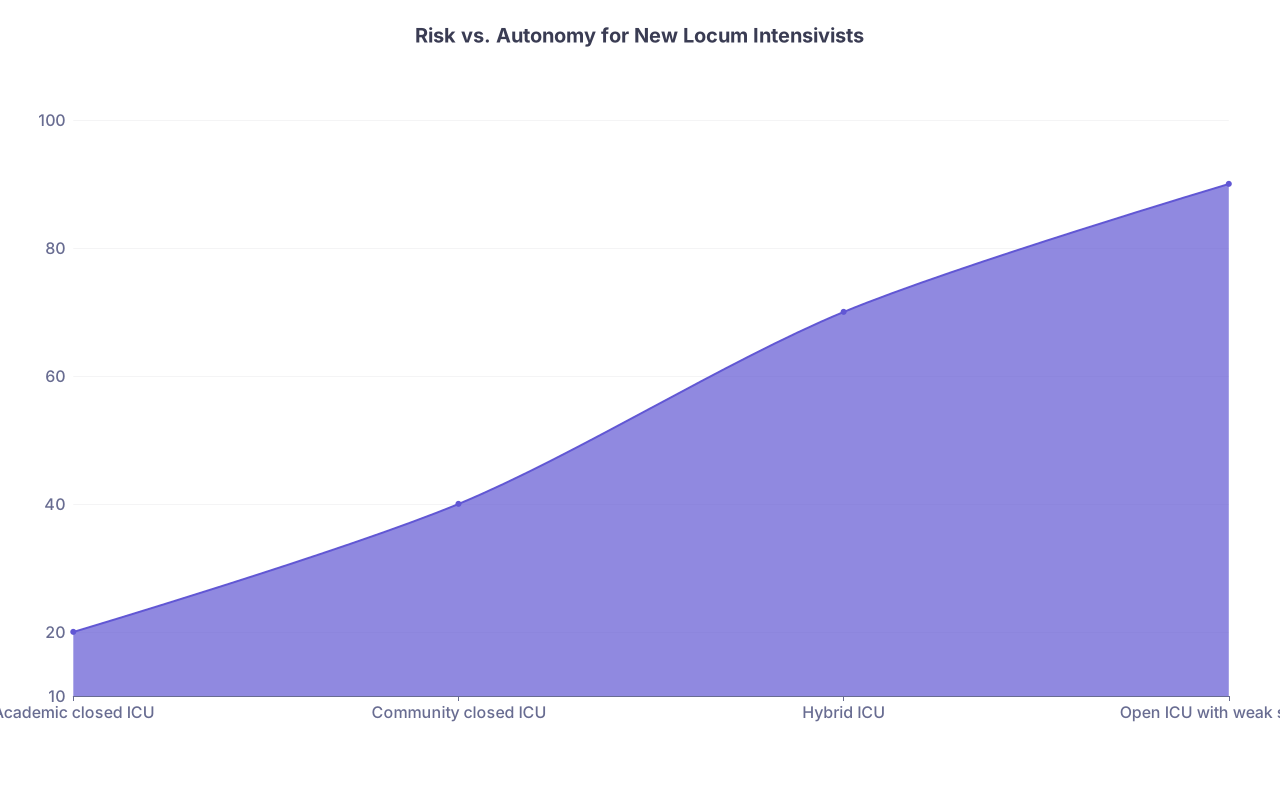
| Category | Value |
|---|---|
| Academic closed ICU | 20 |
| Community closed ICU | 40 |
| Hybrid ICU | 70 |
| Open ICU with weak support | 90 |
Rough guideline:
First year out of fellowship
Best: Closed ICUs with solid in-house support, clear night coverage, and reasonable census.
Avoid: Solo night coverage with unclear backup, high-volume open ICUs where you are the only person comfortable with vents.Comfortable but not a superhero
Reasonable: Community closed or hybrid units where you are the day intensivist and can shape plans, with at least some night APP support.
Still cautious: Rural setups with “ICU-lite” where you do everything from bronchs to dialysis decisions with minimal backup.Very experienced intensivist (5+ years)
You can choose to take on high-autonomy, high-risk gigs—rural solo coverage, tele-ICU leadership roles—but you should demand higher pay and explicit written limits on your role.
This is not about bravado. It is about matching real skills and cognitive bandwidth to actual job demands. ICU locums is where impostor syndrome gets people hurt—either you, or patients, or both.
Practical Ground Rules Once You Are Onsite
Let me finish with the nuts-and-bolts habits that actually protect you.
Walk the unit at the start of your shift—every time.
- Look at every vented patient personally.
- Glance at pressor doses and trajectories.
- Scan the board for new admissions and “borderline” step-downs.
Establish your contact expectations.
- Tell charge nurse and APP: “I want to be called for X, Y, Z. I do not want you to sit on lactate of 4 and a rising pressor.”
- Reaffirm this after the first incident where they did not call early enough.
Write deliberate, defensive notes on high-risk cases.
- For unstable shock, severe ARDS, or major goals-of-care controversies, your note should read like a narrative of your thinking, not just bullet points.
- Explicitly document discussions with surgeons, hospitalists, or consultants when there is disagreement.
Use your sign-out like a safety net, not a formality.
- Clear, prioritized problem lists.
- Identify “watch closely tonight” patients and why.
- Name who is responsible if you are not in-house: “NOC coverage by APP X; intensivist on call Y.”
When a case feels system-dangerous, say something.
- To nursing leadership: “These ratios are unsafe; here is exactly what I am seeing.”
- To medical director: “This combination of no RT, no in-house provider, and high census is a setup for catastrophe.”
- Then document that you raised concerns.
You are not going to fix American critical care staffing. But you can refuse to be complicit in the worst of it.
Key Takeaways
ICU staffing model and night coverage structure are not background details. They are the main determinants of your clinical, legal, and personal risk as a locum intensivist.
Open and hybrid ICUs with weak night coverage are where most hidden landmines sit. If you cannot define who owns each patient at 3 a.m., you are already behind.
Your best protection comes before you step into the unit: ask hard questions, decline obviously unsafe setups, and when you do accept, combine visible presence with meticulous documentation and explicit communication about escalation and responsibility.