
It’s June. Your residency graduation dinner is on the calendar. Your fellowship starts September 1st. You’ve got about 8–10 weeks of “freedom” that everyone keeps telling you is sacred.
You, however, are staring at your student loan balance, the moving costs to your fellowship city, and the fact that your checking account barely survives each month on PGY-3/4 pay. And someone mentioned, “You should just do locums this summer — you’ll make a ton.”
This is where you are:
You have a gap between residency and fellowship, or you’re considering delaying fellowship for a year. You’re hearing that locum tenens can be a smart bridge. But you also know: anything involving licensing, pay structures, and malpractice can go sideways if you wing it.
Let’s walk through how to use locums between residency and fellowship in a way that’s actually smart — financially, legally, and career-wise — not just “I guess I’ll sign whatever this recruiter sent me.”
Step 1: Decide Which “Gap” You’re Actually In
Not all “between residency and fellowship” situations are the same. Get clear on your scenario first, because it completely changes what “smart structuring” looks like.

| Step | Description |
|---|---|
| Step 1 | Finish Residency |
| Step 2 | Short gap |
| Step 3 | Planned gap year |
| Step 4 | Indefinite gap |
| Step 5 | Light, flexible locums |
| Step 6 | Stable recurring locums |
| Step 7 | Long term locums plus job search |
| Step 8 | Fellowship start date |
Here are the three most common:
Short gap (4–12 weeks) between residency and fellowship
You’re starting fellowship this cycle, just with a summer gap.Planned “gap year” before fellowship
You matched, but you negotiated a delayed start. Or you’re applying this cycle with a year off in between.Didn’t match / changed your mind about fellowship
You’re reapplying, changing specialties, or considering skipping fellowship altogether.
Your situation dictates:
- How aggressive you can be with locums hours
- How much continuity you should seek
- How much you can care about the rate versus the location and schedule
If you’ve got a 2-month window before a July 15 pulmonary fellowship, you’re going to structure locums very differently than someone taking a full year before cardiology.
Step 2: Understand the Real Constraints (Not the Fantasy Version)
Locums between residency and fellowship sounds easy in theory: graduate → show up → work for big money. Reality has some friction.
The big constraints:
1. Licensing and credentialing times
2. Malpractice coverage and tail timing
3. Fellowship policies about moonlighting
4. Your personal bandwidth and burnout
Let’s get specific.
Licensing & Credentialing Lag
If you’re reading this in April and you graduate June 30, you are already behind for some states if you want to start locums July 1.
Typical timelines (assuming you’re reasonably organized):
| Step | Faster States | Slower States |
|---|---|---|
| New state license | 6–8 weeks | 3–6 months |
| Hospital privileging | 4–8 weeks | 2–4 months |
| Locums agency onboarding | 1–3 weeks | 4+ weeks |
If you want to work locums between residency and fellowship, the smart play is:
- Start the conversation with locums agencies no later than January–February of your final year.
- Decide which single state you’ll prioritize for your gap work. Two at most.
- Ask early: “What’s realistically the earliest start date you can credential me by, given I finish June 30 and will have my final training verification then?”
If you start in May hoping to work in July in a slow state like California or New Jersey, you’ll probably be unemployed all summer.
Malpractice Coverage Handoff
You’ll be covered as a resident by your hospital’s policy. Your fellowship will have its own coverage. Locums will be covered by either:
- The locums agency’s malpractice
- Or (rarely, and avoid if you can) your own separate policy
You need clean separation:
- Residency coverage ends: usually your last day of employment; tail is handled by the hospital for your training work.
- Locums coverage: must start on day one of your first locums shift. Confirm occurrence vs claims-made. Confirm tail responsibility in writing.
- Fellowship coverage: starts when you’re on payroll there.
Nightmare scenario I’ve seen: resident finishes June 30, does a random “weekend favor” shift July 2 at a small hospital, assumes they’re covered as “moonlighting under residency policy,” gets burned because the training contract ended June 30. Do not be that person.
Get emails, not vibes. Ask the locums agency in exact words:
“Please send me the malpractice coverage details in writing, including limits, whether it’s occurrence or claims-made, and who pays tail.”
If they dodge that question, I’d walk.
Step 3: Pick Your Locums Structure Based on Your Gap Type
Now the meat of it: how to actually structure locums so it supports your larger plan instead of sabotaging it.
Case 1: Short Gap (4–12 Weeks) Before Fellowship
Goal here:
- Make enough money to cover moving and build a small buffer
- Do not show up to fellowship completely fried
- Don’t mess with licensing situations that you cannot finish
Smart structure for this scenario:
Prefer in-state locums
If your residency state is relatively locums-friendly and you already have a full license, use that. It avoids new-state delays.Choose block schedules, not scattershot shifts
For example: 7-on/7-off hospitalist blocks for 2 weeks in July. Or 3–4 ED shifts per week at the same site for a month.Cap yourself at a hard line
Example: “I’ll work no more than 14 total locums days between graduation and fellowship start.” If they offer more, nice problem, but hold the line.Avoid complicated practice environments
You don’t want to learn a brand-new EHR and hospital bureaucracy for 8 shifts. Community site, simple setup, minimal committees.
A very workable plan:
- July 8–14: 7-on hospitalist locums block
- July 22–28: second 7-on block
- Entire month of August: off, move, reset, maybe a few urgent care shifts locally if you really want
The structuring principle: compress income into one or two dense blocks, with clean time off around it.
Case 2: Planned Gap Year Before Fellowship
Now we’re in a different game. Money and CV both matter more. You’re out of training for a full year. People will ask what you did, and they should not see chaos.
Here, you want:
- Predictable recurring income
- A narrative that still supports your fellowship goals
- Guardrails so you don’t accidentally just become a full-time exhausted locums doc with no time to apply, study, or interview
This is where smart structuring really pays off.
You want something like this:
- One “anchor” gig: recurring locums at the same site 1–2 weeks per month
- Optional “top-up” gigs: occasional extra weeks at second site for specific months if you want more income
- Dedicated months or weeks blocked off for interviews, boards, or research/scholarly work
Example structure for a gap year before cardiology fellowship:
- Anchor: Community hospitalist locums, 7-on/7-off, same site, same EHR, stable team
- Do this 2 weeks every 6 weeks, not every 2 weeks → gives you limbo periods for interviews/applications
- Top-up: 5–7 ED shifts per month at a local site near where you live, flexible scheduling
And on your CV this becomes:
2026–2027: Hospitalist Physician (Locum Tenens), XYZ Community Hospital
- Inpatient adult medicine, 14–18 patients per day, independent practice
- Additional PT urgent care/ED coverage at [Name]
That reads clean. Deliberate. Not “I bounced around 9 hospitals and 3 states because every recruiter dangled a slightly higher hourly rate.”
Case 3: Didn’t Match / Reapplying or Changing Path
If you’re in this spot, everything is more sensitive. Program directors will pick apart what you did in that in-between period.
Smart structure here looks like this:
Choose locums that align with your target fellowship specialty as much as possible
- Applying for GI? Hospitalist locums with strong procedures exposure and complex medicine, not just fast-track urgent care.
- Going for EM? ED locums, not just telemedicine.
Don’t overload your schedule the first 3–4 months
You need time for: rewriting your application, research projects, potentially another exam (Step 3 or specialty board), UCERF courses, etc.Stay away from “sketchy” settings
Understaffed rural shop where you’re the only doc, no backup, “just sign these 30 charts a day” type setups? That’s not something you want PDs questioning later if something goes wrong.
A decent structure here:
- First quarter: 10–12 shifts/month, leaving 8–10 truly free days for application work
- Second quarter: can ramp up to 14–16 shifts/month once your application materials and letters are solid
Step 4: Money, Rates, and Not Getting Played
You’re probably thinking about the money. Good. You should. But you should be smart about how you think about it.
Locums between residency and fellowship is a short-term strategy. The goal is not to chase the single highest advertised hourly rate. It’s to maximize net gain while minimizing chaos.
Typical ranges (realistic, not recruiter fantasy):
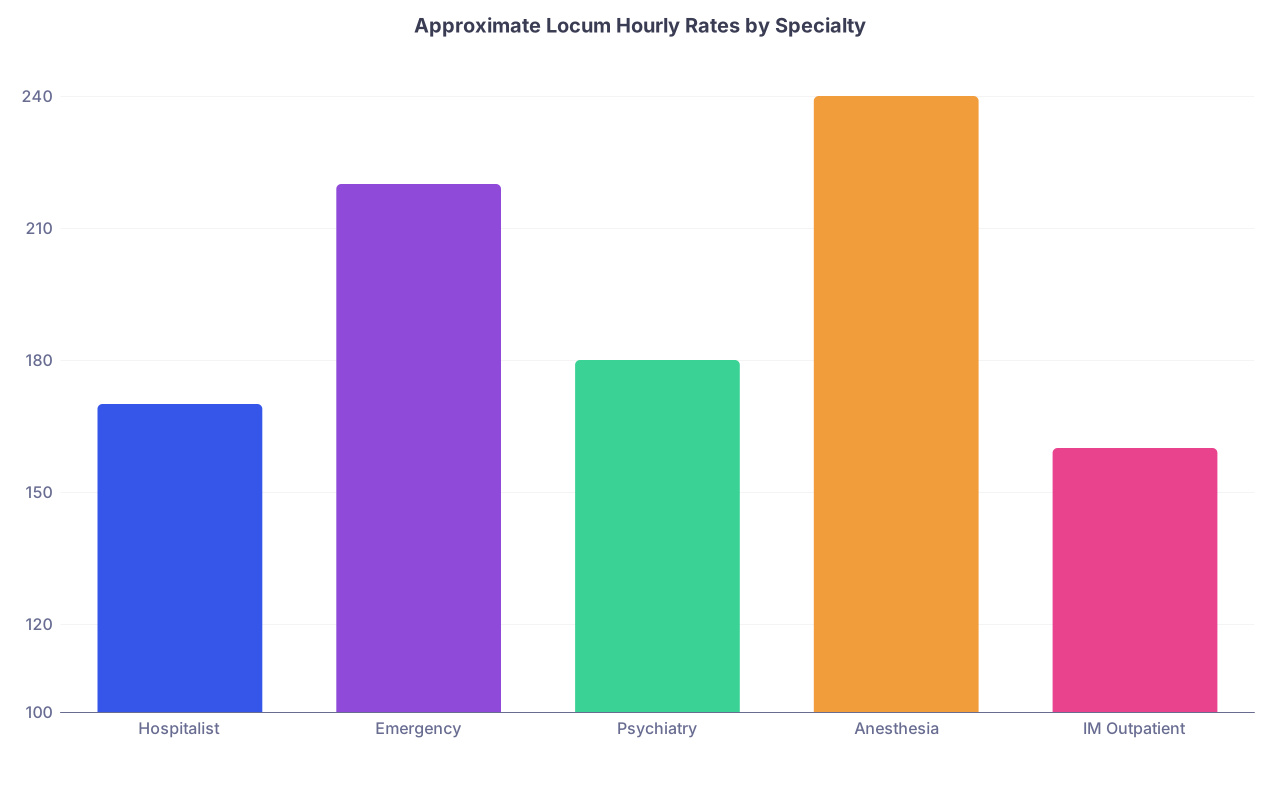
| Category | Value |
|---|---|
| Hospitalist | 170 |
| Emergency | 220 |
| Psychiatry | 180 |
| Anesthesia | 240 |
| IM Outpatient | 160 |
Smart structuring money rules:
- Prioritize consistency over a few extra dollars/hour
$180/hr at one site you know well, with travel paid and stable census, can beat $210/hr at a place that burns you out and demands more non-billable time.
2. Lock in guaranteed minimums
Push for daily minimums: “10 hours guaranteed” or “$X guaranteed per shift even if volume is low.” It’s common and reasonable.
- Clarify what’s paid and what’s free
- Are you paid for call? In-house vs beeper?
- Are notes and charting outside of shift included?
- Are travel days compensated?
- Are you paying for your own state license? Ask if the agency will reimburse. Many will.
- Lodging: hotel vs crappy extended stay vs physician housing. This matters a lot on day 20.
- Car rental vs mileage. Parking fees. All that nickel-and-diming.
For a short pre-fellowship gap, I’d take:
- Slightly lower rate + direct flight + decent housing + fewer hoops
over - Max rate + two connections + motel next to the freeway + dysfunctional hospital
You don’t need heroics. You need clean, easy cash.
Step 5: Fit Locums Around Your Fellowship Obligations (and Risks)
You’re not just a free agent. You have a fellowship program that will own you soon, and they do not care about your locums side quest if it interferes with their schedule or risks their reputation.
A few non-negotiables:
Do not work locums a day or two before fellowship orientation
You want 3–7 days clean before you start. Move, settle, sleep, handle HR and credentialing, and mentally switch gears. Starting fellowship post-call from some other hospital across the country is idiotic.Consider the optics of your locums choices
If you’re going into a very academic fellowship and spend a whole year in a sketchy for-profit ED mill, that’s not fatal, but it’s not neutral either. It’s a story you’ll have to explain. “I picked a high-volume place to keep my skills sharp and my income stable while I focused on publishing X” is very different from “I just chased the highest check.”Check your fellowship contract for outside work restrictions
Some programs explicitly prohibit moonlighting. Others allow it with permission after a certain PGY-level or after Step 3. If you’re doing locums before fellowship starts, you’re usually fine — but some places have pre-employment clauses on competing institutions, medical staff membership, etc. Read the thing. Or have someone experienced read it with you.Medical staff and NPDB risk
Bad outcome during a locums stint? Credentialing or privileging issues? That follows you. I have seen fellowship onboarding delayed because something dumb happened during a poorly supervised locums job. Another reason to pick stable, reputable sites, especially in this transition period.
Step 6: How to Actually Find and Lock the Right Locums Gig
Everyone jumps into the first recruiter email they get. That’s how you end up in the wrong state, wrong practice, wrong schedule.
Smarter way:
Talk to 2–3 agencies, not 10
Ask each one the same questions:- “What assignments do you realistically have for a new grad in my specialty for [state X] starting around [month, year]?”
- “What’s a typical shift structure and census at those sites?”
- “Can you give me one contact of a previous locums doc I can talk to?”
Filter aggressively for timeline
If they say, “We’d love to get you into this great gig in Oregon, but licensing takes 4–6 months,” and you have a 2-month gap → useless. Next.Ask specifically for “short-term summer coverage” or “gap coverage”
Hospitals know this pattern. Many specifically look for new grads to cover summer shifts when staff are on vacation.
Here’s what a smart email to a recruiter looks like:
“I’m finishing internal medicine residency in [state] on June 30, 2026. I start cardiology fellowship September 1, 2026. I have/will have a full unrestricted license in [state]. I’m looking for 10–14 hospitalist shifts between July 8 and August 15, ideally at one or two sites max, with paid lodging and malpractice. I prefer 7-on blocks. Do you have anything that fits those parameters and can realistically be credentialed in that time frame?”
That email saves everyone time. If they send you generic garbage after that, you know what you’re dealing with.
Step 7: Protect Yourself on Paper
Locums contracts are usually “standard” — but “standard” in that industry just means “written for the agency and hospital’s benefit, not yours.”
Key clauses to pay attention to (and push back on if needed):
Cancellation terms
- What if they cancel the whole assignment? Do you get a guaranteed minimum?
- What if they cancel individual shifts within X days? Is there a cancellation fee?
Non-compete / restrictive covenants
- Are you blocked from working at that hospital directly for a year? (Might be fine in a gap, but know what you’re agreeing to.)
- Are you blocked from working anywhere within X miles? That’s absurd for short-term pre-fellowship work. Push back.
Indemnification language
- You do not want to be the one indemnifying the hospital or agency for their own negligence. At minimum, this should be mutual or removed.
Malpractice and tail spelled out, as I mentioned earlier
If you’re uncomfortable evaluating this yourself, spend a few hundred bucks to have a physician contract lawyer look at your first locums agreement and mark it up. For a year-gap with serious money at stake, this is not optional in my book. For a 2-month short gap, at least read the damn thing line by line and ask questions.
Step 8: Energy Management — Not Burning Yourself Before Fellowship
You’re finishing residency. You are not “rested.” I don’t care how cushy your schedule was. Your cognitive and emotional reserves are low.
So structure locums with that in mind:
- Avoid super-remote assignments with long commutes and zero backup if you’re already fried
- Don’t pack every day with shifts “because the rate is good”
- Put hard days off on the calendar before you start negotiating dates
Between residency and fellowship, the best structure I’ve seen:
- One or two intense locums blocks
- Followed by a hard stop for 1–2 weeks of actual rest before you start the next phase
That buffer week before fellowship is not a luxury. It’s survival.
FAQs
1. Is it a red flag to fellowship programs if I do a full year of locums before starting?
Not inherently. What matters is the story and structure. A year of well-structured hospitalist locums at 1–2 hospitals, with clear responsibilities and maybe some scholarly work on the side, is fine. A year bouncing through 9 random clinics because you chased every extra $10/hr, with nothing cohesive on your CV, looks worse. Programs want to see consistency and purpose, not chaos.
2. Should I prioritize doing locums in the same city where my fellowship will be?
Nice if it lines up, not mandatory. For a short gap (2–3 months), I’d prioritize easy travel and simplicity over geographic alignment. For a full gap year, working near your future fellowship city can help with housing, familiarity, and networking, but don’t force it if the gigs there are poorly structured or underpaid.
3. Can I keep doing locums during fellowship?
Sometimes. Many fellowships technically allow moonlighting after a certain PGY year or after board exams, but with approval. Practically, it depends on the specialty and program culture. Critical care, cards, surg subspecialties — you may not realistically have the bandwidth. If you want to keep a locums relationship, structure it as “available for occasional weekends/holidays” and be prepared to say no most of the time.
4. What if I don’t have Step 3 done yet — can I still do locums?
Depends on the state and hospital. Some will demand Step 3 and full board eligibility; others will credential you with a training license or full license plus proof of finishing residency. If you’re missing Step 3, your options shrink dramatically. My blunt advice: take Step 3 during residency so this isn’t even a variable. If it’s too late for that, tell recruiters up front and see which sites can work with that timeline.
5. Is it ever smarter to skip locums and just rest between residency and fellowship?
Yes. If you’re severely burned out, if you have no financial pressure, or if your fellowship is going to be brutally intense (surgical subspecialties, for example), taking 4–8 weeks completely off can be the smartest “structure” of all. You can still do a few local per-diem shifts if you get antsy. Locums is a tool, not a requirement. The smart move is whatever leaves you financially stable and mentally ready to show up strong to fellowship.
You’re standing at the hinge between two training phases. The temptation is to cram as much paid work as possible into that space. The wiser move is to treat that gap like a short, high-yield project: define your constraints, pick one or two clean locums setups, get the paperwork and malpractice squared away, extract the money, then shut it down and reset.
Do that, and you’ll walk into fellowship with more money, sharper skills, and your sanity mostly intact. Once you’re there, you’ll have a whole new set of decisions about moonlighting, side gigs, and what comes after fellowship. But that’s a situation for another day.