
Losing a key mentor right before residency applications can wreck your LOR strategy—if you handle it passively.
You’re not powerless here. But you are on a clock.
I’m going to walk you through exactly what to do if your main letter writer retires, moves institutions, or otherwise disappears from your home program right before—or during—your residency application cycle.
Not theory. The actual conversations, emails, timing, and backup plans that keep their letter powerful instead of looking like a ghost from three institutions ago.
Step 1: Understand How Programs View “Former” Mentors
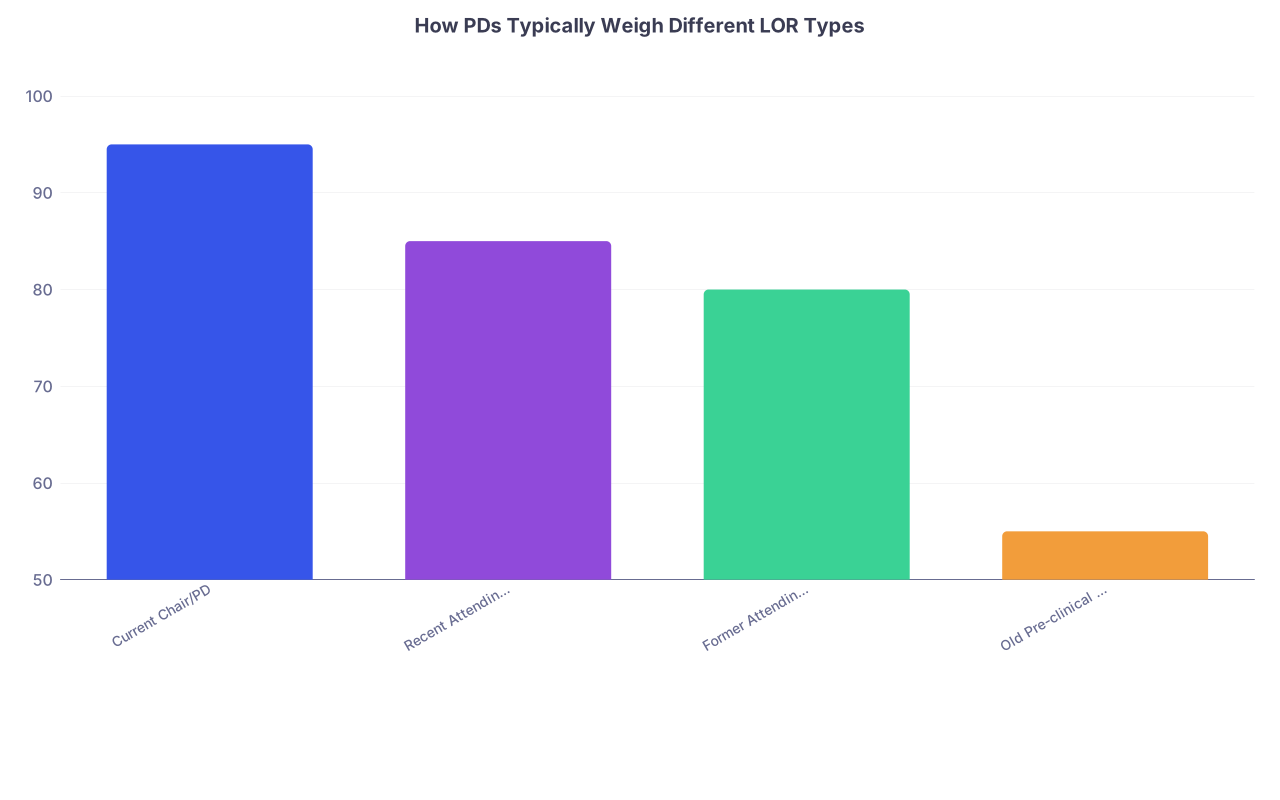
| Category | Value |
|---|---|
| Current Chair/PD | 95 |
| Recent Attending (same place) | 85 |
| Former Attending (moved) | 80 |
| Old Pre-clinical Faculty | 55 |
Here’s the unfiltered reality:
Program directors mostly care about:
- Who you are clinically—right now
- Whether the writer knows you well
- Whether they trust the writer’s judgment and reputation
Whether your mentor is at your institution this minute is secondary.
A strong letter from a moved/retired attending who clearly knows your work is still valuable. But it needs a few things:
- Clear dates: when they supervised you
- Clear role: were they faculty at your med school/hospital at that time
- Clear context: why they’re now at Institution B or retired
Weak letters become suspicious when:
- The writer barely remembers you
- There’s no context: “Associate Professor, [random hospital you’ve never been at]” with no mention of when/where you worked together
- The letter reads like a template and could apply to any student
So your job is not to panic about the institutional mismatch. Your job is to preserve:
- The relationship
- The timing of the letter (fresh vs ancient-sounding)
- The clarity of the story
Step 2: If Your Mentor Hasn’t Left Yet – Move Fast
If you just found out they’re moving or retiring soon, this is the best-case “bad” scenario. You still have access.
Here’s the move: you treat this like a mini-crisis project and handle it this week. Not “sometime soon.”
What to say to them
You can do this in person or by email, but don’t overcomplicate the language.
Script you can adapt:
Dr. Smith, I heard you’ll be leaving [Institution] at the end of June—congratulations on the new role. I wanted to ask for your guidance on residency letters.
I learned a tremendous amount working with you on [rotation/project], and your perspective would mean a lot on my application.
Would you be comfortable writing a strong letter of recommendation for my residency applications this fall? If so, is it easier for you to write it now while you’re still here, or closer to application season at your new institution?
Key points embedded in that:
- You say “strong letter” explicitly (you want them to self-select out if they’re lukewarm)
- You raise timing as a convenience question, not a demand
- You normalize that they might write it from the new place
If they agree, you immediately follow up with:
- CV or ERAS-style CV
- Brief personal statement draft (or at least your specialty choice and goals)
- Bullet list of 4–6 concrete things you did with them: cases, presentations, QI projects, feedback you implemented
You are not “being annoying.” You’re making it easier for them to write a specific letter instead of a vague one.
Ask them to anchor the letter in time
The letter should clearly say something like:
“I supervised Ms. Jones as a third-year medical student on the internal medicine service at [Old Institution] from March–April 2025, during which time I served as an Associate Professor of Medicine and attending physician.”
If they’re still here when they write it, that line is automatic. If they’ll write from the new place, that line becomes critical.
You do not need to ask them to mention the move or retirement explicitly; the letterhead and signature will show it. But the body must clarify when and where they knew you.
Step 3: If They Already Left – Rebuild Contact and Context

This is the more common scenario: you find out they’re gone, maybe months later, when you’re starting ERAS.
You still have options.
3.1. Track down updated contact info
Use:
- Their old institutional email (often forwarded for a bit)
- Google + specialty + name + “faculty” or “clinic”
- LinkedIn or Doximity pages
- Ask your department coordinator or another attending:
“Do you happen to have Dr. Smith’s current email? I’d love to reconnect and ask about a residency letter.”
Do not make this weird. Faculty change jobs all the time. Residents ask for contact info all the time.
3.2. How to re-open the relationship
Your email needs to do three things:
- Re-establish who you are
- Acknowledge the move gracefully
- Make a specific, time-bound request
Template:
Subject: Residency application and LOR request
Dear Dr. Smith,
I hope you are doing well and that your transition to [New Institution] has gone smoothly. I rotated with you on [service] at [Old Institution] in [month/year]; we worked together on patients such as [brief reminder – e.g., the complex CHF patient we co-managed with cardiology], and you supervised my [presentation/QI project/teaching session].
I am now a [MS4/PGY1 applying to X], planning to apply to [specialty] this cycle. Working with you was one of the most formative parts of my training, and your feedback significantly shaped how I approach [clinical reasoning/procedures/patient communication].
If you feel you can provide a strong, detailed letter of recommendation based on our time working together, I would be very grateful. ERAS opens for letter uploads on [date] and my target for letter submission is [date, usually 2–3 weeks later]. I’m happy to send an updated CV, personal statement draft, and a brief summary of my work with you to make this as easy as possible.
Thank you again for your mentorship, and I hope we can reconnect.
Best regards,
[Name]
[Med school]
[AAMC ID if you want]
Do not apologize endlessly. Do not write a 900-word life story. Their bandwidth is limited. Be clear and efficient.
Step 4: How to Handle Logistics in ERAS
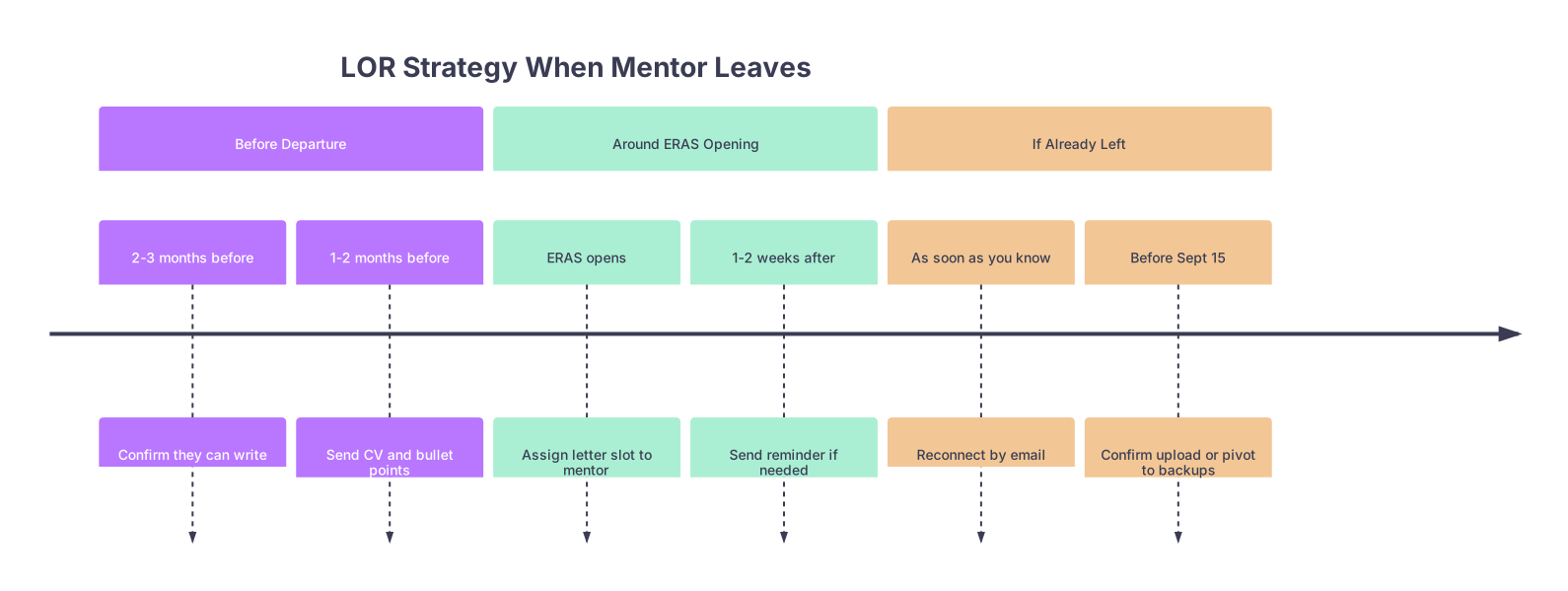
| Period | Event |
|---|---|
| Before Departure - 2-3 months before | Confirm they can write |
| Before Departure - 1-2 months before | Send CV and bullet points |
| Around ERAS Opening - ERAS opens | Assign letter slot to mentor |
| Around ERAS Opening - 1-2 weeks after | Send reminder if needed |
| If Already Left - As soon as you know | Reconnect by email |
| If Already Left - Before Sept 15 | Confirm upload or pivot to backups |
A lot of students screw this up not because of the mentor, but because they mishandle the technical part.
Key details:
- In ERAS, you list your letter writer’s current title and affiliation. If they’ve moved, use the new one.
- You do not need a letter to be from your home institution to count. Programs care more that it’s real, meaningful, and relevant.
- Most mentors will put the institution where they supervised you inside the letter text anyway.
You also want:
- At least one letter from your home department currently (especially for core specialties like IM, surgery, peds)
- A mix: one from the moved/retired giant who loved you, one from a current attending, possibly one from research if it’s meaningful
If your mentor is retired and fully out of academia, it still can work. Their title shifts to something like:
“Professor Emeritus of Medicine, Former Associate Program Director, [Institution]”
That’s still a real, weighty voice—especially if they had a major role before retirement.
Step 5: When It’s Actually Not Worth Using Their Letter
Let me be blunt: some letters age poorly.
A moved or retired mentor letter is not worth using if:
- They barely remember you and respond vaguely
- They ask you to essentially write the entire letter yourself and “they’ll sign” (ethically gross, also often obvious)
- All their stories about you are from a pre-clinical course three years ago and you now have strong 4th-year clinical letters
In practice, you should choose your 3–4 letters based on:
| Scenario | Use Their Letter | Replace Their Letter |
|---|---|---|
| They knew you clinically | Yes | |
| They’re known in your field | Yes | |
| They supervised you briefly years ago | Yes | |
| Letter is generic/short | Yes | |
| You now have stronger, recent clinical letters | Yes |
If you have to decide between:
- A famous name who barely knew you
- A mid-tier attending who can describe you precisely and enthusiastically
You pick the second one. Every time. PDs have said this to my face more than once.
Step 6: How To Politely Ask If Their Letter Will Still “Carry Weight”
If your mentor left on bad terms, or your school’s department is…political, you may wonder if their letter hurts you.
You cannot ask “Is your letter still valuable or are you persona non grata?”
You can ask this:
I really valued working with you at [Old Institution], and your perspective on my clinical work would be very meaningful in my application.
Since you’ve now transitioned to [New Institution/retirement], do you think programs in [specialty] will still view a letter from you as appropriate and helpful? I’m also collecting letters from current faculty at [Med school], and I want to make sure my letter set is well-balanced.
That lets them:
- Reassure you if their name still holds weight
- Gently signal if your home department is likely to ignore their voice
- Encourage you to prioritize another current faculty if needed
If they sound hesitant, treat their letter as optional—not your anchor.
Step 7: Building a Redundant LOR Strategy So You’re Not Screwed
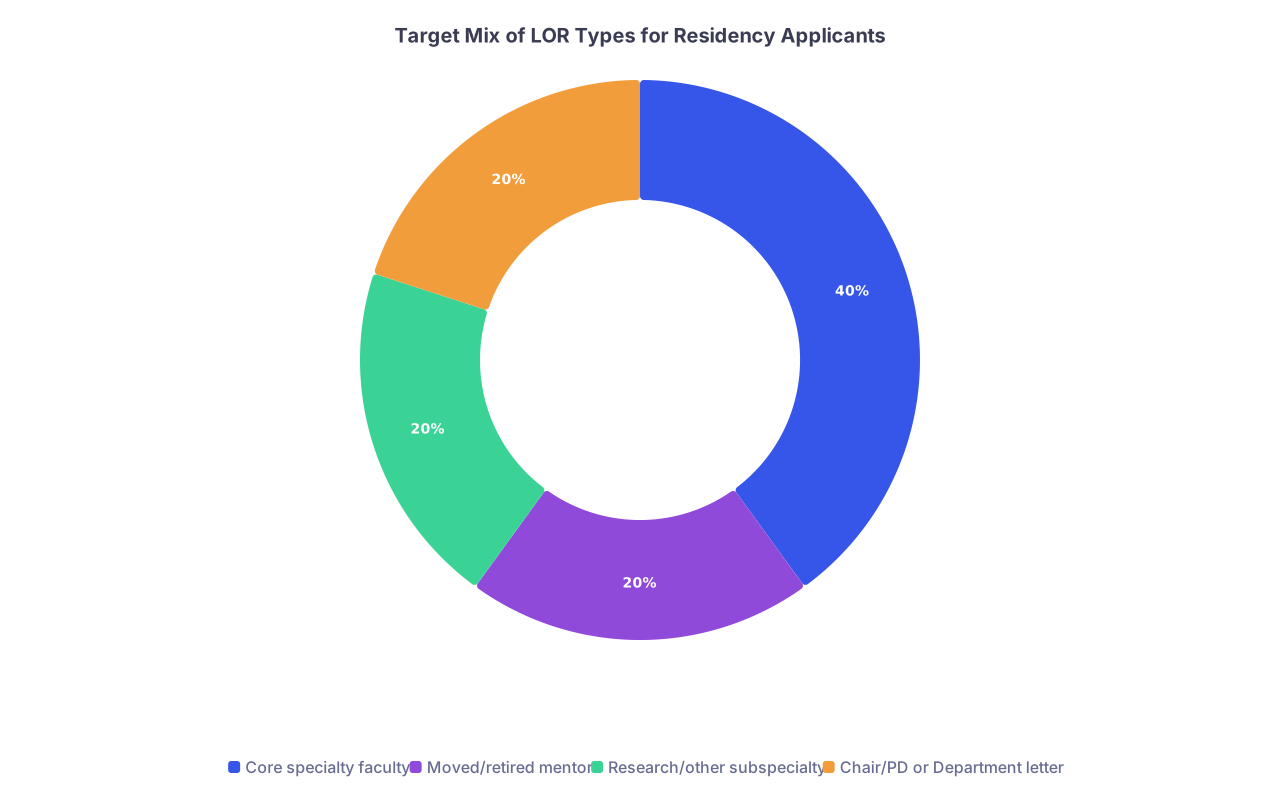
| Category | Value |
|---|---|
| Core specialty faculty | 40 |
| Moved/retired mentor | 20 |
| Research/other subspecialty | 20 |
| Chair/PD or Department letter | 20 |
If you’re relying on one superstar mentor and they vanish, you’ve built a fragile system. Do not repeat that mistake.
For this cycle:
Aim for:
- 1–2 letters from core specialty attendings at your current institution
- 1 from your moved/retired mentor (if strong)
- 0–1 from research or a different but relevant specialty
And then you over-collect. You can assign different letters to different programs.
Example specialized strategy:
- Applying IM with 5 letters total collected
- Moved cardiology attending who supervised you on wards (strong)
- Current IM ward attending
- Ambulatory IM attending
- Research mentor in quality improvement
- Department letter from IM chair or PD
You might send:
- Academic IM programs: moved cardiology mentor + current ward attending + research mentor + chair letter
- Community IM programs: current ward attending + ambulatory attending + moved mentor
The point: your mentor’s departure should adjust your strategy, not define it.
Step 8: If They Retired Completely – Unique Angles To Use
Retired faculty often:
- Have zero institutional constraints on what they write
- Are more candid
- Have long reputations in the field
Their letter can be powerful if:
- They were big names (former PD, division chief, renowned teacher)
- They’re describing you as “one of the best trainees I supervised in X years at [Institution]”
- They clearly state their former positions
You need to help them with:
- Updated info about where you are now
- Your specialty goals
- What you’ve done since they last saw you
And you should explicitly ask them to frame the letter historically:
Since you’re now Professor Emeritus, would you be comfortable briefly describing your former roles at [Institution] in the letter? I think it would help programs understand the context of your assessment.
That’s not pushy. It’s just strategic.
Step 9: Emotional Side: Don’t Get Stuck in “Abandoned” Mode
I’ve seen students stall their entire application season because their favorite attending left and they “felt weird” asking for a letter now.
Do not romanticize this.
Faculty leave. Retire. Burn out. Get poached by another hospital. It rarely has anything to do with you.
If you had a real mentoring relationship, most of them are happy you remembered them. They like seeing their former students succeed. It’s one of the few non-soul-crushing parts of the job.
If you reach out respectfully, give them an easy off-ramp (“if you can provide a strong, detailed letter”), and accept a no gracefully, you’ve done your side of the relationship.
Then you move on and build Plan B, C, and D with current faculty.
Common Situations and What To Do—Fast Answers

Situation A: They ghost your email
Wait 10–14 days. Then send:
Dear Dr. Smith,
Just a quick follow-up on my previous email about a potential residency letter. I know you’re very busy, so if now is not a good time or you prefer I seek letters from more current supervisors, I completely understand.
Thank you again for everything I learned while working with you.
Best,
[Name]
If no response after that, you drop it and lean harder on other letters. Do not chase them a third time.
Situation B: They agree but upload late
You set your expectations early:
ERAS opens for letter uploads on [date], and my goal is to have letters in by [date]. Would that timeline work for you?
If they miss your internal deadline, you send:
Dear Dr. Smith,
I hope you’re doing well. I wanted to gently check whether you’re still able to submit the letter for my residency applications. My other letters are now in ERAS and I will begin certifying my application on [date]. If your schedule no longer permits, I completely understand and can adjust my letter set accordingly.
Thank you again for your support.
Best,
[Name]
Notice: you give them a graceful exit. Some will step up immediately. Others will bow out. Both are fine; ambiguity is not.
FAQ (Exactly 5 Questions)
1. Will programs think it’s weird if my letter writer is now at a different institution than the one on my transcript?
No. Faculty move constantly. As long as the letter clearly states when and where they supervised you, it’s normal. Programs see this every cycle. What looks weird is a vague letter with no context, not a changed affiliation.
2. Is a letter from a retired mentor as valuable as one from a current attending?
It can be, if the retired mentor had a significant role (former PD, division chief, long-time faculty) and knew you clinically. A generic letter from a retired basic science professor is weak. A detailed letter from a former IM PD who calls you “one of my top students in 10 years” is gold.
3. Should I list their old institution or new one in ERAS?
Use their current title and institution in ERAS (whatever they are at the time of application). Inside the letter, they should mention their prior role where they actually supervised you. The combination tells programs: this is who I am now, this is who I was when I knew the applicant.
4. Can I ask for a new letter if they already wrote one last year when I didn’t match?
Yes, and you should. Email and say you’re reapplying, briefly summarize what you’ve done since (new rotations, research, responsibilities), and ask if they’d be willing to update the letter to reflect your recent progress. A slightly updated letter looks better than resubmitting a clearly old one with stale timing.
5. What if my home department is political and they dislike the mentor who left? Will that hurt me?
Inside your own institution’s internal processes, maybe. For external residency programs evaluating your ERAS, they care far more about the content and the credibility of the writer in the specialty. That said, you should still secure at least one strong letter from a current faculty member in your department so no PD wonders, “Why doesn’t anyone there want to vouch for this person?”
Key points:
- A moved or retired mentor’s letter can still be powerful if the relationship was real and the context is clear.
- Your job is to act early, communicate clearly, and build redundancy with current faculty so one person’s departure doesn’t tank your application.
- Prioritize letters that are detailed, recent, and genuinely enthusiastic—regardless of where the writer is sitting this year.