
It’s November. Or January. Or honestly, whatever month it is where it feels way too late to be changing your mind. You finally admitted to yourself that your original specialty isn’t it… and now you’re staring at your ERAS documents thinking:
“I’m switching specialties late—are my old LORs useless now?”
Your brain goes straight to worst case:
All those letters are trash. No one will take you seriously. Programs will think you’re flaky. You’ll have to beg for all new letters while attendings are busy and annoyed. You’ll look like a confused mess compared to people who “always knew” what they wanted.
Let’s walk through this. Because you’re not the first person to do this, and you will 100% not be the last.
The brutal truth: no, your old LORs are not automatically useless
Let me take the scary version first:
No program director is going to see a strong letter from an attending who knows you well and say, “Oh, different specialty? Trash.” That’s not how any of this works.
Programs care about a few core things in letters:
- Are you hardworking?
- Are you safe and reliable with patients?
- Do you function well on a team?
- Are you teachable, not a nightmare to work with?
- Do you actually show up, do the work, and give a damn?
Those traits are specialty-agnostic. A medicine attending saying you were the most reliable student on the team? That absolutely still matters for emergency, anesthesia, psych, radiology—whatever you’re pivoting to.
Where old letters start to lose value is when:
- They’re generic and vague (“pleasant to work with,” “good student”)
- They are clearly tailored to your old specialty in a way that clashes with your current story
- They’re from very early in med school and don’t reflect who you are now
- You have zero letters from your new specialty or anything even vaguely related
So your old LORs are not useless. But they might not be enough by themselves.
How programs usually see late switchers (it’s not as damning as you think)
I’ve watched this play out in multiple cycles: people switching from:
- Surgery → Anesthesia
- IM → Radiology
- EM → IM
- OB → Family
- Surgery → Psych (yes, really, and they matched)
Programs see late switchers in a few categories:
The “clear story” switcher
They can explain why they’re switching in a coherent, non-dramatic way. They have at least one decent letter in the new specialty. Old LORs back up that they’re a hard worker. Programs usually accept this. People change.The “panic pivot” switcher
Looks like they just tanked Step 2 or didn’t get interview invites in their original specialty and suddenly rebranded with no explanation. No updated letters, no thoughtful personal statement—just chaos. That raises eyebrows.The “quiet regret” switcher
They rotated early in something else, realized late that they liked it more, but don’t have strong letters in the new field. Programs will still consider them, but they’ll want to see: did faculty anywhere think you were excellent?
Your letters are one piece of that narrative. Not the whole thing, but a visible chunk.
What to actually do with your old letters
Here’s the move: don’t throw them out mentally before you evaluate them. You’re panicking, so your brain says “all or nothing.” But you need to think more surgically.
Ask yourself for each old LOR:
- Does it say specific, strong things about my work ethic, clinical skills, professionalism, initiative?
- Or is it generic filler?
- Does it scream “[Old specialty] or bust” the whole way through?
If you don’t remember the content (very common, because people waive access), go by:
- Who wrote it?
- How closely did you work with them?
- Did they offer to write you a letter vs you begging them?
- What did they say in person about you?
As a rough guide:
| Letter Type | Value Now |
|---|---|
| Strong IM letter for EM/Anesthesia | High |
| Strong Surgery letter for Radiology | Moderate |
| Glowing FM letter for Psych or IM | High |
| Generic “good student” from anyone | Low |
| Letter heavily pushing old specialty | Low–Moderate |
Old letters that describe you as:
- Hardworking
- Independent
- Detail-oriented
- Great with patients
- Calm under pressure …are still gold.
But if the letter is like:
“Alex is destined to be an outstanding orthopedic surgeon; they live and breathe orthopedics; their whole identity is orthopedic surgery,”
and now you’re applying psych… that one’s working against your narrative.
Do you have to know the exact wording? No. But if you know the attending framed you as “a future X specialist” and you’re now firmly Y, that letter moves lower priority in your lineup.
How many new specialty-specific LORs do you actually need?
You don’t need to wipe your LOR slate clean. But you do need to anchor your application in the new specialty.
Bare minimum I’d want if I were you:
- At least 1 strong letter in the new specialty
- Ideally 2 in the new specialty
- Then 1–2 from other fields that know you well and vouch strongly for you
So, for example, if you’re switching from surgery to anesthesia:
- 2 anesthesia letters (attendings who actually saw you work)
- 1 strong surgery letter talking about your work ethic and OR performance
- Optional: 1 medicine or ICU letter if it’s solid
If you’re late in the game, even 1 really solid new-specialty letter plus 2 very strong old ones can be workable, as long as your personal statement explains the switch.
The awkward part: asking old letter writers to “reframe” or write new letters
This feels gross, I know. But it’s normal.
You might be thinking: “Won’t they be offended I’m switching? Won’t they think I wasted their time?”
Most attendings have seen students/switchers before. The better ones actually respect when you’re honest with yourself instead of forcing a bad fit.
You’ve got a couple options:
Option 1: Ask for a brand new, specialty-neutral or updated letter
Email along the lines of:
Dr. X,
I hope you’re doing well. I wanted to update you that after more clinical exposure, I’ve decided to pursue [new specialty] rather than [old specialty]. I’m very grateful for your support and your previous letter on my behalf.
Because you worked with me closely and know my clinical abilities well, I was wondering if you’d be willing to write an updated letter focusing on my work ethic, clinical reasoning, and teamwork skills that would support applications in [new specialty]. I really valued your mentorship on [rotation name] and would be happy to provide my CV and a brief summary of my experiences in [new specialty].
Thanks again for all your help,
[Your Name]
You’re not begging. You’re giving them a reasonable, clear ask.
Option 2: Keep the old letter as-is and prioritize new-specialty letters on top
You can also just:
- Get 1–2 new letters in the specialty you’re switching to
- Use old letters in supporting roles
- Put the most relevant letters at the top in ERAS
This works especially well when:
- Old letters are strong but not hyper-specific to the old specialty
- You don’t have a ton of time and the old writer is hard to reach
“But what if my old LORs totally contradict my new path?”
This is the nightmare scenario in your head:
A letter that says you’re 100% committed to, say, neurosurgery, and now you’re applying to psych.
Programs are not dumb. They know:
- Students change their mind after rotations
- Not everyone has exposure to every field early
- Some people find their “real” fit later
The real damage = silence or confusion, not the existence of an old letter.
You fix that with:
A personal statement that clearly tells the story:
Not overly dramatic. Not dragging your old specialty. Just:
“I thought X was it for me, but on [experience] I realized I connected more with [Y aspects]. Over time, I kept gravitating toward [new specialty things].”An advisor or Dean’s letter (MSPE addendum if necessary) briefly acknowledging the change if it’s super late or you re-applied.
New letters that reinforce:
“Yes, they belong here. We’ve seen them in this field, and they fit.”
So even if your old letter screams “future surgeon,” it doesn’t kill you as long as your newer materials anchor your application in your new identity.
Timeline panic: what if I’m switching really late?
Let’s say:
- It’s late fall/winter
- Application is already in, or nearly in
- You’re only now realizing you want to switch
You probably feel like it’s over. It’s not necessarily.
What you can still do:
- Scramble to get at least one rotation in the new specialty (even an elective, sub-I, or short experience)
- Get one solid letter out of that experience, even if the attending isn’t a famous name
- Send that new letter to programs (especially community and mid-tier academic places) with a brief email explaining your updated interest
- Update your personal statement and send a new version where allowed
Is it late? Yes.
Is it ideal? No.
Is it absolute death? No.
I’ve seen people match with:
- One new-specialty LOR
- Two old-specialty letters
- Honest explanation in their statement
- Modest ranks but a clear story and decent interviews
You’re not automatically sunk just because this didn’t hit you in July.
How programs actually read your letters as a late switcher
Here’s what a PD or APD is roughly reading for in your file:
Consistency of the story
Do your letters + personal statement + experiences all fight each other, or generally move in the same direction?Floor, not ceiling
Letters are often used to rule people out, not crown them king.
Does anyone say you’re unsafe? Lazy? Unprofessional? Difficult? Those are killers.
A letter saying “they’re solid, hardworking, and eager to learn” still helps.Evidence someone would hire you
They want to know: did anyone on planet earth like working with you enough that they’d pick you again?
Your late switch doesn’t erase the fact that:
- You showed up at 5am for surgery rounds
- You followed up on labs
- You connected with patients
- You helped interns and residents and weren’t a ghost
That still counts.
Visual reality check: old vs new letters in your application
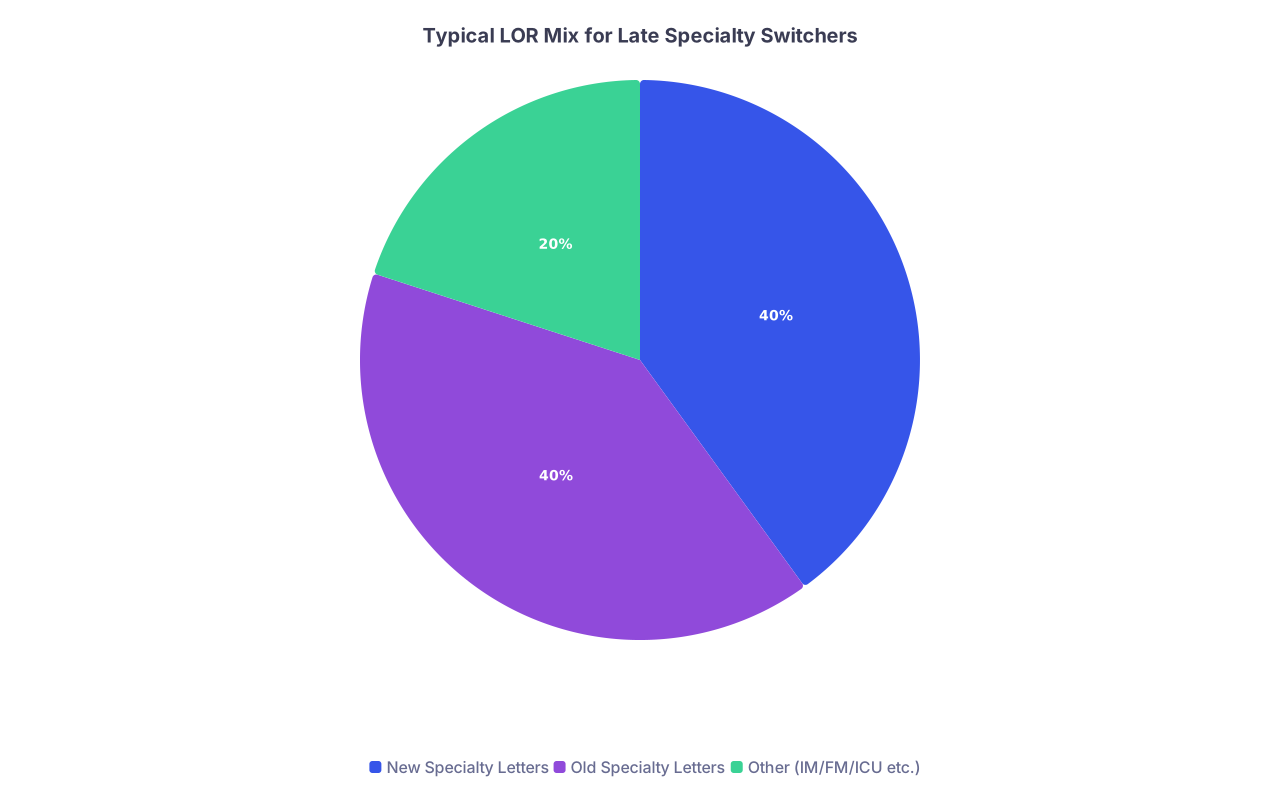
| Category | Value |
|---|---|
| New Specialty Letters | 40 |
| Old Specialty Letters | 40 |
| Other (IM/FM/ICU etc.) | 20 |
You’re aiming for a mix, not a clean slate. Programs are used to seeing this.
How to rank and select which letters to include
ERAS lets you assign up to 4 LORs per program. You don’t have to send the same exact set to every program.
Simple, realistic strategy:
- For your new specialty:
- Always include your strongest new-specialty LOR
- Add your second new-specialty LOR if you have it
- Fill remaining slots with the strongest old letters that praise your work ethic/clinical skills
- If you have a weirdly specific old-specialty letter that conflicts hard, send it only if you absolutely need to hit 3–4 total and have no better options
Remember: a strong letter from a different specialty is better than a weak letter from your new one.
Quick sanity check: cases where old LORs really are almost useless
There are a few scenarios where I’d tell you, yeah, you need to prioritize replacing them:
- The letter writer barely knew you, and you only worked with them a couple days
- They historically write bland, template letters for everyone
- You never felt they were impressed with you at all
- They openly told you, “I’m happy to write you a letter” but never sounded enthusiastic
- You’ve since done much stronger rotations with people who actually know you
If that’s your whole LOR pool, that’s not a “switching specialty” issue. That’s a “my letters aren’t actually strong” issue. Different problem, same solution: get better, more recent letters.
FAQ: Late Specialty Switch & Old LORs
1. Do I need to throw out all my old LORs and start from zero?
No. That’s panic-brain talking. Keep:
- Any letter that strongly praises your work ethic, clinical skills, professionalism, or team behavior
- Any letter where the writer clearly knew you well
Replace or de-emphasize the ones that are generic or aggressively tied to your old specialty identity.
2. What if my only really strong letters are from my old specialty?
Use them. Programs would rather see strong letters from another field than weak or nonexistent letters in the new one. Then push hard to get at least one decent letter in the new specialty, even if it’s from a short rotation or outpatient clinic.
3. Is it bad if none of my letter writers are from the new specialty?
Not ideal, but not absolute death—especially in less competitive specialties or if you’re applying broadly. You’ll need:
- A very clear explanation in your personal statement
- Strong clinical letters from other fields
- Possibly a plan to do an away/sub-I and update programs later with a new letter
4. Can I ask a previous writer to change a letter for my new specialty?
You can’t ask them to “edit” an already uploaded letter, but you can ask them to write a new one that’s more specialty-neutral or focused on your core qualities. Many will say yes if you were a good student for them.
5. Will programs judge me for changing my mind late?
Some will raise an eyebrow if your story is sloppy or your application looks thrown together. But if your narrative is coherent and your letters back up that you’re a strong clinician and good teammate, most will accept that people figure things out on different timelines.
6. What if I don’t know how strong my old letters are?
You probably won’t know exactly, especially if you waived your rights (which is standard). Go by:
- How enthusiastic the attending seemed when they offered
- How closely they worked with you
- Whether they’d seen you over time, not just one day or one patient
If you’re deeply unsure, focus on getting newer, clearly supportive letters rather than obsessing over what you can’t see.
Key points:
- Your old LORs aren’t automatically useless just because you’re switching specialties; they still prove you’re a solid, trustworthy clinician.
- You do need at least one (ideally two) letters in your new specialty to anchor your story, then you layer your strongest old letters on top.
- The biggest risk isn’t “old letters”; it’s a confusing, unexplained narrative—fix that with a clear personal statement and a few strategically chosen new letters.