
What if the best letter of recommendation you’ve ever gotten… suddenly feels “invalid” because the attending left your hospital two months before ERAS opens?
That’s the nightmare, right? You finally found someone who really “gets” you as a clinician, they write you a glowing letter, and then boom: they take a job at another hospital or go into private practice. And now you’re spiraling:
Does my letter still count?
Will programs think it’s sketchy?
Should I ask them to rewrite it on new letterhead?
Do I need a whole new letter this late in the game?
Let me cut through the anxiety first: their letter still carries weight. A lot of weight. You are not screwed. But there are some nuances worth understanding.
First: No, Your LOR Doesn’t “Expire” When They Leave
Everyone’s first fear is the same: “If they’re not faculty there anymore, does the letter become useless?”
No. Programs don’t treat it like a gym membership that gets canceled when the attending moves.
Residency programs care about who is writing about you and how well they know you, not whether their current email address ends in @bigacademiccenter.edu or @randomcommunity.org.
Attendings change institutions constantly. People move between:
- Academic hospitals
- Community sites
- VA systems
- Private practice
I’ve seen letters from:
- A former program director who left academics to work at an insurance company
- A surgeon who moved from a big-name university to a small private hospital
- A medicine hospitalist who switched from one state to another in the middle of application season
All of those letters still got taken seriously. Programs didn’t throw them in the trash because the logo changed.
What matters more:
- Are they a physician (or PhD/research mentor, depending on context)?
- Do they clearly describe working with you in a meaningful way?
- Do they write specifically and credibly about your clinical performance, judgment, work ethic, and potential as a resident?
If yes, then their institutional move is basically background noise.
How Programs Actually Look at LORs (Not the Fantasy Version in Your Head)
I know the internal monologue: “They’ll see the old institution name and think I’m lying or recycling a letter from last year” or “They’ll assume this person doesn’t know me well because they’re not at that hospital anymore.”
That’s not how they read these.
Imagine a PD or faculty sitting at 10 pm, skimming through 60 applications after a full clinic day. They are not zooming in on the letterhead logo like forensic analysts. They’re scanning for:
- Who is this writer? (Attending vs chief vs research mentor)
- What is their role? (Program director, clerkship director, staff physician, etc.)
- How strongly are they endorsing this applicant?
- Do they give concrete, believable examples?
They’re trying to answer:
“Would I trust this person to take care of my patients at 2 am?”
If your mentor’s letter makes that case, they do not care that the writer now works three states away.
Where it can matter is this: institutional prestige gives a very small “halo” effect. Letters from a big academic name can catch the eye a bit more. But your attending’s credibility doesn’t vanish when they walk out of the building. Their reputation, their CV, their experience—those went with them.
But What If the Letter Still Has the Old Institution Logo?
This is where people really start spiraling:
“What if they wrote the letter when they were still faculty here, but by the time I apply, they’re gone? Is that ‘dishonest’ somehow?”
No. Think about the timeline:
- You rotated with them at Old Hospital.
- They supervised, evaluated, and got to know you there.
- They wrote a letter based on your work there.
So the letter reflecting that institution is completely appropriate. It’s literally what happened.
The only thing programs might care about is whether they can contact the letter writer if needed. And that’s almost always solved by:
- Updated email address in the signature
- Or a professional email that still forwards or remains active
If the letter shows their old title and institution, but with a clear name and at least one working email, you’re fine.
Would it be “nice-to-have” if they updated it with their new role? Sure. Is it mandatory? No.

When It Does Matter That They Left
Let me be honest: there are a few edge cases where it can get a little messy. Not fatal. Just…messy.
The main ones:
They were your “home department” big-shot letter
Like: the only letter from your home IM department is from a faculty member who’s no longer part of that department.Some programs like seeing a letter from current leadership (e.g., PD, chair, clerkship director) to show your home program “supports” you. If your only “home” letter is from someone who left on bad terms or who isn’t involved anymore, it could look a bit thin institutionally. Not a dealbreaker, just less ideal.
They left abruptly or under weird circumstances
You might worry: “What if they were fired? Or left during an investigation?”Programs almost never know those details. Even when they do, they separate the writer’s issues from your performance unless there’s something obviously off or inappropriate in the letter. They’re not investigating every writer’s HR file.
They’re now in an unrelated, non-clinical role
Example: They were an academic surgeon; now they do full-time industry research and haven’t touched a patient in years. The letter is still usable, but it carries a bit less weight as a “clinical” LOR compared to someone very actively supervising residents/rotations.
Even in these scenarios, your application isn’t tanked. The worst-case interpretation isn’t “this applicant is shady.” It’s more like, “Ok, this is a strong letter, but I also want to see one from someone currently working closely with residents in this specialty.”
So you fix that by complementing it with one or two more “standard” letters.
Should You Ask Them to Rewrite It on New Letterhead?
This is the classic overthinker move. I’ve done it; I’ve seen others do it. The internal debate:
“If they already uploaded it once to ERAS, is it annoying to ask for a new version? Will I look ungrateful? Will they think I’m questioning their professionalism?”
Here’s my blunt take:
- If they’re moving well before application season, and they offer to update the letter with their new title/institution? Sure, that’s ideal.
- If they already submitted the letter in ERAS and now you’re just obsessing over the logo? Let it go.
What programs care about most is the content of the letter and the credibility of the writer. Swapping out a logo from Old Hospital to New Hospital doesn’t meaningfully change that.
The only time I’d seriously consider asking for an updated letter:
- The letter is obviously dated in a way that makes it look old (e.g., “I am current chief of X at Y Hospital,” but they lost that role years ago).
- They themselves offered and said, “Once I’m settled, I can re-upload with my new title.”
Even then, phrase it like:
“Dr. X, only if it’s easy for you, would you like to update the letter with your new title and institution? But if not, the original is absolutely fine—I’m very grateful either way.”
If there’s any doubt: err on the side of not making their life harder.
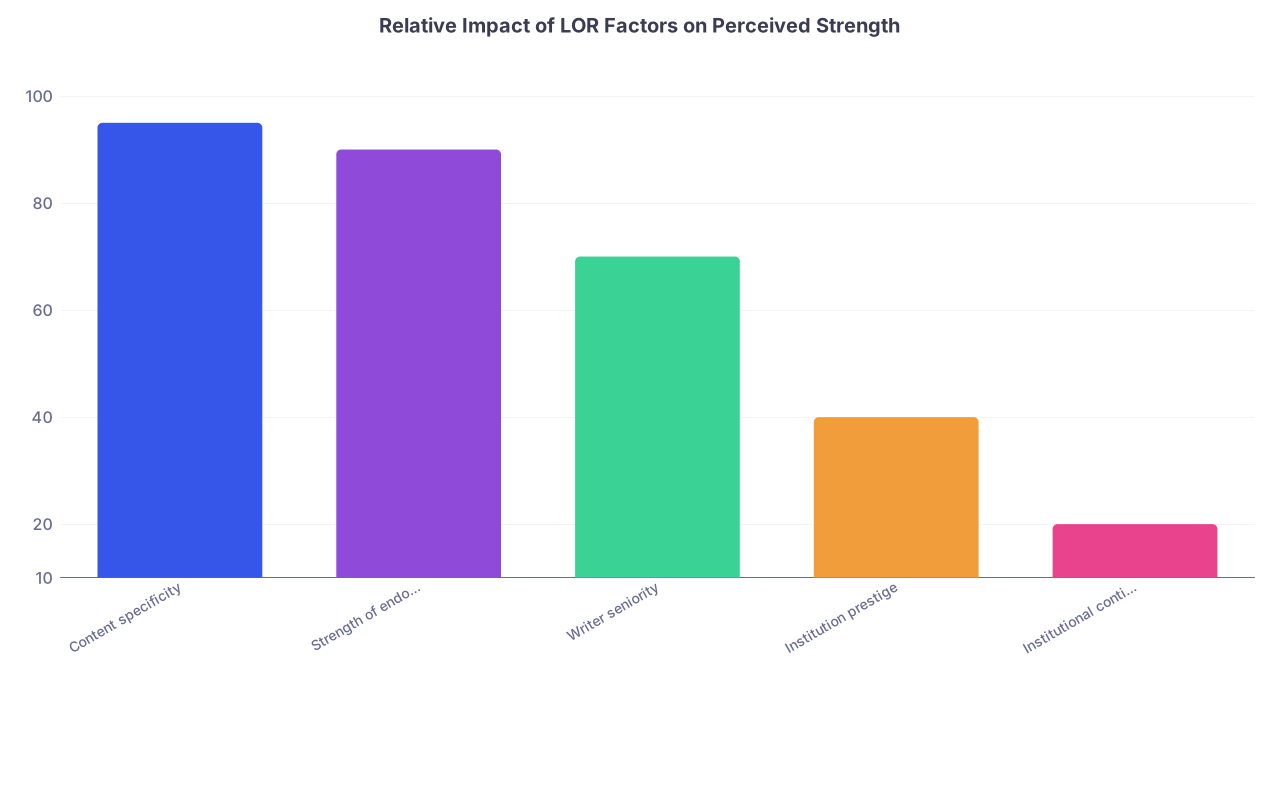
| Category | Value |
|---|---|
| Content specificity | 95 |
| Strength of endorsement | 90 |
| Writer seniority | 70 |
| Institution prestige | 40 |
| Institutional continuity | 20 |
“But Won’t Programs Think This Is a Reused Letter From Last Year?”
Another big spiral: you see the date on the letter and panic that it’s “too old” or they’ll assume you’re a reapplicant.
Reality check:
- Letters written within the same calendar year or even within the last ~12 months are commonly used
- Faculty don’t sit down every August to rewrite fresh LORs for every student they supervised that year
If you’re applying right after your rotations, a letter written 6–9 months ago is completely normal.
If you are actually a reapplicant, then yeah, ideally you refresh at least some letters. But that’s a reapplicant issue, not a “my mentor left the institution” issue.
Programs don’t have the time to Sherlock Holmes the exact timeline of when your mentor moved, and they’re not cross-checking that against your ERAS transmission dates. That’s just your anxiety talking.
Does Their New Institution Change Anything for You?
Sometimes, weirdly, your mentor leaving can help.
Say your mentor was an associate PD at a mid-tier program but just moved to a brand-name institution in your specialty. Same person, same praise, but now their title says “Associate Professor, [Very Famous University].”
Suddenly their name recognition goes up. That letter might carry more weight now.
Even when they move to a smaller hospital, what matters is that they’re still practicing, still part of the field, still credible. If they’re well-known locally or in a niche area, program faculty might recognize their name regardless of where they currently work.
The only time their new institution matters much is when they pick up or lose formal roles like:
- Program Director / APD
- Clerkship Director
- Department Chair
Those titles function as shortcuts: “This person writes a lot of letters; they know what a strong applicant looks like.” But again, if the content is strong, the title is a bonus, not the backbone.
When You Should Consider Getting Another Letter
I’m not going to pretend every situation is magically fine. There are times when, yes, you should probably add or replace a letter—not because they left, but because of how your overall LOR set looks.
Think about your letter “portfolio” the way PDs do:
They want to see:
- At least one strong letter in your chosen specialty, from someone who actually supervised you clinically
- For some fields, a letter from your home department leadership (IM, Surgery especially)
- Evidence from multiple settings, not just one tiny niche of your experience
So if your situation looks like:
- Your only letter in your specialty is from someone no longer clinically active or significantly detached from residency education
- Or your only home department letter is from someone who left and you have zero connection to current leadership
Then, yes, I’d try to add another letter if there’s still time:
- Ask a more current attending in that department
- Reach out to the clerkship director / site director who knows you even moderately well
- Use sub-Is / acting internships to generate new letters
Not because your original letter is invalid. But because programs want multiple data points.
| Situation | What To Do |
|---|---|
| Mentor wrote strong, detailed letter; now at new institution | Keep and use it as-is |
| Mentor left, but is still clinically active and in your specialty | Keep; optionally add one more recent letter |
| Only home department letter is from faculty who left years ago | Try to add a current home department letter |
| Mentor moved out of clinical medicine entirely | Keep as supplemental; add a fresh clinical LOR |
| Letter is 1–2 years old and you’re reapplying | Request an updated version or new letters |

| Step | Description |
|---|---|
| Step 1 | Have mentors LOR |
| Step 2 | Consider new writer |
| Step 3 | Use as supplemental, add clinical LOR |
| Step 4 | Use as part of LOR set |
| Step 5 | Keep letter & seek 1 more specialty LOR |
| Step 6 | Strong, specific letter? |
| Step 7 | Still clinically active? |
| Step 8 | Have other current specialty LORs? |
How to Talk About It If It Ever Comes Up
You’re probably imagining some grilling in an interview:
“So, your letter from Dr. X—why are they no longer at your home institution?”
This almost never happens. Faculty are too busy asking you about your research and the time you made a mistake on the wards.
If it does come up, keep it boring and simple:
“Dr. X was a hospitalist in our internal medicine department when I worked with them on my third-year rotation. They’ve since taken a position at [New Institution], but at the time they supervised me closely and got to know my clinical work very well.”
Done. No drama. No conspiracy.
If they push further (they probably won’t):
“They left for a new opportunity closer to family / with a different role in education. I’ve stayed in touch and I’m grateful they were able to write on my behalf.”
You don’t speculate about their HR history. You don’t overshare. You just tie it back to your connection and clinical work together.

The Hard Truth: This Matters Less Than You Think
Here’s the part that’s easy to say and hard to believe when you’re in full pre-ERAS panic:
If you have:
- A strong, specific letter from someone who actually supervised you
- At least one or two other solid, current clinical letters, ideally in your specialty
- An overall application that isn’t wildly out of range for the programs you’re targeting
Your mentor moving institutions is not going to be the thing that makes or breaks your match.
Programs don’t rank applicants based on “LOR writer remained at same hospital, +2 points.” They’re looking for:
- Clinical competence
- Reliability
- Ability to work in a team without creating drama
- Evidence that faculty trust you with patients
Your mentor’s letter still does that. Even from a new zipcode.
What You Should Do Today
Do this right now:
Open your LOR list and, next to your mentor’s name, write down:
- Their current role (clinician? educator? in your specialty?)
- How well they knew you clinically (rotation? sub-I? research plus clinic time?)
- Whether you have at least one other strong current letter in your target specialty
If the answers look like:
- “Yes, they’re still clinically active; yes, they knew me well; yes, I have at least one other solid specialty LOR”
Then stop second-guessing that letter. Keep it. Use it proudly.
If you realize you’re short on current specialty letters, make one concrete move today: email one attending or clerkship director and ask if they’d be willing to write on your behalf this cycle.
Not ten emails. Not rewriting your whole strategy. Just one ask.
That, more than obsessing over a logo on your mentor’s letterhead, is what will actually move your application forward.