
Most applicants are using standardized and narrative letters of recommendation completely wrong.
They treat them as interchangeable “letters.” They are not. They are different weapons, and if you do not deploy the right one for the right program and the right weakness, you are wasting opportunities.
Let me break this down specifically.
1. What “Standardized” vs “Narrative” LORs Actually Mean
First, definitions. Because a lot of confusion starts right here.
When I say standardized LOR, I am talking about letters that:
- Use a structured form or template, usually provided by a specialty or program (e.g., EM SLOE, plastic surgery standardized form, some medicine departmental letters).
- Include check-box ratings (top 10%, above average, etc.).
- Often force explicit comparisons: “Rank this student compared to peers,” “Would you take them in your program?”
- Have limited free-text space with specific prompts.
Narrative LORs:
- Classic “free text” letters on department or personal letterhead.
- Attending can choose structure, length, and focus.
- No forced ranking or standardized comparison fields.
- Quality varies wildly—from “this student is excellent” fluff to deeply specific, high-yield advocacy.
In ERAS, almost everything just looks like “LoR,” but behind that upload are two very different beasts.
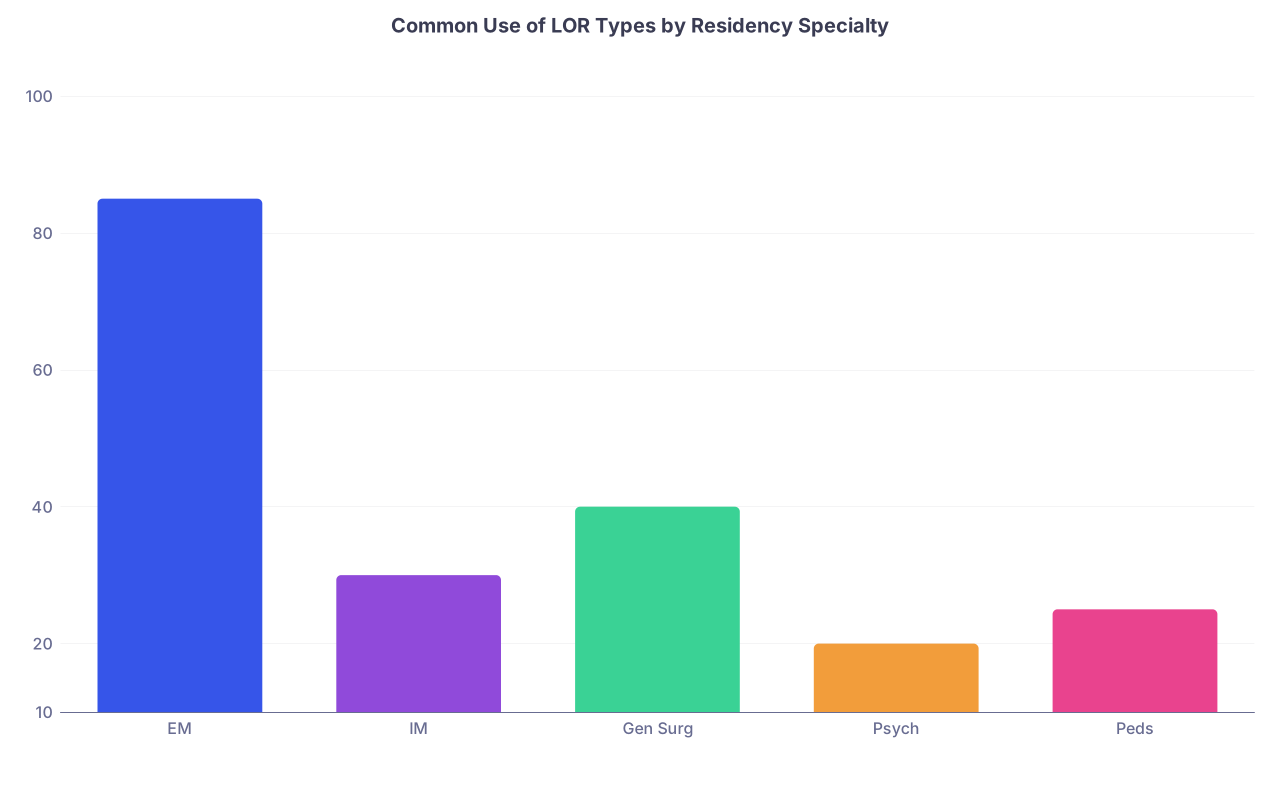
| Category | Value |
|---|---|
| EM | 85 |
| IM | 30 |
| Gen Surg | 40 |
| Psych | 20 |
| Peds | 25 |
Interpretation: In EM, standardized (SLOE-style) letters dominate. In IM, surgery, psych, peds, they exist in some places but are not universally expected.
Concrete examples
Emergency Medicine:
The SLOE (Standardized Letter of Evaluation) is king. A generic narrative letter from an EM attending is almost worthless compared to a SLOE. Programs know the SLOE language, the grading culture, and the embedded ranking.Internal Medicine:
Many academic IM departments now produce a Departmental / Chair Letter with semi-standardized language or a template (especially at large institutions). Still, narrative letters from subspecialty faculty carry weight if they are detailed.Surgery:
You will see structured forms in some departments, but most letters are still classic narrative. However, program leadership reads them with a quasi-standardized lens: who wrote it, what phrases, what level of advocacy.
If you approach all of these as “just letters,” you miss the strategic layering: standardized = benchmarking, narrative = storytelling and nuance.
2. How Programs Actually Use Each Type
Residency programs are not reading every word of every letter with equal attention. They do pattern recognition.
Standardized letters: the triage tools
For standardized formats (EM SLOE is the clearest example), programs use them to:
- Rapidly compare you to peers: “Top 1/3, middle 1/3, lower 1/3.”
- See global rank statements: “I would rank this student in the top X of those I have supervised.”
- Calibrate across schools: they know certain schools grade harder / softer.
- Spot red flags in coded language (e.g., “met expectations” in a box where “outstanding” exists is not neutral; it is a downvote).
These letters are heavily weighted because they compress a ton of information into a consistent, comparable format. Even busy PDs read them.
Narrative letters: the nuance and the rescue
Narrative letters:
- Fill in context: non-traditional path, late bloomers, change in trajectory.
- Show specific behaviors: teaching, leadership, team dynamics, integrity.
- Provide personal advocacy: “I pushed to have her on our short list last year” or “I would be thrilled to have him in our program.”
- Counterbalance or explain mediocre standardized language.
But they are noisy. Some attendings overpraise everyone. Some underpraise everyone. Some write three sentences. Some write two pages. Programs learn which letter writers are calibrated and which ones are useless cheerleaders.
So the tactical rule:
- Standardized LORs set your floor and comparative rank.
- Narrative LORs set your ceiling and tell the story of why to invest in you.
3. Tactical Roles: When Each Type Helps or Hurts
Here is where people start losing ground. They collect whatever they can, in whatever format, and hope volume makes up for strategy. It does not.
If you are a strong applicant
“Strong” meaning: solid clinical evals, good Step 2 (if required), no major professionalism issues, reasonably competitive for your target specialty.
For you:
Standardized letters lock in your advantage.
A SLOE with top-third rankings and “outstanding” boxes is a weapon. A structured IM departmental letter putting you in the “top 10% of students I have supervised in the last 5 years” gives committees permission to rank you high.Narrative letters should be specific and aligned with your brand.
If your angle is “teaching-oriented future academic,” then your narrative letters should highlight teaching, academic curiosity, teamwork. Not vague “hardworking, pleasant, punctual.”
You do not want a mediocre standardized letter from a place that does not know you. A lukewarm standardized letter can drag you down more clearly than a generic narrative one.
If you are a borderline or late-blooming applicant
Here is where narrative letters can save you if you are deliberate.
Standardized letters will often:
- Reflect lower rankings: “middle 1/3,” “above average but not outstanding.”
- Include hedged or generic comments.
- Expose any evaluator ambivalence in a very obvious, check-box way.
You cannot hide that. What you can do is flank it with powerful narrative advocacy:
- A subspecialist who saw your improvement across the month.
- A PI who can speak to your persistence and intellectual maturity.
- A medicine attending who watched you struggle early but finish as one of the strongest students on the team.
I have seen this scenario multiple times:
A student with a mediocre SLOE but a brutal backstory, and a narrative letter that essentially says, “I watched the growth; if you look at raw numbers alone you will miss what this person is now capable of.” That can move a candidate from “auto-ding” to “discuss in committee.”
When standardized hurts more than it helps
You should be cautious with standardized LORs if:
- The writer has not seen you enough clinically.
- You were on a short, chaotic rotation where nobody had time to know you.
- You had a documented conflict or mismatch with the team.
In those settings, a generic narrative letter is safer than a form that makes the writer commit to lukewarm rankings.
I am not telling you to avoid required standardized letters (e.g., EM SLOEs). I am telling you not to manufacture additional mediocre standardized evaluations if they are optional.
4. Specialty-Specific Realities (and My Take on Each)
You cannot apply the same LOR strategy for EM, IM, surgery, psych, and think you are being “efficient.” You are being lazy. Programs notice.

Emergency Medicine
- Non-negotiable: SLOEs. Ideally 2, usually from academic EM rotations.
- Programs know SLOE language extremely well.
“Outstanding” vs “excellent” vs “very good” is not semantics; it is ranking.
Narrative EM letters are basically filler unless from a nationally known figure. A glowing narrative from an EM attending at a community site will not compensate for a weak SLOE from an academic site.
Tactic:
Prioritize doing your EM rotations where you can secure strong SLOEs from faculty who actually observed you and know how to write them.
Internal Medicine
- Mix of:
- Departmental or Chair letter (semi-standardized at some institutions).
- Classic narrative letters from ward attendings and subspecialists.
Many IM PDs still read narrative letters pretty carefully. They are looking for:
- Work ethic and follow-through.
- Ownership of patients.
- Team behavior (especially with nurses and co-residents).
- Ability to think through complex cases.
Tactic:
Have at least one letter from a core IM ward attending who saw you across most of the month and can describe your day-to-day performance, and one from a subspecialty or research mentor if you are leaning academic.
If your school offers a structured departmental letter:
Use it as one of your “anchors” if you know your comparative standing is decent. If you are near the bottom, over-reliance on that letter is dangerous; you will need narrative letters to offset the impression.
General Surgery
Surgery still runs heavily on:
- Reputation of letter writer.
- Specific language: “I would recruit this student without reservation,” “I tried to persuade them to stay here,” etc.
- Implicit codes: “technically capable,” “strong work ethic,” “never complained.”
Standardized elements exist in some departments, but narrative is still how they talk.
Tactic:
For surgery, a rigid standardized format that yields only “above average” boxes is worse than a tightly written narrative from a surgeon who will actually go to bat for you.
You want:
- One letter from a high-volume service where you clearly pulled your weight.
- One from a well-known surgeon if possible (PD, chair, program leader).
- Possibly one from a research mentor if they are embedded in the surgical department.
Psychiatry, Pediatrics, Family Medicine, others
These are more narrative-heavy specialties, but some institutions use structured forms for departmental letters. In general:
- Narrative detail matters more than check-box structure.
- Programs care about interpersonal functioning, insight, reliability, self-reflection.
Tactic:
Choose writers who have watched you interact repeatedly with patients and teams. A standardized “top half” box check with no story behind it will not move the needle as much as a narrative recounting a difficult patient encounter you handled well.
5. Choosing Who Writes Which Type
This is where you apply actual strategy instead of just asking whoever smiled at you once on rounds.
| Situation | Better as Standardized | Better as Narrative |
|---|---|---|
| EM rotation at academic site | Yes (SLOE) | Only if extra slot |
| Core IM ward month | Department letter or structured form if strong | Attending narrative if detailed |
| Subspecialty elective (IM, surg subspecialty) | Usually no | Yes, if they know you well |
| Research mentor | Rarely | Yes, especially for academic-leaning apps |
| Community rotation short-term | Only if required | Narrative or skip if weak |
When to push for standardized
You push for standardized when:
- The specialty expects it (EM, some IM departments).
- You know you performed near the top of the group.
- The writer is experienced with the format and uses it often.
Example:
On a busy IM ward month, you pre-rounded, knew your patients cold, stayed late, helped interns, and the attending explicitly said, “You’re one of the strongest students I’ve had this year.” That is the rotation you want in a departmental / comparative letter.
When to insist on narrative
Prefer narrative when:
- The writer knows you beyond a single rotation (ongoing mentorship).
- Your performance was strong but not obviously “top” compared to gunners, and a check-box ranking might undersell you.
- You have context that needs to be explained: personal challenges, growth curve, career fit.
A cardiology attending who watched you across several weeks, knows your research, and explicitly said they are “happy to strongly support your IM application” should be writing a longer, narrative-heavy letter, not just ticking boxes.
6. Coordinating Message: Making Letters Work Together
The point isn’t to stack as many glowing letters as possible. It is to create a coherent profile.

| Step | Description |
|---|---|
| Step 1 | Self-assessment |
| Step 2 | Identify key standardized rotations |
| Step 3 | Identify strongest narrative writers |
| Step 4 | Meet with potential writers |
| Step 5 | Share CV + personal statement themes |
| Step 6 | Request specific emphasis |
| Step 7 | Review LOR mix by upload deadline |
| Step 8 | Specialty requirements |
Step 1: Know what each letter is doing for you
You should be able to answer, in one sentence each:
- “My EM SLOE from Hospital X shows I function at the top end clinically.”
- “My IM ward letter shows I own patients and work well with teams.”
- “My research mentor letter shows academic potential and persistence.”
- “My chair letter gives standardized comparative reassurance.”
If you cannot do that, you are collecting letters, not constructing an application.
Step 2: Talk to your writers like an adult
You do not script their letters. But you absolutely can, and should, say something like:
“I am applying to internal medicine with a strong interest in cardiology and academic medicine. I am hoping your letter can particularly speak to my clinical reasoning on the service, how I handled feedback, and teamwork with residents.”
And then hand them:
- A brief bullet list of cases you saw with them.
- Your CV.
- A draft personal statement if you have it.
- A short paragraph on what you are hoping programs understand about you.
This matters more for narrative letters than standardized ones, but even for forms, it nudges the writer to use strong, specific examples in their comments.
7. Handling Weak or Mixed Standardized Letters
Let us talk about damage control, because not every rotation goes well.
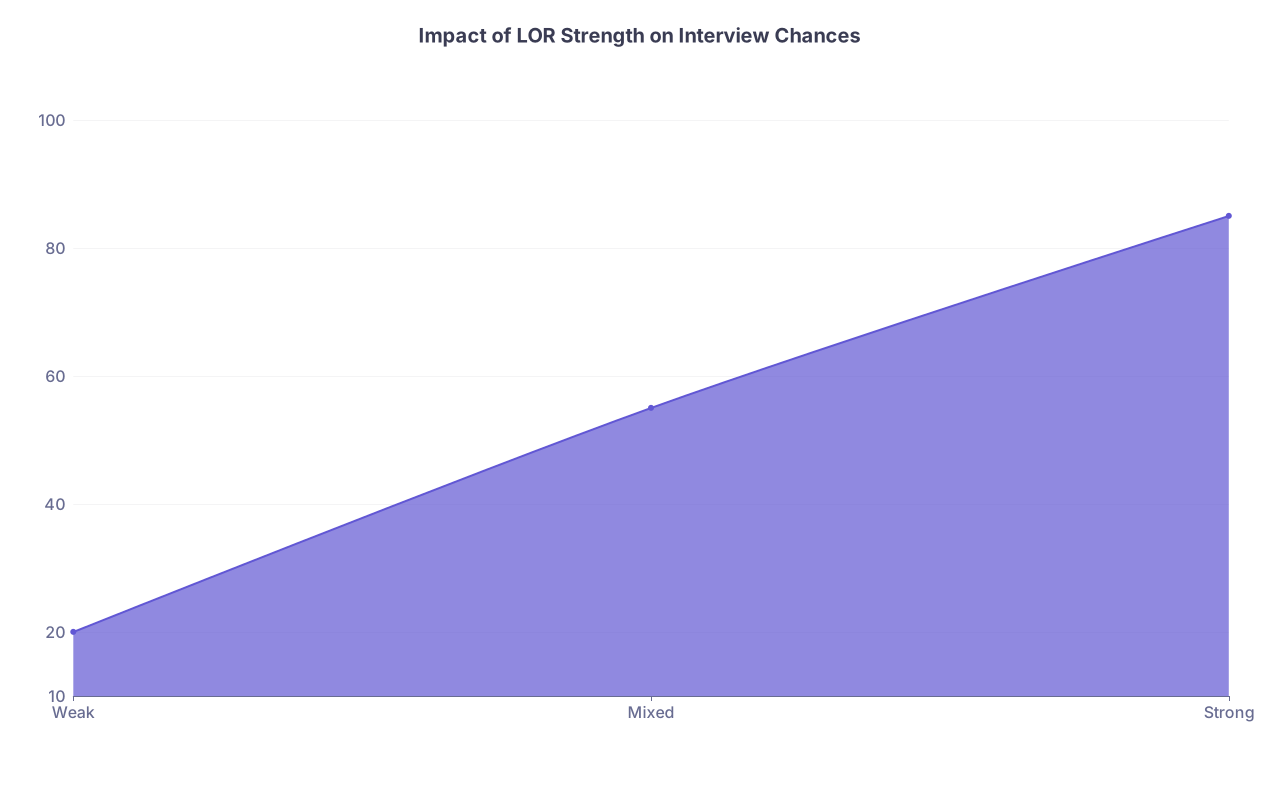
| Category | Value |
|---|---|
| Weak | 20 |
| Mixed | 55 |
| Strong | 85 |
Not real data, but directionally correct: weak letters crush you, strong letters are rocket fuel, mixed ones are survivable if you are smart.
Scenario: Mediocre SLOE / standardized letter
What you do:
Do not duplicate the problem.
Avoid generating extra standardized letters from similar contexts that will mirror the same “average” rankings.Stack your best narrative letters.
Choose 2–3 writers who:- Saw you at your best.
- Can describe very concrete strengths.
- Are willing to be explicitly positive.
Align your personal statement and MSPE narrative.
If the issue was early performance, growth, or a tough personal period, you can very briefly acknowledge the arc. Not a pity story, but a growth story.If appropriate, talk to your dean’s office.
Occasionally, they can adjust phrasing or contextualize an outlier evaluation in the MSPE, so it does not look like your entire clinical story.
Scenario: One lukewarm narrative, one strong standardized letter
This is easier.
A single generic narrative letter will not sink you if your standardized letters are clear and positive. In this case, consider:
- Not using that lukewarm narrative if you have stronger alternatives.
- If you must use it (small school, limited options), balance it with another enthusiastic narrative.
8. Practical Steps: How Many of Each, and From Whom?
Different specialties have slightly different norms, but this is a workable baseline.

Typical letter mix by specialty
Emergency Medicine
- 2 SLOEs (from away and/or home EM rotations).
- 1–2 additional narrative letters (often IM, surgery, or research) if slots remain.
Internal Medicine
- 1 departmental / chair letter (semi-standardized at many programs).
- 2 narrative letters from core IM attendings or subspecialties.
- 1 optional research or longitudinal mentor letter if you are academic-leaning.
General Surgery
- 3 narrative letters.
- One from a core surgery service.
- One from a well-known surgeon if possible.
- One from another surgery or research mentor.
- 3 narrative letters.
Psych, Peds, FM
- 3 narrative letters, mostly from that specialty.
- 1 optional letter from IM, research, or a longitudinal mentor if it adds unique value.
Choosing within limited slots
ERAS caps how many letters you can assign per program (currently 4). More is not better. Think:
- 1–2 letters that benchmark you (standardized, department, chair, very comparative).
- 1–2 letters that tell your story (narrative, detailed, specific to your strengths).
If EM: both benchmark letters are SLOEs, story letters are bonus.
If IM: chair/departmental letter + 1 key IM narrative for benchmarking; extra narrative for story and nuance.
9. Timing, Logistics, and Avoiding Common Mistakes
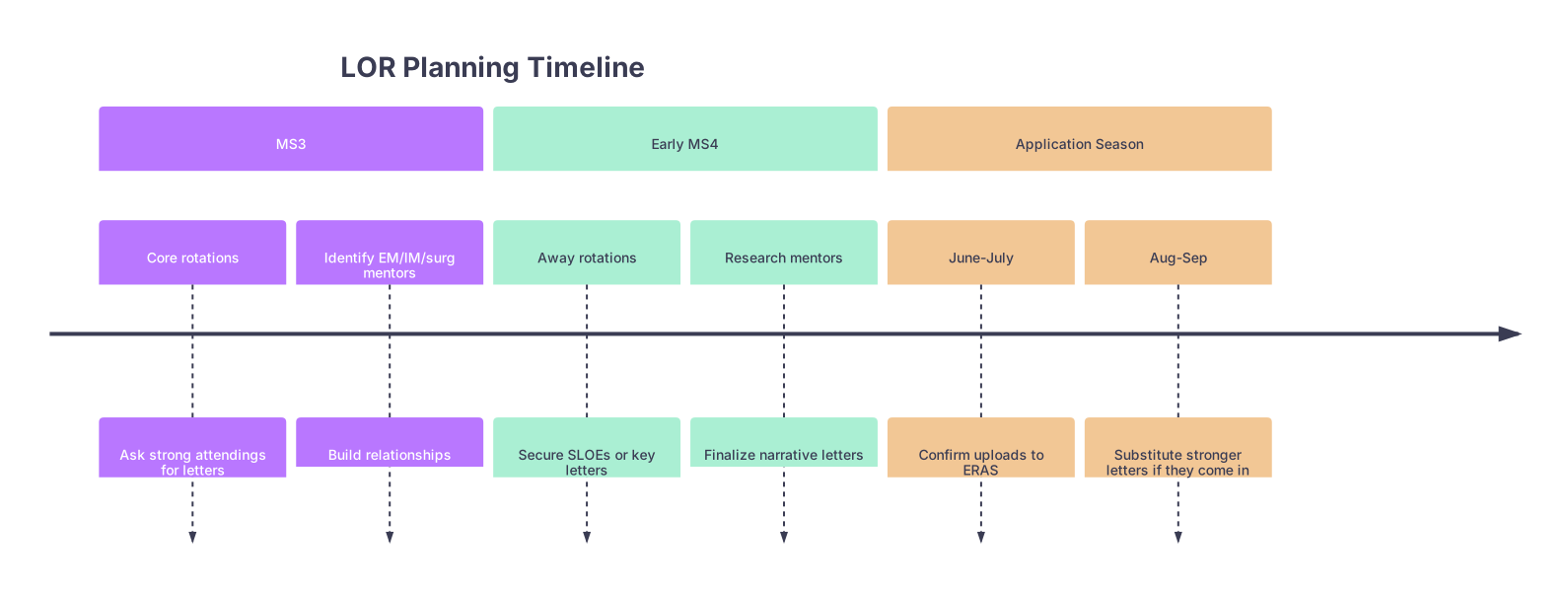
| Period | Event |
|---|---|
| MS3 - Core rotations | Ask strong attendings for letters |
| MS3 - Identify EM/IM/surg mentors | Build relationships |
| Early MS4 - Away rotations | Secure SLOEs or key letters |
| Early MS4 - Research mentors | Finalize narrative letters |
| Application Season - June-July | Confirm uploads to ERAS |
| Application Season - Aug-Sep | Substitute stronger letters if they come in |
Ask while you are still fresh in their mind
Ask at the end of the rotation or shortly after:
“Would you feel comfortable writing me a strong letter of recommendation for X specialty?”
If they hesitate or sound lukewarm, do not push. A “meh” letter is worse than no letter.
Clarify format at the time of request
Ask directly:
- “Our department has a standardized form / chair letter process. Would you be submitting that, or a separate narrative letter?”
- “For EM, my school uses SLOEs. Are you comfortable filling out a SLOE for me based on this rotation?”
You should know which type is coming before you count it as one of your four.
Common mistakes I see over and over
Too many generic narrative letters.
Four “hard-working, pleasant, punctual” letters with no comparative statements. That reads as white noise.Ignoring required or de facto required standardized evaluators.
EM applicant without a proper SLOE? PDs will not take that seriously.Using a weak standardized letter because it looks “official.”
A department form that quietly ranks you in the lower half is a slow poison in your file.No coordination of themes.
One letter calls you an aspiring surgeon, another calls you a future cardiologist, your personal statement says you want primary care. Programs notice the mismatch.
10. Bottom Line Strategy
If you remember nothing else:
Standardized letters:
Use them when they are required or when you are confident you will be ranked near the top of your cohort. They are your comparative proof of caliber.Narrative letters:
Use them to explain, to amplify, to humanize. They are your argument that you belong in their program, not just in their applicant pool.

When you combine them intelligently—one or two letters locking in your benchmark, one or two letters telling a coherent, specific story—you stop being “Applicant #374” and start being a candidate someone on the committee will actually remember and argue for.