
What happens when your LOR packet quietly tells programs: “I’m confused, unfocused, and no one really wants to vouch for me”?
Let me be blunt. Most applicants think as long as they have “four letters” they are fine. That is how people quietly kill their application.
Programs do not just read letters individually. They read the combination. The mix. Who wrote them. What specialty they are from. How long they knew you. Whether they match your story.
A bad combination of letters of recommendation for residency can sink you even if each individual letter is “okay.” I have watched perfectly good applicants get screened out or side‑eyed because their letters together sent the wrong message.
You are not just choosing letter writers. You are building a signal. If that signal is mixed, hesitant, or off‑specialty, you are asking committees to doubt you.
Let’s go through the fatal combinations and how to avoid stepping on these landmines.
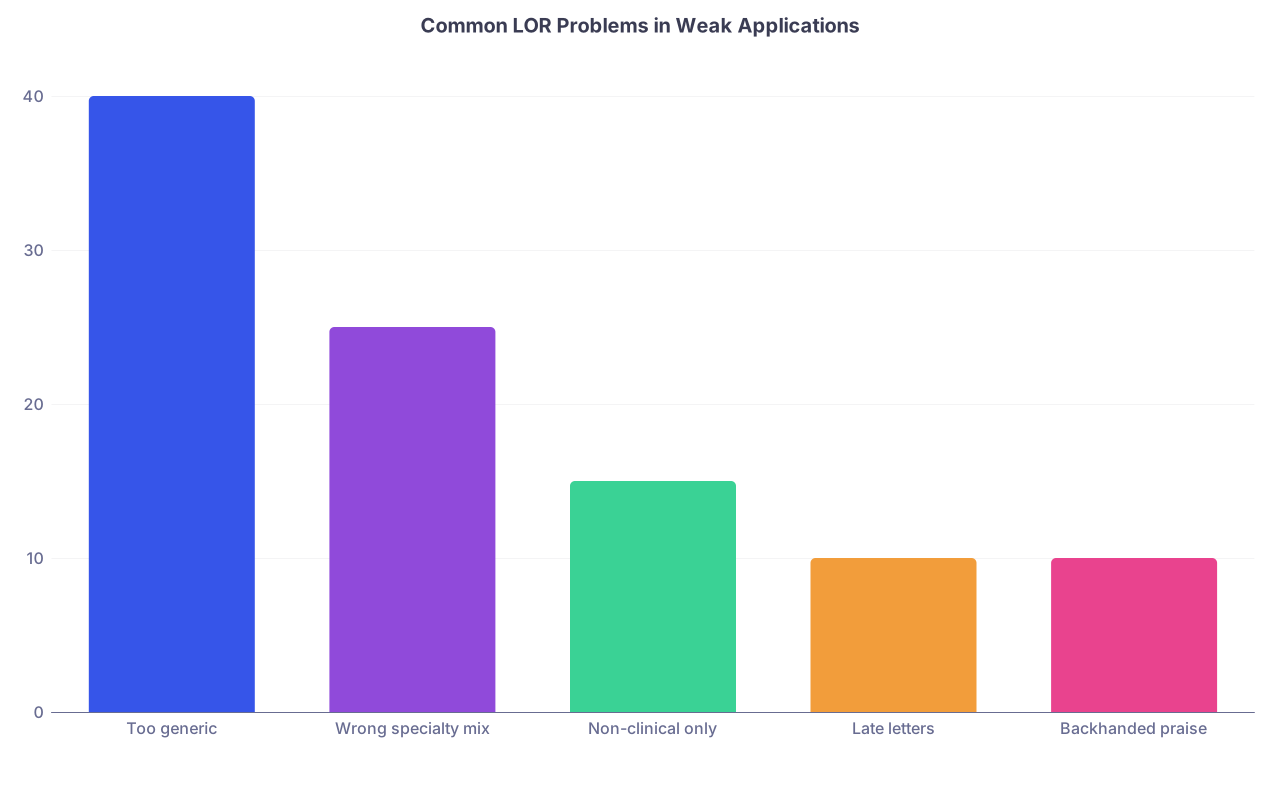
| Category | Value |
|---|---|
| Too generic | 40 |
| Wrong specialty mix | 25 |
| Non-clinical only | 15 |
| Late letters | 10 |
| Backhanded praise | 10 |
1. The “No One in the Specialty Likes Me” Mix
This is the most damaging combination, and I see it every single cycle.
The pattern
You are applying to internal medicine (for example) and your LOR set looks like this:
- 1 surgery attending
- 1 psychiatry attending
- 1 basic science PhD (non‑clinician)
- 1 primary care NP from a pre‑clinical shadowing experience
Zero internal medicine core faculty. Zero hospitalist. Zero subspecialty IM (cards, GI, heme/onc). That is a loud signal.
Programs do not think, “Oh, interesting mix.” They think, “Why does internal medicine not want to vouch for this person?”
Why this kills you
It raises the exact questions you do not want:
- Did they struggle on the IM clerkship?
- Were they unprofessional or unreliable with the IM team?
- Did no IM faculty feel comfortable writing a letter?
- Are they actually committed to this specialty?
They will not email your school to clarify. They will just slide your file into the lower pile.
How to avoid this
You must have at least:
- 2 strong letters from the specialty you are applying into (for most core specialties), and
- 1–2 additional letters that are at least adjacent or broadly general (IM, FM, or whatever your field typically accepts)
If you had a rough IM clerkship:
- Do not just avoid IM entirely. That looks worse.
- Hustle to get a different IM experience: a sub‑I, acting internship, or away rotation with a clean slate.
- Tell the attending early: “I am applying to internal medicine and hoping to earn a strong letter if I perform well.”
You are trying to fix the signal: “Yes, I had issues before, but now IM faculty who worked with me recently are comfortable backing me.”
2. The “Why Are You Cheating on Us?” Mixed‑Specialty Disaster
Programs hate doubt. Nothing breeds doubt faster than letters from different specialties that do not match your stated interest.
The pattern
You are applying to:
- Diagnostic radiology, but your letters are: 2 from surgery, 1 from anesthesiology, 1 from EM. No radiology.
- OB/GYN, but your strongest letter is from pediatrics, and the OB/GYN letter is weak or missing.
- Dermatology, but your letters are: 1 IM, 1 surgery, 1 family med. No derm faculty, no derm research PI.
Worse: the letters themselves hint at indecision.
I have seen this line more than once:
- “When we worked together, she was strongly considering surgery, and I believed she would be an excellent surgical resident.”
In an application to radiology. That is catastrophic. It screams “uncommitted” and “using this as a backup.”
Why this kills you
Residency programs invest years and a lot of money in you. They care about:
- Commitment to the field
- Fit with the culture
- Probability you will actually show up and stay
Mixed‑specialty letters that point in different directions erode that. It looks like:
- You decided late
- You are using them as a failsafe
- No one in the target specialty feels strongly about you
How to prevent this mess
Decide your specialty early enough
You do not need perfection, but by early MS4 you should know what you are actually applying to.Align letters with your final specialty choice
If you pivoted from surgery to radiology, stop collecting new surgery letters “just in case.” You need:- At least 1–2 letters from radiology (clinical or research, depending on field norms)
- General IM/FM letters are okay as supplements, not as the lead
Brief your writers clearly
Do not assume they remember your plans. You tell them, in writing:- What specialty you are applying to
- Why
- What aspects of your work with them fit that specialty
If you are applying to a competitive field and a realistic backup (rad onc + IM, derm + IM), you must be extremely deliberate about which letters go to which programs. ERAS lets you assign letters selectively. Use that.

3. The “All Generic, No Substance” Committee-Shrug Mix
Here is the combination that looks okay on paper but feels dead on arrival when read.
The pattern
You technically have:
- 1 letter from your core specialty
- 2 from other clinical rotations
- 1 research or department chair letter
So what is the problem? Every letter sounds like this:
- “She was a pleasure to work with.”
- “He is a hard worker.”
- “She will make an excellent resident in any program.”
Zero specific anecdotes. Nothing quantifiable. No “top X%” comments. No real sense of ownership from the writer. ERAS is full of this fluff, and committees can smell it.
Why this combination hurts
When four different faculty members all produce vague, pleasant letters, the meta‑message is:
- No one was impressed enough to put their reputation on the line.
- You did not create a memorable impact on any team.
- You did not pick letter writers who know you in depth.
One vague letter is survivable. A full set of them is a red flag.
How to avoid this
You do not control their writing style, but you do control who you ask and how you set them up:
Choose writers who actually know you, not just “big names.” A lesser‑known community attending who worked with you closely for 4 weeks is better than a famous chair who barely remembers your name.
Send a targeted letter packet, not just your CV:
- A short 1‑page “LOR brief”: your specialty choice, 2–3 cases you worked on with them, your strengths you hope they highlight.
- Your personal statement draft.
- Your CV.
Ask the right question
When you request a letter, use the actual phrase:- “Would you feel comfortable writing a strong letter of recommendation for my application to [specialty]?”
If they hesitate, hedge, or downgrade it to “supportive” or “positive” without the word “strong,” do not use them as a primary letter. That hesitation often translates into a lukewarm letter.
4. The “Non-Clinical Overload” Mix
Programs match residents to take care of patients. Not to pipette, code, or publish abstracts all day.
The pattern
Particularly common in research-heavy applicants or MD/PhD students:
- Letter 1: PhD mentor (non‑clinician)
- Letter 2: Postdoc research supervisor
- Letter 3: Another PhD or MPH program director
- Letter 4: One random outpatient attending you saw for 3 half‑days
Your entire LOR packet screams “research fellow,” not “resident physician.”
Why programs get nervous
They start to question:
- Have you actually functioned on an inpatient team?
- Can you pre-round, prioritize, call consults, manage cross-cover?
- Are you going to vanish to the lab mid-residency?
For physician‑scientist tracks and research-heavy specialties (rad onc, neurology with research focus, dermatology), research letters help — but only when balanced.
Safer combinations
Your core letters must still include:
- 2–3 clinical letters from attendings who directly supervised patient care with you
- 1 research letter at most as a supplement, unless your field absolutely expects more (and even then, never zero clinical)
If you are MD/PhD or heavy research:
- Make absolutely sure at least one respected clinician writes something like:
- “Despite extensive research time, she integrated seamlessly into the inpatient team and functioned at or above the level of an intern.”
That one line can offset a lot of “is this person really clinical?” anxiety.
| Target Specialty Type | Minimum Clinical Specialty Letters | Research Letters Safe Range | Off-Specialty Clinical Letters |
|---|---|---|---|
| Core IM/FM/Peds | 2–3 IM/FM/Peds | 0–1 | 1–2 |
| Competitive (Derm, Ortho, ENT) | 1–2 in specialty | 1–2 | 1–2 general (IM/Surg) |
| Research-heavy (Rad Onc, Neuro w/ research) | 1–2 in specialty | 1–2 | 0–1 |
5. The “Late, Missing, or Randomly Assigned” Chaos Mix
This is the quiet killer. Not dramatic, just disorganized. And programs read disorganized as unprofessional.
The pattern
- You list 4 letters in ERAS, but only 2 are actually uploaded by the time programs review applications.
- You assign the wrong letter to the wrong program (e.g., a generic IM letter to a derm program, while your derm letter sits unused).
- You panic in September and ask a last‑minute attending for a letter. They turn it around in 48 hours. It reads like exactly what it is: rushed and superficial.
Why programs care
Programs do not have time to track your missing documents. They see an incomplete or sloppy file and infer:
- Poor planning
- Weak mentorship
- Limited professionalism
None of these help you.
How to avoid this amateur hour
Set internal deadlines
Do not ask for letters in late August and expect timely uploads. Ask:- End of rotation or within 1 week of finishing
- Give them a target deadline: at least 3–4 weeks before ERAS submission
Track everything like it actually matters
Make a simple sheet:- Writer
- Specialty
- Date requested
- Date they agreed
- Date uploaded
- Which programs they are assigned to
Audit your letter-program matching before submission
Especially if you are dual‑applying. You must prevent:- A letter praising you as a great future surgeon going to your radiology programs
- A derm research PI letter going to community IM programs that do not care
If you are unsure which letter to send where, ask someone who has sat on a selection committee. Their 10‑minute opinion can save your cycle.
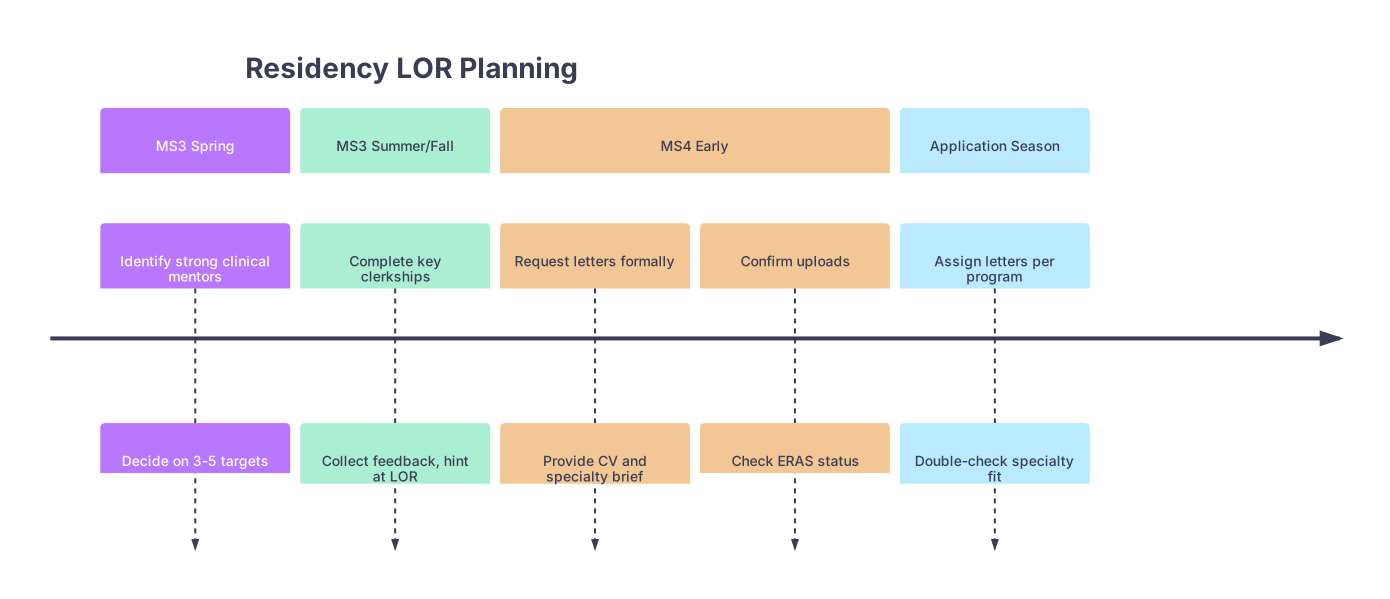
| Period | Event |
|---|---|
| MS3 Spring - Identify strong clinical mentors | Decide on 3-5 targets |
| MS3 Summer/Fall - Complete key clerkships | Collect feedback, hint at LOR |
| MS4 Early - Request letters formally | Provide CV and specialty brief |
| MS4 Early - Confirm uploads | Check ERAS status |
| Application Season - Assign letters per program | Double-check specialty fit |
6. The “Backhanded Praise + Red Flag” Mix
One toxic letter can undo three excellent ones. And you often never see it coming.
The pattern
Most students massively underestimate the damage from even one “concern” sentence in a letter. The killer phrases look like:
- “While he occasionally struggled with time management, he responded well to feedback.”
- “She required more supervision than most students at her level but showed steady improvement.”
- “He will do well in a structured environment with close oversight.”
On its own, it is bad. But when that letter sits next to:
- A generic “hard-working” letter
- A research-only letter
- A distant department chair letter
The combination screams: problem child.
How to reduce your risk
You cannot eliminate risk, but you can dramatically lower it.
Avoid writers who seemed lukewarm about you
If your eval comments during the rotation were mixed or the attending gave you “meets expectations” across the board, do not expect a transformative letter.Ask explicitly for a strong letter
As I said earlier, pay attention to their reaction. If they say:- “Sure, I can write you a letter” in a flat tone
- “I can write a supportive letter”
That is often code for “I will not trash you, but I will not sell you.” Use sparingly, if at all, especially in competitive fields.
Diversify but prioritize
You want 1–2 strong core letters that you are confident in. Then, if one of the others ends up neutral or weak, your packet can survive.
There is no perfect protection. But many disasters were avoidable with better choice of writer and a bit of social awareness on rotations.

7. Combinations That Actually Work
Let me give you a few examples of coherent mixes. Not perfect, but they send a clear, consistent message.
Example: Internal Medicine applicant (solid, not superstar)
- IM ward attending from sub‑internship (core letter)
- IM subspecialty attending (cards, heme/onc, etc.)
- Family med or hospitalist from a different site showing consistency
- Research mentor in outcomes/quality within IM (optional)
Signal: “This person likes internal medicine. Internal medicine likes them. Multiple clinical teams have seen them function and vouch for them.”
Example: Radiology applicant with late switch from surgery
- Radiology attending from a dedicated elective (emphasize quick adaptation, strong reasoning)
- Second radiology letter from research or another rotation
- IM or surgery letter that highlights analytic thinking and reliability (not “future surgeon”)
- Optional: research letter from imaging-related project
Signal: “Yes, they came to radiology later, but now multiple radiologists and at least one core clinician back this choice without contradictions.”
Example: Dermatology with strong research
- Derm attending from clinic or inpatient consults
- Derm research PI letter that clearly describes clinical or translational relevance
- IM or pediatrics attending praising professionalism and follow-through
- Optional: second derm clinical letter
Signal: “Serious about derm, productive in research, and not a disaster on general teams.”
8. How to Audit Your Current LOR Mix (Before It Is Too Late)
Before you lock anything in, sit down and do a brutal review.
Ask yourself:
If a stranger saw only my specialty choice + letter writers’ names and departments, what would they assume about me?
- Deeply committed?
- Confused?
- Back-up hunting?
Does every letter align with my stated specialty?
- Any writer likely to mention prior interest in a completely different field? That letter may be poison for certain programs.
Do I have at least 2 writers who have seen me directly care for patients in settings relevant to my specialty?
- If not, fix that first. Not with email. With actual clinical work.
Is there any obvious gap that would raise questions?
- Applying to IM with zero IM letters.
- Applying to surgery with only clinic‑based letters and no OR or inpatient.
- Applying to psych with zero psych/neuro/behavioral health representation.
If you see one of these red flags in your combination, deal with it now, not when ERAS is already submitted.
FAQ (Exactly 3 Questions)
1. Is it better to have more letters (5–6) to “cover my bases,” even if some are weaker?
No. Excess weak letters do not “average out” the strong ones. Committees look for a coherent picture, not volume. Four well-chosen letters that fit your story are far safer than six where half are generic or off‑specialty. Extra weak letters can actually dilute the impact of your strongest advocates.
2. Can I reuse a strong letter that talks about a different specialty if I changed my mind?
You should be very cautious. If the letter explicitly frames you as a “future surgeon” and you are now applying to radiology, sending that letter is risky. If the specialty is never mentioned and the content is mostly about work ethic, clinical reasoning, and professionalism, it might be reusable as a general letter. When in doubt, ask an advisor who has read a lot of letters and sat on a selection committee.
3. How many non-clinical or research letters are acceptable?
For most applicants, one research or non‑clinical letter is the upper limit, and only as a supplement to strong clinical letters. Core fields like IM, FM, peds, EM, and surgery care much more about how you function on the wards than how you perform at a bench or in a statistics program. If your mix ever flips to “more research than clinical,” you are sending the wrong message.
Key points to walk away with:
- Programs read your LOR mix as a single signal. Off‑specialty, generic, or non‑clinical heavy combinations quietly damage you.
- You need at least 2 strong, aligned clinical letters in your chosen specialty or close to it, with the rest carefully chosen to reinforce your story.
- If your current combination raises obvious questions—no letters in your field, conflicting specialty messages, or mostly generic boilerplate—fix it now, before you hit submit.