
The fantasy that every program gets a perfectly customized letter set is…mostly fake.
Let me say that out loud because it feels almost illegal: most applicants recycle the same 3–4 LORs across a ton of programs. And they match just fine.
You’re not the only one staring at ERAS thinking, “How the hell am I supposed to target 60 programs with only 3 decent letters?” or “Is it bad if my ‘top choice’ and my ‘safety’ see the exact same letters?” This is normal. It just feels like you’re doing something wrong because the stakes are disgusting and nobody explains the reality clearly.
Let’s unpack this without sugarcoating, but also without feeding every nightmare your brain is already playing on loop.
The Ugly Truth: Programs Know You’re Reusing Letters
Programs are not naïve. They know:
- Letters are usually generic (even the “strong” ones).
- Faculty don’t have time to write 5 custom versions per student.
- ERAS is literally designed for you to reuse letters across programs.
So when you’re panicking: “What if they realize I used the same LORs everywhere?” — they already assume you are. It’s the default.
Where people actually get into trouble is not “same set vs different set.” It’s:
- weak letters
- wrong mix of letters
- missing required types (like no specialty-specific letter)
- red-flag content
If your set is solid but not customized per program, that’s not a scandal. That’s just…how this works.
When Using the Same LOR Set Is Totally Fine
Let me be very concrete, because vague reassurance is useless.
You’re probably okay reusing the same set broadly if:
You’re applying to one specialty only
Example: You’re applying to Internal Medicine at 70 programs.- 2 letters from IM attendings (ideally from your home program or strong rotations)
- 1 letter from another clinical attending who knows you well
- Optional 4th: research, department chair, or sub-specialty IM
You can send those same 3–4 letters everywhere. Most IM applicants do exactly this.
Your programs don’t have weird extra requirements
Some programs “strongly prefer” a chair letter, or a letter from their institution if you rotated there. If you don’t have that, guess what? Tons of people still apply. They don’t all get rejected on sight.Your letters are reasonably strong and on message
By “on message” I mean they say things like:- reliable, hard-working
- good team player
- teachable, improves with feedback
- clinically competent for level of training
If you’ve got that, using them everywhere is not a problem. Customization is a luxury, not a requirement.
When Reusing the Same LOR Set Starts to Hurt You
Here’s where the anxiety is justified.
1. You’re Applying to Multiple Specialties
Dual applying is where this gets tricky.
Let’s say you’re applying:
- 40 EM programs
- 40 IM programs
If every single letter screams “This student is destined for EM” — and then you hit submit on a bunch of IM programs with that same set — yeah, that’s going to look off.
Do people still match doing this? Yes.
Is it ideal? No.
Better setup:
- 2 EM letters for your EM programs
- 2 IM letters for your IM programs
- 1 neutral “this student is a great physician” letter you can use for both
Even if you can’t get 2 per specialty, try to have at least one letter per specialty that obviously matches that field.
2. You Ignore Specialty Norms Completely
Some fields really care about specialty-specific letters:
- EM wants SLOEs (standardized letters of evaluation)
- Ortho, ENT, neurosurg, etc. want letters from their own field
- OB/GYN, anesthesia, derm usually expect at least one in-field letter
If you’re applying to EM with:
- 2 family med letters
- 1 peds letter
- 1 psych letter
…and zero SLOEs? That’s not a “reusing letters” problem. That’s “they don’t trust you want their field” territory.
3. You Use a Known Weak Letter Everywhere
This is the nightmare scenario: you kind of suspect one of your letters isn’t great, but you use it across all your applications because you’re scared to drop it.
I’ve seen this play out. Vibes like:
- the attending barely knew you
- they made weird comments in person
- your dean quietly said, “You have enough other letters; you may not need this one” (translation: this letter might be bad)
If you have even a slight bad feeling about a letter and you don’t need it to meet a requirement, don’t use it as part of your default set for 80 programs. Use your best 3–4 and let the rest go.
How ERAS Really Handles LORs (aka You’re Not Crazy)
Let’s strip this down.
You:
- upload letters (well, your attendings do)
- assign letters to each program
Programs:
- see only what you assign
- have no idea what you sent to other programs
You’re not sending some neon blinking sign saying:
“HELLO, THIS IS THE SAME GENERIC SET I SENT TO EVERYONE ELSE.”
They just see the letters in their portal. That’s it.
What matters from their side:
- Do you meet their basic expectations for letter types?
- Are your letters coherent with your specialty choice?
- Do they appear at least moderately strong?
That’s the bar. Not “Did this applicant custom-curate a bespoke LOR set of artisanal recommendations just for us?”
Strategy: Building One “Default” Set You Can Safely Use Broadly
Let’s be practical for a second. You’re tired. You don’t have endless time to micromanage letter combos for 70 programs.
So you build one default LOR set that’s safe for the majority of your list, then tweak only when truly necessary.
Your default set should usually be:
- 1–2 letters from attendings in your chosen specialty
- 1 letter from a different clinical rotation where you shined
- Optional 4th: research or department chair, if it’s actually strong
You use that for:
- the bulk of community programs
- most mid-tier academic programs
- anything that doesn’t have hyper-specific posted requirements
Then you tweak for:
- programs that state something like “We require at least one letter from X”
- programs where you did an away rotation and have a letter from them
- programs in another specialty if you’re dual applying
This way, you’re not building 15 different LOR combos. You have:
- Default Set A (main specialty)
- Optional Set B (slightly adjusted: swap in chair / research / away rotation letter)
- Optional Set C (second specialty)
You’re not crazy or lazy if you stick to mostly one set. You’re normal.
“But What If My Letters Don’t Perfectly Match Each Program?”
Then you’re like 90% of applicants.
Here’s what programs care about more than you having “the perfect” letter for them:
- Are people willing to vouch for you at all?
- Do they say you’re safe, teachable, not a disaster to work with?
- Does someone in the field you claim to want actually recommend you?
Nobody is rejecting you because your letter writer didn’t say
“I believe she’d be an excellent fit specifically for the University of X Residency Program.”
In fact, when I see that kind of thing repeated across letters, it looks fake.
You know what is a problem?
- Letters that clearly don’t know you
- Letters that faintly praise you with tons of qualifiers
- Obvious copy-paste fluff with no specifics
Those can hurt you at 10 programs or 100. The reusing isn’t the problem. The content is.
Worst-Case Scenarios Your Brain Is Spinning Up (and What Actually Happens)
Let’s attack some of the mental horror movies directly.
“A PD will recognize a letter that was sent to another program and judge me.”
No. Realistically:
- PDs don’t compare letters across programs.
- They barely have time to read your file once.
- They fully assume your letter writers used a template and mass-sent.
The only time a reused letter gets noticed is when:
- it’s a famous letter writer who writes the exact same 4 sentences for everyone
- or it’s hilariously generic
And even then, the blame goes to the writer, not you.
“Programs will think I’m not serious about them if my letters aren’t tailored.”
Programs know you’re applying broadly. They don’t expect each letter set to scream “you are my one true love.” They look for interest signals from:
- your personal statement (sometimes)
- your geography / ties
- your interview behavior
- your rank list, eventually (which they never see, obviously)
Your LORs? They just need to be solid and appropriate to your field.
“If I don’t custom-assign the perfect combo to each single program, I’ll get filtered out.”
This is the big one.
Filtering is usually done by:
- Step scores (where still used)
- medical school
- visa status
- red flags
- sometimes research / publications
- sometimes how quickly your file was completed
Letters matter more at the stage where they’re building an interview list from already-screened applicants. At that point, they’re not choosing between “perfectly tailored letter set” vs “reused letter set.” They’re choosing between:
- “3 decent letters from relevant people”
- vs “2 irrelevant letters and 1 random research letter in an unrelated field”
You are not losing interviews because you used the same solid set for 60 programs.
Concrete Examples: What’s Actually Acceptable
Here’s what a realistic situation looks like across different fields:
| Specialty | Solid Default LOR Mix |
|---|---|
| Internal Med | 2 IM attendings, 1 other clinical |
| EM | 1-2 SLOEs, 1 non-EM clinical |
| Surgery | 2 surgery attendings, 1 ICU/IM |
| Psych | 1 psych attending, 1 IM/FM, 1 other |
| Anesthesia | 1 anesthesia, 1 IM, 1 ICU/other |
You can send these mixes broadly across that specialty without tweaking for every program.
Visualizing Where Letters Actually Sit In The Big Picture
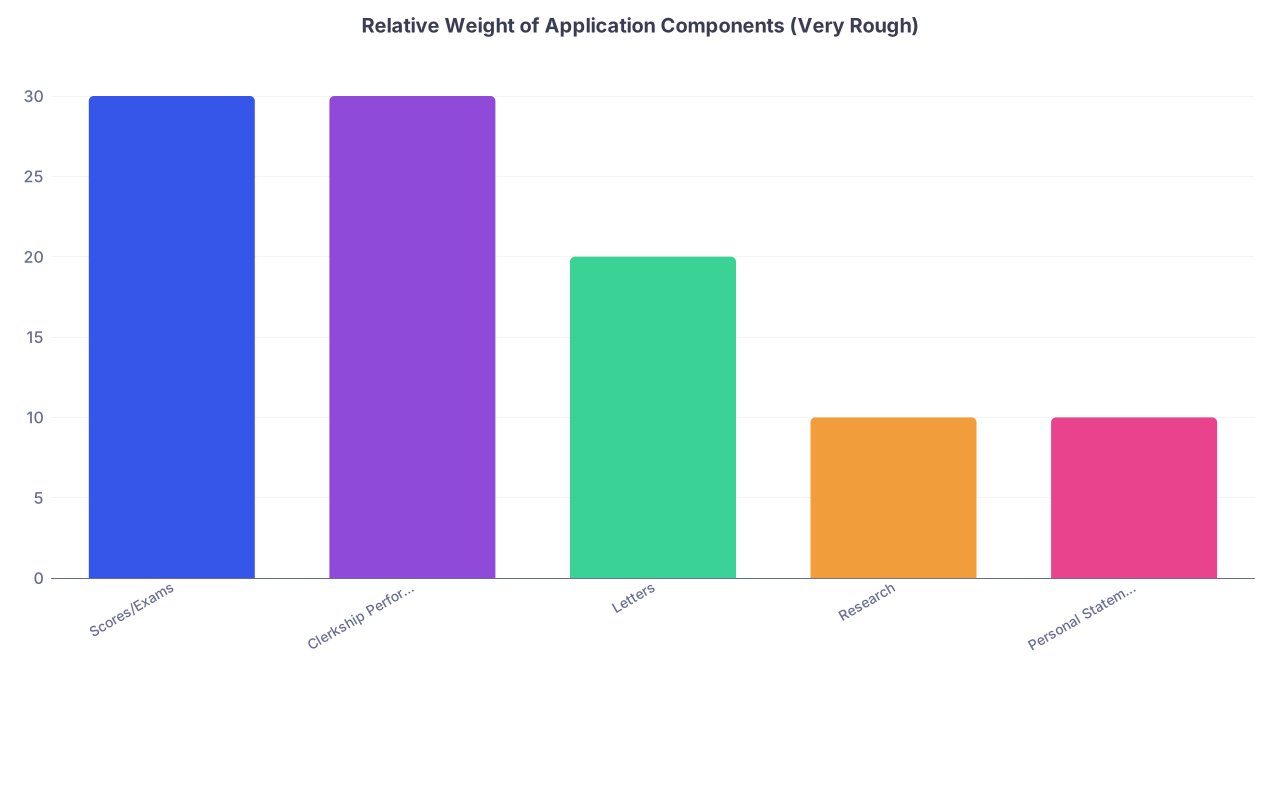
| Category | Value |
|---|---|
| Scores/Exams | 30 |
| Clerkship Performance | 30 |
| Letters | 20 |
| Research | 10 |
| Personal Statement | 10 |
Is this exact? No. Every program is different.
But are letters the magical, all-controlling factor that must be micro-customized for every program? Also no.
They matter. A lot. But not in the hyper-optimized way your panic is imagining.
What To Do If You’re Stuck With One Decent Set And It’s Late
Let’s say it’s October. You:
- have 3 letters
- 2 are from your specialty, 1 is general clinical
- you’re exhausted, rotations are brutal, and getting more letters now feels impossible
Here’s the move:
- Use those 3 letters for your whole list.
- Only panic-adjust if:
- a program you REALLY care about clearly states a specific requirement you’re missing
- you’re dual applying and literally have zero letters in one specialty
- Put your remaining energy into:
- finishing secondaries or supplemental questions
- prepping for interviews
- not failing your current rotation (seriously)
You’re not tanking your entire season because you didn’t engineer a different letter combo for each application.
Quick Process Map: Assigning LORs Without Losing Your Mind

| Step | Description |
|---|---|
| Step 1 | Collect All Letters |
| Step 2 | Identify Specialty-Specific Letters |
| Step 3 | Choose Default 3-4 Strongest |
| Step 4 | Use Default Set for Most Programs |
| Step 5 | Create Set for Each Specialty |
| Step 6 | Check Program-Specific Requirements |
| Step 7 | Adjust Only When Needed |
| Step 8 | Assign in ERAS and Move On |
| Step 9 | Single or Multiple Specialties? |
That’s it. Not infinite combos. Not 12 elaborate strategies. Just: build a solid default, then tweak where it actually matters.
One More Reality Check: Most People Feel Under-Lettered
Almost nobody feels like they have:
- enough letters
- the “right” letters
- perfectly targeted letters
You are not behind because you’re planning to use the same set broadly. That’s standard. The applicants who actually run into problems usually have:
- 0 letters from the specialty they’re applying to
- a known bad letter
- or glaring professionalism / performance issues
If that’s not you, your anxiety is probably louder than the actual risk.

FAQ (Exactly 5 Questions)
1. Is it bad if every single program gets the same exact 3 letters?
No. That’s normal for single-specialty applicants. If your 3 letters are solid and at least 1–2 are from your chosen specialty, you’re fine. You’re not being “found out” or judged for not customizing.
2. Should I ever not use a letter I already asked for?
Yes. If you have even a slight concern the letter might be weak or negative — or if your dean/honors advisor subtly suggests it may not be strong — don’t use it unless you absolutely need the extra letter to hit 3. Better 3 good letters than 4 with one weak link.
3. What if I don’t have a letter from my chosen specialty?
That’s the one situation where I’d actually worry and try to fix it. You won’t be automatically rejected, but it really hurts. See if you can get even a short rotation or clinic time with someone in the field and ask them for a letter, even late.
4. Can I use the same non-specialty letter for multiple specialties if I’m dual applying?
Yes. A strong, general “this person is a solid future physician” letter from IM/FM/peds/etc. can absolutely be reused across both specialties. Pair it differently depending on the specialty: combine it with EM letters for EM applications, IM letters for IM applications, etc.
5. Do programs expect chair letters, and do I need to send them to everyone?
Some programs like or expect chair letters, especially in more competitive specialties or big-name academic places. If you have one and it’s strong, you can swap it in for programs that explicitly care about it. But you don’t need to send a chair letter to every single community program just because you have one.
Key points, stripped down:
- Reusing the same solid 3–4 letters across most of your programs is normal, not a red flag.
- The real issues are missing specialty letters or using weak ones — not lack of per-program customization.
- Build one good default set, tweak for special cases, and stop letting letters eat 90% of your mental bandwidth.