
It’s late. You should be sleeping. Instead, you’re replaying the same nightmare loop in your head:
You and your friend both rotated with Dr. X. Same attending. Same clinic. You both asked for a residency letter. They already got theirs uploaded. People keep saying it’s “amazing.” Now you’re staring at ERAS thinking:
“What if programs literally put our letters side by side? What if they can see that Dr. X wrote my friend a stronger letter than me? What if that single comparison kills my whole application?”
Welcome to the special type of anxiety that only residency applicants seem to understand.
Let me walk through this like someone who has obsessed over the same thing. Because I have.
First: Can Programs Even Tell We Share the Same Attending?
Yes. That part’s real.
They see the letter writer’s name, title, institution, sometimes even department. If two applicants from the same school both get a letter from “John Smith, MD – Department of Internal Medicine, University X,” it’s not a secret.
But here’s the part your brain keeps skipping:
Seeing “same attending” is not the same as “opening both letters, reading them carefully, and doing a side-by-side forensic comparison while drinking coffee and judging your soul.”
Most programs are drowning in applications. Faculty are reading:
- Dozens to hundreds of apps
- On top of clinical work
- In fragmented 5–10 minute chunks
Are they going to occasionally recognize a familiar letter writer? Sure. Are they going to sit there thinking, “Hmm, this is the John Smith letter for Alex… where’s the one for Jamie so I can compare adjectives”?
No. They don’t have time. And honestly, they don’t care that much at that micro level.
They care if:
- The letter is clearly positive / strong / supportive
- It matches the rest of your app
- It doesn’t have red flags
They are not running a contest called “Which Dr. Smith LOR Is Better, 2024 Edition.”
The Ugly Fear: “What If My Friend Got the Better Letter?”
Here’s the worst-case narrative your brain is feeding you:
- Attending loved your friend more
- Wrote them this glowing, flowery, specific, life-changing LOR
- Wrote you a lukewarm, generic, borderline-weak one
- Programs see both and think: “Clearly we want the other one, not you”
- You don’t match, and that’s the reason
Let’s take this apart piece by piece.
1. Attendings reuse a lot of content
I’ve seen this from the other side: faculty who write 40+ letters every cycle. They absolutely recycle phrases and structures. They often have a “template”:
“I had the pleasure of working with [STUDENT] on the [rotation]…”
“They were in the top [X]% of students I’ve worked with…”
“They demonstrated strong clinical reasoning, professionalism, and a commitment to patient care…”
So yes, your letters might sound similar to your friend’s. Programs know this. They don’t penalize you for sharing a letter writer with someone else.
Honestly, faculty reuse is so common that similar wording is expected, not suspicious.
2. Strong vs. mediocre letters are usually obvious even without comparison
A truly weak letter doesn’t need a comparison. You can tell.
Bad signs (that actually worry programs):
- Vague to the point of emptiness: “They completed the rotation and did what was asked.”
- No specific examples or anecdotes
- Weirdly short (like, 1 paragraph short)
- No clear statement of support (“I recommend them” vs “I recommend them highly and without reservation”)
- Subtle negative qualifiers: “with supervision, they were able to…”
But you’re not even reading your own letter. ERAS is closed. You’re guessing. You’re imagining the worst version because that’s how anxiety works.
If your attending truly had concerns about you, at most schools they’d either:
- Decline to write the letter
- Tell you they don’t feel comfortable writing a “strong” letter
- Or write a clearly weak letter (yes, it happens, but it’s not common if they agreed enthusiastically)
Most of the time, if they say “I’m happy to write you a strong letter” and they’re generally a nice, professional attending, your letter is at least fine, probably good.
Is it as strong as your friend’s? Who knows. But it doesn’t have to “beat” your friend’s to help you match.
Do Programs Ever Actually Compare Two Letters from the Same Attending?
Technically possible. Realistically? Rare and usually only in very specific contexts.
When it might happen:
- Super small specialties
- Tiny programs taking like 1–3 residents a year
- Situations where two applicants from the same school are both very competitive for the same limited spot
- Someone on the committee knows the attending personally and is curious
Even then, they’re not doing a petty adjective count.
They’re looking for:
- Any red flags
- Big differences in ranking / strength: “top 1%” vs “above average”
- Discrepancies with the rest of the app
You’re imagining something like:
“Candidate A is described as ‘brilliant, outstanding, one of the best in 10 years’ and Candidate B is only ‘strong, hardworking, excellent.’ Therefore, reject B.”
Reality is closer to:
“We like both of them. Both look good. Both letters are positive; one is maybe a bit more glowing but both acceptable. We’ll rank based on full picture: scores, rotations, fit, interviews.”
Residency selection is not a single-variable algorithm. It’s messy, human, sometimes random.
Letters are one input. Not the verdict.
How Programs Actually Weigh Letters (Not the Way Your Brain Thinks)
Your brain is running this model:
“Letter > everything. Lesser letter = doomed.”
Their actual brain (from what I’ve seen):
- Step scores / exams / transcript
- Dean’s letter / MSPE
- Clinical grades / ranking
- Research / extracurriculars (depending on specialty)
- Fit from personal statement and application
- Interview
Letters sit in that mix as context and corroboration.
Here’s a rough, oversimplified picture:
| Component | Relative Weight (Typical) |
|---|---|
| Exams & Transcript | High |
| Interview | Very High |
| MSPE / Class Rank | Moderate–High |
| LORs | Moderate |
| Personal Statement | Low–Moderate |
Are there programs that obsess over letters? Yes, especially in competitive fields like derm, ortho, plastics. But even there, they’re not turning your application into a gladiator match against your classmate over one attending’s opinion.
They’re looking for: “Do your letters match the story your app is already telling?”
Practical Reality: Your Friend Doing Well Doesn’t Make You Do Worse
This is the mental trap: “If my friend’s letter is better, I’m automatically worse off.” That’s not how most residency slots work.
Programs are not forced to choose exactly 1 person from your school.
I’ve seen:
- 3 people from the same med school match the same internal medicine program
- 2 classmates both match the same EM program with letters from the same PD
- 4 students with letters from the same big-name surgeon all match solid spots
Programs don’t say, “We already have one Person-With-Dr.-X’s-Letter; can’t possibly take another.”
It’s more like: “We like both. Let’s rank both. See how the Match shakes out.”
Your friend winning something doesn’t make you lose by default. You’re not sharing one oxygen mask.
What You Can Actually Do (If This Is Eating You Alive)
Let me split this into two camps:
1. If your letters are already uploaded and apps submitted
You have very limited control now. Which sounds terrifying but is actually freeing.
You can’t:
- Edit the letter
- Ask them to change it
- See what it says
You can:
- Focus on crushing interviews
- Present a coherent, honest narrative that aligns with what your letter likely says (“I worked hard on that rotation, got good feedback, loved that field…”)
- Stop poking the bruise by repeatedly asking people, “Do you think my letter is as good as [friend]’s?”
Honest truth: that spiraling won’t change anything except your cortisol level.
2. If you haven’t asked for the letter yet (or it’s not written)
You have a bit more control here.
Make it easier for the attending to write you a strong, specific letter:
- Remind them of concrete cases or projects: “We worked together on that complicated CHF patient where you let me present to the family…”
- Share your CV, personal statement draft, and a short bullet list: “Things I hope you might highlight…”
- Explicitly ask: “Do you feel you can write me a strong letter for [specialty]? I only want you to say yes if you’re comfortable doing that.”
That last line protects you a lot. Most honest faculty will say no if they’re lukewarm. Which is good—you don’t want a lukewarm letter.
When the Fear Is Actually Pointing at Something Real
Sometimes anxiety isn’t just random. Sometimes it’s because you know the rotation didn’t go great.
If you had:
- Documented professionalism issues
- A clear conflict with the attending
- Bad mid-rotation or final feedback
- The attending hesitated or seemed unenthusiastic when you asked
Then yeah, I’d be more cautious.
In that scenario, if the letter hasn’t been submitted, I’d strongly consider:
- Finding a different letter writer
- Talking to your dean’s office or advisor about whether to keep or drop that letter
- Not relying on that rotation as a main support for your chosen specialty
Weak letters hurt more when they’re from your primary letter writer in that specialty.
What You’re Really Afraid Of
Underneath all of this, the fear isn’t just “my letter vs my friend’s letter.”
It’s:
- “What if I’m actually just not as good?”
- “What if this attending saw the real me and didn’t like it enough?”
- “What if everyone else is playing this game better than I am and I’m the only clueless one?”
Here’s the unpolished truth: some classmates will have stronger letters than you. Some will have weaker ones. Everyone has some flaw in their app.
People with mediocre letters match every year. People with great letters sometimes don’t. It’s messy.
Your job isn’t to win every comparison. It’s to have an application that, in total, makes sense and shows you’re safe, teachable, hardworking, and not a disaster.
And that bar? It’s high, but it’s not “perfectly optimized letter arms race.”
Quick Reality Check Scenarios
Let’s sanity-check a few likely situations.
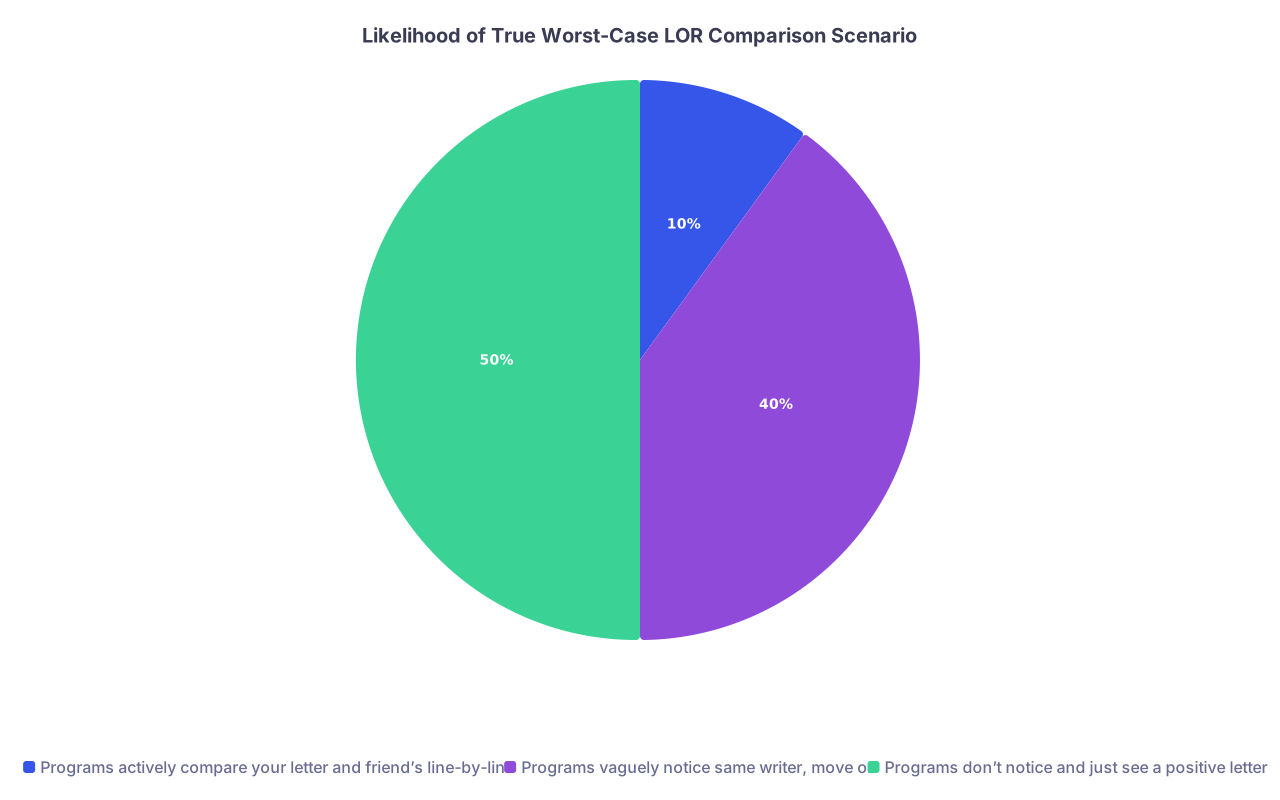
| Category | Value |
|---|---|
| Programs actively compare your letter and friend’s line-by-line | 10 |
| Programs vaguely notice same writer, move on | 40 |
| Programs don’t notice and just see a positive letter | 50 |
These aren’t scientific numbers, but they match what I’ve seen and heard from PDs and faculty over the years. The ultra-dramatic comparison fantasy your brain keeps replaying? Not the dominant use case.
A Few Grounding Thoughts
Before the FAQs, a few blunt reminders:
- If your attending said “happy to write you a strong letter,” it’s probably fine
- Programs don’t have time for detailed one-to-one letter battles
- Your friend’s success is not automatically your failure
- You will never see most of these letters; obsessing over their imaginary content is wasted emotional energy
- The interview—your vibe, your story, your fit—often moves the needle more than microscopic letter differences
Years from now, if you’re anything like the residents I know, you won’t remember whose letter said “outstanding” vs “excellent.” You’ll remember which friends you leaned on when your brain was inventing disasters at 2 a.m—and the fact that you kept moving forward anyway.
FAQ (Exactly 6 Questions)
1. What if my attending wrote “top 25%” for me and “top 10%” for my friend—am I doomed?
No. Programs see those relative rankings, but they don’t treat “top 10% vs top 25%” as life-or-death unless you’re both applying to something tiny and hypercompetitive. It might matter at the extreme hyper-elite level, but for most programs, both of those are solid. They’re more concerned about “top 10% vs average” or “cannot compare.” You’re not competing solely with your friend; you’re part of a much bigger pool.
2. Can I ask my attending if they wrote me as strong a letter as my classmate?
You can, but I wouldn’t. It puts them in a weird position and almost never gives you real, actionable info. At best, they’ll say something generically reassuring. At worst, you sour the relationship. A better question before they write it is: “Do you feel you can write me a strong letter for [specialty]?” Then trust their answer.
3. Will similar wording between my letter and my friend’s look bad?
No. Faculty reuse phrases constantly. Programs know this. They’re not running plagiarism checks on LORs. Similar structure or boilerplate intros are normal. What matters more is whether your letter has some individualized content and clearly positive support—not whether it sounds like an original Shakespearean monologue.
4. What if my friend matches somewhere I don’t—will I always assume it was the letter?
Probably, yes, because that’s how our brains assign blame. But in reality, match outcomes are multi-factor: interview performance, timing, regional ties, random committee preferences, sheer luck. Blaming one letter comparison is emotionally neat but usually inaccurate. You’ll almost never get a clean, causal “It was the LOR” answer from any program.
5. If I’m really worried about one specific letter, should I remove it from ERAS?
If you have concrete reasons to believe it might be weak—bad rotation, awkward vibes, attending hesitated when asked—then talk to your dean’s office or a trusted advisor. They’ve seen patterns and can give better specialty-specific advice. If your only concern is “What if it’s not as strong as my friend’s?” with no actual red flags, I’d keep it. Removing a perfectly fine letter because of imagined comparisons is usually more harmful than helpful.
6. Do programs ever tell you if a letter hurt your application?
Almost never. Post-match feedback, when you can even get it, is usually vague: “We had a strong pool,” “Your scores were slightly below our average,” “Apply more broadly next time.” They’re not going to say, “Dr. X liked your classmate more.” LOR effects are mostly behind the curtain. Which is exactly why it’s not worth torturing yourself over speculative comparisons you’ll never be able to confirm.
Years from now, you won’t remember which attending wrote which sentence or who got the “better” adjective. You’ll remember the general fog of stress, maybe a few sharp moments of panic—and the fact that you still showed up, still interviewed, still kept going even when your brain insisted that one hidden letter might sink everything.