

What do you actually do when you’ve already walked away after not matching, and now you want back in—but your CV has a giant gap and you’re scared programs will just write you off?
Good. Let’s deal with that head-on.
You’re not a typical “re-applicant.” You’re the person who:
- Graduated, went through the Match (maybe twice), did not match
- Stepped away—maybe to industry, research, another degree, or a completely different job
- Now realizes you want back into clinical medicine
That’s a different situation than just “I didn’t match last year.” You’re dealing with:
- Time away from clinical practice
- Skepticism from programs about your commitment and clinical readiness
- Logistics: references, licensing, USMLE/COMLEX timing, visas (for IMGs), and explaining the story
I’m going to walk you through what actually works to re-enter. Not theory. The playbook I’ve seen people use successfully when they were “too far out” by conventional wisdom.
Step 1: Get Honest About Your Starting Point
Before you touch ERAS, you need a brutal, clear-eyed assessment. No fantasy thinking.
Here’s what matters most for re-entry:
- Time since graduation
- Exam status (all steps passed? any failures? score vs pass/fail era?)
- Prior Match history
- What you did after leaving medicine
- Citizenship/visa constraints
- Specialty choice (this one is huge)
Make yourself a one-page reality sheet. No spin. Just facts.
| Factor | Lower Risk | Higher Risk |
|---|---|---|
| Years Since Grad | 0–3 years | 5+ years |
| USMLE/COMLEX Status | All passed, no failures | Multiple failures / missing Step 3 |
| Specialty Target | Primary care / psych / FM | Derm, Ortho, Plastics, ENT |
| Clinical Activity Gap | Recent consistent involvement | 2+ years with no clinical exposure |
| Visa Status | US citizen/GC | Needs visa sponsorship |
Now be blunt: are you a high-risk, moderate-risk, or low-risk candidate for re-entry?
If you’re:
- 6+ years out
- With exam failures
- No recent clinical work
- And chasing a hyper-competitive specialty
Then no, you’re not “one more strong PS away” from fixing this. You need a different strategy and probably a different target specialty.
Step 2: Decide If Re-Entry Is Realistic—and Under What Conditions
This is the crossroads step most people skip. They just jump back into ERAS and “see what happens.” That’s how you burn another year.
You need to answer three questions:
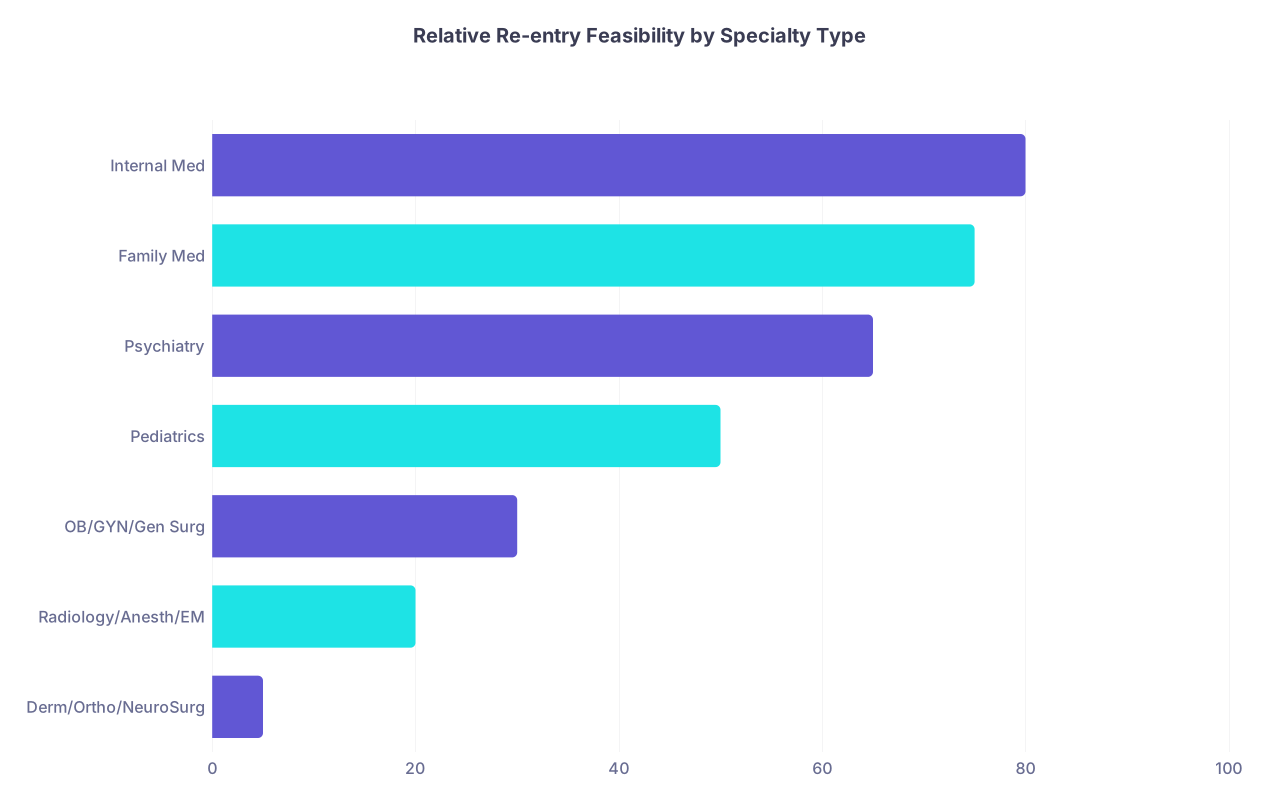
- Under what specialty conditions is re-entry realistic for me?
- Under what geographic and program tier conditions is it realistic?
- Under what timeline is it realistic?
If you’re 4+ years out and working as a software engineer now, trying to go back into ortho? Forget it. That ship sailed.
If you’re willing to pivot to:
- Internal Medicine (especially community programs)
- Family Medicine
- Psychiatry
- Pediatrics (sometimes)
- Preliminary medicine/surgery as a door opener
Your odds go up dramatically.
| Category | Value |
|---|---|
| Derm/Ortho/NeuroSurg | 5 |
| Radiology/Anesth/EM | 20 |
| OB/GYN/Gen Surg | 30 |
| Pediatrics | 50 |
| Psychiatry | 65 |
| Family Med | 75 |
| Internal Med | 80 |
I’m not saying it’s easy anywhere. I’m saying where it’s possible if you’re several years out.
Your decision:
- Either you adjust your specialty to maximize re-entry chances
- Or you accept that this may be over clinically and consider non-clinical paths in medicine
You can’t keep chasing a prestige specialty and claim you’re “doing everything possible” to get back.
Step 3: Rebuild Clinical Credibility—Fast
This is your main problem: programs see a gap and doubt your clinical sharpness and commitment.
You have to attack that gap.
Your goals here:
- Show recent, consistent clinical involvement
- Get current letters from people in US healthcare (or your target system)
- Demonstrate you’re not clinically rusted
Real options that actually work:
Full-time clinical job (non-physician role)
- Clinical research coordinator in a hospital
- Hospitalist scribe
- Clinical associate / patient care tech (if realistic)
- NP/PA collaborator role (if you have relevant background)
This is gold because it gives you both recency and network.
Transitional clinical roles
- Telehealth triage roles (if clinically deep enough)
- Clinical quality / utilization review roles that involve chart work
These help, but you’ll still want some in-person exposure if possible.
Voluntary unpaid clinical exposure
- Observerships
- Extended shadowing with meaningful responsibilities (documentation, notes, QI projects under supervision where allowed)
These are weaker than a job, but better than nothing—especially for IMGs.
Research with a heavy clinical component
- Outcomes research in a hospital-based group
- Trials where you see patients, sit in clinic, handle data from real encounters
Here’s the reality: listing “Data analyst at tech company” for three years with no clinical activity is a red flag. You can’t undo the past, but you can fix the present. Six to twelve months of strong, relevant clinical-adjacent work changes how you look.
Step 4: Fix Your Testing Profile (Including Step 3 if You Can)
If you’re post-grad and trying to re-enter, Step 3 (or COMLEX Level 3) becomes more important than people like to admit.
Program directors read “not in residency + no Step 3” as: risky hire, more work, unknown performance.
Your orders:
- If eligible: take and pass Step 3 / Level 3 before the next Match cycle, or at least have it scheduled early enough that scores will be back by rank list time.
- If you’ve had prior failures: you need a clean, solid pass now. Not necessarily a 260, but clearly competent.
For re-entry candidates, a passed Step 3 does three things:
- Signals you’re serious and still engaged with medicine
- Eases program anxiety about whether you’ll pass in-training boards
- Makes you more attractive to community programs that rely on residents for service coverage
I’ve seen borderline candidates land IM spots only because they already had Step 3 done and the program needed people who could moonlight sooner and handle boards.
Step 5: Craft a Coherent Story (No, Not a Sob Story)
You must be able to explain:
- Why you did not match
- Why you left medicine
- Why you want to return now
- Why this specialty and this time are different
If your explanation sounds like:
“Things were hard, I felt burned out, so I worked in consulting for a bit, now I miss patients.”
That is not strong enough. It sounds impulsive.
You need a story that:
- Accepts responsibility for what went wrong
- Shows growth and specific changes
- Shows you tested your desire to return, not just woke up nostalgic
Example structure that works:
Briefly: What happened then
“I did not match in 2021 after applying broadly in general surgery. Looking back, my application had two problems: my clinical evaluations were average, and I had not built strong relationships with faculty for letters.”Why you stepped away
“I’d been running on fumes for years. I made a rushed, panicked attempt at the Match instead of reassessing. After not matching, I stepped out and took a full-time clinical research coordinator position in cardiology.”What changed / what you learned
“That role reset how I work. I had time to reflect, saw how strong clinicians think, and realized that what I actually enjoyed most was ongoing, longitudinal management—the internal medicine side of those patients—rather than procedures. I also rebuilt better study habits and prepared for Step 3, which I passed in 2024.”Why now and why this specialty
“For the last 18 months, I’ve been in clinic weekly, involved in direct patient contact and care coordination. I’m not choosing internal medicine as a fallback; I’ve watched it up close and sought it out. Now I’m ready to commit, fully aware of what residency demands.”
No dramatics. Clear arc. No blaming “the system,” your school, or some mysterious bias.
Step 6: Build New Letters That Actually Matter
Your old MSPE and dean’s letter are fixed. You can’t rewrite those.
But you can add new, strong, recent letters.
You’re aiming for:
- 2–3 letters from the last 12–18 months
- At least 2 from physicians in your target specialty or adjacent primary care
- At least 1 from someone who has seen you do real work recently (not just “observed for 2 weeks”)
You get those by:
- Performing like a resident in your current role (even if it’s non-physician)
- Showing up early, staying late, volunteering for projects
- Telling your supervising physicians directly: “I’m planning to re-enter residency and will be applying to X this coming cycle. If over the next few months you feel you can honestly write a strong letter for me, I’d really value that.”
Do not wait until August to spring this on them. Start months in advance so they can actually observe you.
Step 7: Use Alternative Entry Points—Not Just the Main Match
Re-entry candidates often do better when they’re opportunistic and flexible.
You’re not on equal footing with an M4 with a clean, straight timeline. You shouldn’t play the game as if you are.
Here are doors people underestimate:
SOAP (Supplemental Offer and Acceptance Program)
- If you’re willing to go almost anywhere and accept prelim or categorical IM/FM/psych, SOAP can be an entry point.
- It’s chaotic. But I’ve seen people 4–5 years out slip into prelim or community IM spots through SOAP because programs needed bodies fast and these applicants were ready with Step 3.
Out-of-cycle / off-Match positions
- Programs lose residents mid-year. People withdraw, get dismissed, or have health issues. That leaves sudden PGY-1 or PGY-2 vacancies.
- If you’re serious, you should be checking:
- Residency program websites
- State GME consortium job boards
- Word of mouth through any PDs or attendings you know
- Many of these are not widely advertised.
Preliminary year as a bridge
- A prelim IM or surgery year—especially at a community hospital—can get you “in the system,” with fresh clinical evaluations and US experience.
- Then next year, you apply again to categorical positions backed by current PD letters.
Is this comfortable? No. You may have to move states, take less-than-ideal programs, or start in prelim rather than categorical. But you said you want back in. This is often the reality.
Step 8: Massive Targeting Strategy—Not Vanity Applications
This part is blunt: your “dream program” list is irrelevant. You’re in recovery mode, not fantasy mode.
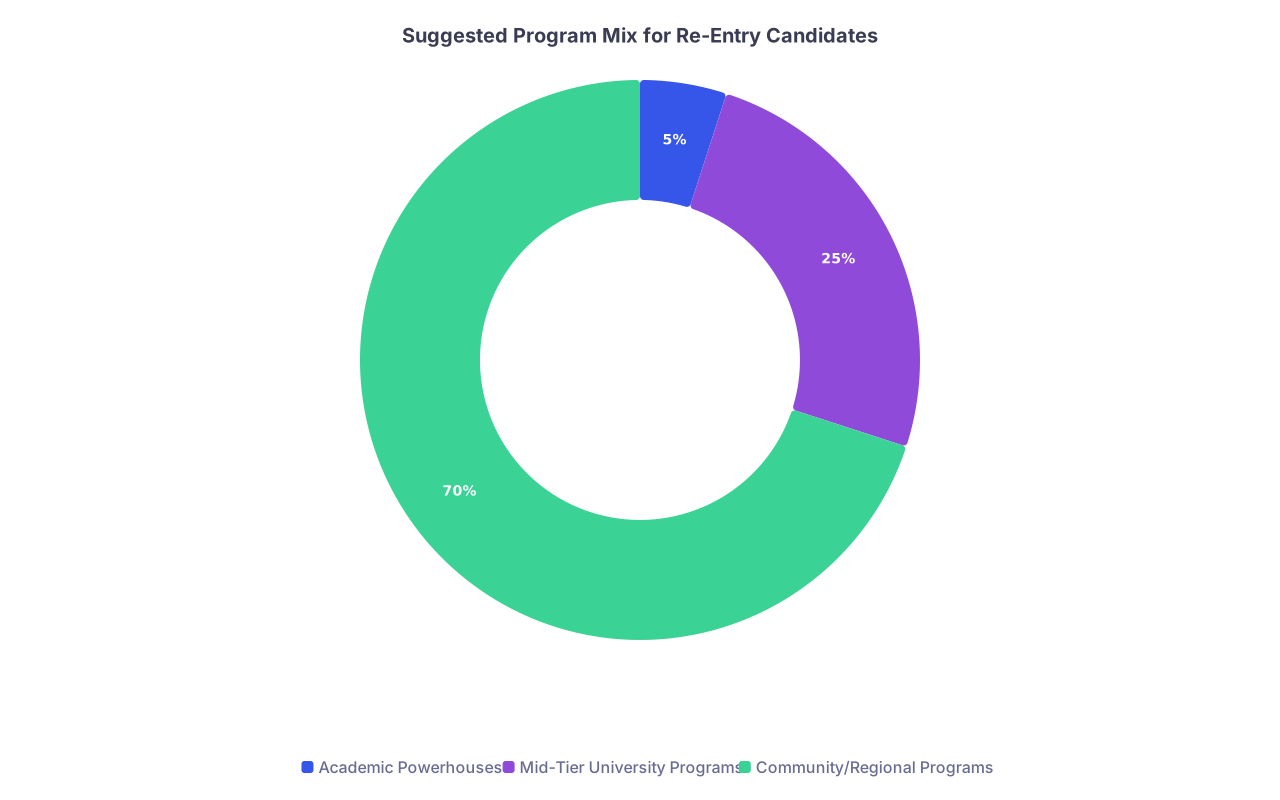
Your targeting should be:
- Very broad geographically
- Heavy on community and newer programs
- Focused on specialties open to nontraditional grads
| Category | Value |
|---|---|
| Academic Powerhouses | 5 |
| Mid-Tier University Programs | 25 |
| Community/Regional Programs | 70 |
Apply smart:
- 5–10%: reach programs (mid-tier academic, places with history of taking IMGs / non-traditional applicants)
- 25–30%: solid but not hyper-selective programs, often university-affiliated community sites
- 60–70%: pure community programs, smaller cities, less desirable locations
And stop wasting time on programs that clearly state “within 3 years of graduation only” if you’re 7 years out. They mean it.
Step 9: Fix How You Interview as a “Returner”
Programs will ask you, one way or another:
- “So… what happened?”
- “Why didn’t you match?”
- “Why did you leave medicine?”
- “Why come back now?”
You need rehearsed, short answers. Not a confessional, not a TED talk.
Good principles:
- Own your role in past outcomes
- Be specific about what’s changed (skills, mindset, specialty choice)
- Emphasize what you’ve done recently that proves readiness
- End with forward focus, not regret
Example:
“I didn’t match in 2020 because my application was unbalanced—my Step scores were fine, but I hadn’t secured strong letters or demonstrated a clear fit for the specialty. After that, I made a poor decision: I rushed another application cycle without correcting the fundamentals. When I still didn’t match, I stepped away to work as a full-time clinical research coordinator in cardiology. Over the last two years I’ve been in clinic weekly, taken Step 3 and passed, and realized that internal medicine is actually where my skills and interests line up. I’m not applying to see what happens; I’m applying because I’ve tested this path in real life and chosen it deliberately.”
No drama. No self-pity. Just a clean narrative.
Step 10: Parallel Plan—In Case This Cycle Fails
You get one more year to push hard. But you also need to be an adult and have a Plan B that isn’t “try the same thing forever.”
Parallel planning means:
- If you don’t get interviews this year → what’s your next move?
- If you get interviews but don’t match → what will you change next cycle (if you even do another)?
- At what point do you say, “Okay, clinical residency is not happening,” and pivot fully?
This isn’t defeatist. It’s sanity-preserving.
Viable non-residency paths (if re-entry fails):
- Clinical research leadership
- Medical affairs / pharma
- Health tech, clinical product roles
- Public health, policy, outcomes research
- Education (med ed, test prep, etc.)
You’re allowed to decide that you don’t want to spend 5 more years living in limbo chasing a 5% chance. But if you do choose to chase it now, then commit and do it properly this cycle.
| Period | Event |
|---|---|
| Months 1-3 - Reality assessment and specialty choice | Done |
| Months 1-3 - Secure clinical job/observership | Active |
| Months 1-3 - Plan Step 3 / Level 3 exam | Active |
| Months 4-6 - Take and pass Step 3 | Milestone |
| Months 4-6 - Build relationships for letters | Ongoing |
| Months 4-6 - Draft personal statement and CV | Ongoing |
| Months 7-9 - Submit ERAS early | Target |
| Months 7-9 - Keep clinical involvement strong | Ongoing |
| Months 7-9 - Prepare for interviews | Ongoing |
| Months 10-12 - Attend interviews / SOAP prep | Critical |
| Months 10-12 - Monitor off-cycle openings | Ongoing |
| Months 10-12 - Decide on next-year plan if unmatched | Decision |
Quick Reality Checks You Need to Hear
- Programs do take people who left and came back. It happens every year.
- The further you are from graduation, the narrower your target options become.
- Your best leverage points: recent clinical work + Step 3 + strong, recent letters + realistic specialty pivot.
- You are not going to finesse your way into derm or ortho with a clever essay after 5 nonclinical years. Let that fantasy go.
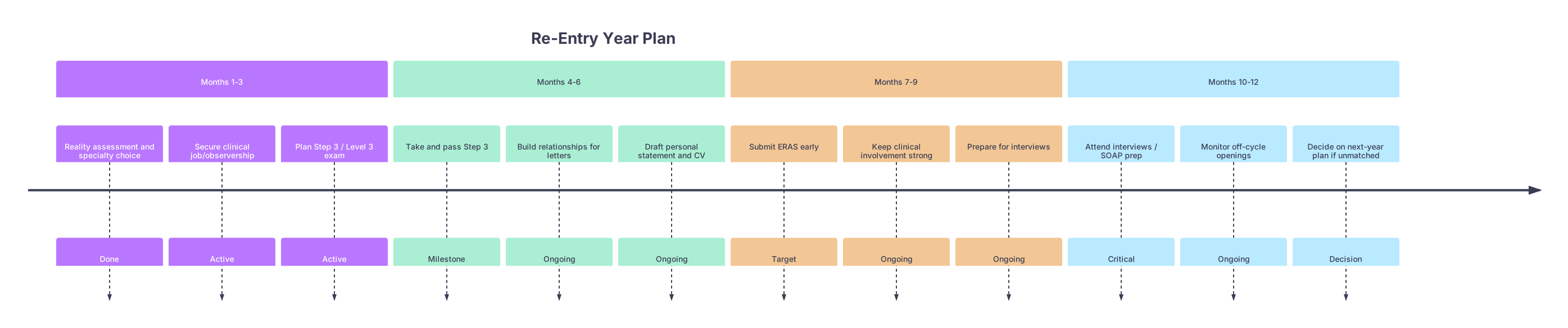
You want back in? Then your life for the next 12–18 months needs to look like someone who lives and breathes medicine again—not someone who “used to be into that.”
FAQs
1. I’m 6–8 years out from graduation. Is it even worth trying to re-enter?
Maybe. Not under all conditions. If you’re 6–8 years out, with no recent clinical work and no Step 3, and you’re fixed on a competitive specialty—then no, it’s probably not worth it. If you’re willing to pivot to IM/FM/psych, get 6–12 months of solid clinical-adjacent work, take and pass Step 3, and apply broadly to community programs and SOAP, you still have a non-zero shot. But you should go into it knowing this is a high-risk effort and should absolutely have a non-residency Plan B in motion.
2. Should I do another unpaid observership or a nonclinical but paid job (like pharma) this year?
If your goal is residency re-entry, choose the option that gets you as close to real patients and real clinicians as possible—even if it pays less. A relevant clinical research coordinator or scribe role with strong attending contact is more valuable than a high-paying nonclinical role that’s purely corporate. Observerships can help, but short, one-off shadowing is weak; if you go that route, push for multi-month, recurring presence where attendings can see your reliability and write real letters.
3. Do I need to explain every year of my gap in my personal statement?
You don’t need to write a diary. But you do need to make the story legible. Group periods together: “From 2020–2023, I worked in health tech, first as a data analyst and later as a clinical product lead. During that time I remained involved in medicine through X and Y. Over the last year, I’ve returned to direct clinical work as a research coordinator in internal medicine.” The key is that when a PD scans your app, they don’t have to guess what you were doing all those years, and they can see a clear transition back toward clinical care.
4. How many Match cycles should I realistically attempt before stopping?
For most re-entry candidates, two serious, fully-committed cycles is the upper limit before you need to rethink. By “serious,” I mean: recent clinical work, Step 3 done, realistic specialty choice, broad targeting, and an application that’s actually different from the last one. If you do all that twice, still get few or no interviews, and nothing changes in your profile between years, a third or fourth cycle usually just burns time and money. At that point, it’s responsible to pivot and build a stable, meaningful non-residency career in or around medicine.
Key takeaways:
- Re-entry after leaving post-unmatched is possible, but only if you rebuild clinical credibility with recent work, Step 3, and new letters.
- You’ll almost always need to be flexible: about specialty, location, program tier, and entry path (SOAP, prelim, off-cycle).
- Go all-in for one or two cycles with a realistic plan—and keep a parallel non-residency path developing so your life doesn’t stay stuck on pause forever.


