The worst financial decision you’ll ever make might look completely logical on a premed advising flyer.
The fear that nobody says out loud
You’re not actually asking, “Is a post‑bacc worth it?”
You’re asking, “Am I about to borrow $30k–$80k for a program that still doesn’t get me into med school… and then I’m stuck with the debt, the shame, and no M.D. or D.O. at the end?”
That’s the real nightmare.
Not just the money. The what if it doesn’t work.
I’ve watched people:
- Borrow $60k+ for a formal post‑bacc, not get enough interviews, then reapply two more cycles while payments kicked in.
- Take on a cheap DIY post‑bacc at a community college, get whispered doubts from advisors, then still end up at a perfectly fine MD school.
- Skip the post‑bacc entirely because they were scared of debt… and then never applied. Just quietly quit the dream.
So no, this isn’t just a math problem. It’s an identity problem, a future‑you problem, and a “how much risk can I stomach without throwing up” problem.
But there is a way to think about this that’s more precise than “YOLO, debt is normal” and less paralyzing than “if I borrow this money and it fails, I’ve ruined my life.”
Let’s start with something cold and concrete: the numbers.
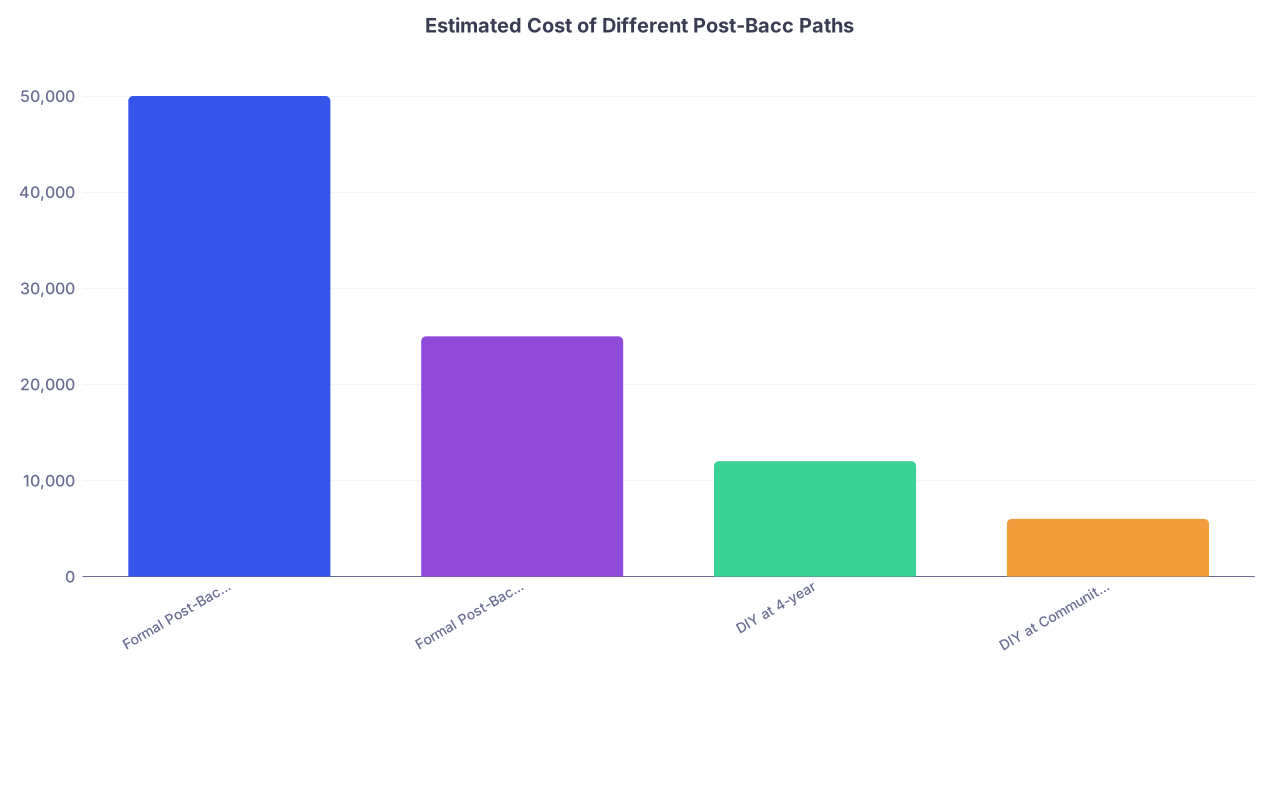
| Category | Value |
|---|---|
| Formal Post-Bacc (Private) | 50000 |
| Formal Post-Bacc (Public) | 25000 |
| DIY at 4-year | 12000 |
| DIY at Community College | 6000 |
What you’re really buying when you take loans for a post‑bacc
Everyone frames it as: “You’re buying more classes to fix your GPA or get prereqs.”
(See also: What If My Post-Bacc GPA Isn’t a 4.0? How Med Schools Actually See It for more details.)
That’s only half true.
When you sign for that loan, you’re actually buying a very specific gamble:
A second academic story
If your undergrad GPA is trash (or just mediocre), you’re trying to buy a new narrative:
“I used to struggle. Then I turned it around. Look at this 3.7+ in rigorous science coursework.”A seat at the table
Some formal post‑baccs:- Have linkage agreements (apply early to a partnered med school with specific GPA/MCAT and maybe skip the glide year)
- Give you a committee letter
- Plug you into advising, mock interviews, and alumni connections
You’re literally paying for access and structure.
Time
Time to improve your GPA, earn new strong letters, shadow, volunteer clinically, maybe prepare for the MCAT properly. You’re taking out a loan to buy time to become the version of yourself who is actually competitive.
But here’s the ugly truth: you can pay for all of that and still not get the outcome.
You can do a $50k post‑bacc, end with a 3.4 post‑bacc GPA, a mediocre MCAT, and very mixed results. And now that “time” you bought is also time you owe interest on.
So the question isn’t, “Is a post‑bacc worth it?”
It’s: “Given my stats and my realistic ceiling, is this specific loan‑funded path a good bet?”
That means you need to be brutally clear about your starting point.
When taking out loans for a post‑bacc can make sense
Let me be specific. Because the vague “It depends” answer just ramps up the anxiety.
Loans for a post‑bacc are more likely to be worth it when:
You have a low-ish cumulative GPA but a clear upward potential
- Example:
- cGPA: 3.1
- sGPA: 2.9
- Last 30–40 credits: mostly Bs and a couple of As, but not a strong trend
With 30–40 credits of solid A/A‑ work in a well‑structured post‑bacc, your trend and recent performance can become your selling point.
You know you can crush the MCAT with time and structure
If your practice exams (when you actually try) hover in a range that could realistically be 510+ with discipline, then building that academic foundation with a post‑bacc is not insane. You’re not buying magic; you’re buying runway.
You’ve already tested your ceiling a bit
If you’ve taken a few recent DIY upper‑level sciences (like biochem, physiology, micro) and got A’s while working or managing life stuff, that’s evidence you’re not the same student you were at 19. Loans to expand that success might be a calculated risk, not a blind leap.
You’re not ignoring cheaper alternatives
This is key. If you’ve run the numbers on a cheaper DIY route (state school / community college / online where acceptable) and there’s a specific reason the formal post‑bacc gives you an advantage—you’re not just dazzled by branding—you’re being more rational.
You’re emotionally honest about risk
You could do everything “right” and still not get in on the first cycle. If the thought of taking out $30k–$60k and maybe having to reapply once or twice doesn’t just bother you but would absolutely destroy you… that’s a red flag.
The loans are less terrifying when your situation looks like:
“Without this, I’m stuck at a 2.8–3.0 with no shot. With this, I have a real path to a 3.3–3.5 plus strong trend, plus MCAT prep, plus support.”
That’s not guaranteed success. But it’s a measurable improvement.
When taking loans for a post‑bacc is probably a bad idea
Here’s the part nobody with a financial stake in your enrollment likes to say.
Sometimes, the correct answer is: don’t borrow that money. At least not for that program.
Red flags I’ve seen over and over:
Your grades aren’t just low—they’re chronically low without a break
If your transcript is wall‑to‑wall C/C‑/D in science without a single sustained stretch of As even in easier courses, a $40k post‑bacc won’t magically fix whatever is going wrong. Whether it’s study habits, burnout, undiagnosed learning issues, or life chaos—you don’t solve that just by changing buildings and raising the tuition.
You haven’t proved to yourself you can handle 12–15 cr of hard sciences
I don’t care how badly you “want it.” If you haven’t taken a full, recent, loaded science semester and done well, borrowing tens of thousands to test that hypothesis is dangerous. That’s like learning to swim by jumping off a boat in the middle of the ocean.
You’re already drowning in undergraduate debt
If you’re sitting on $80k+ from undergrad and now you’re thinking, “Maybe another $50k for a post‑bacc?”—stop. You may still go to med school and ultimately out‑earn the debt, but your risk tolerance needs to be much, much stricter. You don’t get infinite do‑overs.
You’re choosing a program for prestige, not function
“I got into [fancy university]’s post‑bacc, I have to go!”
No, you don’t. If their advising is mid, there’s no linkage, their med school barely takes any of their own post‑baccs, and the cost of living is absurd… you’re basically buying a name for your resume. That’s not what gets you interviews.
You’re hoping a post‑bacc will fix non‑academic weaknesses
No amount of GPA repair compensates for:
- Zero clinical exposure
- Weak or generic letters
- No real understanding of what doctors actually do
A loan can’t buy maturity, insight, or long‑term commitment.
If your main problem isn’t your GPA, taking out loans for more classes is just misdirected effort.
The “but what if I end up hating medicine?” spiral
Here’s the thought that hits you at 1 a.m.:
“What if I do this post‑bacc, get into med school, go $300k+ in debt total, and then in M3 I realize I hate patient care, I’m miserable, and I’ve burned a decade and a mountain of money?”
It’s a fair fear. Medical training is brutal.
But let’s be blunt: if that’s your true terror, the problem isn’t the post‑bacc loan. It’s that you haven’t tested the core assumption: that medicine is the life you want.
A post‑bacc doesn’t fix that. It magnifies it.
If your exposure to medicine is mostly TV shows, TikToks, and shadowing for 20 hours in a shiny clinic, you’re not ready to commit to $50k of anything.
Before you even think about a loan:
- Get real clinical work. CNA, MA, scribe, EMT, ED tech. Something where you’re actually in the thick of it, regularly, for months.
- Talk to residents and attendings who aren’t trying to recruit you. Listen when they complain. Watch who’s burned out and why.
- Pay attention to which stressors drain you versus energize you. Some people love chaos and 12‑hour shifts. Some disintegrate.
If after that, you still want in—knowing it’s messy—then a loan for a post‑bacc stops being a blind bet and starts being a calculated one.
The cold numbers: will this actually ruin your life?
Let’s zoom out for a second. Because the brain loves disaster narratives.
Say you borrow $40,000 for a post‑bacc at ~7% interest.
Ballpark:
- Standard 10‑year repayment will run somewhere around $450–$500/month
- If you consolidate and stretch repayment, that drops—but you pay more interest over time
Now layer in med school:
You borrow $250k–$350k over four years (not insane for many U.S. MD/DO schools once you include living costs).
You’re staring at maybe $300k–$400k total at graduation.
That sounds catastrophic until you remember:
- Attending physicians in many fields clear $200k–$300k+, often more
- Income‑Driven Repayment (IDR) and PSLF exist, imperfect but real
- Your “effective” lifetime income after training is still very high compared to almost any other path that starts from a 3.0 GPA and a panic attack
I’m not saying the debt is trivial. It’s not. It shapes your life. It limits your options in certain ways.
But the $30k–$60k you’re obsessing over now? In the context of the full medical training cost, it’s a small slice that matters mostly if it doesn’t lead you to the next step.
The nightmare scenario is not: “I owe $350k as a practicing physician.”
The nightmare is: “I owe $80k–$120k in undergrad + post‑bacc loans and never got into med school.”
So your whole decision-making process should focus on one thing:
Does this loan‑funded post‑bacc meaningfully increase the probability that I cross the threshold into med school?
If the answer is a shaky maybe, you have more homework to do.
Concrete filters for deciding: is this post‑bacc + loan worth it?
Here’s how I’d interrogate any program if I were putting my future on the line:
Ask for outcomes you can verify
- What percentage of students from the last 3–5 years eventually matriculated into MD/DO?
- Into any health professional school vs med school specifically?
- How many needed more than one cycle?
If they dodge, give vague ranges, or lump together PA, dental, and podiatry to make numbers look better, be suspicious.
Look at their floor, not their stars
Programs love to show off the student who had a 3.4 and is now at Harvard.
You want to know: what happened to the student who started with a 2.8 science GPA, no research, and took the MCAT twice? That’s closer to your risk profile.Examine your own capacity
Picture this:- Full‑time course load of hard sciences
- Commuting
- Maybe part‑time work
- MCAT studying within 12–18 months
- Clinical volunteering or continued hours
If that scenario makes you feel determined: good. If it feels impossible or like you’re hoping you “magically handle it this time,” you may be underestimating the grind.
Compare to DIY alternatives, honestly
Can you:- Enroll as a non‑degree student at a local public university or community college
- Stack 24–36 credits of upper‑level bio/chem/physiology
- Get A’s for a fraction of the cost
- Build relationships for letters
If yes, why exactly is the pricey formal route better? The answer might be valid—linkage, structure, advising—but you should be able to articulate it without hand‑waving.

| Step | Description |
|---|---|
| Step 1 | Low GPA or Missing Prereqs |
| Step 2 | Price out DIY + outcomes |
| Step 3 | Research formal post-baccs |
| Step 4 | DIY with minimal or no loans |
| Step 5 | Reassess medicine or consider SMP |
| Step 6 | Consider loans as calculated risk |
| Step 7 | Do not take large loans for weak program |
| Step 8 | Can you do a low-cost DIY option? |
| Step 9 | DIY improves GPA to competitive level? |
| Step 10 | Formal post-bacc has strong outcomes & support? |
The emotional side: living with the “what ifs”
Here’s the part nobody prepares you for.
Whatever you choose, there will be nights when you’re convinced you picked wrong.
- If you take the loans: you’ll panic every time your grades wobble or an exam goes badly. “Did I just pay $4,000 for this C+?”
- If you don’t take the loans: you’ll spiral when you see classmates heading to fancy post‑baccs and posting med school acceptances on Instagram.
There is no anxiety‑free path. There’s just the version of anxiety that matches your values.
So ask yourself:
Which regret would hurt more?
- “I stayed safe, avoided loans, but never really gave myself a realistic chance to fix my record and apply seriously.”
- Or: “I took a big swing, borrowed money, did my best… and it still didn’t pan out.”
There isn’t a right answer. There’s only the one you can live with without hating yourself in ten years.
If you’re the kind of person who would be tortured by never trying, the loans might be emotionally worth it if the program is solid and your self‑assessment is honest.
If you’re the kind who would be crushed by financial strain and uncertainty, then you need a more conservative route—even if that means letting go of the med school dream eventually.
What you should do today
Don’t stay in the vague “I’m scared of loans” fog. Do something specific.
Today, do this:
Write down your actual numbers:
- cGPA
- sGPA
- Last 30 credit GPA
- Any recent science courses and grades
Pick one formal post‑bacc and one DIY route you’re considering. For each, write:
- Estimated total cost (tuition + fees + living)
- How many credits you’d realistically complete
- What GPA you’d aim for, based on your recent performance
Then answer, in writing, this brutal question for each option:
“If I did this program exactly as planned and hit my target grades, would my application become honestly competitive for at least some MD/DO schools?”
If you can’t answer that confidently for the expensive program, you have no business taking out big loans for it yet.
Start that little document right now. Title it “Is this post‑bacc + debt actually worth it?” and force yourself to see the numbers and logic on one page.
Once it’s out of your head and on paper, the decision won’t feel easy—but it will feel clearer.