The obsession with “perfect” post‑bacc letters of recommendation is hurting more applicants than weak letters ever will.
You’re not crazy for spiraling about this. Post‑bacc LORs feel like this giant trap: you went back to school to “fix” your academic story, and now you’re thinking, “If I don’t get glowing letters out of this, did I just torpedo my whole application… again?”
Let me say this clearly: your application does not live or die on whether your post‑bacc letters are magical, multi-paragraph love letters. Strong letters help. Bad letters hurt. But “average but positive” letters combined with clear academic improvement and a coherent story? That’s absolutely survivable.
Let’s pull this apart before your brain convinces you to withdraw from everything and disappear.
(See also: Worried I Picked the Wrong Post-Bacc: Can I Recover My Application? for more on recovering your application.)
What You’re Really Afraid Of (And What’s Actually True)
You’re not just worried about LORs. You’re worried about what they represent:
- “If my post‑bacc professors won’t write me strong letters, maybe I’m not actually residency-material-premed-material-doctor-material at all.”
- “If I only get generic letters, adcoms will immediately toss my app.”
- “My classmates all have research PIs who adore them, and I have… a professor who barely knows my name.”
Here’s the unpopular truth I wish more people said out loud:
Most post‑bacc letters are not that special. And med schools know that.
They know you:
- Took compressed or evening courses
- May have been one of 40–100 students
- Might’ve been juggling work, commuting, or caregiving
- Often had just 1–2 semesters to build relationships
So no, they’re not sitting there saying, “Hmm, why doesn’t this 2‑semester post‑bacc student have three over-the-top letters saying they walked on water?” They’re looking for something much more basic:
- Are you competent?
- Are you reliable?
- Did you show real improvement and maturity?
- Does at least one person who taught you recently think you’re solid and trustworthy?
That’s it. That’s the bar.
Your application “collapses” when:
- A letter is actively negative or faint-praise (“shows up on time when reminded,” “did satisfactory work”)
- Your academic improvement looks fake or unsupported (you say you changed, but no one backs it up)
- There’s a total mismatch—your personal statement says you’re this hyper-engaged future physician, and every letter reads like nobody really noticed you
But you know what doesn’t make your app collapse?
Letters that are:
- Short but clearly positive
- Generic format but specific enough to show you passed through their actual class, did well, acted like a grown adult
That’s extremely common. And perfectly usable.
What “Strong” Post‑Bacc LORs Actually Look Like (Not the Fantasy Version)
In your head, a “strong” LOR probably sounds like:
“This is one of the top students I’ve ever taught in my 30-year career. I would trust them with my own life. Admit them or you’re making the mistake of the century.”
Real life is more like:
“X earned an A in my upper-level physiology course and frequently participated. They worked well with peers in group activities, turned in assignments on time, and showed clear improvement over the term. I believe they will be a diligent medical student.”
Not poetic. Not movie-level. But fine.
A solid post‑bacc letter usually hits:
- Your grade
- Your work ethic (showed up, participated, didn’t disappear)
- Some evidence of maturity (asked questions, came to office hours, handled setbacks)
- A line or two about your potential in medicine or further training
That’s it. That’s what gets written 90% of the time. Med schools know the difference between “glowing” (great) and “solid/competent” (still totally acceptable) and “lukewarm/concerned” (problem).
Your goal is not “extreme hype.”
Your goal is “clear, consistent support from people who actually interacted with you.”
Worst-Case Scenarios You’re Imagining vs Reality
Let’s walk through the nightmare scripts running in your head.
1. “I can’t get any post‑bacc letters at all”
Is that actually true, or just your anxiety? Be honest.
Real “no-letter” situations:
- Fully online post‑bacc, never spoke to faculty, turn camera off, never emailed
- You joined late, took one class, never connected with anyone
- You did badly or dropped courses and are ashamed to ask
If you genuinely cannot get any post‑bacc letters, is your application doomed? No. But you lose a key chance to prove recent academic ability.
You’d need to:
- Lean on older but still relevant science letters (from undergrad or master’s)
- Add clinical or research letters that comment on reliability, growth, professionalism
- Clearly explain in your personal statement/secondaries what changed academically and why you’re now ready, even without a recent faculty champion
Will some schools dislike this? Yes. Will all of them toss you? No.
2. “My professor said they’d write one, but what if it’s lukewarm?”
If a professor agrees to write a letter after you explicitly say, “Would you feel comfortable writing me a strong letter?” and they still say yes, most of the time it’ll at least be neutral-positive. They’re not excited to write hit pieces. It’s effort for them too.
Real red flag is if they:
- Hesitate
- Say “I can write you a letter, but I don’t know you very well”
- Or “I can write a general letter, if that’s okay” and sound awkward
If that’s the vibe, don’t use them as a primary academic letter if you have any alternative. But one “meh but not negative” letter mixed with 1–2 better ones? Fine. Not fatal.
3. “Everyone else in my post‑bacc has known their professors for years. I’m behind.”
No, they don’t. I promise you’re overestimating how tight everyone else is with faculty.
What usually happens:
- One or two students become the go-to people for a certain professor, and everyone hears about it
- People exaggerate (“My PI loves me” = they replied to one email with more than three sentences)
- Social media amplifies the handful of people with ridiculously glowing letters and makes that look normal
Med schools expect variability. Not everyone is going to have their post‑bacc program director write them an epic character study.
How to Build “Good Enough” LORs from an Imperfect Post‑Bacc
You can’t just manifest letters, but you’re not powerless here either.
1. Make the ask the right way
Stop sending:
“Hi, can you write me a letter for med school? Due in 3 weeks. Thanks.”
Use something like:
- Ask in person or on Zoom if possible
- Say: “I really respect your course and I’ve been working hard to improve my academic record. Would you feel comfortable writing me a strong letter of recommendation for medical school?”
Then back them up with:
- Your CV
- A short paragraph about your story (why post‑bacc, what changed, your goals)
- A list of concrete examples: “I particularly appreciated [specific lecture/project/lab] and how it influenced my interest in [topic].”
You’re afraid this makes you annoying. What it actually does is give them something to work with, so they don’t default to generic filler.
2. Diversify who writes for you
You don’t only need post‑bacc letters. Most schools mainly care that:
- At least 2 letters are from science faculty
- At least 1 letter is from someone who taught you recently
- The overall set of letters tells a coherent story
You can pull from:
- Undergrad science professors (even if it’s been a few years)
- Lab PI or research mentor
- Clinical supervisor (MA, scribe, EMT, CNA, etc.)
- Volunteer coordinator or physician you’ve worked with closely
If your post‑bacc letters are just “fine,” but your research PI or clinical supervisor writes an incredible, detailed letter about your growth, responsibility, and resilience—that can absolutely balance things.
3. Give them something concrete to praise
If you’re already thinking, “I didn’t go to office hours, I sat in the back, I never spoke,” okay. That’s real. But you can start now.
Even midway through a term:
- Show up to office hours once a week for a month and ask real questions (about content, not “how do I get an A?”)
- Do the optional assignment. Ask thoughtful follow‑ups on lecture topics.
- Email them with a short reflection about why you’re in a post‑bacc and what you’re working to prove to yourself and adcoms.
You’re not trying to fake a personality. You’re trying to make visible that you care, that you’re engaged, that you’re not just chasing a grade. That’s what ends up in letters.

| Step | Description |
|---|---|
| Step 1 | Start Post-Bacc |
| Step 2 | Attend class & do well |
| Step 3 | Visit office hours 2-3 times |
| Step 4 | Share short academic/med story |
| Step 5 | Ask for strong letter with CV & details |
| Step 6 | Send reminders & thank you |
How Adcoms Actually Read Your Letters (And Where Post‑Bacc Fits)
Here’s something that never gets explained well: letters are read in context, not in isolation.
Say you’ve got:
- Undergrad GPA: 2.9
- Post‑bacc GPA: 3.8, multiple upper-division sciences
- MCAT: 512
- Clinical: 1500+ hours
- Volunteer: solid, long-term
- LORs:
- Post‑bacc professor: “X earned an A, participated occasionally, seemed focused and mature.”
- Research PI: Very strong, detailed, loves you.
- Clinical supervisor: Strong, very specific.
Adcom reaction is not: “Why wasn’t the post‑bacc letter more effusive? Reject.”
It’s: “Okay, recent academics look strong and stable. Someone recent in a classroom setting thinks they’re fine. PI loves them. Clinical supervisor trusts them with patients. Their personal statement explains the turnaround. This adds up.”
What kills trust is mismatch:
- You claim you’re super engaged in class → professor says you were quiet and disengaged.
- You say you’re a leader → every letter calls you “quiet but okay.”
- You talk about dramatic academic transformation → letters feel generic and unimpressed.
The fix? Make sure what you’re telling schools matches the behaviour people have actually seen from you.
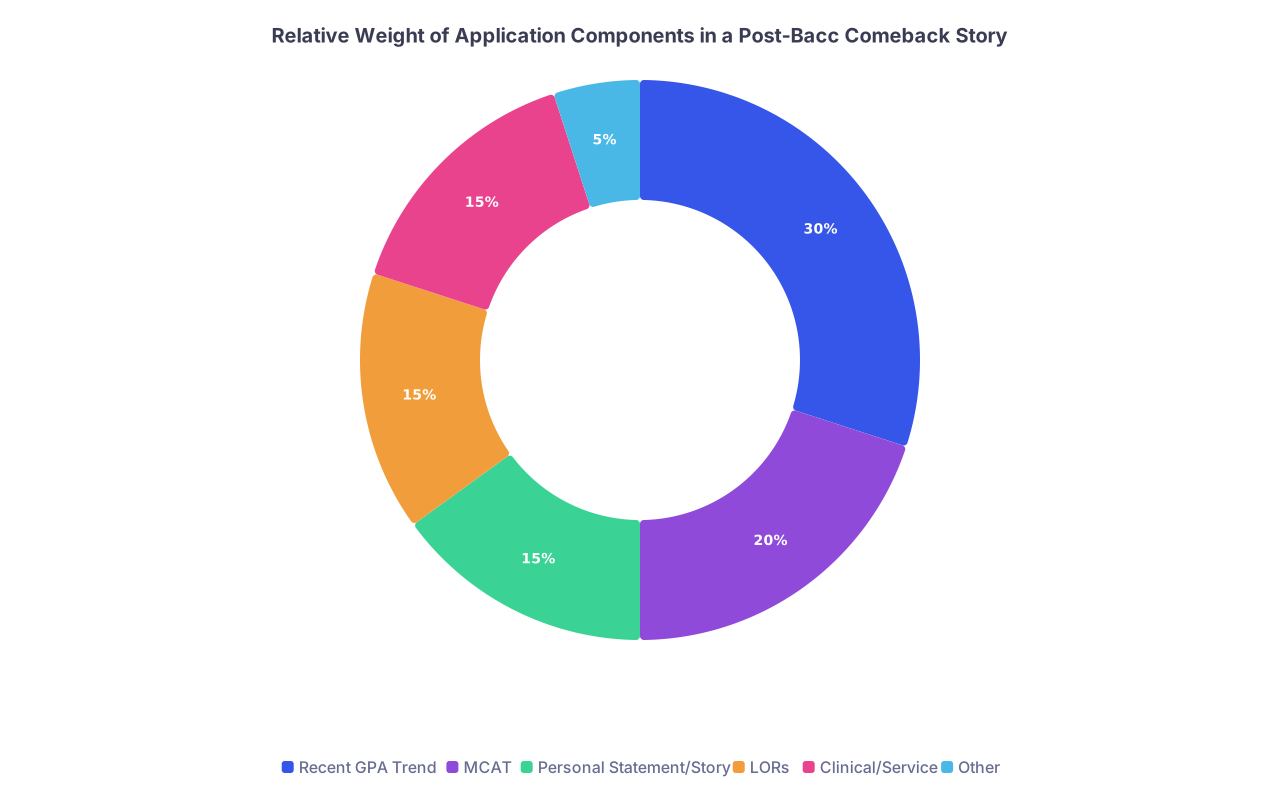
| Category | Value |
|---|---|
| Recent GPA Trend | 30 |
| MCAT | 20 |
| Personal Statement/Story | 15 |
| LORs | 15 |
| Clinical/Service | 15 |
| Other | 5 |
If You’re Already Late and Panicking
Maybe it’s application season. You’re staring at the “Letters” section of AMCAS or AACOMAS and thinking, “I should’ve started this a year ago.”
Okay. Now what?
Triage mode:
Identify who definitely knows you best (not just titles):
The professor who saw you struggle and then saw you improve, the supervisor who’s watched you with patients, the PI you’ve met with 40 times.Ask directly, now: “I’m applying this cycle and the letter deadline is [date]. Would you feel comfortable writing me a strong letter of recommendation for medical school?”
Don’t disappear after asking: Send a follow-up with:
- CV
- Transcript
- Draft of your personal statement (if you have it)
- A short bullet list: “Here are 3 things I hope might be reflected in the letter, if they match your experience of me…”
Accept that your letters might not be perfect this cycle. Then ask the real question: are they good enough that your application tells a coherent story, or are they actively undercutting you?
If it’s the latter and you know it—like, your only potential letter writer barely remembers you and has said that to your face—you might be better off delaying a cycle and using that time to build actual relationships rather than throwing in an application you already know is structurally weak.
That’s not failure. That’s strategy.
The Part You Don’t Want to Hear (But Need To)
If you’re terrified your post‑bacc LORs will “collapse” your app, ask yourself this:
Is this really about the letters, or is it about doubt that your post‑bacc actually changed anything?
Because if deep down you feel like:
- You didn’t really engage
- You coasted and just chased grades
- You didn’t address the habits that tanked undergrad
Then you’re not really afraid of the LORs. You’re afraid someone will say out loud what you already suspect.
That’s actually fixable. But not with one email asking for a letter three days before the deadline.
You fix that by:
- Showing up differently right now
- Owning your story in your personal statement instead of dodging it
- Letting your growth be visible to at least a few people who can speak to it honestly
Strong letters come from strong, consistent behaviour over time. Not from being “likable” or lucky.
FAQ (6 Questions)
1. Do med schools expect all my post‑bacc letters to be from post‑bacc faculty?
No. They expect recent academic letters somewhere in your file. One or two from post‑bacc science faculty is ideal, but a mix of:
- Undergrad science faculty
- Post‑bacc faculty
- Research/clinical supervisors
is completely normal. They care more that the letters are recent enough and match your story than that every single one is labeled “post‑bacc.”
2. Is it bad if my strongest letters are non-academic (clinical or research) instead of from my post‑bacc professors?
Not necessarily. Many adcoms love strong clinical and research letters because they show who you are in real, messy environments. You still need some academic letters to show you can handle coursework, but if your PI or clinical supervisor writes the best, most detailed letter, that can absolutely anchor your file. Just don’t skip having at least one science faculty letter if schools require it.
3. What if my professor barely knows me but is the only one available to write a post‑bacc letter?
Then you need to give them as much context as possible: your CV, transcript, personal statement draft, and a short “here’s why I’m in a post‑bacc and what I’m working to prove.” Ask them directly if they feel they can write a strong letter; if they hesitate, consider whether you can lean more heavily on other recommenders and keep this letter as a secondary one rather than your main academic anchor.
4. Can an average post‑bacc LOR be “saved” by a great MCAT and strong GPA trend?
Yes. Numbers aren’t everything, but they’re not nothing either. A 3.7+ post‑bacc in hard sciences plus a solid MCAT can do a lot of heavy lifting. An average but clearly positive post‑bacc letter then functions as confirmation: “Yes, this person really did handle upper-level science recently and wasn’t a disaster.” That’s enough. Your personal statement and other letters can carry more of the enthusiasm.
5. Should I read my letters or waive my right to see them?
For med schools, you almost always want to waive your right. Confidential letters are taken more seriously. If you don’t trust someone enough to write a fair letter you’re willing to waive for, you probably shouldn’t be using them. The hard part is emotional—you want certainty—but in practice, waiving is the norm and expected.
6. If my post‑bacc LOR situation is genuinely weak this year, is it smarter to delay applying?
Sometimes, yes. If you can’t secure any recent academic letters that are more than “I vaguely know this name,” and your story is heavily dependent on your post‑bacc turnaround, then waiting a year to build real relationships, do more upper‑level coursework, and earn better letters is often the smarter move. One thoughtful, strategic gap year is much better than burning an application cycle where the core of your “I’ve changed” story isn’t backed up by anyone who’s actually seen you change.
Key points, without sugarcoating:
- Your application won’t collapse just because your post‑bacc letters aren’t glowing, as long as they’re clearly positive and your overall story (GPA trend, MCAT, experiences) is strong.
- Weak or nonexistent recent academic letters can hurt, but they’re usually fixable—with better asks, more context, and a mix of other strong recommenders.
- If your gut says your post‑bacc didn’t actually change how you show up, fix that first. The best letters are side effects of how you live this process, not magic words someone else invents for you.