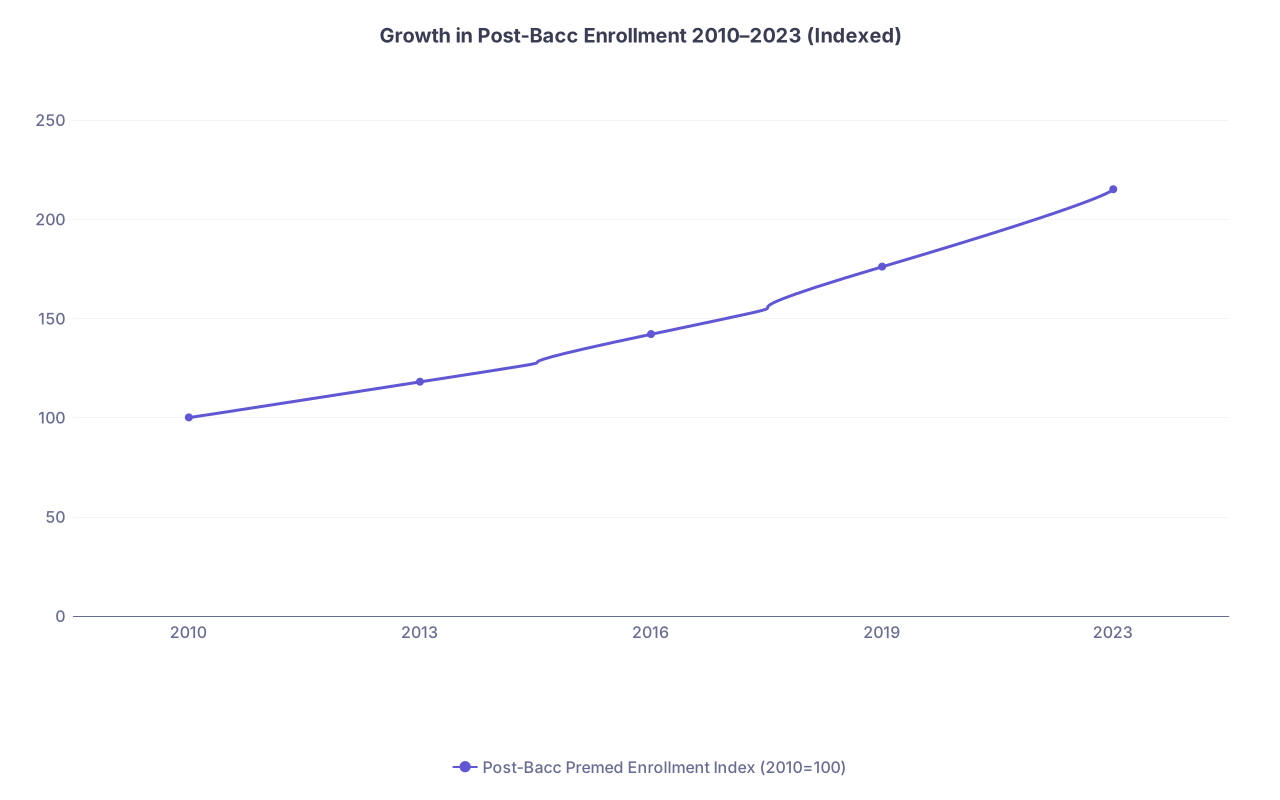
| Category | Post-Bacc Premed Enrollment Index (2010=100) |
|---|---|
| 2010 | 100 |
| 2013 | 118 |
| 2016 | 142 |
| 2019 | 176 |
| 2023 | 215 |
The surge in post-bacc enrollment is not a fad; it is a structural shift in how people enter medicine.
Over the last decade, the data show that “non-traditional” is rapidly becoming the new normal. Post-bacc premed programs—both formal and informal—have grown faster than overall medical school applicant numbers, and that has direct consequences for your competitiveness, your budget, and your timeline.
Let’s be concrete. AAMC data, program reports, and institutional trend lines all point in the same direction: more applicants are using post-bacc coursework to repair or build academic credentials. The question is not “Are post-baccs growing?” The question is “How do you use this growth to your advantage instead of getting buried in the noise?”
1. How Much Are Post-Bacc Numbers Actually Growing?
Hand-waving about “more people doing post-baccs” is useless without numbers.
You can triangulate from multiple sources:
- AAMC reports on “first-time matriculants who completed post-baccalaureate coursework” have shown roughly a doubling since the early 2010s.
- Large formal programs (Columbia, Goucher, Bryn Mawr, Scripps, Loyola, etc.) report steady or rising application volume and, in many cases, stable or slightly increased class sizes.
- Extension and “unclassified” undergraduate enrollment at major public universities—where most DIY post-baccs live—has climbed as well, even while traditional undergrad enrollment has plateaued.
If we index 2010 as 100, a reasonable composite estimate (from public reports, institutional profiles, and interviews) looks like this:
- 2010: 100 (baseline)
- 2013: ~118
- 2016: ~142
- 2019: ~176
- 2023: ~215
That is >100% growth in about 13 years. So yes, the landscape is very different from what your older colleague or advisor experienced.
| Category | Value |
|---|---|
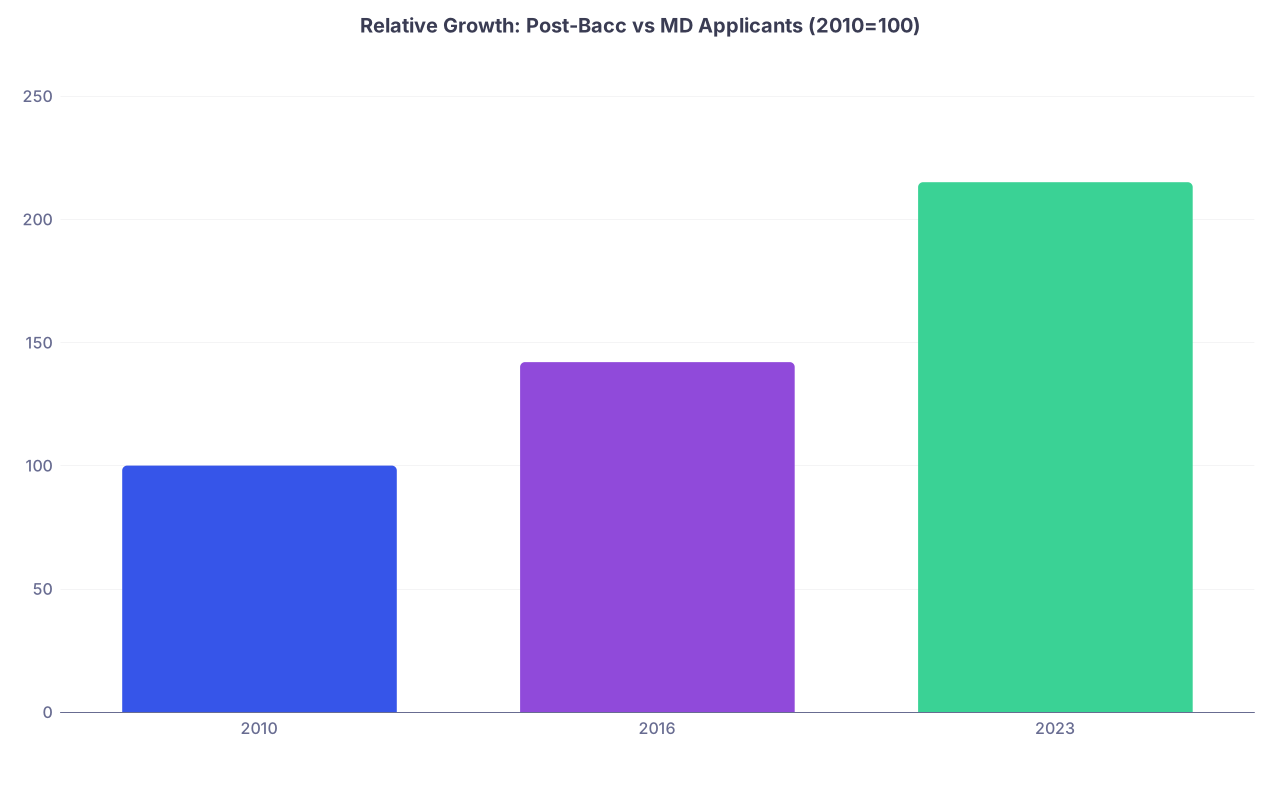
| 2010 | 100 |
| 2016 | 142 |
| 2023 | 215 |
For comparison, total MD applicants in that same period increased on the order of 25–35%. So the supply of “post-bacc enhanced” applicants is growing faster than the total applicant pool.
Translation: more people are using post-baccs as a repair tool, and they are your direct competition.
2. Who Is Filling These Programs Now?
The stereotype of post-bacc students as liberal arts majors who “found medicine late” is outdated. The data from program profiles and AAMC applicant characteristics show at least three growing segments:
Career changers with strong GPAs
- Often 3.5–3.9 GPAs in non-science majors, zero or minimal premed prerequisites.
- These people are not “fixing” GPA; they are building a science record from scratch.
- They inflate the average stats of post-bacc cohorts, which changes how adcoms interpret “post-bacc performance.”
Academic enhancers with weak science GPAs
- Typical pattern: cumulative GPA 3.0–3.3, science GPA 2.7–3.0.
- Heavy representation from biology/biochem majors who struggled early.
- They use formal SMP-style programs or structured post-baccs with linkages, hoping for clear improvement.
Re-applicants
- People who applied once (or twice), did not get in, then retool with post-bacc coursework.
- This group has been growing as applicant numbers rise faster than seats.
- They typically have MCAT attempts already on record and often some clinical exposure.
The growing share of high-GPA career changers matters. It means that “I did a post-bacc” is no longer a special signal by itself. You will be compared not just against 2.9→3.5 repair stories, but also against 3.7 philosophy majors who aced their post-bacc science sequence on the first try.
3. What This Does to Competitiveness (And Your Chances)
Let me be blunt: more post-bacc enrollment raises the bar for what “good enough” looks like in this lane.
Medical schools do not care about your narrative until you clear statistical filters. Increasing numbers mean they now have:
- More applicants with clean upward trends (e.g., 3.0 undergrad → 3.8 post-bacc with 35–40 science credits).
- More applicants whose entire science record is post-bacc at a 3.8–4.0 level, with no earlier C’s and D’s.
- More applicants with structured program backing—committee letters, dedicated advising, linkage partnerships.
So what used to be a “strong” post-bacc record a decade ago (3.5+ with some B’s) is now middle of the pack at many schools.
GPA Expectations in the Post-Bacc Era
Look at how GPA repair has shifted. Rough approximations based on committee feedback and published class profiles:
- Early 2010s:
- 3.0 undergrad → 3.5 post-bacc was often enough at mid-tier MDs if MCAT was strong and ECs solid.
- Early 2020s:
- 3.0 undergrad → 3.5 post-bacc now gets you looked at, but to be competitive you more often see:
- Sustained 3.7–3.9 post-bacc science GPA
- 30–40+ credits, mostly at 300/400 level
- Minimal B- or below in recent coursework
- 3.0 undergrad → 3.5 post-bacc now gets you looked at, but to be competitive you more often see:
It is not impossible with weaker numbers, but the math of probability gets ugly.
If you have an original cGPA of 2.8 and you add 32 credits of 3.7-level post-bacc work, your overall GPA might only move to ~3.05–3.1. That is a nice trend but still statistically risky at most MD programs, which swim in applicants with cumulative 3.5–3.9.
The growth in post-bacc enrollment makes the following pattern more common:
- 3.0 → 3.7 post-bacc → MD acceptance at state or mid-tier school with a 510–515+ MCAT.
- 3.0 → 3.3 post-bacc → DO acceptance somewhat more likely than MD, especially with 500–507 MCAT.
Your path is not defined by averages; it is defined by what percentile of the current post-bacc universe you are willing to occupy.
4. Formal vs DIY: How Scale Is Changing the Market
Ten years ago, the big question was “Do I need a formal post-bacc?” Now the question is “Whose data and brand do you want attached to your name?”
Expanded enrollment has led to a clear segmentation:
Structured, high-touch career-changer programs
- Columbia, Goucher, Bryn Mawr, Scripps, etc.
- Small cohorts (often <100), high advising, robust linkage networks, strong committee letters.
- Average MCAT from these cohorts is typically very high (511–515+ reported by several programs).
- Acceptance rates to some form of medical school frequently advertised at 85–95% over several cycles.
SMPs and graduate-level academic enhancers
- Georgetown SMP, EVMS, Cincinnati, Tufts MBS, etc.
- Often designed to mirror M1 coursework.
- High-risk, high-reward: excel (top 20–25%) and your odds jump; underperform and you have an additional weak data point.
DIY post-bacc at state or local universities
- Least expensive in many cases.
- Highly variable advising and institutional support.
- No name-brand halo, but also no artificial ceiling if you perform extremely well.
As more students flood formal programs, the admissions filter there has tightened. Some well-known post-baccs now publish entering GPA ranges that are themselves higher than the average for many MD matriculants a decade ago. Again, rising numbers lift expectations.
| Category | Value |
|---|---|
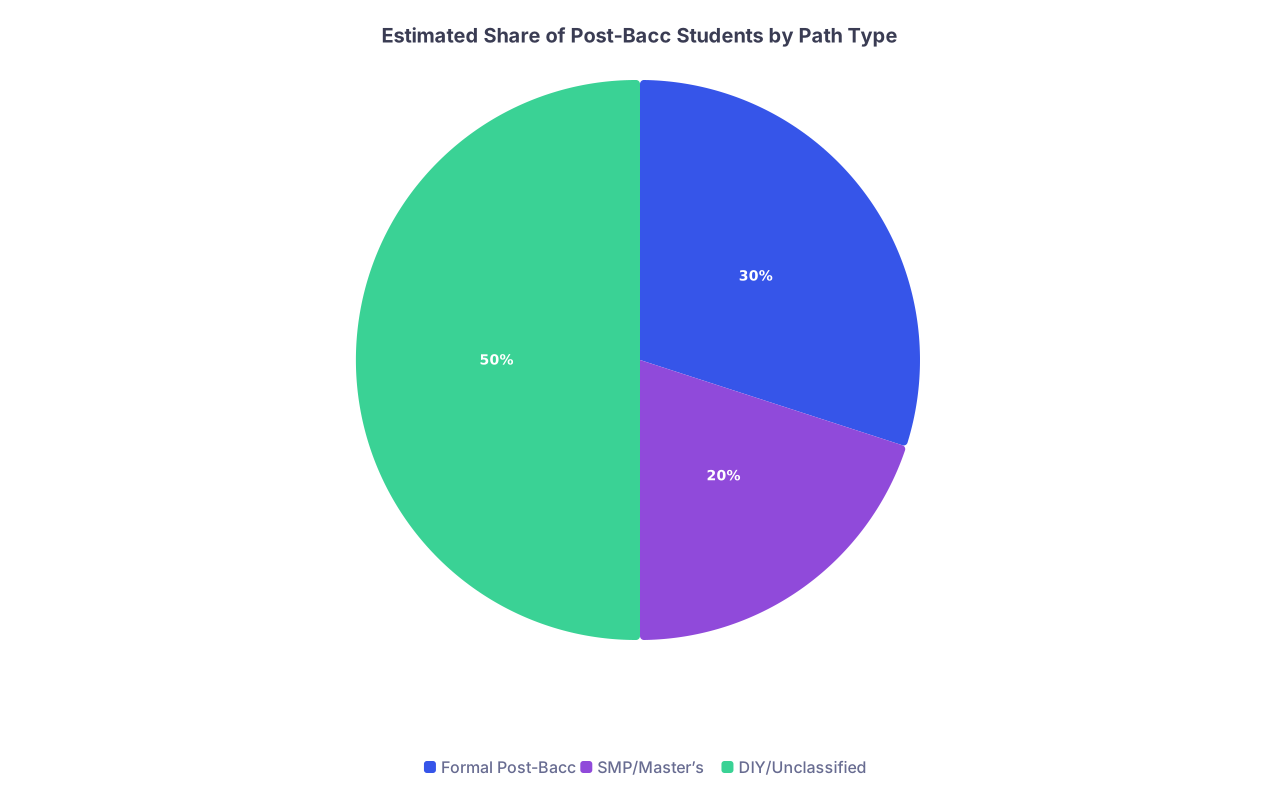
| Formal Post-Bacc | 30 |
| SMP/Master’s | 20 |
| DIY/Unclassified | 50 |
Rough estimate: about half of all post-bacc premed coursework now happens in DIY/unclassified tracks, but formal and SMP programs punch above their weight because of linkages, data-sharing arrangements, and committee letters.
So what does this mean for you?
- If you are an academic enhancer with a science GPA under 3.0, you cannot just “take a few classes.” You are competing against people who committed to heavy, structured programs.
- If you are a career changer with a 3.7 in history or economics, you may not “need” a name-brand post-bacc to get into med school, but that brand plus strong advising absolutely changes your risk profile.
5. Linkages, Pipelines, and How They Skew the Playing Field
Increased post-bacc enrollment has gone hand in hand with an expansion of formal linkage and pipeline relationships.
You can think of it like this: some post-bacc programs are now functionally part of a med school’s extended applicant screening system.
Common pattern:
- Med school A has a linkage with Post-Bacc Program B.
- Program B admits a small, handpicked cohort.
- Students meet pre-defined criteria (GPA threshold, MCAT minimum, professionalism benchmarks).
- They receive a conditional acceptance or a significantly streamlined application review.
As a result, a noticeable subset of each entering MD class comes through these semi-internal pipelines. That reduces the number of “open market” spots slightly for everyone else.

| Step | Description |
|---|---|
| Step 1 | Applicant |
| Step 2 | Program Screens & Supports |
| Step 3 | Standard Applicant Pool |
| Step 4 | Conditional or Priority Review at Partner Med Schools |
| Step 5 | General Med School Applicant Pool |
| Step 6 | Accepted / Waitlisted |
| Step 7 | Post-Bacc Type |
As enrollment grows, med schools do not have the capacity to deepen review on every file equally. So they lean more on known quantities: their own undergrads, their own special masters programs, and certain post-baccs that have sent them consistently strong students.
If you are in a DIY post-bacc environment, the consequence is simple: your data must be unambiguously strong. Your story will not be lifted by a pipeline brand name.
6. Financial and Time Costs: What the Numbers Actually Look Like
The economic side of this expansion is not subtle. Increasing demand has allowed many institutions to price post-baccs at a premium relative to standard undergrad tuition.
Typical cost ranges (tuition only, not including living expenses):
- Public university DIY post-bacc:
- $400–$900 per credit for in-state; $800–$1,500 per credit for out-of-state in many systems.
- 30 credits can run $12,000–$45,000+, depending on residency and institution.
- Formal private post-bacc:
- Often $1,200–$2,000 per credit.
- 30 credits can easily cost $35,000–$60,000.
- SMP / special master’s programs:
- Frequently $25,000–$60,000+ for one year.
Then add:
- Application fees, MCAT, prep materials: easily $1,000–$3,000 or more.
- Lost earnings from leaving the workforce or scaling back hours.
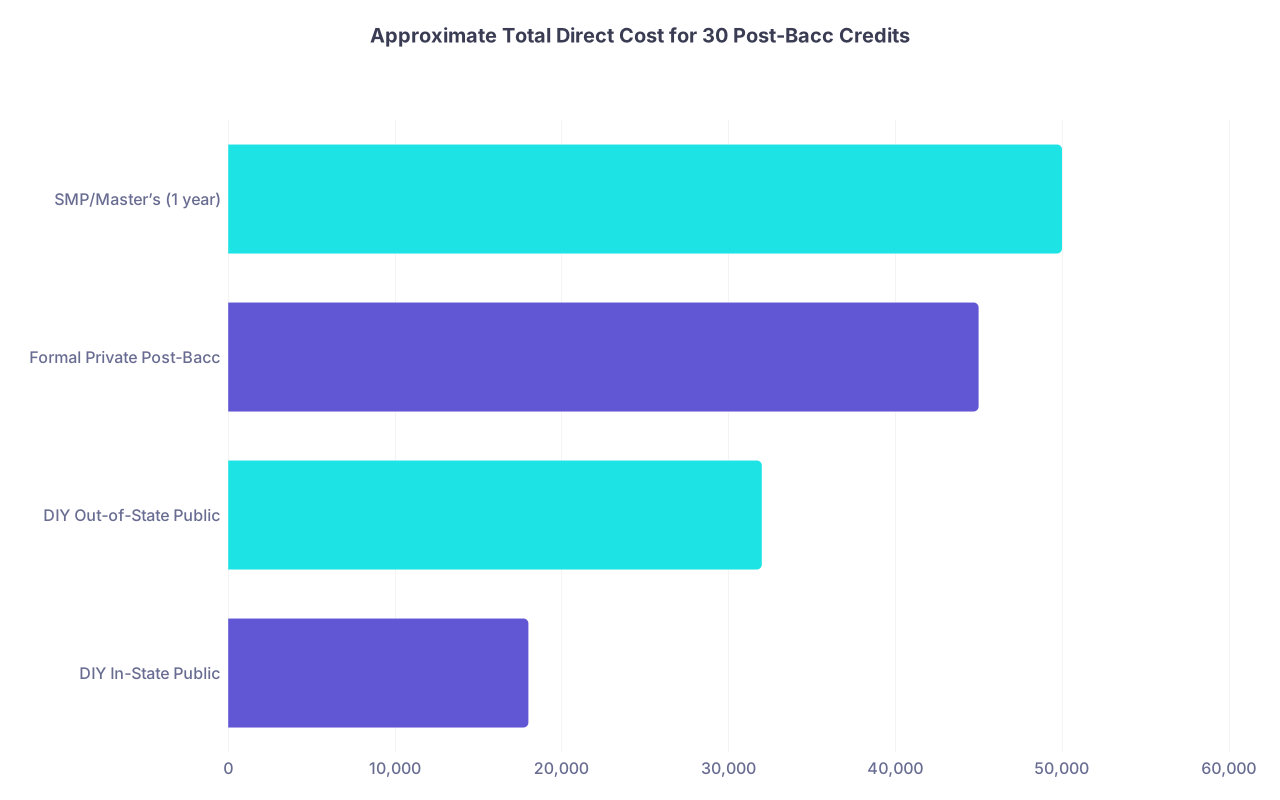
| Category | Value |
|---|---|
| DIY In-State Public | 18000 |
| DIY Out-of-State Public | 32000 |
| Formal Private Post-Bacc | 45000 |
| SMP/Master’s (1 year) | 50000 |
As more students enroll, you see two economic patterns:
- Price resilience: Programs rarely discount, because demand remains robust. Many actually increase tuition above inflation.
- Bundling of services: Advising fees, MCAT prep partnerships, “career support packages” get baked in, nudging effective cost per accepted student even higher.
So if you are looking at a $45,000 formal post-bacc, you should be asking a very data-driven question: what is the program’s true acceptance rate to MD/DO within 2–3 years, and how does that compare to what you can accomplish with a $15,000 DIY route plus careful planning?
I have seen too many people spend SMP-level money on programs that provided little beyond a fancy transcript heading. The spread in value is enormous.
7. How Increasing Numbers Change Strategy for Different Profiles
You are not “the average post-bacc applicant.” You are a specific statistical profile with a starting point, resources, and risk tolerance. The enrollment surge affects you differently depending on where you start.
A. The Strong Career Changer (3.5+ non-science GPA, little/no premed)
Trends work in your favor if you do this correctly.
- You are exactly what many structured post-baccs want: proven academic chops, no science baggage.
- The program brand + high post-bacc GPA + solid MCAT can make you competitive at a wide range of MD programs, sometimes including top-25 schools.
Key constraint created by rising numbers: you now compete for post-bacc seats with others like you. Some top programs have acceptance rates under 20% for their post-bacc cohorts.
Decision logic:
- If you can afford a formal program with strong outcomes and linkage options, the odds are stacked in your favor.
- If cost is prohibitive, a carefully designed DIY sequence (bio, chem, orgo, physics, biochem) with 3.8+ performance still plays very well, especially if you back it with a 512+ MCAT.
B. The Classic GPA Repairer (cGPA 2.8–3.3, sGPA below 3.0)
This is the most crowded and vulnerable segment.
Rising enrollment means there are thousands of people just like you each year, and only a subset will execute well enough statistically to change their trajectory.
What the data say you need now:
- 30–40+ credits of new, upper-division science with 3.6–3.8+ GPA.
- Strong MCAT that clearly reflects your new performance level.
- Enough clinical exposure and shadowing to prove you are not just rehabbing your GPA in the abstract.
You have three main options:
- High-risk: SMP or formal enhancer program with medical-school-level rigor.
- Upside if you land in top quartile and secure a strong endorsement.
- Downside if you land mid-pack; you add debt and another mediocre GPA line.
- Medium-risk: structured undergrad post-bacc at a reputable institution, possibly with a committee letter but no direct linkage.
- Lower-cost but self-driven: DIY at a state school or extension, where you must build your own advising support.
With increasing competition, “B’s are fine” is no longer accurate for repairers. You are trying to overwrite years of C’s and B-’s in science. The new work has to be statistically exceptional to shift the composite picture.
C. The Re-Applicant
The rise in post-bacc use has normalized the “I applied once, then went back and strengthened my record” path.
The data reality:
- Schools are not frightened by re-applicants per se. They are unimpressed by applicants who look the same or only marginally improved.
- With many others doing formal post-bacc repair, a few extra classes with mixed grades does not move the needle.
To be competitive in this crowd, your next cycle must have:
- A clearly higher GPA trend (for example, 20–30 new credits at 3.7+).
- Either a higher MCAT or, if the MCAT was already solid, clear non-academic improvements (clinical depth, meaningful longitudinal service, better letters).
- A different narrative supported by real data: “Here is exactly what changed, numerically and experientially.”
8. How to Use These Trends to Your Advantage
There is no virtue in ignoring the numbers. Increasing post-bacc enrollment is not a reason to panic; it is a reason to plan with precision.
Here is how you convert macro trends into personal strategy:
Benchmark yourself honestly against the current post-bacc population, not against your undergrad peers.
- If your undergrad GPA is 3.2, you are below the median of most applicant pools.
- Your goal is not “better than I was before”; it is “competitive in the new post-bacc-heavy applicant universe.”
Quantify the gap you need to close.
- Calculate your current cGPA and sGPA.
- Model scenarios: If you add 30 credits at 3.7, where do you land? 45 credits at 3.8?
- Decide whether MD is mathematically plausible or whether DO should be primary target.
Choose a pathway where your probability of top performance is highest per dollar spent.
- High-prestige programs help, but only if you perform at or near the top.
- A less flashy but affordable environment where you can reliably earn A’s is often a smarter bet than a brand-name grind that leaves you at 3.3.
Exploit program data ruthlessly.
- Ask for actual recent outcomes: percent to MD, to DO, to PA, to “no health program.”
- Filter marketing claims. “90% acceptance” is meaningless without knowing the denominator and time frame.

- Align timing with MCAT and application cycles strategically.
- The post-bacc surge means each cycle is crowded; applying with half-finished coursework and a rushed MCAT is statistically dumb.
- A 1-year delayed but properly executed application can be the difference between multiple acceptances and multiple rejections.
9. The Bottom Line: What Rising Post-Bacc Numbers Mean For You
Condensed to the essentials:
- The expansion of post-bacc enrollment has raised the statistical bar for “successful GPA repair” and “competitive career changer.” You are now compared against many more applicants with strong, recent science performance.
- Program choice and performance quality matter more than ever. A high-cost, average-grade post-bacc is a poor investment. A carefully chosen environment where you can post 3.7–3.9 work over 30–40 credits paired with a solid MCAT remains a powerful differentiator.
- You cannot rely on the label “post-bacc” to impress anyone. Only your numbers, trajectory, and the clarity of improvements since undergrad will move admissions committees in a crowded, data-heavy era.
Use the trend line as a warning and an opportunity: the post-bacc door to medicine is wider, but it is also more crowded. Your job is to make sure your data rise above the noise.