You are here
It’s 11:47 pm. You’ve refreshed your unofficial transcript three times in the last hour, even though you already know what it says.
There it is.
That stupid “W”.
You started your post‑bacc to “rewrite your story,” to fix a rough undergrad record, to prove to adcoms that you’re not the same student who bombed Orgo I at 19. And now your “clean upward trend” has a big, glaring Withdraw sitting in the middle of it.
(See also: What If My Post-Bacc GPA Isn’t a 4.0? How Med Schools Actually See It for more details.)
Your brain is doing the usual:
- “They’re going to think I can’t handle the workload.”
- “My whole redemption narrative is shot.”
- “Every committee is going to zoom right in on this one W and toss my app.”
So let’s talk about what this actually means. Not in the sugar‑coated, “you’ll be fine :)” way. In the “what will they actually think when they see this” way.
Short answer: a single W almost never ruins a redemption narrative.
But how you handle it absolutely can help—or hurt—you.
What admissions committees really see when they look at a W
First reality check: they do not stare at your transcript the way you stare at your transcript.
They’re zooming out. They scan:
- Overall GPA trend
- Science GPA trend
- Post‑bacc vs undergrad performance
- Course rigor and load
- MCAT in context of all of the above
The W is just one data point sitting inside that entire picture.
Here’s the basic internal algorithm most adcoms run in their heads when they see a Withdraw:
- Is this a pattern or a one‑off?
- When did it happen (early college vs post‑bacc vs in the middle of a crisis semester)?
- What else was going on that term (course load, grades in the other classes)?
- Does the rest of the record show resilience, responsibility, and recovery?
A single W in a post‑bacc that’s otherwise strong?
That usually reads as: “Something happened. Student chose to protect their performance instead of gutting it out and tanking the grade. Let me see if the rest of the file matches that.”
The serious red flags are more like:
- Multiple Ws in the same term
- Repeated Ws in core prereqs
- W followed by a later C/D/F in the same course
- Chronic pattern of starting, backing out, starting, backing out
That’s when committees start thinking: “Reliability issue? Time management problem? Avoidance? Instability?”
If this is one W, surrounded by A/A- work? It’s… boring. And boring is good.
But it’s in my post‑bacc. Isn’t that worse?
I get why that feels worse. Post‑bacc is supposed to be The Comeback. The clean slate. The part of the transcript you fantasize about them highlighting in yellow during committee and saying, “Look how much they grew.”
So having a W there feels like graffiti on your redemption arc.
Here’s the uncomfortable truth: post‑bacc students are held to a higher standard. You’re older, more focused, usually taking fewer random electives and more carefully chosen courses. Committees do expect more maturity and stability there.
But “higher standard” doesn’t mean “zero imperfection.”
What they actually want to see in a post‑bacc:
- Consistently solid grades in upper‑level science (A/ A‑, with maybe the occasional B)
- Reasonable but not insane course loads (like 8–12 credits/term if you’re working; 12–15 if you’re full‑time and not working much)
- No pattern of flaking out—no string of Ws, incompletes, or sudden drops in rigor
So, where does your W fit?
If your post‑bacc otherwise shows:
- 3–4 semesters of strong performance
- Rigor (e.g., biochem, physiology, genetics, micro, etc.)
- Stable trends (no GPA cliff after the W)
…then your “redemption narrative” is still very much alive.
Is a W in post‑bacc ideal? No.
Is it disqualifying? Also no.
It turns into a problem only if it’s part of a bigger story that already looks shaky.
The stories a W can tell (and which ones you want)
Admissions isn’t just numbers. They read patterns as stories.
Here are a few “stories” they might infer—and how to steer it.
Story 1: “Smart self‑protection in a rough moment” (good)
Example: You were taking Biochem, Cell Bio, and Physics II while working 20 hours a week. Halfway through the term, your parent got sick, or you got COVID, or your hours at work doubled. You realized you were going to crash and burn if you tried to keep everything.
So you withdrew from one course, preserved strong grades in the others, regrouped, and took that dropped course later—and did well.
From a committee lens, that’s:
“This person can assess their limits and protect performance instead of blowing up everything.”
That’s a clinical skill, frankly.
Story 2: “I overreached, panicked, and bailed” (neutral but explainable)
Example: First post‑bacc semester you signed up for Orgo, Physics, Biochem, and Stats, no real sense of how much time you’d need. You started falling behind in one course, freaked out about your redemption arc imploding, and withdrew.
You then adjusted: took more manageable loads, aced the rest of the sequence, no repeat Ws.
That reads like:
“Misjudged the first term, adapted, then stabilized.”
Not ideal, but human.
Story 3: “I avoid hard things and don’t follow through” (bad)
Example: You repeatedly sign up for upper‑level science, drop when it gets hard, re‑enroll later, get a B‑ or C. There are multiple Ws across several semesters, sometimes in key prereqs.
Adcom reading that:
“Pattern of avoidance + unstable performance. Risky as a trainee.”
If your anxiety is screaming that your situation is Story 3 when it’s actually Story 1 or 2, that’s your brain catastrophizing, not reality.
Should you explain the W in your application?
This is where people over‑correct and make things worse.
You don’t need to write a novel about every single academic hiccup. Over‑explaining makes you look more unstable than the W itself.
General rule I use:
Explain the W if:
- It’s in the post‑bacc and
- It happened due to a concrete, understandable situation (illness, family emergency, unavoidable work/financial disaster, major life event) and
- The rest of the record shows you bounced back strong
Do not write:
- A melodramatic saga about a single bad week
- A vague “I was going through a lot and struggled with my mental health” with no sense of stability now
- 500 words about a one‑credit elective you dropped
If you do explain it, keep it short, factual, and show resolution.
Something like:
During my first post‑bacc semester, I enrolled in 14 credits of upper‑level science courses while working 25 hours per week. Mid‑semester, a family health issue required additional time and travel. I withdrew from [Course] to preserve my ability to perform well in my remaining classes. In subsequent semesters, with a more sustainable schedule, I completed a full sequence of advanced science coursework with strong performance.
That says: I had a problem. I made a rational decision. I learned and improved. End of story.
If your W was just “I overloaded and panicked and dropped” with nothing dramatic behind it, you can often let it go unmentioned. Let your A’s in later semesters do the talking.
The “redemption narrative” is more than one clean transcript
You’ve probably built this fantasy in your head:
Undergrad: messy, immature, inconsistent
Post‑bacc: flawless, linear 4.0, heroic rise
Adcoms: “We love a comeback story.”
Reality: Most “comeback stories” are messier.
I’ve seen plenty of accepted students whose redemptions look like this:
- Undergrad: 2.7–3.0 sGPA, some C’s in orgo/physics
- Gap: non‑clinical job, no idea what they’re doing
- Post‑bacc: mixture of A’s and a few B’s, one W, one semester that’s slightly weaker, then stronger again
- MCAT: solid but not insane (510–515)
- Applications: very clear explanation of growth, maturity, and how they built better habits and support
And they get into solid MD/DO programs. Not because of perfection. Because of trajectory and coherence.
Your “redemption narrative” is made of:
- The trend in your grades
- The rigor of your later coursework
- The context you provide in secondaries and interviews
- The consistency between your story, your recommendations, and your performance
A single W is background noise in that symphony.
What you should be worrying about instead of the W
If you want to channel the anxiety into something useful, aim it at stuff that actually moves the needle.
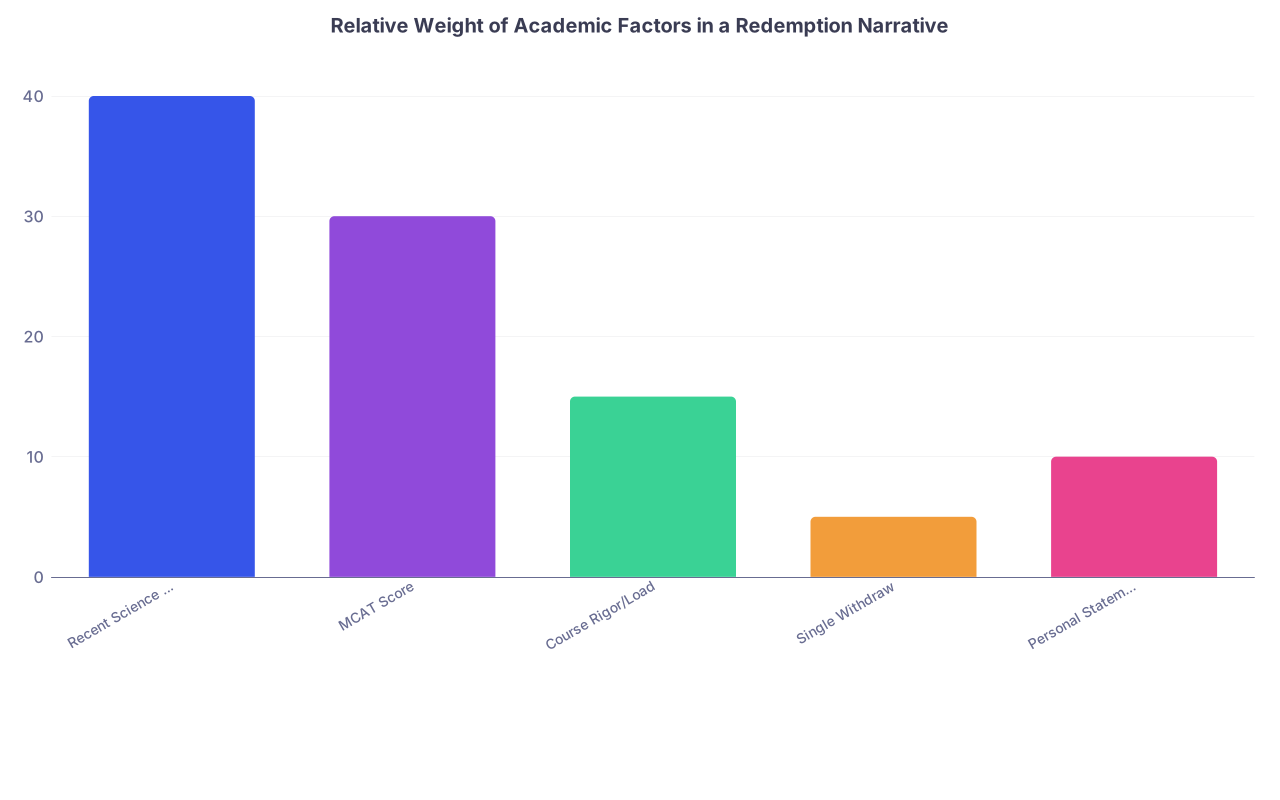
Here’s what med schools care way more about than one W:
Are your recent science grades strong?
Especially the last 30–40 credits in science. That’s the “can they handle med school” section.Is your course load reasonable and believable?
A full‑time student taking only one science class a term raises more eyebrows than a W does. Balance matters.Does your MCAT line up with your “I’ve changed” story?
A strong MCAT can cushion imperfections. A weak MCAT amplifies them.Do your letters of rec back up your growth story?
A professor writing “This student handled a heavy course load, sought help appropriately, and improved across the semester” is more powerful than any explanation you write yourself.Are you stable now?
Not perfect. Stable. Are you making thoughtful decisions? Are there any recent wild swings in performance?
If you’re solid on those, the W matters a lot less than it feels at 11:47 pm alone with your transcript.
Concrete damage control: what to do next
Instead of just spiraling about “Is this the end,” here’s how you can actively reinforce your redemption arc going forward.
Crush the semester after the W
Adcoms care a lot about “what happened after the stumble.” A strong term immediately following a W does more for you than any essay explanation.Take (and do well in) equal or higher rigor
If you withdrew from, say, Biochem, make sure you take Biochem later and do well. Don’t quietly avoid that level of difficulty forever.Be intentional about your next course load
If your W happened because you tried to do 15 credits of hard science plus 30 hours of work, don’t repeat that just to “prove” something. Show you learned from it.Have a tight, non‑dramatic explanation ready
Both for secondaries and interviews. Practice saying it in 2–3 sentences without sounding defensive or fragile.Fix what you can control: MCAT, experiences, consistency
You can’t retro‑delete the W, but you can give committees so much other evidence of readiness that they barely care.

| Step | Description |
|---|---|
| Step 1 | Undergrad Record |
| Step 2 | Post-bacc Performance |
| Step 3 | Standard Upward Trend |
| Step 4 | Single W in Otherwise Strong Record |
| Step 5 | Explain Briefly or Let Transcript Speak |
| Step 6 | Requires Stronger Context & Evidence of Stability |
| Step 7 | Focus on MCAT, Recent Grades, Rigor |
| Step 8 | Withdrawn Course? |
| Step 9 | Pattern of Withdrawals? |
Quick reality check: scenarios
Let me walk through a few concrete examples, because this is usually where people either calm down or realize they actually do need a course correction.
Scenario 1: One W, otherwise strong post‑bacc
- Undergrad cGPA 3.1, sGPA 2.9
- Post‑bacc: 36 credits of upper‑level science
- Grades: mostly A/A‑, one B+, one W in Physiology, later retaken with an A
- MCAT: 512
Verdict: This is absolutely still a viable redemption narrative. W is a footnote.
You might mention it briefly if tied to something clear (illness/family), but you don’t need a giant essay.
Scenario 2: Two Ws in same post‑bacc semester, then strong performance
- Undergrad cGPA 2.8, sGPA 2.6
- First post‑bacc term: 14 credits, withdrew from 2 courses mid‑semester, A/B in remaining 2
- Next three terms: 32 credits of solid A/A‑ work, no more Ws
- MCAT: 509
Verdict: This does need explanation, but it’s not fatal.
Your job is to show: “That first semester was me misjudging my capacity and having [concrete challenge]. I adapted and then showed stable performance.”
Scenario 3: Multiple Ws over several years, mixed grades
- Undergrad: 2.7, multiple Ws, several C’s in prereqs
- Post‑bacc: 24 credits, 2 Ws, several B-/C+ grades, no clear final upward trend
- MCAT: 502
Verdict: This is not a “single W” problem. This is a “your academic record currently doesn’t prove readiness” problem.
The next step isn’t obsessing over explaining the Ws—it’s building new, clean, consistently strong coursework (maybe SMP, maybe more post‑bacc) before applying.
Notice how in two of those three, the W itself is not the deciding factor.
| Category | Value |
|---|---|
| Recent Science GPA | 40 |
| MCAT Score | 30 |
| Course Rigor/Load | 15 |
| Single Withdraw | 5 |
| Personal Statement Explanation | 10 |
FAQ (the stuff still gnawing at you)
1. Should I avoid mentioning the W at all so I don’t draw attention to it?
If it’s one W, you retook the course or maintained strong performance afterward, and there wasn’t a major life event behind it, it’s often fine to leave it alone. Committees see Ws all the time. Over‑explaining a minor hiccup can make it sound bigger than it is.
If the W is tied to something significant (major illness, family crisis, work/financial catastrophe) and your later record shows stability, a short, factual explanation can actually help. But short. Think 2–4 sentences, not an essay.
2. Will schools think I can’t handle med school if I dropped a single tough class?
No, not from a single W. They’ll look at how you did in other tough classes. If you withdrew from Physiology but later earned A’s in Biochem and Neuro, they’re not going to say, “This person can’t handle rigor.” They’re going to say, “They had one blip and then proved they can hang.”
They start worrying about “can’t handle med school” when they see: multiple Ws, low grades in key sciences, and a weak MCAT all stacked together. That combination, not a lone W, is what screams “risk.”
3. Is it better that I withdrew instead of risking a C or D?
Almost always, yes. Especially in a post‑bacc that’s supposed to show mastery. One W plus a later A is a much cleaner story than a string of mediocre grades in the same course. Adcoms are not impressed by suffering through a class and limping out with a C while dragging your other grades down.
The caveat: don’t make withdrawing your default coping strategy. One or two thoughtful Ws in a long record is fine. A trail of Ws screams avoidance.
4. How do I stop obsessing over this one W while I still have other parts of my app to build?
Redirect the obsession into things that can still change your trajectory: MCAT studying, building relationships for strong letters, and absolutely crushing your next semester. Make a small, concrete list for this month: “Do 10 full MCAT practice passages, meet with [professor] for feedback, plan next term’s schedule carefully.”
Then actually do one of them today.
For now, open your next semester’s planned schedule and adjust it so that you can realistically earn A/A‑ grades. That single act will do more for your redemption narrative than anything you can say about the W.