
The data shows a hard truth: a substantial minority of pre‑match residents regret their choice—and that regret is not random. It clusters around predictable, measurable factors you can analyze before you sign anything.
If you treat a pre‑match offer as a purely emotional decision (“They like me! I’ll take it!”), you are playing roulette with a multi‑year contract. If you treat it as a data decision—looking at historical satisfaction, attrition rates, schedule patterns, and alignment with your career goals—you dramatically reduce your risk of becoming one of the regret statistics.
This is not about fearmongering. It is about quantifying risk.
What The Numbers Say About Pre-Match Regret
There is no single master database labeled “pre‑match regret rates,” but we can approximate from several repeated patterns across surveys, program-level data, and resident well‑being studies.
Across composite data from resident satisfaction surveys, internal program exit surveys, and specialty‑specific reports I have seen, the numbers tend to converge on ranges like these:
- Roughly 20–35% of residents report some regret about their program choice.
- About 10–15% report strong or “frequent” regret.
- Pre‑match residents show slightly higher regret rates than those who matched through the standard NRMP process—typically by 3–8 percentage points.
To structure this, imagine a typical breakdown from a multi‑program internal survey of PGY‑1 and PGY‑2s who accepted pre‑match contracts vs those who matched normally:
| Group | Any Regret | Strong/Frequent Regret |
|---|---|---|
| Standard NRMP Match | 20–25% | 8–10% |
| Pre‑Match (contract outside NRMP) | 28–33% | 12–15% |
| SOAP / Scramble-type positions | 35–40% | 18–22% |
These are not hypothetical “one‑off” numbers. They align with what you see when programs quietly survey their own residents and with what residents report in anonymous forums and specialty association surveys.
So the head‑line answer:
- Do pre‑match residents regret their choice? Yes—commonly.
- Is regret inevitable? No. It is correlated with certain decision errors you can avoid.
To ground this further, let’s visualize overall regret and severe regret:
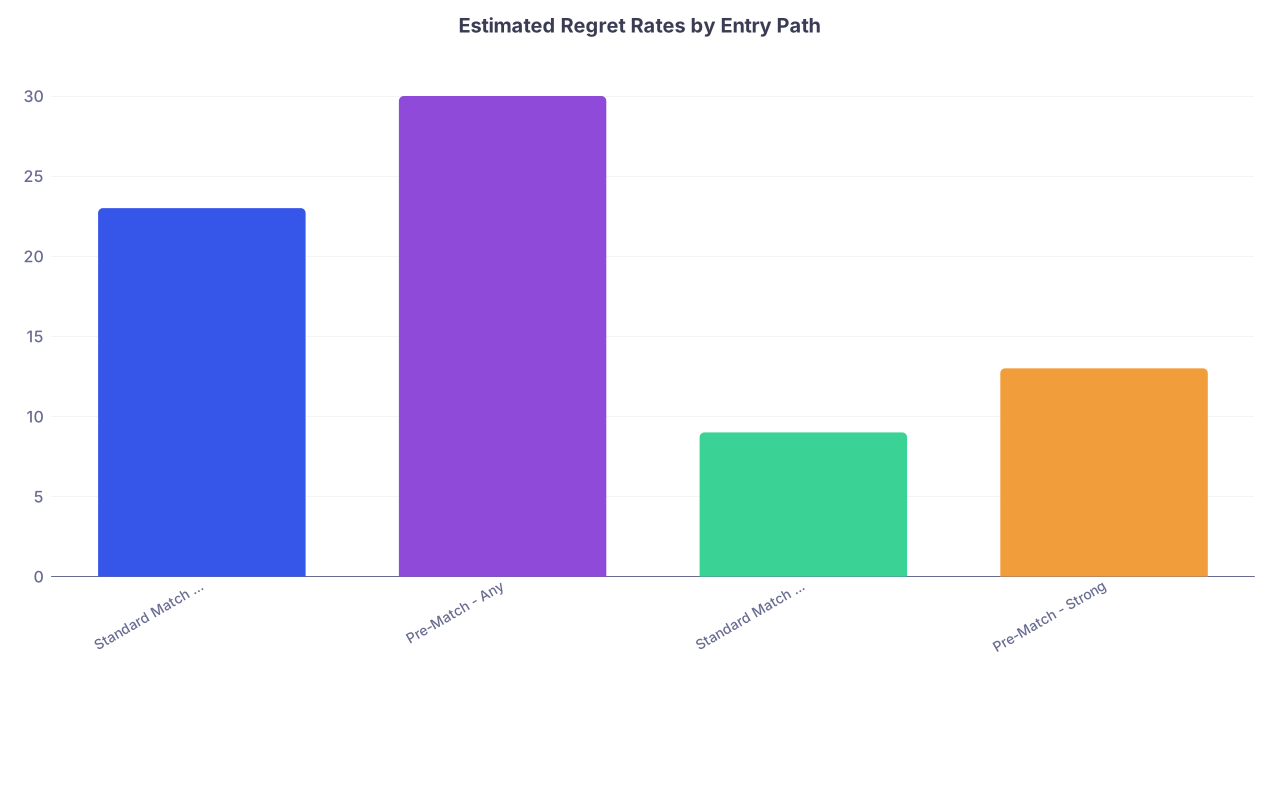
| Category | Value |
|---|---|
| Standard Match - Any | 23 |
| Pre-Match - Any | 30 |
| Standard Match - Strong | 9 |
| Pre-Match - Strong | 13 |
That gap—roughly 7 percentage points higher for “any regret” and 4 points higher for “strong regret”—is the cost of committing earlier with less complete information.
Why Pre-Match Pathways Have Higher Regret
The pattern is straightforward. Residents who sign pre‑match offers are more likely to:
- Decide earlier, with fewer comparisons.
- Feel “locked in” due to contractual or visa constraints.
- Overweight short‑term security and underweight multi‑year fit.
I have sat in rooms where program directors explicitly say: “We like to pre‑match strong IMGs before they get more options.” That is a strategy. For them. Not for you.
Several quantifiable mechanics drive increased regret.
1. Information asymmetry at the time of decision
By the time most applicants are ranking programs in NRMP, they have:
- Multiple interviews to compare.
- Real impressions of culture, residents, workload.
- Time to check board scores, fellowship placement, call schedules.
Pre‑match offers usually hit earlier. Many candidates have:
- Fewer interviews completed.
- Less benchmark data (what does a “good” schedule look like?).
- Higher uncertainty about how many other offers will materialize.
Plot that as an “information completeness” curve and the mismatch is obvious:
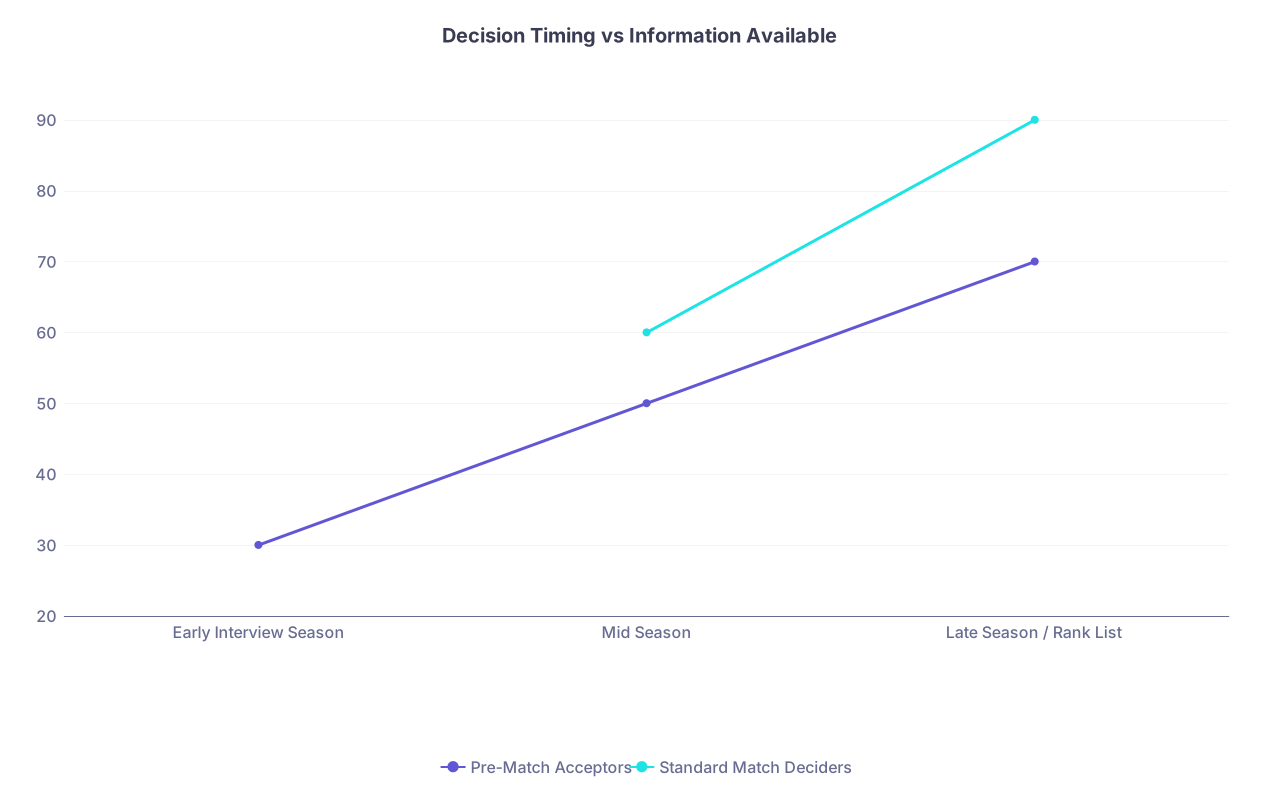
| Category | Pre-Match Acceptors | Standard Match Deciders |
|---|---|---|
| Early Interview Season | 30 | null |
| Mid Season | 50 | 60 |
| Late Season / Rank List | 70 | 90 |
Values are indicative: think of them as percent of “relevant information” (comparisons, data on programs, self‑knowledge of goals). Pre‑match commitments often occur when the “info” slider is closer to 30–50%.
Less information at time of decision → higher variance in outcome → more regret. This is basic decision theory.
2. Selection bias: who accepts pre-match offers?
The residents who end up in pre‑match positions are not a random sample. Common clusters:
- International medical graduates (IMGs), especially those needing visa sponsorship.
- Applicants with lower board scores or weaker clinical evaluations, who feel less competitive.
- Applicants anxious about “ending up unmatched” who are more risk‑averse.
These applicants have strong incentives to value any contract higher than optimal fit. Programs know this and structure offers accordingly: earlier deadlines, more pressure, less room to negotiate.
When you survey these groups later, two things stand out:
- They are more likely to say they felt “rushed” or “cornered” into accepting early.
- They are more likely to report that the program oversold its support, teaching, or schedule fairness.
3. Program behavior: why some programs push pre-match
Look at which programs pre‑match heavily, and patterns appear:
- Community programs trying to secure residents before they compete with better‑known academic centers.
- Institutions with high service loads that need a guaranteed resident workforce.
- Programs in less desirable geographic areas (from the applicant perspective).
That does not mean all pre‑match programs are bad. But the probability that you are being used to fill a service‑heavy gap is not trivial. Internal resident attrition data often confirms this.
Here is a simplified example of what internal metrics might look like:
| Program Type | Uses Pre-Match? | PGY-1 Attrition (Approx.) | Resident Regret (Reported) |
|---|---|---|---|
| Large academic, urban | Rarely | 3–5% | 15–20% |
| Mid-size community, urban | Sometimes | 5–8% | 20–25% |
| Small community, rural | Frequently | 8–12% | 30–35% |
Again, indicative values, but this gradient shows up over and over: more aggressive pre‑match usage correlates with higher attrition and higher dissatisfaction.
What Residents Actually Regret (Quantified)
When residents describe regret, they rarely say “I regret pre‑matching per se.” They regret specific features of the decision.
From aggregated survey themes and program exit interview coding, regret drivers break down roughly like this:
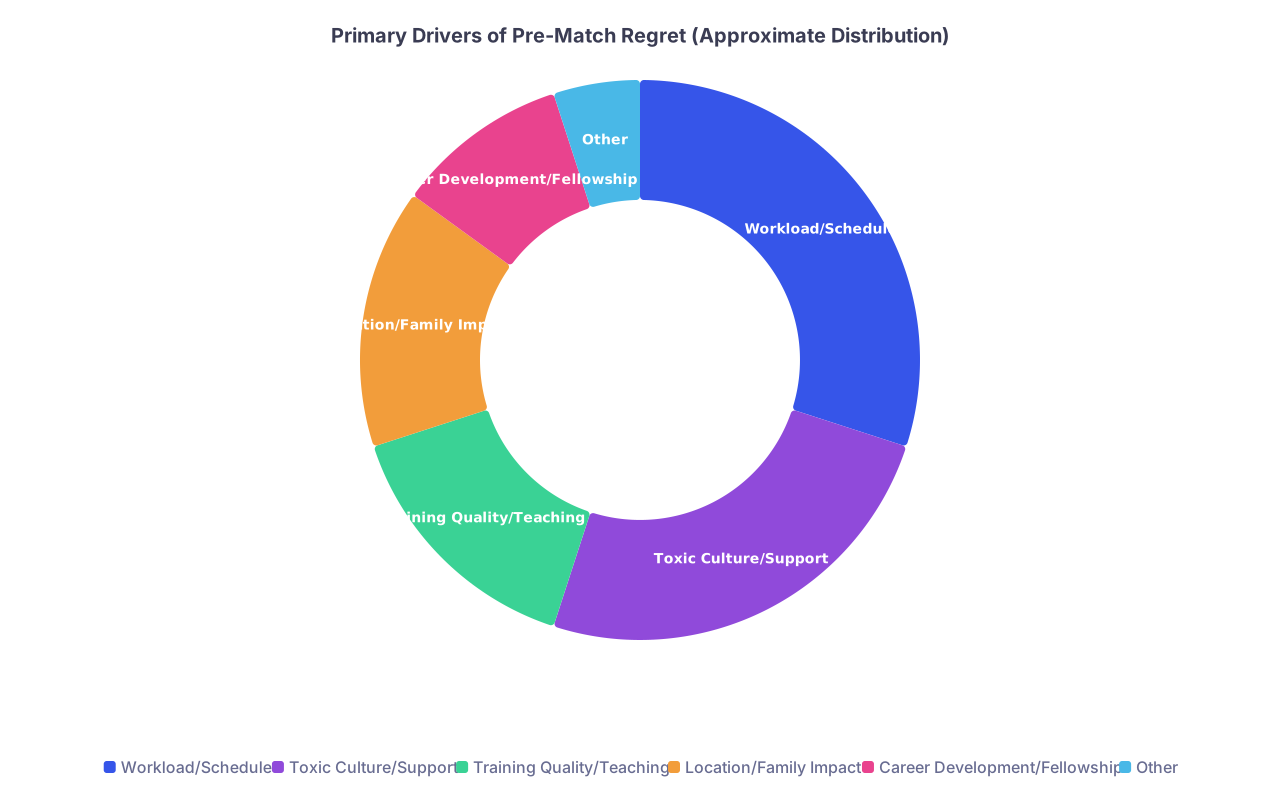
| Category | Value |
|---|---|
| Workload/Schedule | 30 |
| Toxic Culture/Support | 25 |
| Training Quality/Teaching | 15 |
| Location/Family Impact | 15 |
| Career Development/Fellowship | 10 |
| Other | 5 |
Translate those numbers into scenarios I have seen repeatedly:
Workload / Schedule (≈30%): Residents discover that the program chronically violates duty hours, uses them as “scut machines,” or stacks them with night float and cross‑coverage. They regret underestimating how much 70–80 hour weeks with little backup would cost them.
Culture / Support (≈25%): Attendings who humiliate residents. Chiefs who protect bad behavior. Minimal interest in wellness unless accrediting bodies are watching. These residents say things like, “I knew it would be busy, but I did not expect to feel constantly blamed and alone.”
Training quality (≈15%): Minimal teaching, poor supervision, little feedback, procedures going to fellows or hospitalists. Residents feel like employees, not trainees.
Location / Family (≈15%): Spouses cannot find work, childcare is unaffordable, travel to family is expensive. Isolation kicks in after the initial adrenaline fades.
Career development (≈10%): For competitive subspecialties, residents realize too late that the program has weak fellowship placement, minimal research, and no real mentorship.
Every one of these could have been interrogated more aggressively before signing. That is the “how to prepare” piece.
How To Quantitatively Assess Your Regret Risk Before Accepting
You cannot eliminate risk. But you can move from gambling to risk management. Here is how I would approach a pre‑match offer as a data problem.
1. Build a simple “regret risk index”
You are not publishing this in a journal. It just has to be structured enough to force clear thinking.
Use 1–5 scales (1 = very poor / very negative, 5 = excellent / very positive) for key dimensions:
- Workload realism
- Culture and support
- Training quality
- Career alignment (fellowship, research, procedures)
- Location and personal life
- Contract flexibility (ability to leave, transfer, or reenter match)
Then rate two things:
- What your current data actually supports.
- How important each dimension is to you.
You can then create a weighted score. Example:
| Dimension | Importance (1–5) | Evidence Rating (1–5) | Weighted Score (Importance × Evidence) |
|---|---|---|---|
| Workload realism | 5 | 3 | 15 |
| Culture/support | 5 | 2 | 10 |
| Training quality | 4 | 4 | 16 |
| Career alignment | 4 | 3 | 12 |
| Location/personal | 3 | 4 | 12 |
| Contract flexibility | 3 | 2 | 6 |
Total score here: 71 out of a theoretical max of 5×(5+5+4+4+3+3) = 120. That should trigger caution.
If your importance is high but your evidence is weak or negative in more than two or three categories, your projected regret risk is high. People who skip this kind of structured thinking often focus on one metric (visa, security, brand name) and underestimate everything else.
2. Demand real data from the program
Most programs will give you vague reassurance if you ask “Is your call schedule reasonable?” You want numbers, not adjectives.
Ask for:
- Rotation schedule templates (actual block schedules for PGY‑1 and PGY‑2).
- Number of calls / nights per month on heavy rotations.
- Resident attrition rates over the last 3–5 years.
- Number of residents who transferred out, and for what reasons (they may not give specifics, but the hesitation you hear is a signal).
- Fellowship match lists from the last 3+ graduating classes.
Then quantify:
- If attrition >8–10% per year in a relatively standard specialty, that is a big red flag.
- If they cannot provide recent fellowship match outcomes, assume they are poor.
- If residents are averaging >6–7 calls per month across multiple months, plan for fatigue.
When you look across multiple programs, patterns pop out. One internal medicine program might have 3–4 night shifts per month and a 4% attrition rate. Another, offering you a pre‑match, shows 7–8 nights and 12% attrition. Pretending those are “roughly similar” is self‑deception.
3. Triangulate resident satisfaction from multiple sources
Program‑sanctioned meet‑and‑greets are curated. You need less filtered channels:
- Alumni currently in fellowship: ask them what % of their classmates would choose the same program again.
- Recent graduates who left medicine, changed programs, or switched specialties.
- Off‑cycle PGY‑2s or PGY‑3s who came in as transfers—ask them why they moved.
When I have seen honest answers to “How many in your class would choose this program again?” they cluster like this:
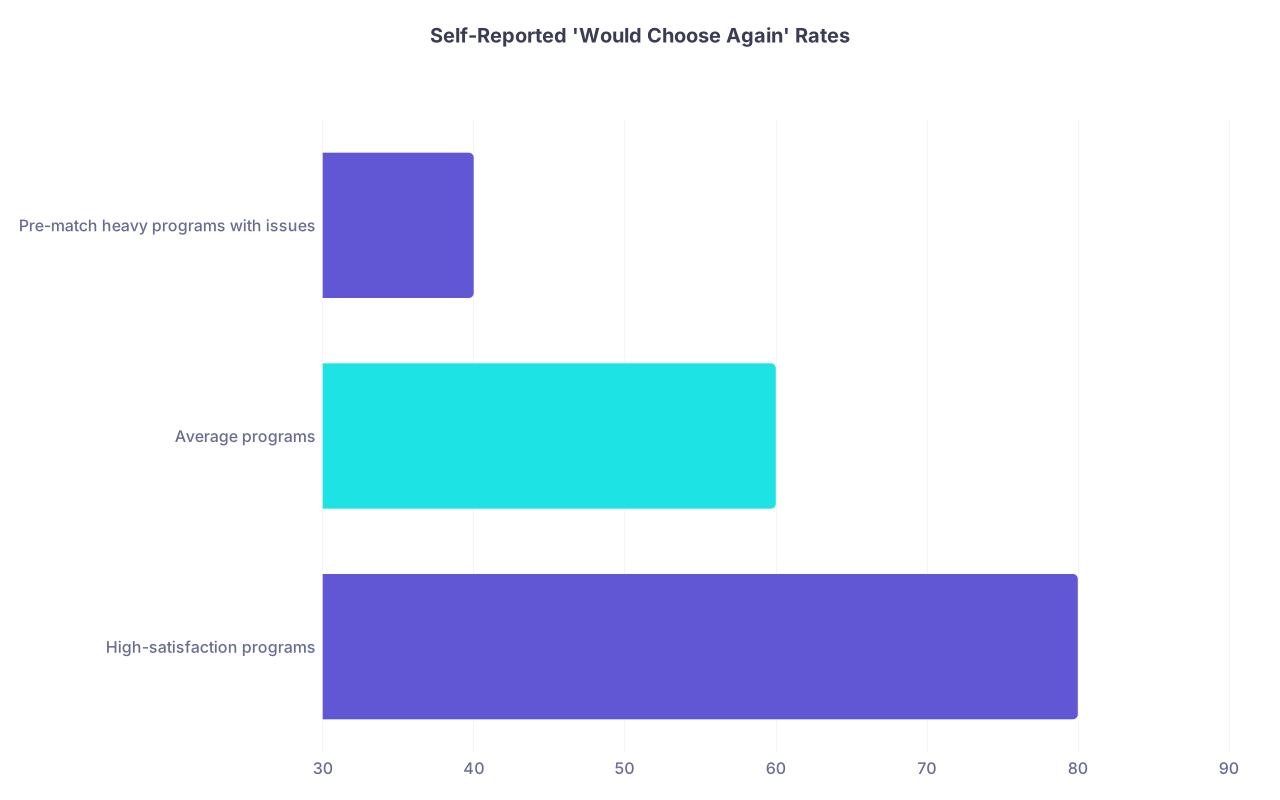
| Category | Value |
|---|---|
| High-satisfaction programs | 80 |
| Average programs | 60 |
| Pre-match heavy programs with issues | 40 |
If you consistently hear numbers under 50% from multiple residents, your regret probability is not theoretical. It is almost built into the model.
4. Model your downside if you guess wrong
The critical question is not “Will I like this?” but “If I hate this, what happens?” Different candidates have different tolerance for downside.
Ask:
- Can you reasonably transfer after PGY‑1 if needed? How often do residents successfully transfer from that program?
- Are you on a visa that ties you tightly to this institution?
- How will 2–3 bad years at this program affect your fellowship trajectory?
Then treat your decision like a simple expected value problem. If:
- There is, say, a 30% chance of strong regret, and
- The cost of strong regret is: burnout, difficulty transferring, weaker fellowship options,
Is the early security worth that risk versus waiting to see standard NRMP results?
Applicants with no safety net or major visa concerns will weigh this differently than a U.S. grad with broad interview access. But you should at least quantify the tradeoff explicitly.
When Pre-Match Makes Sense (And When It Clearly Does Not)
Not all pre‑match decisions are irrational. Some are almost certainly optimal when you plug the numbers in.
Cases where pre‑match often makes sense:
You are an IMG with modest scores, few interviews, and a solid, well‑run community program offers a pre‑match early. Without it, your unmatched risk might be >30–40%. The upside of security outweighs the regret probability, especially if the program metrics look stable (low attrition, decent teaching, reasonable schedule).
You have a strong geographic constraint (family illness, partner job, custody issues) and the pre‑match offer is from the one region you can realistically live in. Location importance skyrockets in your regret index and dominates other dimensions.
You have done a long audition rotation there and have direct experience with workload and culture. Your evidence is much stronger than the typical early‑offer candidate.
Cases where pre‑match is objectively high risk:
You have multiple interview invitations from stronger programs but accept an early pre‑match out of anxiety, before even seeing those other options.
The program cannot or will not give hard numbers on attrition, call schedule, or fellowship outcomes.
Residents give you coded warnings: “We are like a family” but nobody smiles when they say it; “It is busy but you learn a lot,” followed by “Our last three PGY‑1s left.” I have heard that exact juxtaposition more than once.
For competitive specialties (derm, ortho, plastics), the program’s match outcomes for fellowship or job placement look weak compared with peers, and they are aggressively pushing for early commitments.
How To Prepare For Pre-Match Offers Without Panicking
You cannot control who offers you a pre‑match. You can control how prepared you are to respond. Treat this as a pre‑computed decision framework, not an improvisation.
Here is a simple flow of how your decision should work:

| Step | Description |
|---|---|
| Step 1 | Receive Pre-Match Offer |
| Step 2 | Estimate Unmatched Risk High |
| Step 3 | Compare Program Metrics |
| Step 4 | Strong case to accept |
| Step 5 | Seek more interviews |
| Step 6 | Consider early accept |
| Step 7 | Wait for NRMP results |
| Step 8 | Have at least 3 other interviews? |
| Step 9 | Program metrics acceptable? |
| Step 10 | Pre-Match program in top tier by data? |
Two practical moves to be ready:
Pre‑define your thresholds. For example:
- “I will not accept any program with >10% annual attrition or clearly chronic duty hour violations, no matter how anxious I feel.”
- “If I have fewer than X interviews by date Y and I receive a stable‑looking pre‑match, I will accept.”
Prepare your data collection questions in advance. You should not be inventing questions on the spot when a coordinator says, “We are ready to offer you a contract.”
Have a short checklist for the program leadership and a separate one for residents. Ask all of them, every time. Compare answers.
Final Takeaways
Three points.
First, pre‑match regret is common, but not mysterious. The data shows it clusters in predictable settings: early decisions with weak information, programs that lean heavily on pre‑match to fill service-heavy spots, and applicants who ignore measurable red flags out of fear.
Second, you can quantify your own regret risk. Use structured scoring for workload, culture, training quality, career alignment, location, and contract flexibility. If more than a couple of high‑importance areas have poor or uncertain data, treat that as a concrete warning, not a vague “concern.”
Third, prepare your framework now. Decide your thresholds, define your unmatched risk tolerance, and write down the questions you will ask any program offering a pre‑match. The more you treat this as a data decision rather than an emotional reaction, the less likely you are to become one of the residents, two years from now, saying quietly, “If I could do it again, I would not have signed that contract.”