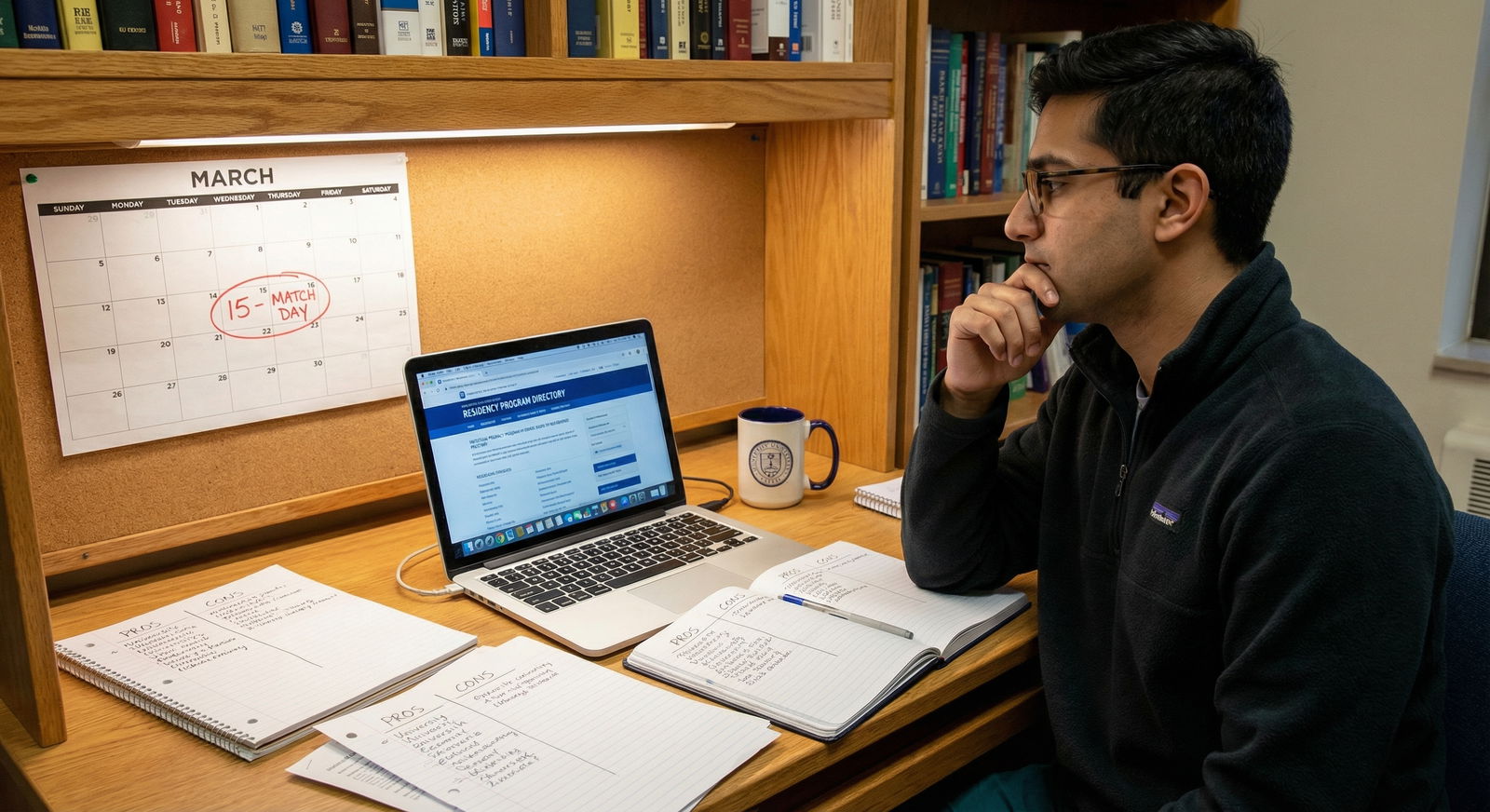
Most applicants are blindsided by pre‑match offers. That is a mistake.
If your specialty or region uses pre‑match contracts, you cannot treat them as some rare unicorn. You plan for them the way you plan for Step 2 or rank lists: deliberately, on a timeline, with clear decision rules before the adrenaline hits.
I will walk you through this chronologically: what you should be doing 3–4 months before interview season, month by month as invites hit, then week‑by‑week and day‑by‑day once a real offer is on the table.
1. Three to Four Months Before Interview Season: Get the Ground Rules Straight
At this point you should forget the gossip and anchor yourself in facts.
Step 1: Understand how pre‑match actually works in your context
By late June–July (for a typical September–January interview season), you should:
Clarify whether:
- Your specialty and region even allow pre‑match offers.
- Programs are using “preference signaling only” vs actual binding contracts.
- The NRMP rules (or your national match system) define any early acceptances as violations.
Talk to:
- Recent grads from your school who matched in your specialty last cycle.
- Your program director or advising dean.
- One or two trusted upper‑level residents in your target specialty.
Ask blunt questions: “Did anyone in your class get pre‑match offers? From what programs? When did they come? Were they verbal or written?”
If you do not know the rules and local culture by August, you are already behind.
Step 2: Define your categories of programs
You cannot decide on an early offer without knowing where that program sits in your personal hierarchy.
By the end of July, make a simple tiered list:
- Tier A – Dream / would sign today
- Tier B – Very strong / competitive with many others
- Tier C – Safety / acceptable but not ideal
- Tier D – Would not rank
You do not have to share this with anyone. But it must exist before offers start.
Create a quick table in your own notes with your top 15–20 programs. Then, for each, assign a tier and a rationale (location, reputation, fellowship pipeline, family reasons, visa support, etc.).
| Tier | Example Program Type | Your Action if Pre-match Offered |
|---|---|---|
| A | Home institution, strong fit | Very likely accept early |
| B | Well-known academic center in good city | Consider, compare with others |
| C | Community program in less desired region | Likely decline or delay |
| D | Any program you would not rank | Politely decline outright |
This is what will keep you from panicking into a bad contract in December.
Step 3: Decide your default strategy
By August 1, pick a baseline stance:
- Strategy 1: “Pre‑match friendly”
You are open to signing a strong early offer, especially from Tier A. - Strategy 2: “Match‑first”
You will almost never accept a pre‑match unless it is a perfect fit and you have risk factors (low Step/COMLEX, visa issues, couples match complications, red flags). - Strategy 3: “Desperate but disciplined”
You have a weaker application and will seriously consider early offers from any solid Tier B/C program, but still with a clear minimum bar (no toxic cultures, no unaccredited programs, etc.).
Write your strategy down. Literally: one sentence at the top of your application notes. You will revisit it later, but you need that anchor.
2. One to Two Months Before Interview Season: Build Your Decision Framework
Now we move into August–early September. At this point you should stop daydreaming and build concrete tools.
Create your pre‑match decision checklist
By mid‑August, draft a one‑page decision checklist you will pull out if an offer appears. It should include:
Program quality
- Board pass rates above X% (you decide the threshold)
- Recent ACGME citations? (Yes/No)
- Fellowship match list strong in your area of interest?
Training environment
- Resident morale (from conversations, not glossy brochures)
- Case volume appropriate for your field
- Procedure opportunities / clinic time balance
Lifestyle / geography
- Cost of living tolerable
- Family / partner considerations
- Commute reasonable (not 90 minutes each way unless you enjoy suffering)
Career alignment
- Academic vs community fit
- Research support if you care about that
- Visa sponsorship if relevant (H‑1B vs J‑1 clarity)
Deal‑breaker flags
- Chronic unfilled positions
- Multiple residents left mid‑year in last 2–3 years
- You witnessed or heard about overt toxicity during interview day
You are building a pre‑commitment device. Something you can use when your adrenal glands are screaming “Just sign it!”
Pre‑write your scripts
By early September, prepare language for three scenarios:
- They hint at a pre‑match but do not formalize it yet.
- They offer you an early contract you actually want to consider.
- They offer a pre‑match you know you will not accept.
For example:
Soft interest, no firm offer:
“I am very interested in your program and would be honored to train here. I am still early in my interview season, but this program is definitely among my top choices.”Serious interest in a real offer:
“I appreciate this offer a lot. Your program aligns strongly with what I am looking for. I do need a short amount of time to review everything carefully with my mentor so that I can give you a firm, honest answer.”Clear decline:
“I am very grateful for your confidence in me. After careful thought, I would like to continue through the regular Match process. I hope to keep your program high on my rank list.”
Having these phrases ready spares you from awkward, rambling answers in a conference room with four faculty staring at you.
3. As Interview Invites Start (Weeks Before First Interview)
Once September hits and invites trickle in, your planning should shift from hypothetical to tactical.
Track your competitiveness in real time
At this point you should stop guessing about your market value and use data.
By the time you have 5–10 invites, create a simple tracking sheet:
- Number of programs applied to
- Number of invites received
- Types of programs (university, community, region, etc.)
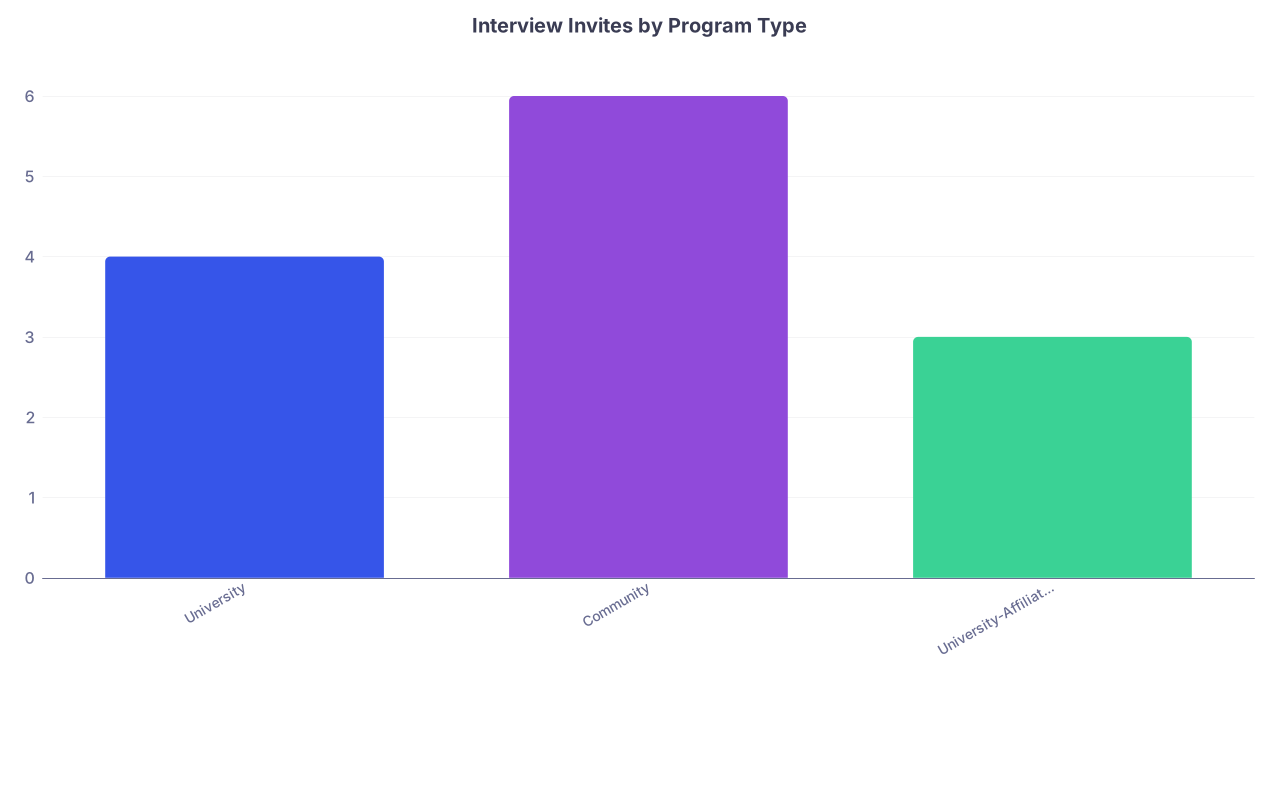
| Category | Value |
|---|---|
| University | 4 |
| Community | 6 |
| University-Affiliated | 3 |
If you applied to 80 programs and have 2 invites by mid‑October, you are in a different risk category than someone with 18 invites. That should shift how aggressive you are with pre‑match offers.
Update your tiers based on real encounters
Your July “Tier A/B/C” list was theoretical. By October, after a few interviews and pre‑interview dinners, the reality might be different.
At this point you should:
After each interview, re‑tier that program:
- Was the culture better or worse than expected?
- Did the residents seem burned out or supported?
- Did the PD actually know your name and story?
Note any programs where:
- Faculty explicitly said, “We move quickly with strong candidates.”
- Residents hinted, “Some of us signed early” in previous years.
Flag these as “Pre‑match possible” in your notes.
4. During Interview Season: Week‑by‑Week Preparation for Offers
Now we are in the thick of it: late October through January.
Week 1–2 of interviews: Observe and log
At this point you should keep your ears open and your mouth careful.
During early visits:
- Listen for:
- “We do not participate in pre‑match.” → low likelihood.
- “We have historically filled partly outside the Match.” → high likelihood.
- After interviews each week:
- Update your ranking spreadsheet.
- Re‑check your “strategy sentence” from August. Still feel right, given your invite volume?
You are not making decisions yet. You are mapping the battlefield.
Week 3–4: Identify realistic pre‑match candidates
By your third or fourth interview week:
Pick 3–5 programs that are:
- High on your personal list and
- Realistic sources of pre‑match offers (based on history and vibe).
For each, write:
- One sentence why you would sign early.
- One sentence why you should hold out for the Match instead.
If you cannot articulate both, you are not ready for an offer from that program.
5. The Week Before Any High-Risk (Pre‑match‑Friendly) Interview
For programs you suspect may offer early contracts, you must go in with a specific micro‑plan.
3–5 days before the interview
At this point you should:
Re‑read:
- Your checklist.
- Your scripts.
- Your strategy sentence.
Decide your provisional stance for that exact program:
- “If they offer on the spot and the visit confirms my expectations, I am prepared to say yes within 48 hours.”
- Or, “Even if they offer, I want at least 2–3 more interviews before committing.”
Confirm your communication chain:
- Which mentor will you call that night if something happens?
- Who can read a contract quickly (hospital GME office, legal aid, or a savvy chief resident)?
Write their names and numbers down. You will not be hunting for phone numbers in a hotel lobby at 9 pm.
6. The Day Before and Day Of a Likely Pre‑match Interview
Day before
At this point you should:
- Review recent news or problems at that hospital (expansions, mergers, probation, etc.).
- Print or save your decision checklist for quick reference.
- Remind yourself: you are interviewing them too. Pre‑match does not mean you are desperate.
Interview day: Real‑time signs
During the day, pay attention:
- Red flag comment from resident: “Honestly, we lose people every year.”
- PD style:
- Collegial, transparent, asks about your goals → better odds it is a healthy program.
- Vague, evasive about case volume and duty hours → think very hard before signing.
If they say nothing about offers, fine. You simply rank them normally later.
If they hint at “moving quickly” but do not offer anything concrete, use your soft‑interest script and stay non‑committal.
7. When a Pre‑match Offer Actually Comes: First 24–72 Hours
This is the critical window. Most bad decisions happen here.
Hour 0–2: Do not commit verbally
At this exact point you should do nothing irreversible.
If they offer you a spot in person or on the phone:
- Thank them directly.
- Say something like:
“I am very honored by this offer. This program is a serious contender for me. I want to make sure I review everything carefully and talk with my mentor so that I can give you a clear, honest commitment. Could I have [24–72] hours to think this through?”
Do not:
- Say “yes” on the spot.
- Start emailing other programs about it.
- Post anything remotely related on social media (obvious, but people still do dumb things).
Hour 2–12: Gather facts, not opinions
Immediately after:
Write down exactly what was offered.
Title (categorical vs prelim), start date, contract length, any extra terms (research year, funding guarantees, moonlighting rules).Ask for it in writing:
“Could you please send me the details of the offer and a draft of the contract so I can review it carefully?”Contact:
- Your primary specialty advisor.
- One resident or fellow at that program (ideally not hand‑picked by the PD).
You are not asking, “Should I take it?” yet. You are asking:
- “Is there anything about this program that would make a pre‑match unwise?”
- “Have you heard of residents leaving or being pushed out?”
- “How is the board pass rate and fellowship placement?”
Hour 12–36: Run the checklist and compare scenarios
Now pull out the tools you built months earlier.
- Apply your decision checklist item by item.
- Look at your current invite count and perceived competitiveness.
Use a simple mental model:
- Scenario A: Accept now.
- Scenario B: Decline and stay in the Match.
Ask yourself:
- Realistically, what is the best‑case program I could reach in the Match?
- Is this pre‑match offer clearly below, equal to, or above that likely ceiling?
If your application is borderline and the offer is from a solid, non‑toxic program, declining it because “maybe a top 5 will love me” is usually fantasy.
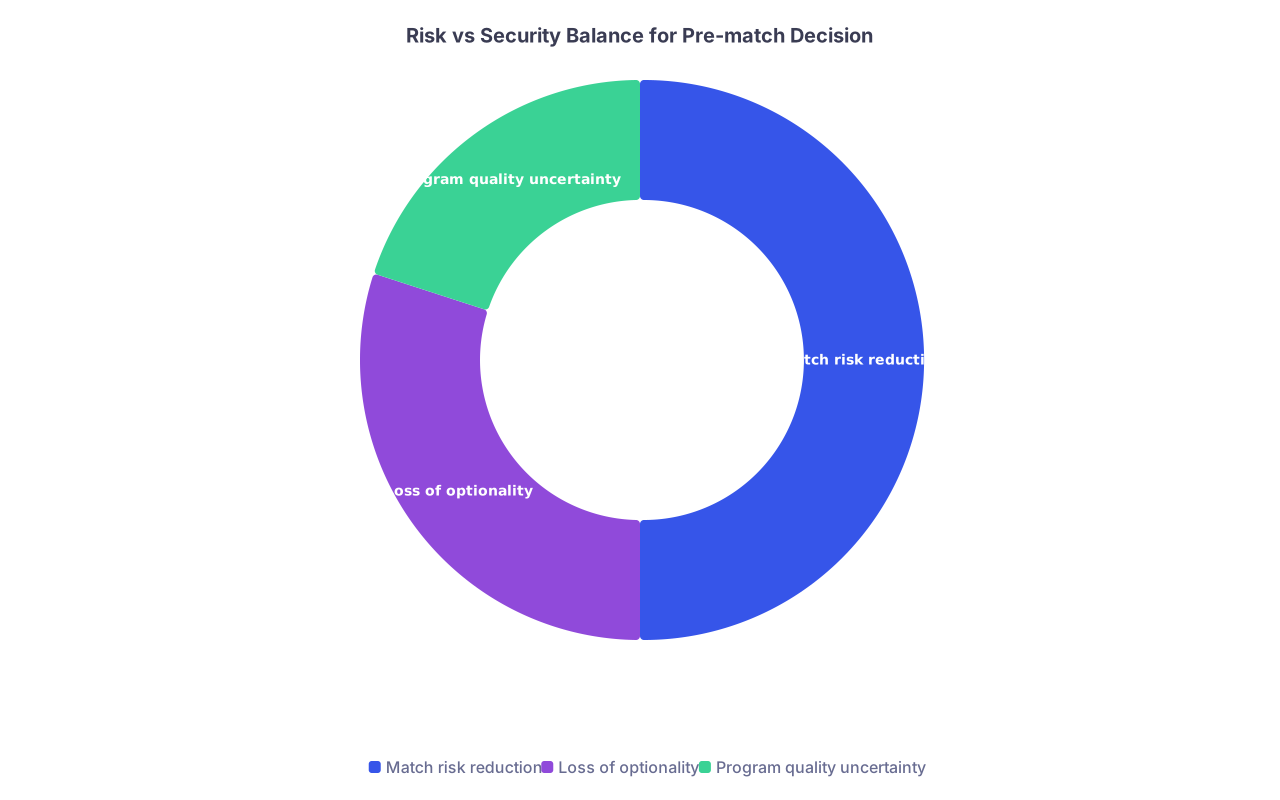
| Category | Value |
|---|---|
| Match risk reduction | 50 |
| Loss of optionality | 30 |
| Program quality uncertainty | 20 |
Hour 36–72: Make the call and close the loop
By the end of your agreed period (do not stretch it without explicit permission):
If you decide to accept:
- Call first, then email to document.
- Clarify that accepting means:
- You will withdraw from the Match in that specialty if rules require.
- You understand any NRMP or local regulations about early commitments.
If you decide to decline:
- Thank them clearly and respectfully.
- Do not ask if they will still rank you highly. Just assume they might or might not.
- Example:
“After a lot of thought and discussion with my mentors, I have decided to remain in the Match process. I am sincerely grateful for your confidence and I continue to hold your program in high regard.”
Then let it go. No second‑guessing every hour for the next week.
8. After Accepting or Declining: The Next Few Weeks
If you accept a pre‑match
At this point you should:
- Confirm:
- What steps are needed with NRMP / matching body.
- Whether you must cancel remaining interviews (often, yes for that specialty).
- Notify:
- Your dean’s office / international office (for visas).
- Any mentors who wrote strong letters for you.
Do not keep interviewing “just for practice” if rules or ethics prohibit it. Programs talk to each other more than you think.
If you decline and stay in the Match
Your risk has not changed. Your psychology has.
For the next few weeks:
- Do not signal regret or uncertainty to other PDs.
- Use the experience to refine your sense of:
- What you value.
- How competitive you really are.
If more offers come, your decision will be faster, because you already walked through the process once.
9. Visualizing the Overall Timeline
Here is how the full arc usually looks across the year.
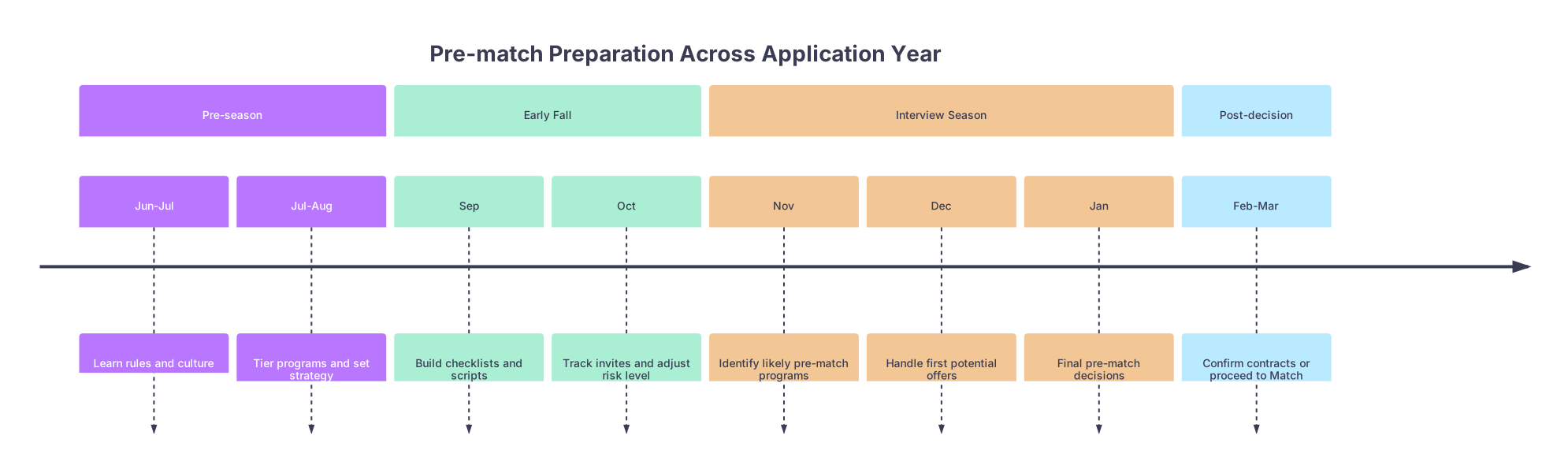
| Period | Event |
|---|---|
| Pre-season - Jun-Jul | Learn rules and culture |
| Pre-season - Jul-Aug | Tier programs and set strategy |
| Early Fall - Sep | Build checklists and scripts |
| Early Fall - Oct | Track invites and adjust risk level |
| Interview Season - Nov | Identify likely pre-match programs |
| Interview Season - Dec | Handle first potential offers |
| Interview Season - Jan | Final pre-match decisions |
| Post-decision - Feb-Mar | Confirm contracts or proceed to Match |
Key Takeaways
- Decide your pre‑match philosophy months before interview season, not in a conference room under pressure.
- Build concrete tools early: a tiered program list, a decision checklist, and prepared scripts for accepting or declining.
- When an offer comes, slow the process: get it in writing, consult mentors, run your checklist, then commit firmly within an agreed time window.