
What if you sign this pre‑match and then find out in March you could have matched somewhere “better”… and you just never gave yourself the chance?
That’s the thought, right? That sick, gnawing “what if I’m settling” feeling sitting under your ribs while you reread that email for the 20th time.
You’ve got a pre‑match offer from a program that wasn’t your top choice. Maybe not even top five. And now you’re spiraling:
If I say yes, am I panicking?
If I say no, am I delusional?
Let’s walk straight into that anxiety, not around it.
First: What a Pre‑Match Actually Means (Not the Fantasy Version in Your Head)
Pre‑match feels like a secret back door into residency. You get an offer before Match Day, they want you, you lock it in. Feels flattering. Also terrifying.
Stripped of all the emotions, a pre‑match basically means:
- A program wants to take you outside the main Match (or in SOAP‑ish / institutional variations depending on country/system).
- If you accept and sign, you’re usually done. Contract. Committed.
- You’re trading the uncertainty of Match Day for a guaranteed spot at a specific place.
Your brain is running two competing narratives:
- “If they want me this much, maybe I’m stronger than I think.”
- “If I’m so strong, shouldn’t I be getting offers from my top choices instead?”
I’ve watched people freeze right here and do nothing until an offer expired. Which is a decision. Just a passive one.
So before the anxiety fully hijacks you, you need a few anchors.
The Real Question: Risk vs. Regret, Not “Am I Good Enough?”
This isn’t actually about whether you’re “selling yourself short.”
It’s about which regret you’re more afraid of:
- Regret A: “I signed too early, I could have done better.”
- Regret B: “I passed on a sure thing, then didn’t match.”
Both are awful. No version of this is emotionally clean. You’re just choosing your flavor of fear.
Here’s where your own risk tolerance matters way more than your CV stats. But your stats do matter in terms of reasonable odds.
Let’s be concrete.
| Factor | Low Risk to Decline | High Risk to Decline |
|---|---|---|
| Specialty competitiveness | FM, Psych, Peds (non-elite) | Derm, Ortho, Plastics, Rad Onc |
| Your application strength | Strong, no red flags | Multiple red flags, exam failures |
| Interview volume | 15+ solid interviews | < 8 interviews, many at lower tiers |
| Visa status | Citizen/green card | Needs visa sponsorship |
| Geographic flexibility | Very flexible | Needs tight location constraints |
This isn’t perfect, but it gives you a sense of reality vs. wishful thinking.
If you’re an IMG with 5 interviews in Internal Medicine and one of them pre‑matches you? Different situation than a US MD with 18 interviews in Pediatrics, no fails, decent scores.
I’m not saying “strong applicants never take pre‑match.” I’ve seen strong people absolutely take a pre‑match because of geography, family, or just being done with anxiety. That’s valid.
But if you’re going to say yes or no, do it with your eyes open.
Brutally Honest Check: How Strong Are Your Chances Without This Offer?
Let’s say this out loud because no one wants to be the “negative” friend and tell you:
You can be an amazing future doctor and still be a risky applicant on paper.
Here’s what you need to stare down:
1. Specialty Reality Check
Are you applying to:
- FM / Psych / Peds / IM (non‑super‑competitive programs)?
- Ortho / Derm / ENT / Plastics / Ortho / Urology / Neurosurgery?
If you’re in a hyper‑competitive specialty with borderline stats, a pre‑match from a “lower” program might actually be a gift, not a consolation prize.
If you’re in a less competitive specialty with broad interviews, you may have more room to gamble.
2. Actual Numbers: Interviews and Tiers
Ignore vibes. Go by numbers.
- How many interviews do you realistically have lined up or already done?
- How many of those are at programs that are equal or better than this pre‑match program?
- Are you geographically flexible or limited to one region?
If you have:
- 3–5 total interviews, and this is your only clear “we want you” signal → declining is risky.
- 15+ interviews, with several places you’d clearly rank higher → you can think harder about declining.
Your anxiety will tell you you’re failing no matter what. So you have to counter that with something objective.
3. Red Flags You Might Be Downplaying
Be honest about stuff you’ve half‑buried:
- Step/board failure
- LOA, extended time to graduate
- No US clinical experience (for IMGs)
- Weak or late letters
- Poor interview performance so far (you can usually feel it)
Programs will pre‑match people they like and believe are good fits. But they’ll especially move quickly on someone they know might struggle in the open Match pool. Not because you’re bad. Because they know how brutal the system is.
If you have significant red flags and someone is essentially saying, “We will take you now”? You don’t casually walk away from that.
“Lower Choice” Might Be Code for Something Else
Before you label this “settling,” you need to unpack why this is lower on your list.
Because sometimes that label is based on dumb stuff you’ve absorbed from classmates or Reddit, not your actual life.
Ask yourself:
- Is it “lower” because it’s in a smaller city and people talk down about it?
- Because the program isn’t big‑name academic?
- Because it’s community-based and not flooding you with research?
- Because some PGY‑3 on SDN said “lol avoid”?
And then separate that from hard, meaningful reasons:
- Poor board pass rates
- Documented toxic culture / malignant leadership
- Residents consistently overworked beyond reason, no support
- No fellowship opportunities in a path you really care about
- Geography that would wreck your support system or family plans
“Lower choice” because it’s not as shiny = ego.
“Lower choice” because it’s truly a worse fit or bad environment = legitimate concern.
You’re not shallow for caring about prestige. Everyone does. But if you make a 3‑year decision purely on perceived status, you can end up miserable at a “top” place that doesn’t actually fit you.
Concrete Things to Do Before You Answer
Don’t just sit there refreshing your email and catastrophizing. You actually have some moves.
1. Get More Intel on the Program. Real Intel.
You need more than the website and a 30‑minute Zoom.
- Email a couple of current residents individually.
Ask:- “What’s one thing you wish you’d known before you matched here?”
- “Would you choose this program again?”
- “How supportive are they with struggling residents?”
- Look at where their grads go: jobs, fellowships, locations. Does it match anything you might want?
If you start hearing the same red flag from multiple people? Pay attention.
If the worst you hear is “it’s a bit more work, but people are supportive”? That’s… actually pretty good in residency terms.
2. Clarify the Deadline and Exact Terms
Don’t guess. Ask them directly:
- When do I need to decide by?
- Is this binding if I accept? (Usually yes, but confirm.)
- Will you still rank me if I decline the pre‑match?
Some programs will still rank you. Some won’t. You want to know which game you’re playing.
And no, asking these questions doesn’t make you look ungrateful. It makes you look like an adult signing a contract.
3. Pressure Test Your Gut Feeling
Your anxiety is loud. Your actual gut is quieter but usually more honest.
Try this exercise (yes, actually do it):
- Imagine you accept the offer. Close your eyes. Picture emailing other programs, backing out of interviews, telling your friends “I’m done, I matched at X.”
What do you feel first: relief or dread? - Now imagine you decline. Picture going back into uncertainty, interview grind, waiting for Match Day. What hits first: lightness (“I’m still in the game”) or panic?
You’re not looking for 100% clarity. You won’t get it. Just notice which side feels slightly more aligned with your values, not your fear.
Worst-Case Scenarios (Let’s Actually Say Them Out Loud)
Your brain is already doing this in the dark, so let’s drag it into the light.
Scenario 1: You Accept. Then Later Realize You “Could Have Done Better.”
This is what you’re terrified of if you’re ambitious.
You say yes. You stop interviewing. In March, you see classmates matching at places you had on your dream list. You start building alternate history in your head:
“I probably would have matched there too if I hadn’t panicked.”
Maybe. Maybe not. The ugly truth: you never actually know.
What this scenario does give you:
- A guaranteed training spot
- No Match Day stomach ulcer
- The opportunity to become a solid doctor in a real program that wanted you enough to commit early
Will you occasionally wonder “what if”? Yeah. Welcome to adulthood.
But that’s not the same as “I ruined my career.” Most residency programs, even mid‑tier or community ones, can get you where you want to go if you work, network, and show up.
Scenario 2: You Decline. Then Don’t Match.
This is the nightmare that keeps people up at 3 a.m.
You say no. You keep interviewing. You rank places you think you’ll match at. March comes. “We are sorry, you did not match.”
Now what?
You might:
- End up in SOAP, scrambling for any open position.
- Delay graduation or take a research year.
- Change specialties.
Is your life over? No. But it’s a much, much harder year. And future applications will have to explain a prior non‑match.
This is why people with any significant risk profile often accept a pre‑match from a reasonable program. Because this scenario genuinely hurts more than “I wonder if I could have done better.”
Are You Actually “Selling Yourself Short”… or Just Protecting Yourself?
Let me say something blunt:
A lot of us dramatically overestimate how much program prestige matters long‑term and underestimate how much basic things like support, decent call schedules, and non‑toxic leadership matter to your sanity.
I’ve seen people:
- Take a pre‑match at a solid but unflashy program, do well, get into great fellowships, and be totally fine.
- Decline pre‑matches chasing some fantasy of “top 10 or bust,” not match, and spend a year in emotional and financial hell.
- Become absolutely miserable at “dream” programs that chewed them up and didn’t care.
You’re not selling yourself short if:
- The program trains competent residents
- You can imagine being reasonably okay living there for 3+ years
- You’re not ignoring screaming red flags about abuse or dysfunction
- The alternative (no match) is a real risk for you
You might be selling yourself short if:
- You have a very strong application in a non‑insane specialty
- You have broad interviews at places clearly better aligned with your goals
- You’re only considering this offer out of raw anxiety, not because you actually see yourself there
- The program really doesn’t fit your career goals (e.g., you want academic cardiology and the program hasn’t sent a grad to fellowship in 10 years)
But even then, it’s not black‑and‑white.
A Quick Framework to Ground Your Decision
Here’s a way to structure your thinking without spiraling endlessly.

| Step | Description |
|---|---|
| Step 1 | Pre match offer |
| Step 2 | Strongly consider accept |
| Step 3 | Ask questions and confirm terms |
| Step 4 | Accept or lean accept |
| Step 5 | Compare with other interviews |
| Step 6 | Lean decline |
| Step 7 | Reassess risk and gut |
| Step 8 | High risk applicant |
| Step 9 | Like program and location |
| Step 10 | Many better options |
Ask yourself:
Am I objectively high‑risk on paper?
(Low interviews, red flags, competitive specialty, visa issues.)Do I actually dislike this program, or is it just ego and status?
If I end up here, am I okay telling people, “Yeah, this is where I matched”?
If your honest answers are:
- Yes, I’m high risk
- No, I don’t hate the program
- Yes, I could live with this outcome
Then taking the pre‑match is not “selling yourself short.” It’s making a rational, self‑protective choice.
What I’d Tell You If We Were Sitting in the Call Room Right Now
If you were across from me with a cold coffee and that email open, here’s what I’d actually say:
- If you are an IMG or have serious red flags and this is a decent program that treats residents like humans? Lean hard toward saying yes.
- If you’re a reasonably strong applicant with many interviews at places you clearly like better, and this pre‑match feels like a panic button, not a fit? You’re allowed to say no.
- Stop framing this as “am I good enough for better?” and start framing it as “what risk level can I live with if things go badly?”
Because in the end, the question isn’t “Am I selling myself short?”
It’s: “If this is where I end up, can I build the life and career I want from here?”
If the honest answer is yes—even with some disappointment and ego bruising—then accepting the pre‑match isn’t a failure. It’s you choosing stability in a system that loves chaos.
And if the honest answer is no, then don’t sign just because you’re scared. Scared is normal. But 3+ years in the wrong place because you didn’t trust yourself? That’s a different kind of regret.
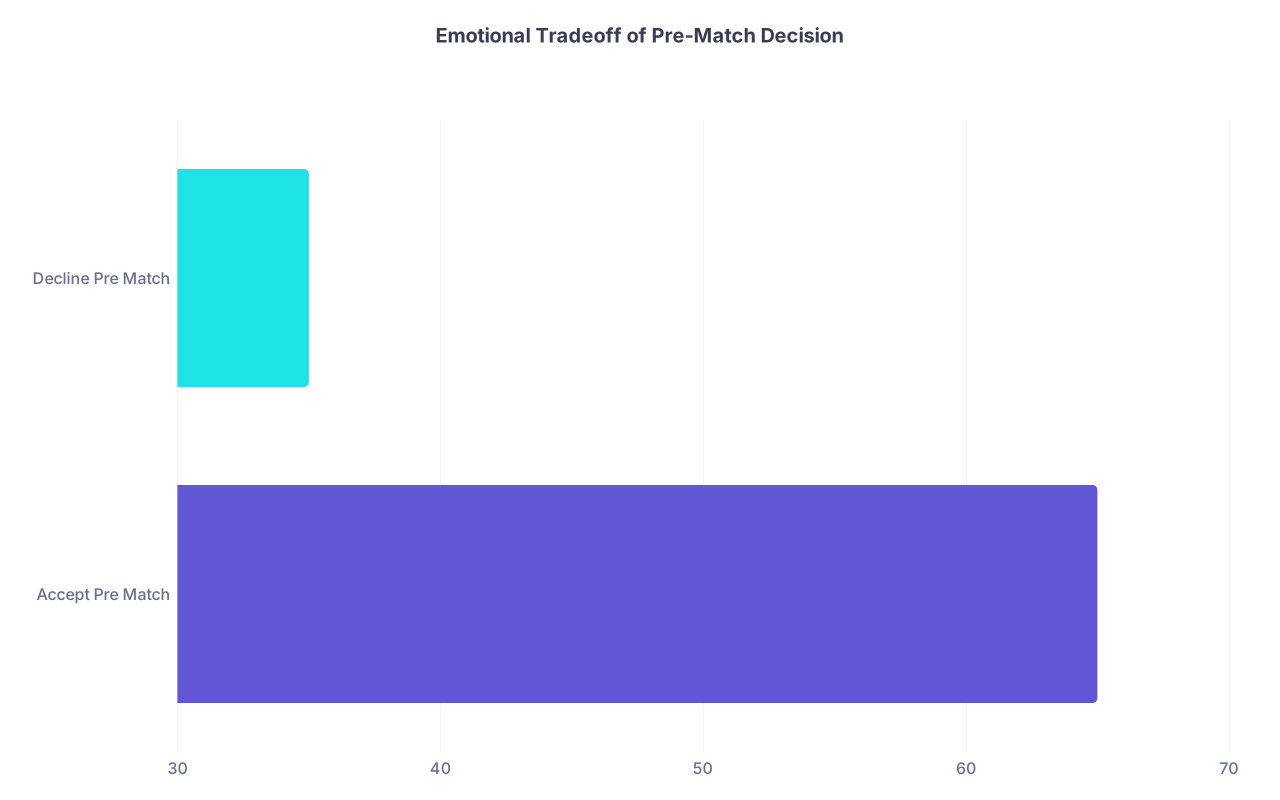
| Category | Value |
|---|---|
| Accept Pre Match | 65 |
| Decline Pre Match | 35 |
If you remember nothing else:
- This decision is about risk tolerance and fit, not your worth as a future physician.
- A “lower choice” that genuinely wants you and will train you well beats a fantasy program that never ranks you.
- You will always wonder “what if” no matter what you choose. Pick the “what if” you can actually live with.