
It’s January. Your phone buzzes on call and you see it: an email from that program. Not just another generic “we enjoyed meeting you” thing—an actual pre-match offer. Your heart jumps, then immediately drops.
Because now the spiral starts.
“Do they really want me… or do they just need a warm body to cover nights?”
“Is this a sign they love me, or a sign their program is so awful they can’t fill?”
“If I take this, am I about to sign away three years of my life to be a service robot?”
You’re not excited. You’re nauseous.
Let’s walk through this like what it is: a high-stakes decision that could either save your year or lock you into a nightmare. I’m going to be blunt about the red flags and also about what’s just anxiety talking.
First: Why Programs Pre-Match At All (Good vs Sketchy Reasons)
Some programs use pre-match for strategic, reasonable reasons. Others use it like duct tape on a sinking ship.
Here’s the spectrum:
- Solid reason: They interviewed you early, really liked you, and want to lock in strong candidates before the chaos of the Match.
- Mixed reason: They’ve had a few mediocre fill years and want to “secure” warm bodies, but the program isn’t a total disaster.
- Terrible reason: They have a reputation problem, their residents are fleeing, the workload is abusive, and they need to bypass normal market forces by locking people in early.
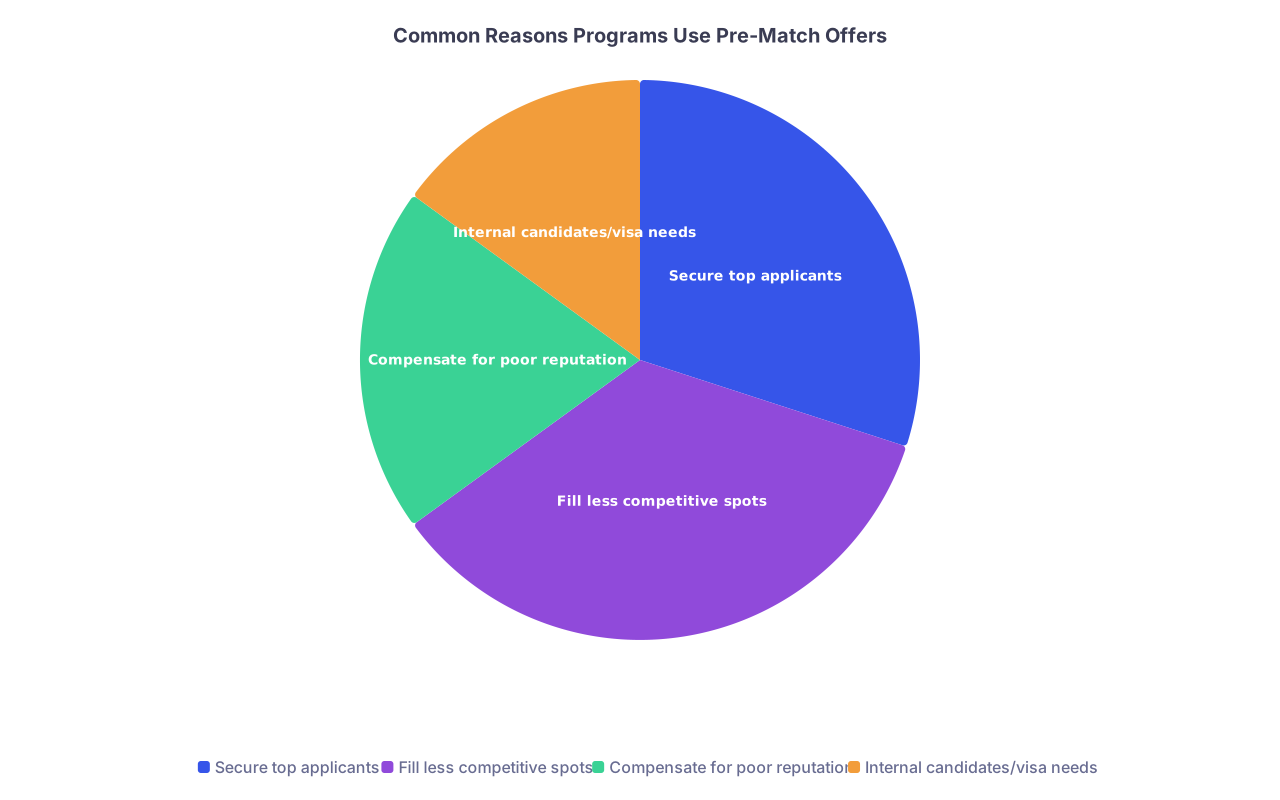
| Category | Value |
|---|---|
| Secure top applicants | 30 |
| Fill less competitive spots | 35 |
| Compensate for poor reputation | 20 |
| Internal candidates/visa needs | 15 |
Your job is figuring out which bucket this offer falls into. Spoiler: you won’t get 100% certainty. But you can get close enough to make a sane decision instead of panic-accepting… or panic-declining.
Step 1: Hard Red Flags That This Might Be a Workhorse Spot
Let’s start with the scary part. Signs you might be signing up to be a glorified shift mule.
1. Nobody You Trust Has Anything Good to Say
You check Reddit, SDN, your school’s internal spreadsheets, that one Google Doc everyone passes around, and it’s the same theme:
- “Service heavy”
- “Residents look exhausted”
- “People transferring out”
- “Stay away if you have other options”
Reddit exaggerates, sure. But when smoke is consistent across multiple sources and multiple years? That’s not great.
Ask yourself:
- Have I found any detailed, recent positive review from a current or very recent grad?
- Does my school’s advising system have this program tagged as “backup only,” “avoid,” or “fine for unmatched”?
If everyone’s screaming “don’t do it,” don’t ignore that because you feel desperate. That’s exactly how people get trapped.
2. Zero Transparency When You Ask Direct Questions
How programs respond to very specific questions tells you almost everything.
Ask things like:
- “How many residents have left the program in the last 3 years?”
- “What are your duty hour violation trends like?”
- “What’s the typical week like for an intern on wards—hours, number of patients, call schedule?”
- “What percentage of your graduates get the fellowships they want?”
If the answers are:
- Vague (“We’re busy, like everyone else”)
- Defensive (“We don’t like to focus on negative things”)
- Evasive (“I don’t have those exact numbers right now”)
Bad sign. Programs proud of their training are more than happy to brag with specifics. Programs using residents as overtime labor get real slippery real fast.
3. Residents Look Half-Dead—and Don’t Hide It
If you interviewed in person or virtually, think back:
- Did residents look completely drained?
- Did anyone accidentally say “we work a lot…like really a lot” and then nervously laugh?
- Did they say “we’re like family” in a way that felt like trauma-bonded hostages, not supportive colleagues?
If one resident seemed tired, that’s residency. If every resident looks broken and emotionally flat, that’s culture.

4. They Push You To Decide Fast. Like, Uncomfortably Fast.
Programs are allowed to have deadlines. But pressure is different.
Red flag phrases:
- “We need to know by tomorrow.”
- “Just trust us, this is an incredible opportunity.”
- “If you don’t sign quickly, we have a long list of other candidates.”
This isn’t a used car. If they won’t give you 48–72 hours to think, ask questions, and talk to mentors, that screams insecurity. Confident, healthy programs don’t need to corner you.
5. Their Fill History Looks Rough
Check NRMP data. Look at:
- Did they have unfilled positions in prior years?
- Are they known for heavy use of SOAP?
- Is there a pattern of IMGs only, with no US MD/DOs ever ranking them highly?
None of that is automatically bad. But combine “multiple unfilled spots + pre-match push + bad reputation” and yeah, you might be the patch for a leaking service schedule.
| Signal | Green-ish | Yellow | Red |
|---|---|---|---|
| Recent unfilled spots | 0 | 1 year | 2+ years |
| Resident attrition past 3 yrs | 0–1 | 2–3 | 4+ |
| Response to your questions | Specific | Vague | Defensive |
| Decision time you’re given | ≥72 hrs | 48 hrs | <24 hrs |
Step 2: Signs This Isn’t Just a Service Workhorse Trap
Now, the part your anxiety is going to want to ignore: there are legitimate reasons to pre-match that don’t mean “hellhole.”
1. Residents Are Tired But Not Miserable
Residency is hard. People are tired, that’s baseline.
Good signs:
- Residents complain in a normal, relatable way (“Yeah, ICU months are brutal, but you learn a ton”).
- They have specific good things to say: supportive PD, strong teaching, decent autonomy, good fellowship match, or a collegial vibe.
- When you ask, “Would you choose this program again?” most say yes or “probably yes, with realistic expectations.”
If they sound honestly mixed—but not trapped—that’s…normal.
2. They Actually Answer Your Hard Questions
You send the PD or chief a detailed email. They respond with:
- Specific numbers (“We had 1 resident leave in 3 years, for family reasons.”)
- Clear schedules (“Interns typically work 55–65 hours a week with occasional spikes.”)
- Real downsides (“We’re service heavy on X rotation, but we recently added a night float to help.”)
Programs with warts but integrity are a thousand times better than shiny-looking programs that lie.
3. Their Match Outcomes Aren’t Trash
Look for:
- Where do grads go? Fellowships? Jobs?
- Any examples of people matching into good fellowships from there (even 1–2 per year is fine for many specialties)?
- Do residents seem proud of where alumni land?
You’re not looking for Harvard-style match lists. You’re just confirming this isn’t a career dead-end.
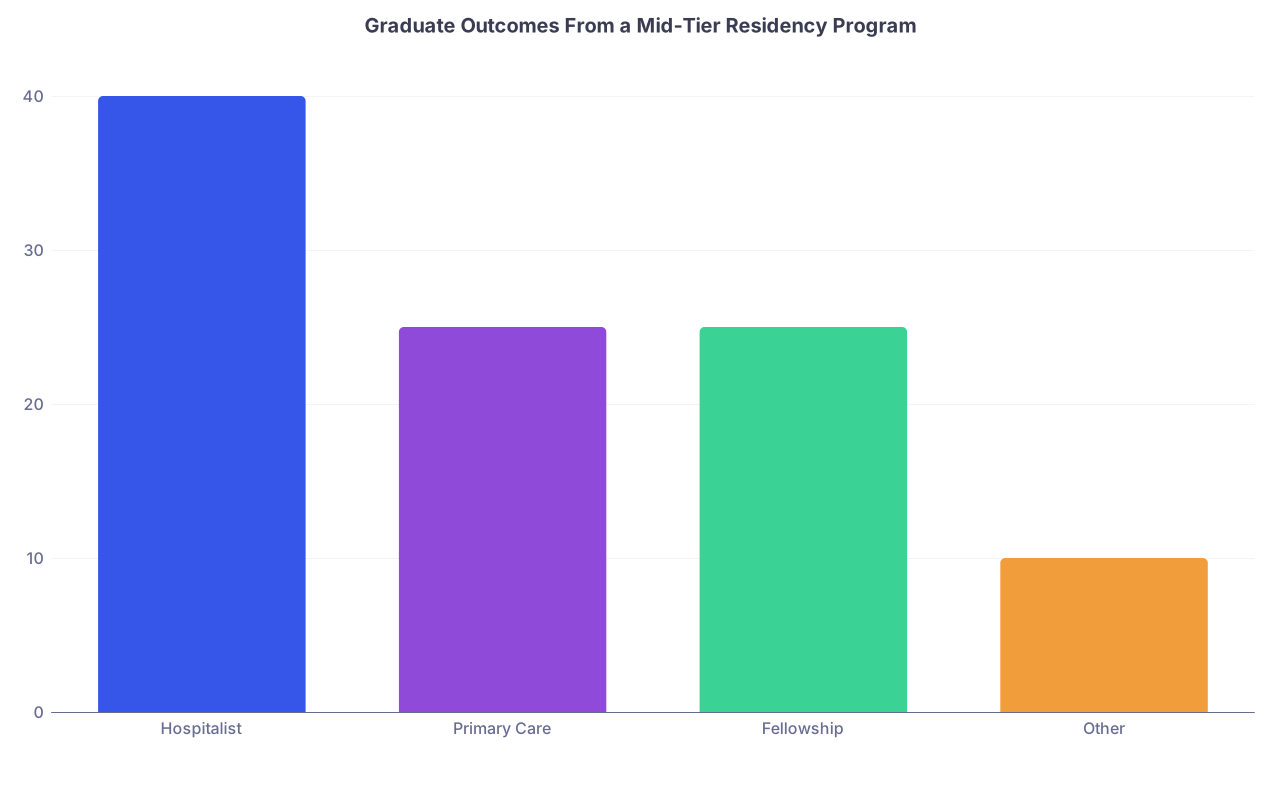
| Category | Value |
|---|---|
| Hospitalist | 40 |
| Primary Care | 25 |
| Fellowship | 25 |
| Other | 10 |
If the distribution looks reasonably like that, it’s not a doom program. It might just be unglamorous but functional.
Step 3: How To Actually Investigate This Offer (Without Losing Your Mind)
You’re not powerless here. There are moves you can make in the next 48–72 hours that dramatically clarify the picture.
1. Email Current Residents Directly
Not the ones hand-picked for interview day. Find:
- Random residents listed on the website
- Graduated residents on LinkedIn
- People from your med school who matched there years before
Message something like:
“Hi Dr. X,
I recently interviewed at [program] and received a pre-match offer. I’m strongly considering it but want to make sure I understand the reality of training there. Would you be willing to share your honest perspective—things you like, things you wish were different, and whether you’d choose it again? Even a short reply would really help.”
People remember this feeling. Many will be honest, sometimes brutally so.
2. Talk to Someone at Your School Who Actually Knows This Program
Not just your generic dean who says “Every program is a good program if you work hard.” The person you want:
- The advising dean who handles your specialty
- A recent grad from your school who went into that specialty and knows the scuttlebutt
- The program liaison if your school sends people there semi-regularly
Ask them straight:
“Is this the kind of place where residents get trained well but work hard, or is it fundamentally unhealthy?”
You want a sentence-level gut answer, not a politically correct paragraph.

3. Call the Program Coordinator and Ask Logistics Questions
Workhorse programs often slip here.
Ask:
- “What’s the typical call schedule for interns?”
- “How many off days in a 4-week block do residents get?”
- “How many hospitals do residents cover, and how far are they?”
You’re not just listening to the answers. You’re noticing tone. Do they sound used to fielding panic questions about overwork? Or do they calmly walk you through things?
Step 4: The Ugly But Practical Question — What Are Your Other Realistic Options?
This is where the anxiety spikes, because now it’s about risk.
You can’t evaluate a pre-match offer in a vacuum. You have to compare it to what your honest, non-delusional Match prospects are.
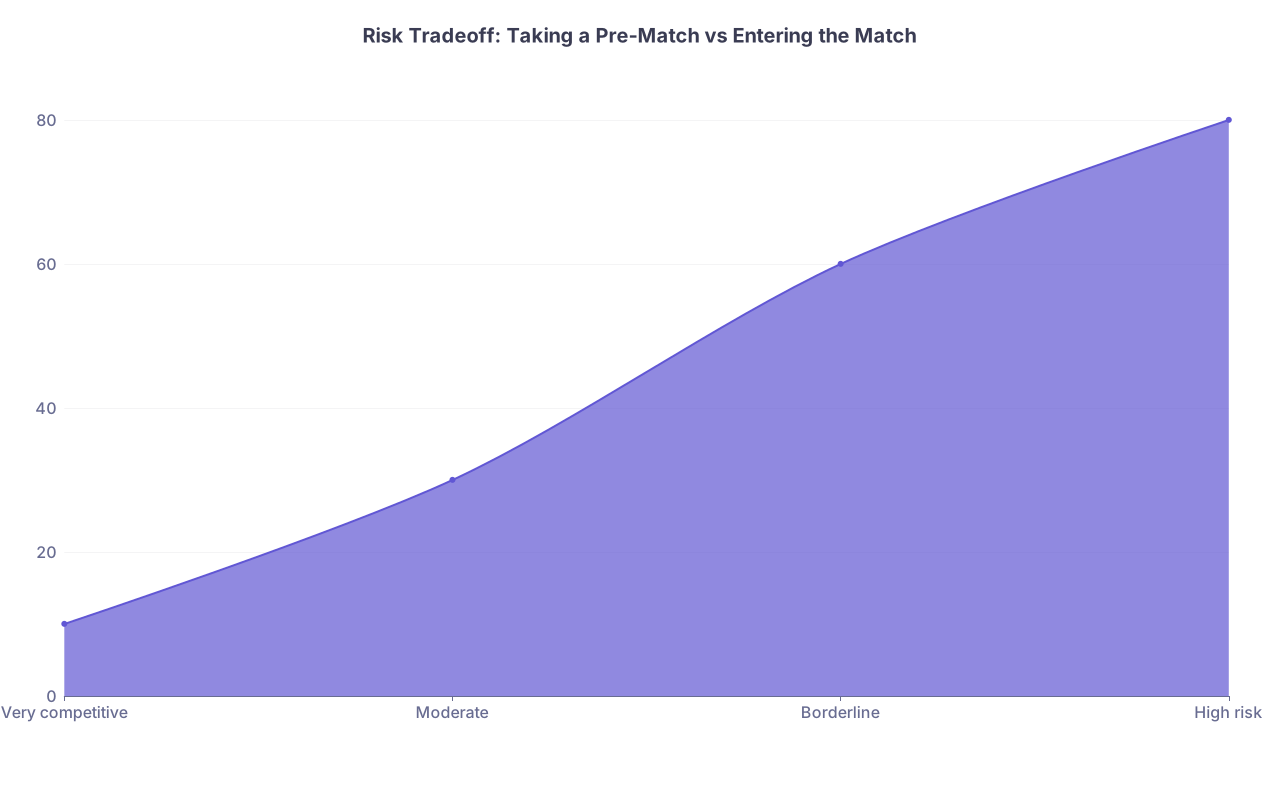
| Category | Value |
|---|---|
| Very competitive | 10 |
| Moderate | 30 |
| Borderline | 60 |
| High risk | 80 |
If you’re:
- US MD with decent scores and solid application in a mid-competitive specialty → You probably have options. A sketchy pre-match is less worth accepting.
- DO or IMG in a competitive specialty or with weaker scores → The calculus changes. A less-than-perfect program may still beat the trauma of SOAP and potential unmatched.
This sucks, but it’s real:
Sometimes you take a “workhorse” type place for survival, get trained, and then move in fellowship or as an attending. I’ve seen that work out fine for a lot of people who hated their programs but loved their eventual careers.
Brutal but honest questions to ask yourself
- If I decline this and don’t match, can I emotionally and financially survive a reapplication year?
- Am I okay betting on an uncertain Match when I have one sure thing now?
- Do I want to gamble for “better” when I don’t actually know what better will be?
There isn’t a right answer. There’s just the one you can live with.
Step 5: Make the Decision Without Letting Panic Drive the Car
By the time you’re deciding, you’ll be exhausted from all the thinking and talking. That’s exactly when you’re most likely to just give in to fear.
So anchor yourself:
Quick 3-Column Reality Check
Write this down on paper, not in your head.
| Column | What You Write |
|---|---|
| Pros of taking offer | Security, location, visa, etc. |
| Cons of taking offer | Service-heavy, reputation, culture worries |
| Worst-case if decline | Unmatched, SOAP, re-applying, extra year |
Then ask:
- Which worst-case can I tolerate more:
Being overworked in residency but eventually done?
Or sitting unmatched, scrambling, and maybe repeating the entire cycle?
Neither is fun. But one will feel slightly less catastrophic to you. That’s your answer.

| Step | Description |
|---|---|
| Step 1 | Pre-match offer |
| Step 2 | Lean no unless no other options |
| Step 3 | Consider waiting for Match |
| Step 4 | Seriously consider accepting |
| Step 5 | Discuss with mentors |
| Step 6 | Make decision you can live with |
| Step 7 | Program seems abusive? |
| Step 8 | Match chances decent? |
FAQ (Exactly 5 Questions)
1. If a program pre-matches me, does that automatically mean it’s desperate and terrible?
No. Some really solid community programs pre-match because they’re not big names and don’t want to lose strong applicants to “prestige” places. It does mean they’re more worried about filling than the big academic powerhouses. That’s not automatically a red flag. You judge based on resident happiness, transparency, and outcomes, not just the fact of a pre-match.
2. Is it stupid to accept a pre-match at a program with a bad reputation if I’m an IMG/DO with weaker stats?
Not automatically. For some people, that’s the smart move. If your chances in the Match are objectively low, a rough but real residency spot might be better than no spot at all. The trick is sizing your risk honestly. I’ve seen people hold out for “better” and end up unmatched, and they’d absolutely go back and take the imperfect pre-match if they could redo it.
3. How big of a deal is it if residents say the program is “very service heavy”?
“Service heavy” is code you need to decode. It can mean:
- Normal busy program where you learn a ton and are tired = acceptable
- Soul-sucking schedule where you’re just stabilizing endless admissions with no teaching = problem
If residents still feel supported, still have teaching, and still match decently into fellowships or decent jobs, “service heavy” might be tolerable. If they pair it with words like “toxic,” “unsafe,” or “no support,” that’s a much bigger deal.
4. Can I accept the pre-match and still rank other programs higher in the Match?
Depends on your country/system and specific rules. In many international settings with pre-match contracts, once you sign, you’re committed and should not continue in the Match. In the US NRMP system, true pre-match contracts are unusual now because of NRMP rules, but some specialties/paths differ. You absolutely need clear guidance from your dean or NRMP rules before playing games here. Don’t assume you can “game” the system; people get burned.
5. What if I accept and regret it later—can I leave a bad program?
Yes, but it’s hard and messy. Residents do transfer, but it usually requires: open spots elsewhere, good reason, decent evaluations, and time. You can’t bank on that as your main plan. Think of it like this: if you absolutely hated it, could you gut it out for 3 years knowing it gets you to your end goal? If the answer is “literally no, I’d break,” that’s a strong push not to sign.
If you remember nothing else:
- A pre-match isn’t automatically a trap, but pressure, vagueness, and miserable residents are giant red flags.
- You have more power than you think: ask hard questions, talk to real residents, and demand time to decide.
- In the end, choose the risk you can live with—not the one your anxiety is screaming about at 2 a.m.