
It’s late. Your phone just buzzed. You’re staring at an email from a program: “We’d like to offer you a pre-match contract…”
Your heart drops into your stomach.
You should be relieved, right? This is what everyone says they want. A bird in the hand. Security. No Match Day panic.
Instead, your brain jumps straight to:
“If I say yes, what if I ruin my career?”
“If I say no, what if I never get another offer and I go unmatched?”
“What if this is my only shot and I blow it?”
Welcome to the pre-match spiral. It’s brutal.
Let’s walk through how to actually think about this—like a rational adult human—while your brain is screaming worst-case scenarios in the background.
First: What a Pre-Match Offer Really Is (Not the Fantasy Version)
A lot of people talk about pre-match like it’s this golden ticket or this career-ending trap. It’s neither. It’s a contract. With trade-offs.
Stripped of all the drama, a pre-match offer is basically:
- A program saying: “We like you enough to commit now instead of taking our chances in the Match.”
- You deciding: “Do I want to lock in this program for sure and be done, or do I want to gamble for something possibly better… with risk?”
Here’s what’s actually at stake:
| Option | Main Upside | Main Downside |
|---|---|---|
| Accept Pre-Match | Guaranteed position, no Match risk | Locked into one program, less optionality |
| Decline Pre-Match | Chance at “better fit” program | Risk of no match or less desirable spot |
| No Offer (Yet) | Full flexibility | Full uncertainty |
The problem is your brain doesn’t see that table. It sees:
- Accept = “I will hate my life for 3+ years at a mediocre program in a sketchy city.”
- Decline = “I will go unmatched, have to explain this failure forever, and maybe never become an attending.”
You’re not broken. That’s just anxiety doing its thing.
The goal isn’t to magically feel calm. The goal is to make a good enough decision even while you’re terrified.
Step 1: Stop Letting the Vague “Better Program” Fantasy Run the Show
You can’t compare a real, concrete pre-match offer to some hazy image of “a better program somewhere.” That’s like comparing your current partner to an imaginary perfect person you made up in your head. No contest. The fantasy always wins.
You need to put the pre-match offer up against realistic alternatives.
Grab paper or your laptop and actually write this out:
What exactly is the offer?
Program name, location, specialty, PGY-1 start, any special tracks, etc.What do you realistically think you could get in the Match?
- Based on:
- Your scores (or pass/fail context)
- Your specialty
- Your interview invites so far
- Geography you’re willing to live in
- Not based on:
- What your friend with a 265 got
- What your school “average” is
- What some random Reddit thread said
- Based on:
What is your actual nightmare scenario? Spell it out. Don’t just say “going unmatched.” Say: “I go unmatched, scramble into a prelim year in a city I don’t like, have to reapply, and feel behind.”
It feels awful, but oddly, defining it makes it slightly less like a dark cloud and more like something you can evaluate.
You’re not making lists for fun. You’re forcing your brain to work with data instead of vibes.
Step 2: Brutally Honest Self-Check – What Risk Can You Actually Tolerate?
Not theoretically. Not “future me, who will be brave and relaxed.” You. Right now. The person who’s barely sleeping waiting for interview emails.
Ask yourself:
- If you did decline and go unmatched, could you emotionally handle doing this again next year?
- Would you be okay taking a prelim year or research year to try again?
- Would your financial situation allow that?
- How much of your identity is currently tied up in “matching this cycle”?
I’ve seen people do this:
- Top-of-class, strong application, tons of interviews. They accept a pre-match at a solid mid-tier community program because their anxiety is off the charts and they just want to be done. Then they spend 3 years thinking “I could’ve been at [insert big academic name].”
- Others roll the dice, decline a good offer, chase a fantasy “perfect fit,” and then match somewhere significantly worse—or not at all. Then they spend a year or more regretting, “I should’ve just taken the sure thing.”
There’s no zero-risk path. There’s only picking your flavor of risk:
- Risk now (decline, gamble on the Match)
- Or regret risk later (accept and always wonder “what if”)
Your tolerance is personal. Not moral. Not “brave vs cowardly.” Just… what can you actually live with?
If just imagining the worst-case Match scenario makes you physically nauseous, a decent pre-match may be worth more than it “looks” on paper.
Step 3: Stop Ranking Programs by Ego and Start Ranking by Life
You’re probably comparing programs in your head with labels like:
- “Top tier / mid tier / low tier”
- “Big name vs no-name”
- “Academic powerhouse vs community”
That’s how med students talk. It’s not how actual residents think when they’re post-call, exhausted, and staring at their life choices.
Ask the questions that matter when it’s 2 a.m. and you’re on your fourth admission:
- Will I get adequate training so I can function as an attending?
- Are the residents reasonably happy or at least not dead inside?
- Is the program malignant or actually supportive when people struggle?
- What’s the call schedule like? Clinic load? Scut?
- How safe is the area I’ll be living in? How expensive?
- Will I have any support system nearby—friends, family, partner?
If your pre-match program isn’t glamorous but:
- Residents didn’t trash it behind closed doors
- Graduates pass boards and get reasonable fellowships or jobs
- People described it as “busy but fair” or “supportive”
- You could live in that city for 3–4 years without hating everything
…that’s not a consolation prize. That’s a solid residency.
Does it bruise the ego if it’s not a “top 10” name? Maybe. But your ego doesn’t do night float.
Step 4: Use a Simple Decision Framework (Because Your Brain Is Overheating)
When your anxiety is high, your brain basically short-circuits and starts catastrophizing. You need structure.
Here’s a simple 4-box approach you can actually do:

| Step | Description |
|---|---|
| Step 1 | Pre-match offer received |
| Step 2 | Decline and stay in Match |
| Step 3 | Strongly consider accepting |
| Step 4 | Program acceptable life wise |
| Step 5 | Realistic chance of better |
| Step 6 | High anxiety about risk |
Translate that into questions:
Baseline: Is this program actually acceptable? Not “is it my dream,” but:
- Could I live here for 3+ years?
- Could I train here and feel safe and competent?
- Do I see residents who seem like people I could be?
If the answer is a hard no in your gut—not ego, gut—that’s a strong argument to decline, even if you’re scared.
How realistic is it that I’ll get something better? Look at:
- Number and quality of interviews you have
- How competitive your specialty is
- Historical match data from your school for people like you
What does my anxiety profile look like?
- If uncertainty is absolutely crushing you, and this program is decent: it might be rational to accept just for your mental health.
- If you’re anxious either way but you’d hate yourself more for “settling,” that’s a point toward rolling the dice.
It’s not perfect. But it breaks the spiral into decisions you can reason through.
Step 5: Get Outside Your Own Head (But Choose Your People Carefully)
The worst thing you can do is:
- Blast a group chat: “Should I accept this pre-match from X?”
- Post to Reddit and ask 200 strangers who don’t know your life.
People project. The class gunner who wants MGH will call anything else “settling.” The person who barely scraped interviews will tell you to accept anything that breathes.
You want 3 types of opinions MAX:
Someone who knows your actual application
Usually your dean, an advisor, or a mentor in the specialty. They can say things like:- “With your app, you’re very likely to match somewhere similar or better.”
- Or: “I’d strongly consider taking that offer given your current interview list.”
A resident or fellow in your specialty
They can tell you:- How that program is viewed in the real world
- Whether people from there get jobs/fellowships you’d want
- Whether its supposed “rank” actually matters later
One trusted friend or partner who knows your mental health
They’ll know if you’re the person who will torture yourself with “what if” or the person who will crumble under uncertainty.
Then stop. More opinions after that just turn into noise and pressure.
Step 6: Plan for Regret Up Front
No matter what you do, there will be a moment you question it.
- If you accept: you’ll see some new amazing program on Twitter or hear someone matched at your former “dream” and think, “I should’ve waited.”
- If you decline: you’ll wake up at 3 a.m. convinced you just threw away your only chance.
Expect that. Plan for it.
Tell yourself now: “Future me will second-guess this either way. That doesn’t mean it was the wrong decision. It just means I’m human and anxious.”
Also, remember this ugly truth:
Your career is not decided by this one fork in the road.
People:
- Switch specialties.
- Transfer programs.
- Do fellowships that completely reroute their trajectories.
- Match at unremarkable places and end up in dream jobs.
- Match at shiny places and burn out hard.
Residency matters, yes. But it’s not a single make-or-break binary that determines the next 40 years.
Step 7: If You Accept, Actually Let Yourself Be Done
A lot of people accept a pre-match and then mentally stay in the Match:
- Obsessively checking where classmates interview
- Ranking and re-ranking the programs they might have had
- Stalking program websites “just to see”
That’s torture. If you sign:
Take 1–2 days to grieve what you’re giving up. Honestly.
It is a loss of possibility. You’re allowed to feel sad.Then deliberately shift your energy:
- Read about your new city.
- Reach out to a current resident and ask what they wish they’d known.
- Start thinking about housing, support systems, and how to make life there not suck.
You chose certainty. Milk that for what it’s worth. Don’t drag yourself through a fake alternate Match you’re not even in anymore.
Step 8: If You Decline, Don’t Self-Sabotage
If you say no, you’ll have an anxiety spike. Totally expected.
Normal thoughts you might have:
- “They’ll blacklist me and tell every other program.”
- “I’m doomed; they were my only decent option.”
- “I was stupid. I should’ve just taken it.”
Reality check:
- Programs know people decline pre-match. It’s not some unheard-of betrayal.
- One declined offer does not erase the rest of your application.
- People decline and then match at equal or better places every single year.
Your job after declining is:
- Double down on interview prep.
- Show up as your best version at the interviews you do have.
- Stop treating the decline like a confession of sin. It was a strategic choice.
Quick Reality Anchors (When the Spiral Hits at 3 a.m.)
When your brain starts screaming:
- “If I choose wrong, I’ll ruin my whole life.”
Try grounding with a few facts:
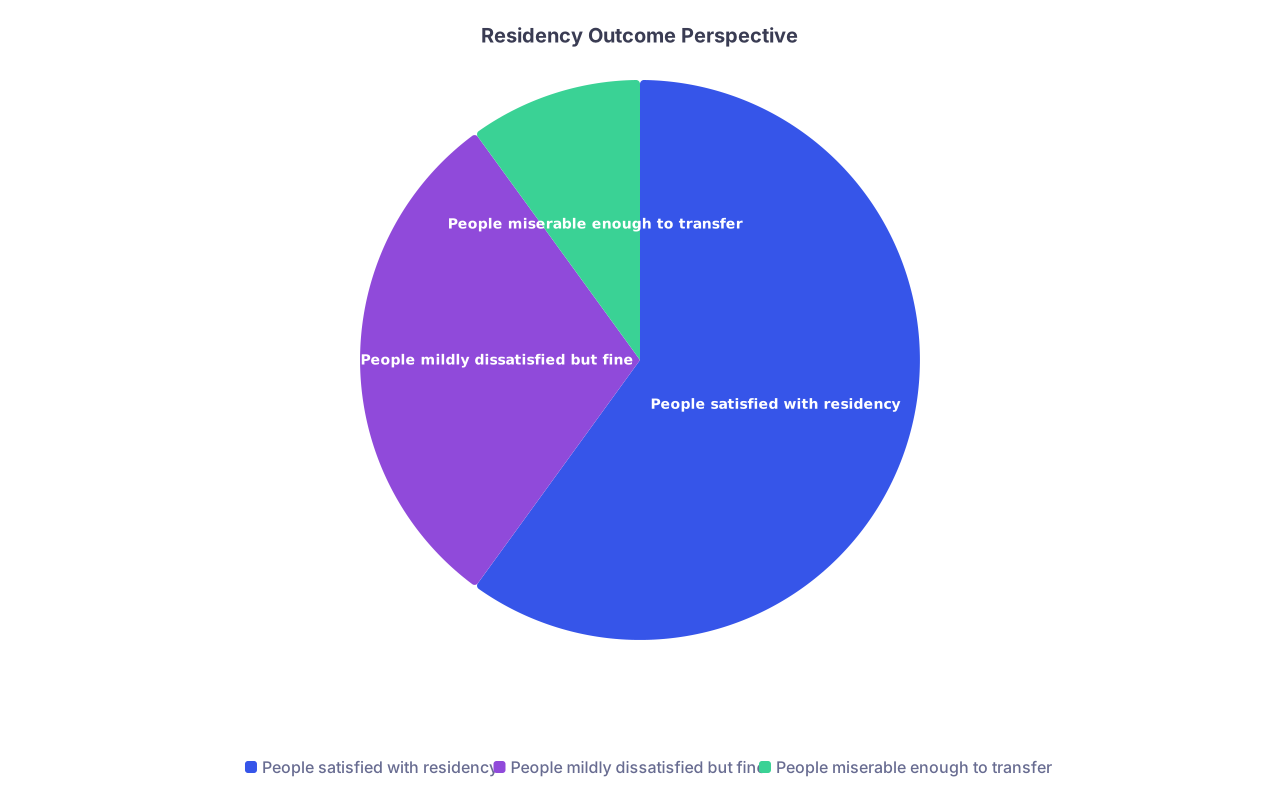
| Category | Value |
|---|---|
| People satisfied with residency | 60 |
| People mildly dissatisfied but fine | 30 |
| People miserable enough to transfer | 10 |
Is that exact data? No. But the pattern is true:
Most people end up fine. Some end up very happy. A small minority truly hate it enough to change, and even they find a way forward.
Residency is huge. And also just one chapter.
FAQs
1. What if the pre-match program is “mid” and my classmates are matching at bigger-name places?
Blunt answer: your classmates’ prestige doesn’t pay your rent or live your life. A “mid” program where you’re supported, trained well, and not destroyed physically or mentally is better than a fancy name where you’re miserable and undertrained. Will there be moments your ego stings? Yes. But you don’t practice medicine as a flex; you practice it as a job and a life. Don’t sacrifice your sanity for a logo on a badge.
2. Is it dumb to accept a pre-match if my advisor says I’m competitive for better places?
Not automatically. Advisors assess your paper competitiveness; they don’t live inside your anxiety levels. If you’re already barely functioning from stress, a secure, solid offer may be the smarter move even if, on paper, you “could do better.” That said, if your advisor—who knows your file—says, “You’re almost guaranteed to match somewhere equal or better,” and the pre-match is at a place you actively dislike, that’s a sign you might be accepting out of fear, not strategy.
3. Will declining a pre-match offer hurt me if that program ends up ranking me in the Match?
Usually not in some dramatic, blacklist way. Programs know applicants weigh options. Some might rank you lower if they feel burned, but many just treat it as: “Okay, they want to see what’s out there.” You shouldn’t decline rudely or last-minute after verbally committing, but a straightforward, respectful “thank you, but I’ve decided to remain in the Match” is not a career death sentence.
4. What if I accept, start residency, and realize I made a mistake?
That happens. It’s not great, but it’s not the end of the world. You have options: transferring (hard but possible), applying to a different specialty later, or finishing and then reshaping your path with fellowship or job choice. I’ve seen people start in community IM, then do a strong cardiology fellowship at a big place and end up exactly where they wanted. I’ve also seen people switch specialties entirely and become way happier. A “wrong” pre-match is not the last move you ever get.
Key points to hold onto:
- You’re not choosing between perfect and disaster; you’re choosing between different types of risk and different versions of “good enough.”
- A solid, non-glamorous program where you can function and grow is far better than an imagined perfect program that doesn’t exist.
- Whatever you choose—accept or decline—you’ll second-guess it at some point. That’s not failure; that’s just how anxious, ambitious people work.