
23% of residents in one large survey thought pre‑match residents were treated worse…while 0% of program directors said they intentionally treat them differently.
Somebody’s wrong.
Let me ruin the suspense: the myth is not that pre‑match residents are treated differently. The myth is how and why that happens. People blame “program discrimination” when most of what you see on the ground comes from contract structure, timing, and basic human psychology.
You’re trying to decide: should you take a pre‑match offer or roll the dice in the Match? You’ve probably heard all the folklore:
- “Pre‑match means they’ll abuse you; you have no leverage.”
- “Pre‑match residents never get good fellowship letters.”
- “If they really liked you, they’d rank you, not pre‑match you.”
- “Programs only pre‑match desperate IMGs.”
Most of that is garbage, mixed with a few sharp grains of truth. Let’s dissect it properly so you can make a rational decision instead of one based on Reddit ghost stories.
What “Pre-Match” Actually Changes (On Paper vs In Real Life)
On paper, pre‑match changes exactly one thing: your contract is signed before the NRMP algorithm runs. Instead of being bound by the Match, you’re bound by an employment agreement.
That has three downstream effects:
- You’re not in the Match for that discipline/PGY spot.
- Your leverage to “walk away” is far lower (and sometimes legally zero).
- The program knows you’re locked in for that year (or multiple years).
Everything else—call schedules, pay, rotations, evaluation—is supposed to be the same.
Here’s the inconvenient reality: structure alters behavior. When a program knows you cannot leave easily, they do sometimes act differently, even if they’ll never phrase it like that in a meeting.
But that’s not universal. And it’s not magic. You can predict which places are likely to treat pre‑match residents worse by looking at a few concrete variables.
Myth 1: “Pre-Match Residents Are Always Treated Worse”
No. But they are treated differently in predictable environments.
In well‑run programs—usually large academic centers that follow NRMP rules for most positions—pre‑match residents (often non‑NRMP or off‑cycle slots) get:
- Identical salaries by PGY level
- The same call schedules
- The same evaluation process
- The same access to mentorship and letters
I’ve seen plenty of pre‑match IMGs in internal medicine at solid university‑affiliated programs get chief resident positions, strong fellowship matches, and zero obvious discrimination. Talk to residents at those places and their feelings are usually “I forget who pre‑matched and who didn’t by October of intern year.”
Where you do see differential treatment is in specific kinds of programs:
- Chronically unfilled, heavy‑service community hospitals
- Programs with persistent ACGME citations
- Places with a pattern of recruiting mostly via SOAP and pre‑match
- Programs with high resident turnover and a reputation everyone warns you about, but you apply anyway because you’re panicking
Those are exactly the programs that rely most heavily on pre‑match and “out‑of‑match” contracts. That’s not a coincidence.
So it’s not: “Pre‑match → bad treatment.”
It’s: “Programs that abuse residents disproportionately use pre‑match to lock people in.”
You’re not being punished because you pre‑matched. You’re being punished because you picked a program that uses pre‑match as a band‑aid for deeper problems.
Myth 2: “Once You Pre-Match, You Have Zero Leverage”
Almost, but not quite. And this matters if you’re trying to protect yourself.
Contractually, yes: once you sign, you’ve surrendered your biggest piece of leverage—your ability to walk away to another residency via the same cycle. The NRMP Match Rules don’t cover you because you’re not in the Match for that position.
But you still have leverage in at least three areas:
Accreditation pressure
Programs still live and die by ACGME reviews and case logs. If they abuse residents so badly that you’re logging 110+ hours per week or missing mandatory education, they’re at risk. That’s leverage, especially if multiple residents are affected.Reputation and recruitment
Chronically toxic programs already know this: residents talk. Bad reputations stick. Many program directors are genuinely afraid of being “that program” future applicants avoid. Residents sharing honest experiences in private networks does more damage than you think.Transfer risk
It’s not easy, but residents do transfer out of malignant programs. When it happens more than once, it becomes a flashing neon sign in accreditation and recruitment. Programs that are just “mildly exploitative” often pull back when they realize someone might actually leave.
The real problem is psychological, not legal: once people sign, they assume they’re trapped. They stop asking for reasonable changes. They internalize, “I signed, so I have to eat whatever they give me.” Program leadership can feel that dynamic.
You can’t bluff “I’ll just go somewhere else” like a ranked‑candidate can. But you’re not a hostage either.
Reality Check: What Actually Changes For Pre-Match Residents
Let’s talk practical differences you might see and how real they are.
| Area | Typical Reality (Good vs Bad Programs) |
|---|---|
| Salary | Same by PGY level in almost all places |
| Call schedule | Same in good; heavier in toxic programs |
| Research/mentorship | Equal access, but effort-dependent |
| Evaluations | Same formal process, variable bias |
| Ability to push back | Lower perceived, not zero |
Schedules and “Workhorse” Status
In decent programs, pre‑match vs Match doesn’t show up on the call grid. They build block schedules by PGY and rotation, not contract type.
In marginal programs, the “locked‑in” residents often slowly become the default coverage:
- Extra nights when the schedule is tight
- Covering for last‑minute sick calls
- Being asked to float between services more often
Is that because they pre‑matched…or because they’re IMGs, quieter, or less likely to push back? Often it’s a mix. But pre‑match status does lower your perceived ability to say no.
Evaluations and Future Letters
Big myth: “Attendings won’t bother writing strong letters for pre‑match residents because you’re stuck.”
Reality: attendings barely know or care who pre‑matched. They know who shows up, does the work, and makes their life easier. That’s who gets letters.
Bias does creep in somewhere else though: program leadership advocacy.
If you’re a pre‑match resident in a program that prefers categorical, US‑grad, NRMP‑matched residents for their “flagship outcomes,” you may notice:
- You get fewer “handshake” intros to fellowship PDs.
- You don’t get the top research projects automatically.
- Leadership spends more of their political capital on the “shiny” residents.
Again, this is not because you pre‑matched per se. It’s the same pattern that affects IMGs, DOs, or anyone perceived as less “prestige enhancing.” Pre‑match residents just often overlap with those groups.
How Programs Actually Use Pre-Match (The Part Nobody Spells Out)
Let’s be blunt. Most programs do not prefer pre‑match as a concept. NRMP is simpler: one pool, one algorithm, cleaner optics.
So when they use pre‑match for categorical spots, they’re usually signaling one of these:
They’re worried you won’t rank them highly enough.
They like you, but they know they’re not a top‑tier program. So they try to “take you off the market” early. This can be perfectly benign and even flattering if the program is solid.They chronically underperform in the Match.
They struggle to fill via NRMP. They fear another SOAP scramble. Pre‑match becomes their security blanket.They operate partially outside NRMP/regular cycles.
Off‑cycle starts, visa complexities, military or special pathway positions—all of these may use non‑Match contracts by default.
The key distinction:
- Strong program using pre‑match selectively to secure specific candidates? Often fine.
- Weak or malignant program dependent on pre‑match as its primary recruitment tool? Red flag.
This is where you should stop listening to generic “pre‑match is bad” takes and start interrogating why that specific program is pre‑matching you.
How To Evaluate a Pre-Match Offer Without Getting Played
Forget vague vibes. You need a structured way to pressure test an offer.
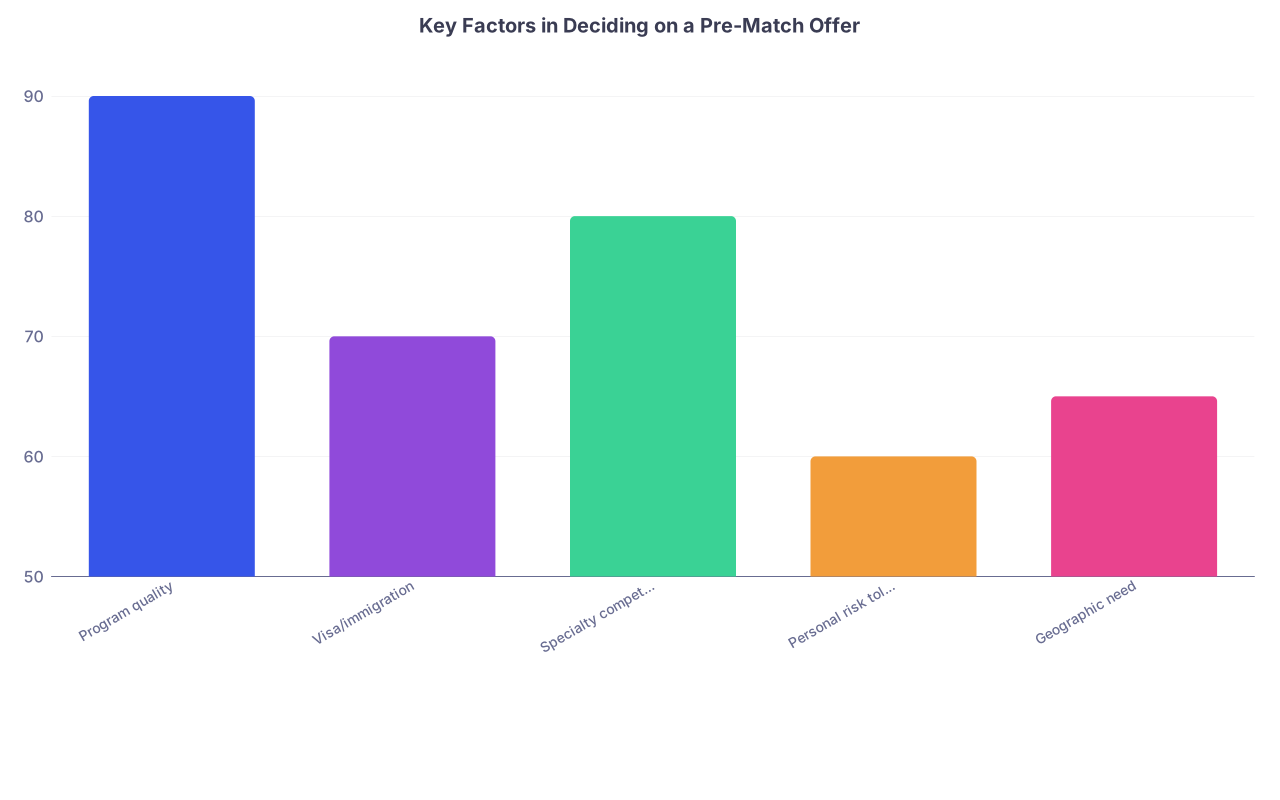
| Category | Value |
|---|---|
| Program quality | 90 |
| Visa/immigration | 70 |
| Specialty competitiveness | 80 |
| Personal risk tolerance | 60 |
| Geographic need | 65 |
1. Audit the Program’s Track Record
Ask for hard numbers. If they dance around, that’s your answer.
You want to know, over the past 3–5 years:
- Board pass rates
- Fellowship or job placement by specialty
- Resident attrition and transfers
- Proportion of positions filled via Match vs SOAP vs pre‑match
If a program fills >50% of its categorical spots through SOAP/pre‑match, that’s not “innovative recruiting.” That’s market feedback telling you nobody wants to be there.
2. Talk to the Right Residents (Not the Ones They Put on Zoom)
Every program has their polished ambassadors. They’re not lying, but you’re getting the filtered version.
You want:
- A second‑year who looks tired but honest
- An IMG or DO who actually pre‑matched there
- Someone who left the program, if you can track them down quietly
Specific questions that cut through fluff:
- “How often are you over 80 hours a week if you’re honest in your logging?”
- “What happens when someone complains about workload or mistreatment?”
- “Of the last 5 residents who left early, why did they leave?”
- “If you had the option again today, would you still come here?”
One “no” you can explain away. Three “no’s” with long pauses? You have your answer.
3. Clarify Exactly What You’re Signing Away
Pre‑match contracts can be sneaky. Read for:
- Duration (1-year vs multi-year commitment)
- Penalties for early termination
- Non‑compete or geographic restriction language (yes, some are that shameless)
- Visa dependencies (what if they don’t renew? what if they lose accreditation?)
If you’re on a visa, pre‑match can be both savior and trap. It secures a spot. But if the program is fragile and you’re chained there, your immigration status rides on their dysfunction.
This is where an actual lawyer—not your uncle who “does some contracts”—is worth the few hundred dollars.
When Saying Yes To Pre-Match Is Actually Smart
Contrary to the online panic, there are scenarios where taking a pre‑match offer is the objectively rational choice.
- You’re an IMG in a competitive specialty (e.g., categorical surgery, neurology at a busy center) and get a pre‑match from a reputable program with strong outcomes.
- You have major geographic constraints (family, spouse job, medical issues) and the offer is from the only realistic program in your target area.
- You’ve had a weak application cycle historically and this is a clear upgrade from likely SOAP outcomes.
Where people go wrong is overestimating their Match odds and underestimating the downside of landing in SOAP or not matching at all.
If you’re deciding between:
- Solid mid‑tier program pre‑match vs
- Delusional hope for a top‑tier match you’re not competitive for
Take the pre‑match. Pride doesn’t take boards or pay loans.
When You Should Walk Away (Even If You’re Scared)
You should have the spine to say no in at least these cases:
- The program cannot provide clear, recent board pass rates.
- They have a pattern of residents leaving or “not renewing contracts” mid‑training.
- Every resident you talk to sounds guarded or terrified to speak freely.
- The contract contains harsh penalties for early termination or weird non‑compete language.
- Fellowship/job outcomes are weak for your goals and they hand‑wave it as “resident dependent.”
If you’re hearing stories about bullying, retaliation, or systemic under‑staffing, pre‑match is not a safety net—it’s a set of handcuffs.
How To Protect Yourself If You Do Pre-Match
Say you sign. Now what? You’re not doomed, you just need to be deliberate.
Document from day one.
Keep a simple log: hours, violations, major incidents. Not because you want to nuke the place, but because leverage depends on evidence.Build external mentors.
Do not rely solely on your PD or APD. Connect with faculty at affiliated institutions, virtual mentorships, specialty societies. You need independent advocates for letters and career advice.Stay match‑level competitive.
Even if you’re locked in, keep your CV moving: QI projects, case reports, presentations. If things go bad and you need to transfer, you’ll be thankful you did.Don’t act like a hostage.
You’re a physician in training, not a indebted servant. Be reasonable, collaborative—and firm on clear boundaries like duty hours, educational time, and abusive behavior.

| Step | Description |
|---|---|
| Step 1 | Receive Pre Match Offer |
| Step 2 | High risk for mistreatment |
| Step 3 | Consider waiting for NRMP |
| Step 4 | Pre Match likely smart |
| Step 5 | Decline and aim for Match |
| Step 6 | Consider offer but protect yourself |
| Step 7 | Program track record strong |
| Step 8 | Your match odds strong? |
| Step 9 | Other options likely? |
The Myth, The Reality, and Your Decision
Let me distill this without sugarcoating:
Pre‑match residents are not universally treated worse; they’re more often found in worse programs.
The abuse pattern follows program quality, not the pre‑match label itself.Your real risk is not “being pre‑match.” It’s signing with a program that needs pre‑match to survive.
If a place can fill easily via NRMP, pre‑match is a tactic. If they can’t, it’s a crutch.A pre‑match offer can be either your smartest move or your biggest trap—depending entirely on how ruthlessly you evaluate the program and the contract.