
The most dangerous decision you will make this application season is what you do with a single pre-match offer.
Not your personal statement. Not which programs you apply to. That one contract in your inbox that feels like a lifeline and a trap at the same time.
You are not going to “just feel it out” or “ask around” and hope for the best. You need a protocol. A stepwise process that turns panic into a structured decision within 48–72 hours.
This is that protocol.
Step 1: Stop the Emotional Spiral and Lock Your Timeline
You saw the email. Your heart rate jumped. You mentally started packing for a new city. Or you felt sick because this is not your top choice.
Pause.
The first move is not deciding yes or no. The first move is controlling time and information.
1.1 Clarify the response deadline immediately
Do not guess. Do not assume you have “a few days.”
Email or call the coordinator or program director the same day:
- Thank them for the offer.
- Ask very clearly:
- Exact deadline (date and time, in which time zone).
- Whether they expect a verbal acceptance before paperwork.
- Whether there is any flexibility in the deadline.
Script (edit to sound like you):
“Thank you again for this generous offer. I am very interested in your program and want to consider it carefully. Could you confirm the deadline for my response and whether there is any flexibility in that date? I want to ensure I make an informed and timely decision.”
Why this matters: Programs sometimes say “we need to know quickly” but will give you an extra 24–72 hours if you ask professionally. That extra window changes everything.
1.2 Freeze impulsive promises
Do not:
- Verbally accept “just to hold it”.
- Hint you are 100% committed if you are not.
- Tell friends or family you are “basically in” before you decide.
Verbal acceptance can be treated as binding. Ethically and sometimes legally. Walking that back looks bad and can harm you.
You are gathering facts. Not committing.
Step 2: Diagnose Your Risk Profile (You Are Not Average)
The right move with a single pre-match offer depends heavily on how likely you are to match elsewhere. Most people wildly misjudge this. They anchor on “my friend matched with worse stats” or “my advisor said I’m competitive.”
You need a cold-eyed risk assessment.
2.1 Classify your risk level honestly
Use this as a rough framework:
| Risk Level | Typical Characteristics |
|---|---|
| Low | US MD, no major red flags, solid scores, multiple interviews pending/offered |
| Moderate | US MD/DO or strong IMG, a few gaps or average scores, limited interviews |
| High | IMG with attempts/gaps, low scores, prior failures, very few or no other interviews |
| Critical | Failed Step/attempts, visa-dependent IMG, specialty switch, almost no interviews |
You do not need to fit perfectly. But you should know which row feels closest.
2.2 Count your actual opportunities, not hypotheticals
Make a quick tally:
- Number of interviews already completed.
- Number of upcoming scheduled interviews.
- Number of programs that:
- Expressed strong interest (personal emails, PD meeting).
- Historically take applicants like you (based on alumni, IMG-friendly lists, etc.).
Forget about:
- Places you only applied to.
- “Maybe” interview hints that never became real invitations.
- Programs that “liked your application” but never scheduled anything.
If you have:
- 0–2 total interviews → You are in high to critical risk territory.
- 3–6 total → Moderate risk (bordering high if there are red flags).
- 7+ in a less competitive specialty → Lower risk, depending on other factors.
2.3 Factor in red flags
You know what they are:
- Failed Step/COMLEX attempt.
- Long gap after graduation (>3 years).
- Probation, professionalism issues.
- Switching specialty late with limited exposure.
- Visa issues (for IMGs).
Each major red flag bumps you one risk category higher than your interview count alone suggests.
If you are high or critical risk and this is a decent program, the pre-match offer is not a curiosity. It is potentially your only contract this cycle.
Step 3: Deconstruct the Offer: Program, Contract, and Reality
Now that you have a sense of risk, you evaluate three things:
- The program quality and fit.
- The contract itself.
- The lived reality of training there.
You are not buying a car. You are buying three to seven years of your life.
3.1 Program quality and your minimum threshold
You need a personal floor: “I will not sign below this level even if I might not match.”
That floor is different for everyone. But there are some clear warning signs.
Red flags that should make you nervous about locking in:
- Chronic ACGME citations or probation.
- History of losing accreditation or closing.
- Massive resident turnover or frequent resignations.
- Repeated stories of toxic leadership, retaliation, or abuse.
- Consistently failing board pass rates.
Check quickly:
- ACGME public site for accreditation status.
- Program website for board pass rates and fellowship placements.
- Blogs, Reddit, SDN, WhatsApp/Telegram IMG groups (with skepticism, but not dismissal).
- Alumni or upper-levels from your school who matched there or rotated there.
Ask yourself, bluntly:
- Would I be embarrassed to train here?
- Would I feel unsafe or exploited here?
- Would this significantly damage my long-term goals (e.g., competitive fellowship)?
If the honest answer to all three is “No” → It is at least acceptable.
3.2 Parse the contract like an adult, not a desperate applicant
Do not just scan for salary and sign.
Key items to find and understand:
Term and duration
- Is this a categorical position through completion or just prelim/transition?
- Are there “reappointment” conditions each year?
Compensation and benefits
- Base salary.
- Health insurance details.
- Meal money, book stipend, housing, parking.
Work expectations
- Average weekly hours (if stated).
- Call frequency.
- Night float structure.
Termination and non-renewal clauses
- Grounds for immediate termination.
- Conditions under which they can choose not to renew you.
- Any language that seems broad and vague (“unprofessional conduct” with no definition, etc.).
Moonlighting
- Allowed or not, and under what conditions.
Bonding / penalties (common in some countries and a few US community hospitals)
- Financial penalties for early exit.
- Commitment to work for the hospital after residency.
If anything looks off, you email the GME office or coordinator with specific questions. You are allowed to ask. Programs that get angry because you read your contract carefully tell you something about their culture.
Step 4: Compare This Offer to Your Realistic Alternatives
Now you put the pre-match offer side-by-side with what you are likely to get through the regular Match.
Not your fantasy list. Your realistic list based on your risk profile.
4.1 Build a simple comparison grid
Do this on paper or a spreadsheet. Columns:
- This pre-match program.
- Your best likely Match outcome.
- Your median likely Match outcome.
- Worst-case: SOAP or not matching.
Rows:
- Program reputation (national / regional / unknown).
- Your specialty fit (FM vs IM vs surgery vs whatever).
- Location (family, cost of living, visa, etc.).
- Training quality (board pass, case volume, teaching).
- Lifestyle (schedule, call, culture).
- Long-term impact (fellowships, job market).
Then you rate each item something like:
- 1 = Poor
- 2 = Acceptable
- 3 = Strong
Be ruthless. If you have no realistic shot at university programs, do not rate “best likely Match” as “university hospital with amazing fellowship outcomes.” Your “best likely” might be “solid community program, decent reputation.”
4.2 Use a quick visual to keep your head straight
Here is how risk vs attractiveness typically shakes out with a single offer:
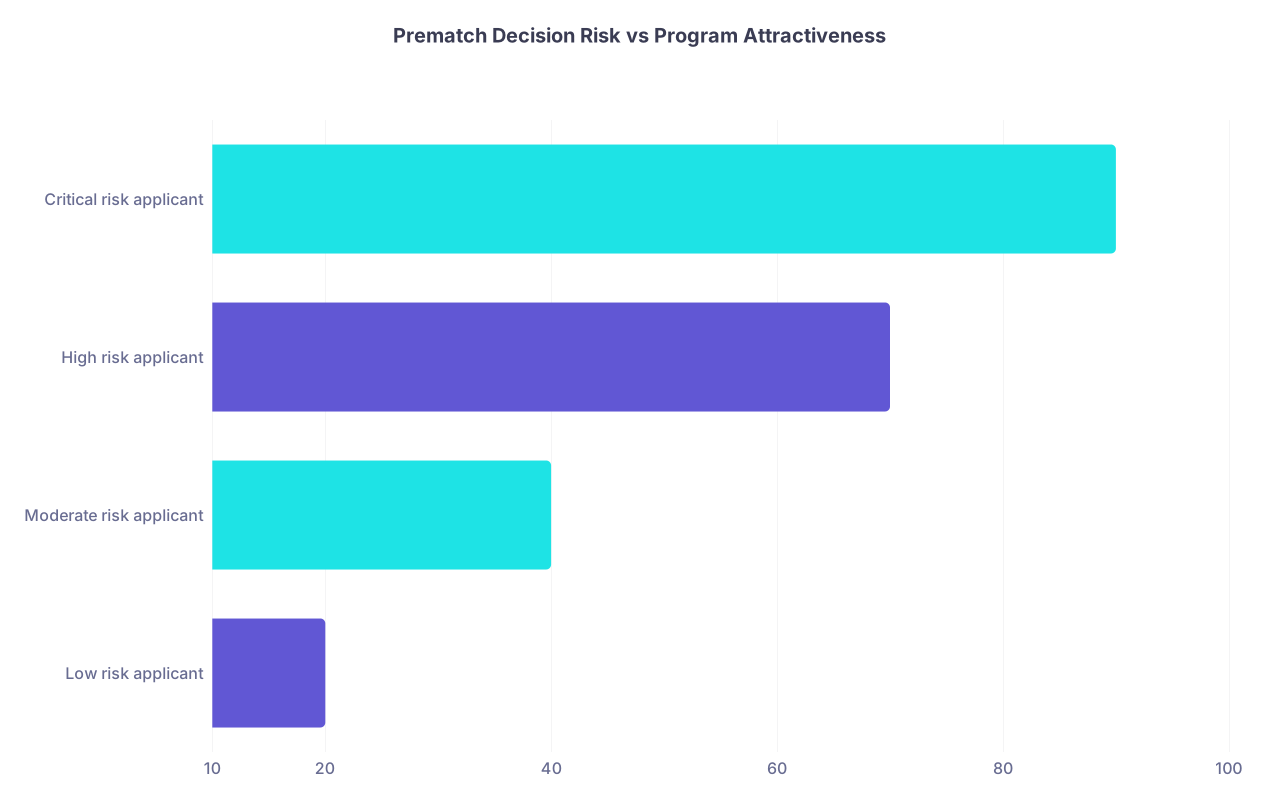
| Category | Value |
|---|---|
| Low risk applicant | 20 |
| Moderate risk applicant | 40 |
| High risk applicant | 70 |
| Critical risk applicant | 90 |
Think of that percentage as “how likely this prematch should be accepted if the program itself is at least acceptable.”
Low risk = you can gamble more. Critical = you probably cannot.
Step 5: Run the Fork-in-the-Road Scenarios
You are basically choosing between two paths:
- Accept pre-match and withdraw from the Match for that specialty.
- Decline and stay in the Match (with this one program gone, and possibly others reacting).
Walk each path forward one year and five years.
5.1 If you accept now
Immediate outcomes:
- You stop stressing about interviews and rank lists for this year.
- You might cancel remaining interviews (program-dependent; some will insist).
- You lock in a known program, location, and salary.
One year from now:
- You are an intern there, for better or worse.
- Moving logistics done, you are in training.
- You may regret not seeing what else you could get—or you may be incredibly relieved.
Five years from now:
- If the program is at least average, you are probably board-eligible and employable.
- You might have fewer fellowship options if it is weaker, but you have a career.
5.2 If you decline and stay in the Match
Immediate outcomes:
- You keep interviewing and ranking.
- This program may not rank you at all now. (Some will still do it. Many will not.)
One year from now (best to worst):
- Best: You match at a program you like more. You feel brilliant.
- Middle: You match at a similar or slightly worse program. The pre-match looks like a missed safety net but not a disaster.
- Worst: You do not match. You are in SOAP chaos or sitting out a year with a red flag of “unmatched applicant.”
Five years from now:
- Best: You trained at a place that opened doors.
- Worst: You are still trying to repair the damage from an unmatched year, or you left clinical medicine.
5.3 Ask the only question that matters
If I decline this, am I truly prepared to accept an unmatched year or SOAP-level program as the price of gambling?
- If your answer is a confident “Yes, because this offer is below my minimum acceptable threshold,” then considering a decline is reasonable.
- If the honest answer is “No way, that would crush me,” you are leaning toward accepting if the program is not toxic.
Step 6: Communicate with Key Programs (Without Being Sloppy)
If this pre-match is not your top choice, you are going to want to know whether your higher-priority programs realistically see you as rankable.
You cannot demand promises, but you can send calibrated interest signals.
6.1 Contact your true top 3–5 programs
Not 15. Not everyone. Just the ones where:
- You have interviewed or are scheduled.
- You would absolutely choose them over this pre-match.
- Your profile fits their usual residents at least somewhat.
Short email to the PD or APD:
“Dear Dr [Name],
Thank you again for the opportunity to interview with [Program Name]. I remain very interested in training at your program. I have recently received a pre-match offer from another institution and must make a decision by [date].
While I understand that you cannot disclose final ranking decisions, any guidance you can share regarding my standing as an applicant would be very helpful as I make this important decision.
Sincerely,
[Your Name]”
Some will ignore it. Some will send generic “we enjoyed meeting you.” A small number will be more direct:
- “We anticipate ranking you highly.”
- “We see you as a competitive candidate for our program.”
- “We cannot comment specifically but you remain under strong consideration.”
You cannot treat those as contracts. But they are data points.
6.2 Do not disclose your offer details everywhere
Avoid:
- Posting the exact program name and specialty on public forums while it is active.
- Emailing 20 programs saying “I have an offer, are you going to rank me?”
You look unserious and potentially breach confidentiality.
Step 7: Apply the Decision Rule Based on Your Risk and the Program
Here is the blunt decision protocol I use when talking with applicants one-on-one.
7.1 If you are high or critical risk
Profile: Few interviews, red flags, IMG needing visa, prior failures, big gaps.
Ask three questions:
- Is this program accredited and stable, not in danger of closure?
- Is this specialty one I can live with long term (even if not my dream)?
- Is the environment at least not clearly abusive or unsafe?
If all three are yes → You strongly lean toward accepting.
Declining in this situation is very often a decision you regret on Match Day. I have watched it happen. Repeatedly.
Consider declining only if:
- The program has serious, well-documented toxicity or accreditation risk.
- The contract has extreme clauses (huge penalties, clearly exploitative terms).
- You have a realistic alternative non-clinical path that you are genuinely willing to pivot to if you do not match.
7.2 If you are moderate risk
Profile: Decent applicants but with some issues; 3–6 interviews.
You have choices, but not unlimited.
Here is your protocol:
- If the pre-match program is:
- In your top 3 realistic choices.
- In a location you can tolerate.
- With acceptable training quality.
→ Lean toward accepting, especially if your other interviews are at similar or weaker places.
- If the pre-match is:
- At a significantly worse program than most of your upcoming interviews.
- In a location that would heavily strain family, finances, or visa logistics.
→ Ask for a short extension, contact top programs, and re-evaluate once you see their replies. But set a hard internal deadline 24 hours before the official one.
7.3 If you are low risk
Profile: Strong metrics, lots of interviews, no major red flags, non-ultra-competitive specialty.
Here you can be more selective:
- If this pre-match is a top choice → Accepting is rational. You lock in your best-case outcome early.
- If it is mid-tier and you have multiple stronger programs showing interest:
- You can decline and stay in the Match.
- Or negotiate for a little more time and wait for explicit reassurance from a top choice.
Still, do not become arrogant. Unexpected non-matches happen to “safe” applicants every year, usually because they over-ranked only dream programs and underestimated local competition.
Step 8: Implement a 48–72 Hour Micro-Plan
You cannot stretch this decision for weeks. Use a tight schedule.
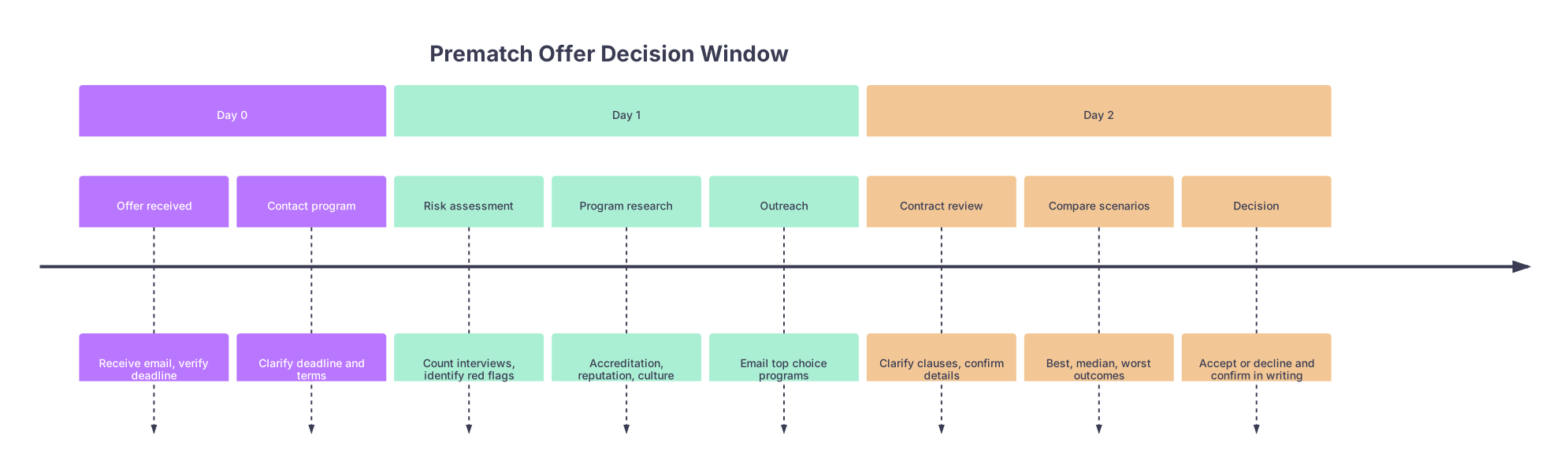
| Period | Event |
|---|---|
| Day 0 - Offer received | Receive email, verify deadline |
| Day 0 - Contact program | Clarify deadline and terms |
| Day 1 - Risk assessment | Count interviews, identify red flags |
| Day 1 - Program research | Accreditation, reputation, culture |
| Day 1 - Outreach | Email top choice programs |
| Day 2 - Contract review | Clarify clauses, confirm details |
| Day 2 - Compare scenarios | Best, median, worst outcomes |
| Day 2 - Decision | Accept or decline and confirm in writing |
Concrete micro-plan:
Within first 12 hours:
- Clarify the deadline and any flexibility.
- Skim contract; flag confusing clauses.
- Do initial risk category assessment.
Within 24 hours:
- Research program rigorously.
- Talk to at least one person who knows the program (alumni, your dean’s office, upper-level who rotated there).
- Email top 3–5 programs you would prefer.
Within 48 hours:
- Review any replies from other programs.
- Re-score your comparison grid.
- Decide internally: leaning accept or decline.
By 72 hours (or your stated deadline, if earlier):
- Make the call.
- Email the program clearly: either acceptance or decline.
- If accepting, ask for next steps (onboarding, paperwork).
- If declining, be professional and concise—do not over-explain.
Step 9: Execute the Decision Cleanly and Protect Your Reputation
Once you decide, you commit. No wobbling.
9.1 If you accept
Your email:
“Dear Dr [Name],
Thank you very much for the offer to join [Program Name] as a [specialty, PGY-1/PGY-2] resident for the [year] academic year. I am pleased to accept this offer and look forward to training with your team.
Please let me know the next steps for signing the contract and completing any required paperwork.
Sincerely,
[Your Name]”
Then:
- Stop participating in the NRMP Match for that specialty as required by rules in your country/region.
- Notify other programs if required or if you have interviews scheduled.
- Do not keep “shopping around” for better deals. That is how you get into ethical and sometimes legal trouble.
9.2 If you decline
Your email:
“Dear Dr [Name],
Thank you again for your generous offer to join [Program Name]. After careful consideration, I have decided to pursue other options that align more closely with my personal and professional circumstances.
I am grateful for the opportunity to have interviewed with your program and to learn more about it.
Sincerely,
[Your Name]”
You will feel a mix of relief and fear. That is normal. Own the choice and move forward—do not send second emails trying to reopen the door.
Step 10: If You Are Still Unsure, Use This Binary Check
You are at the deadline, still stuck. Here is the blunt litmus test.
Picture two Match Day scenarios:
- You signed this pre-match. You are an incoming resident at a program you feel is “fine, not amazing.”
- You declined. On Match Day, your screen shows “We are sorry, you did not match.”
Which scenario makes you more sick to your stomach?
- If Scenario 2 feels clearly worse → Accept.
- If Scenario 1 feels clearly worse and the program is legitimately bad for you (toxic environment, severe mismatch with goals) → Decline.
This is not “follow your heart” fluff. It is your tolerance for risk and regret translated into a concrete choice.
What You Should Do Today
If you have a pre-match offer right now and you’re spinning, do this in the next 60 minutes:
- Write down your risk category and number of interviews.
- Open a blank document and make a 3-column grid: this pre-match vs best likely Match vs worst-case (SOAP / no match).
- Email the program today to confirm the exact response deadline and ask if there is any flexibility.
Do those three things immediately. They force your vague anxiety into specific data. Once you see your situation on paper, the decision stops feeling like a mystery and starts looking like what it is: a high-stakes, but solvable, choice.