
What will you do when a solid pre‑match offer is in your inbox, but it is not from the fanciest name on your list?
This is where smart people sabotage themselves.
Not because they lack information. Because they overvalue prestige and ignore everything that will actually determine whether their residency is a livable, career-building experience.
Let me be direct: name‑chasing ruins more pre‑match decisions than bad scores ever did. I have watched applicants turn down safe, good‑fit pre‑match offers while waiting for a “bigger name”… and then scramble into a worse program months later. Or not match at all.
You are not just choosing a brand. You are choosing who will train you, how exhausted you will be, how supported you will feel, and what options you have when the match dust settles.
Let’s walk through the specific prestige‑driven mistakes that destroy pre‑match choices, and how to protect yourself from them.
The Prestige Trap: Why Smart Applicants Think Dumb Thoughts
Nobody wakes up and says, “Let me make a short‑sighted, ego‑driven decision about my future.” But the trap is subtle.
I keep seeing the same mental script:
- “This is a good offer… but my friends will be more impressed if I wait for [Big Name Academic Center].”
- “It’s just three years; I can tolerate anything if the name is strong.”
- “This program is in a less desirable city, so it must be worse.”
- “Everyone on Reddit says to aim higher. Maybe this pre‑match is a sign I am undershooting.”
The problem is that the market for prestige is irrational. You pay for the logo with things you do not see on the glossy brochure: worse culture, overworked residents, malignant leadership, no interest in teaching, or no support for your actual career goals.
And in the pre‑match phase, you add one more risk: timing. Once you decline or ignore a serious pre‑match offer, it is often gone for good.
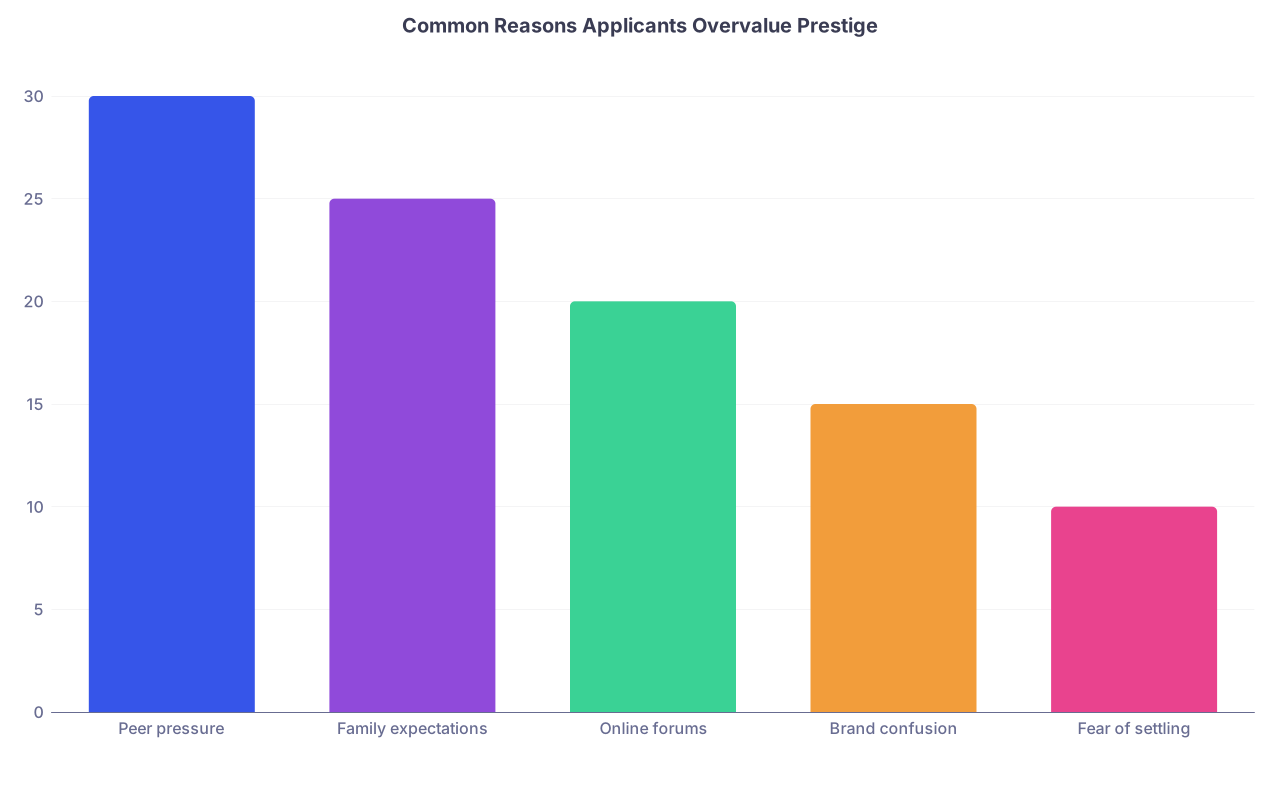
| Category | Value |
|---|---|
| Peer pressure | 30 |
| Family expectations | 25 |
| Online forums | 20 |
| Brand confusion | 15 |
| Fear of settling | 10 |
The big mistake: assuming “strong name” automatically equals “strong training for me.” That “for me” part is where people get burned.
How Name‑Chasing Warps Pre‑Match Risk Calculations
You are in the “Residency Match and Applications” phase. That means you are not playing fantasy football with rank lists—you are dealing with a real risk of not matching.
Prestige obsession ruins risk calculations in three ways.
1. Ignoring Your Actual Competitiveness
I have watched applicants with Step 2 of 225 and one poster at a small conference talk about “holding out” for pre‑match offers from top‑tier academic programs in hyper‑competitive cities. Why? Because their classmates with 255 are interviewing there.
That is not realism. That is self‑delusion.
You need a brutally honest view of your competitiveness by specialty level:
- Scores and clinical grades
- Letters strength (realistic, not fantasy)
- Red flags (gaps, attempts, remediation)
- How competitive the specialty/program/location actually is
| Applicant Profile | Prestige-Driven Move | Smarter Pre-Match Move |
|---|---|---|
| Step 2 225, average MS3 evals, FM | Wait for big-name coastal academic FM | Strongly consider solid community pre-match |
| Step 2 245, solid IM, wants cards | Hold out for top 10 IM only | Lock a strong regional academic IM pre-match |
| Step 2 230, one remediation, Psych | Ignore mid-tier psych pre-match | Take supportive psych program seriously |
| IMG, Step 2 240, no US research | Decline community IM pre-match | Accept stable, IMG-friendly pre-match offer |
The prestige‑driven applicant treats all offers as equal probabilities: “If I got one pre‑match, I can wait for a better one.” That is almost never true. Programs vary massively in risk tolerance and what they see in your app.
Do not assume more offers are coming. Especially not from the places that did not even interview you early.
2. Misreading What a Pre‑Match Offer Means
Huge mistake: treating a pre‑match offer from a mid‑tier program as a “safety” you can casually decline while you chase upper‑tier names in the formal Match.
Reality:
- A pre‑match offer means this program sees you as “take now or lose later.”
- That relationship is asymmetric. If you refuse them now, they are not obligated to rank you highly later.
- Some programs use pre‑match precisely because they know they will lose you in the open match if they wait.
So when you say no while waiting for something shinier, you are often burning a real safety net. And you usually do not have as many nets as you think.
3. Discounting the Cost of Not Matching
People treat “not matching” like an abstract worst‑case checkbox. They do not actually run the scenario.
Here is the actual cost I have seen:
- One full year lost.
- Extra exam prep, tuition, or clinical work just to stay clinically relevant.
- Having to explain a gap at every future application.
- Being forced to apply more broadly or to less desired specialties.
- Financial and psychological fallout that bleeds into residency and beyond.
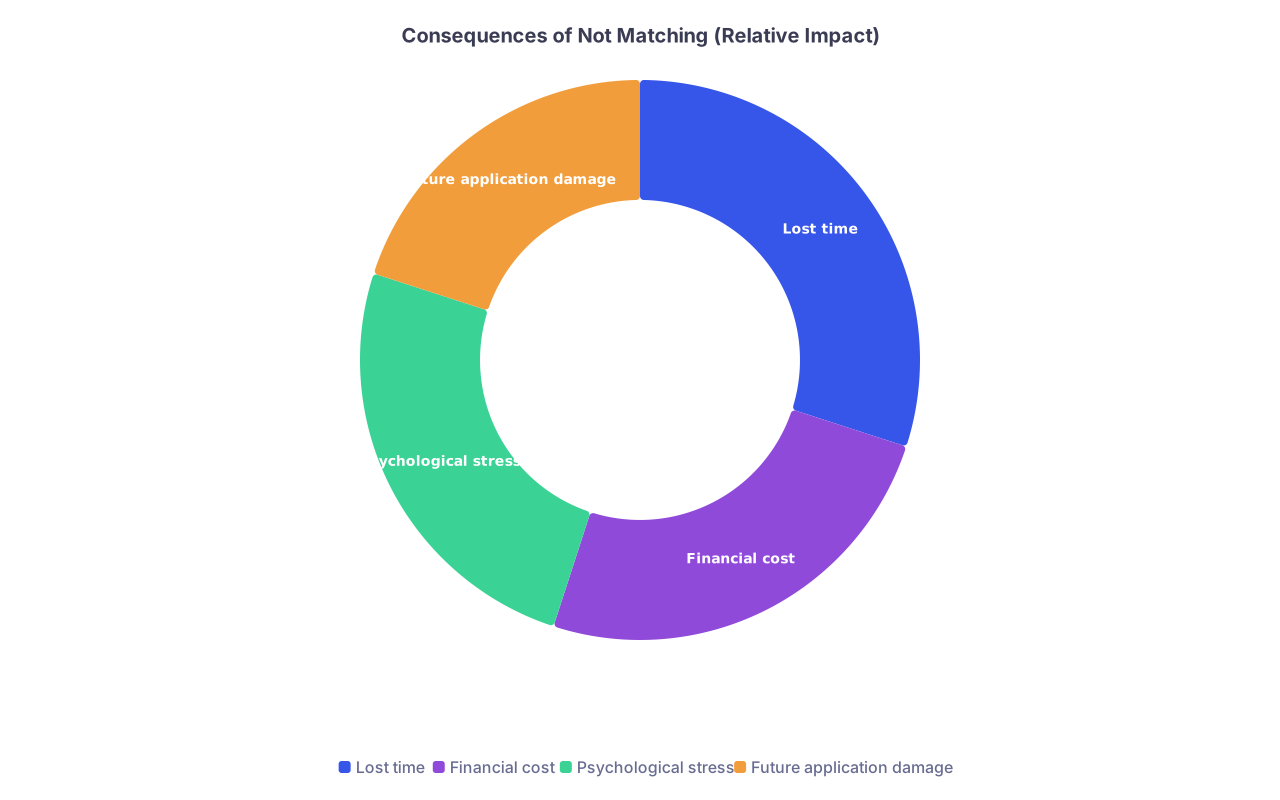
| Category | Value |
|---|---|
| Lost time | 30 |
| Financial cost | 25 |
| Psychological stress | 25 |
| Future application damage | 20 |
Compare that with the real cost of training at a non‑fancy but solid program. The math stops favoring prestige pretty quickly once you stop thinking in logos and start thinking in outcomes.
The Hidden Ways Prestige Can Make Your Training Worse
Here is the part nobody wants to admit out loud: some of the most “respected” programs are miserable places to train for most residents.
Not all. But enough that treating prestige as a proxy for quality is reckless.
1. Toxic Culture Hiding Behind Reputation
Malignant programs do not advertise. They ride on reputation built 20 years ago while residents quietly suffer.
I have heard this too many times at interview dinners:
- “Our attendings are world‑class… but they do not really teach.”
- “You learn by drowning. If you survive, you are strong.”
- “Wellness? That is what weekends are for—if you get them.”
Prestige blinds applicants to red flags they would never tolerate at a lesser‑known place. If this same culture existed at a community hospital with no name, you would walk out. But slap a big university logo on it, and suddenly people say, “It is worth it for the fellowship prospects.”
Sometimes it is. Often it just burns you out.
2. Your Actual Career Goals Get Ignored
A classic prestige overreach:
You want to be a clinically strong, community‑based internist. You get a pre‑match from a regional academic program with great teaching, strong clinical volume, and excellent relationships with community hospitals. But you keep chasing a top‑15 research‑heavy IM program because “it looks better.”
At the fancy place:
- Every resident is pressured to publish.
- The “stars” get faculty attention; the clinically oriented residents get fewer opportunities.
- You feel like a second‑tier trainee because you are not racing for competitive subspecialty fellowships.
At the less flashy place:
- The program values clinicians.
- You get more hands‑on, bread‑and‑butter experience.
- The faculty actually care that you are prepared for independent community practice.
Overvaluing prestige means you value abstract external status over alignment with your real career path. That is how people end up miserable in “top” programs that never fit them.
3. Location and Cost of Living Get Hand‑Waved
Another prestige‑driven error: underweighting cost of living and support systems.
Yes, the big coastal academic brand is shiny. But if:
- You are paying half your PGY‑1 salary in rent.
- Your partner cannot find work.
- You have no social support within 500 miles.
Your life will feel worse than it needs to. For years.
Residency is already grueling. Add isolation and financial strain and watch your risk of depression and burnout skyrocket. But prestige‑chasing applicants often treat these factors as “minor” compared to name. That is fantasy thinking.
A Better Framework: How to Decide on Pre‑Match Offers Without Getting Blinded
You need a structure that forces you to weigh reality over ego.
Forget “Is this prestigious enough?” Ask: “Does this program give me an acceptable floor and a workable ceiling?”
- Floor = You will be trained, supported, and not destroyed.
- Ceiling = You still have realistic paths to your career goals.

| Step | Description |
|---|---|
| Step 1 | Pre-match Offer Received |
| Step 2 | Assess Program Quality |
| Step 3 | Decline Offer |
| Step 4 | Assess Career Fit |
| Step 5 | Consider as Safety Only |
| Step 6 | Strong Contender |
| Step 7 | Compare With Expected Match Options |
| Step 8 | Strongly Consider Accepting Now |
| Step 9 | May Wait, But Monitor Risk |
| Step 10 | Meets Minimum Training & Support? |
| Step 11 | Supports Career Goals? |
| Step 12 | Risk of No Match Acceptable? |
Let me break this into concrete pieces.
Step 1: Define Your “Non‑Negotiables”
Before you are staring at an offer letter, decide what is non‑negotiable for you. Not “nice to have.” Non‑negotiable.
Common ones I have heard from residents who are actually happy where they matched:
- Reasonable resident culture (no chronic screaming, humiliation, or bullying).
- Graduates are competent and independent in your expected practice setting.
- At least neutral support for your career track: fellowships, hospitalist, outpatient, etc.
- Acceptable call schedule and total work hours. Not cushy—just not abusive.
- City or region where you can survive three or more years without hating your life.
Once these are clear, you evaluate pre‑match offers with them in mind. Not with, “Will people from med school be impressed?”
Step 2: Separate Brand From Outcomes
Do a simple test:
Forget the program name. Look only at what happens to its graduates.
| Factor | Big Name Academic A | Less Known Regional B |
|---|---|---|
| Overall reputation | Nationally famous | Mostly regional |
| Board pass rates | 94% | 96% |
| Graduates in your goal | 50% (mostly research) | 70% (clinical/community) |
| Resident satisfaction (word-of-mouth) | Mixed / burned out | Generally positive |
| Cost of living | Very high | Moderate |
If Program B is offering you a pre‑match now, and Program A has not even hinted at ranking you highly, how much are you really gaining by rolling the dice on prestige?
You should care about board pass rates, fellowship and job placements, real alumni careers. Not just where the program’s name sits on some half‑baked online ranking list.
Step 3: Assign Realistic Probabilities
You are a scientist. Treat your options like a probability problem, not a vibes contest.
Estimate (as honestly as you can):
- Chance you match somewhere you would be content.
- Chance you match somewhere you actively dislike.
- Chance you do not match at all.
Now recalculate those numbers if you lock in this pre‑match. How much does it lower your “disaster” probability?
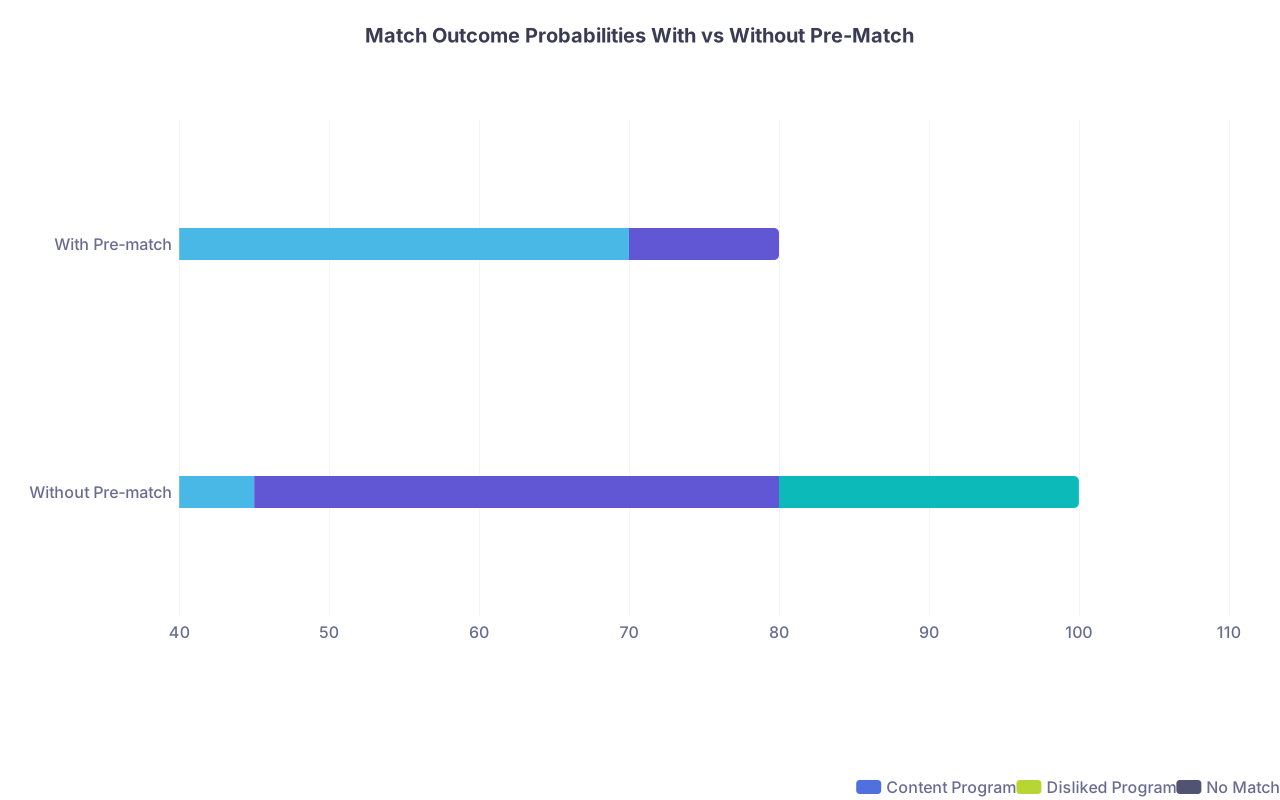
| Category | Content Program | Disliked Program | No Match |
|---|---|---|---|
| Without Pre-match | 45 | 35 | 20 |
| With Pre-match | 70 | 10 | 0 |
Your ego will overestimate the probability of landing something better and underestimate the chance of something worse. You need to correct for that bias consciously.
Step 4: Ask the Questions Prestige-Blinded Applicants Skip
When talking to residents or program leadership, prestige‑driven applicants ask, “How competitive are your fellowships?” and “How many publications do residents have?”
Useful. But incomplete.
You must also ask:
- “Tell me about a resident who struggled here. How did the program respond?”
- “How often do duty hour violations actually happen?”
- “What kind of resident does poorly here?”
- “If someone changes their fellowship goal in PGY‑2, how do you support that?”
- “What percent of your graduates end up roughly where they wanted to be?”
The answers to these questions reveal culture, flexibility, and real expectations. That is what your daily life will feel like. Name alone will not protect you from a bad fit.
Red Flags: When Prestige Is Actively Misleading You
There are specific situations where prestige is not just overvalued—it is misleading.
Watch for these.
Red Flag 1: “Everyone says it is amazing” but residents look dead inside
If the online narrative and the hallway reality do not match, trust the hallway. I have seen programs with legendary names where interview day is polished but every off‑script comment from residents screams burnout.
If a no‑name place had those vibes, you would run. Do not let a famous logo override your eyes.
Red Flag 2: Your main reason is “It opens more doors”
You must ask: which doors, and do you actually need them?
- Do you really need hyper‑elite fellowship placement? Or do you want a reasonable shot at a solid subspecialty program regionally?
- Do you plan on being academic faculty at a top‑tier institution? Or a respected clinician in a city you like?
For most applicants, the incremental door‑opening advantage between a strong mid‑tier program and a top‑tier one is small compared with differences in personal well‑being.
Red Flag 3: You keep saying “just three years”
This phrase has burned so many trainees I have lost count.
Three years of:
- Chronic sleep deprivation.
- Toxic leadership.
- No support if life hits you (illness, family issues, pregnancy).
- Constant pressure to do research you do not care about.
That can fundamentally change who you are by the end of residency. “Just three years” is what people say before they have done one year of internship at the wrong place.
How to Protect Yourself from Prestige Pressure (Family, Peers, and Your Own Ego)
You are not making this decision in a vacuum. You have parents who brag, classmates who flex, faculty who subtly push academic paths.
Here is how you do not get rolled.
Stop announcing your target “tier.”
The more you broadcast, the harder it becomes to accept a “lesser” name without feeling like you lost. Keep your criteria private and results‑focused.Translate prestige talk into outcomes for your family.
“This program will let me be a strong, safe doctor and not destroy my health” is a better explanation than, “It is ranked top 10.”Do not ask Reddit to validate your ego.
Anonymous strangers will always tell you to “shoot your shot.” They do not pay the price if you miss.Use one or two grounded mentors—not ten loud voices.
Show them your actual application. Ask, “If this were your child, would you tell them to decline this pre‑match and gamble on the match?” Then listen.
The Bottom Line: Prestige Is a Factor, Not a Compass
Let me strip this down to the essentials.
You are not trying to win a beauty contest. You are trying to:
- Become a competent physician.
- Stay mentally intact.
- Keep realistic doors open for your future.
Prestige can help with the third. Sometimes the second. It does nothing for the first if the culture and training are wrong for you, and it can actively hurt all three if you let it override judgment.
2–3 key points to leave with:
- Do not treat a solid, good‑fit pre‑match as a disposable backup while you chase logos. You are often throwing away real safety for imaginary status.
- Weigh outcomes and culture above name. Where graduates end up and how residents live day to day matters more than where the hospital sits on some ranking list.
- Your real goal is an acceptable floor and a workable ceiling. If a pre‑match offer gives you both, prestige alone is a bad reason to walk away.