
The worst mistake reapplicants make with pre-match offers is thinking they finally have leverage. You do not. You have options. Those are not the same thing.
You went through a Match cycle and did not end up with a position. Maybe you SOAPed and struck out. Maybe you withdrew too late. Maybe you were “almost ranked” across five programs that all went just a little too high. Now you’re seeing pre-match offers or potential pre-match conversations, and your brain is doing the usual dance:
- “I cannot go through another unmatched cycle.”
- “But what if there’s a better program if I wait for the Match?”
- “Are they only offering pre-match because nobody else wants to come here?”
- “If I sign, am I stuck? If I don’t, am I an idiot?”
You’re not alone. I’ve seen people handle this situation very well and lock in a solid career. I’ve also watched others overplay a weak hand and end up unmatched twice. Let’s make sure you are not in the second group.
1. Know exactly what “reapplicant with a pre-match offer” really means
First, context. You are not a first-time M4 with a fresh timeline and a clean narrative. You’re now “the person who did not match last year” in every program’s eyes. That’s not fatal, but it changes the rules.
Programs think about you in three buckets:
- Risk – Why did you not match? Scores? Red flags? Poor strategy? Visa? Weird gaps?
- Readiness – Are your skills current? Have you done anything meaningful since not matching?
- Commitment – Are you actually going to show up and work or are you using them as a backup?
Pre-match offers to reapplicants usually fall into a few patterns:
- A community IM/FM/psych program that needs bodies and knows you’re hungry.
- A new or lower-tier program trying to secure fill-ins before the Match chaos.
- A program where you rotated, liked you, and doesn’t want to risk losing you again.
- A place that had unfilled positions last year and is trying to avoid SOAP.
None of these are automatically bad. But they’re not the same as a top-tier academic program courting a superstar. You must look at your situation clearly, not aspirationally.
2. Be brutally honest about your risk level before you even touch an offer
Before you decide what to do with a pre-match, you need to rate your own risk of going unmatched again. Not vibes. Data.
| Factor | Higher-Risk Profile | Lower-Risk Profile |
|---|---|---|
| US vs IMG | Non-US IMG / Caribbean | US MD/DO |
| Exam history | Multiple fails / low Step 2 | All passes, average+ scores |
| Gap years | 2+ years not clinically active | Continuous clinical work |
| Specialty choice | Competitive (DERM, RAD, ortho) | Primary care, psych, IM |
| Prior attempts | 2+ unmatched cycles | First reapplication |
If you are:
- A non-US IMG
- With any exam failure
- Re-entering the Match after an unmatched year
- Targeting IM, FM, psych, peds, or prelim spots
Then a legitimate pre-match offer is not “interesting.” It’s potentially life-changing. The threshold for accepting it is much lower.
If you are:
- A US MD/DO
- No exam fails
- You aimed too high or mis-applied last year
- You have strong letters and productive activity since
You can be more selective. But you still cannot pretend last year never happened.
Here’s the rule:
The higher your objective risk, the less room you have to “wait and see” on the Match if you’ve got a real offer in hand.
3. Understand how pre-match offers actually work (and what they cost you)
You should not be making decisions on rumors you heard from someone’s cousin. Get clear on the mechanics.
What a pre-match usually means
- You get an offer outside the NRMP (or via an early contract where allowed).
- If you accept, you’re done. You do not participate in the Match for that specialty/track (and in some cases not at all, depending on rules and waiver status).
- You’re contractually bound. Walking away later is ugly. Programs talk. NRMP violations are not theoretical; they stick.
The real price of a pre-match is not just “I’m stuck at this program.” It’s:
- You give up any chance at a potentially better fit this cycle.
- You telegraph to the market “I was locked in outside the main competition.”
- You lose optionality for this year, in exchange for certainty.
Certainty is not cheap, but after an unmatched cycle, it can be worth every penny.
If you’re unsure what rules apply (NRMP-participating program, state rules, contract terms), this is where you:
- Email NRMP for clarification if needed.
- Ask explicitly: “If I sign this, am I allowed to rank or match anywhere else this cycle?”
- Get it in writing.
4. A clear decision framework: Should you accept, stall, or walk?
Instead of hand-wringing, I want you to walk through a decision tree like a rational adult, not a panicked applicant.
Step 1: Is the program actually acceptable?
Bare minimum questions:
- Is it ACGME accredited and not on probation?
- Do residents routinely graduate and get board-eligible?
- Is there no obvious malignant horror-show reputation?
- Is it in a specialty you can genuinely live with?
If the answer to any of these is “no,” you’re not choosing between good and bad. You’re choosing between bad now and maybe-better-or-worse later. Different problem.
Use hard data:
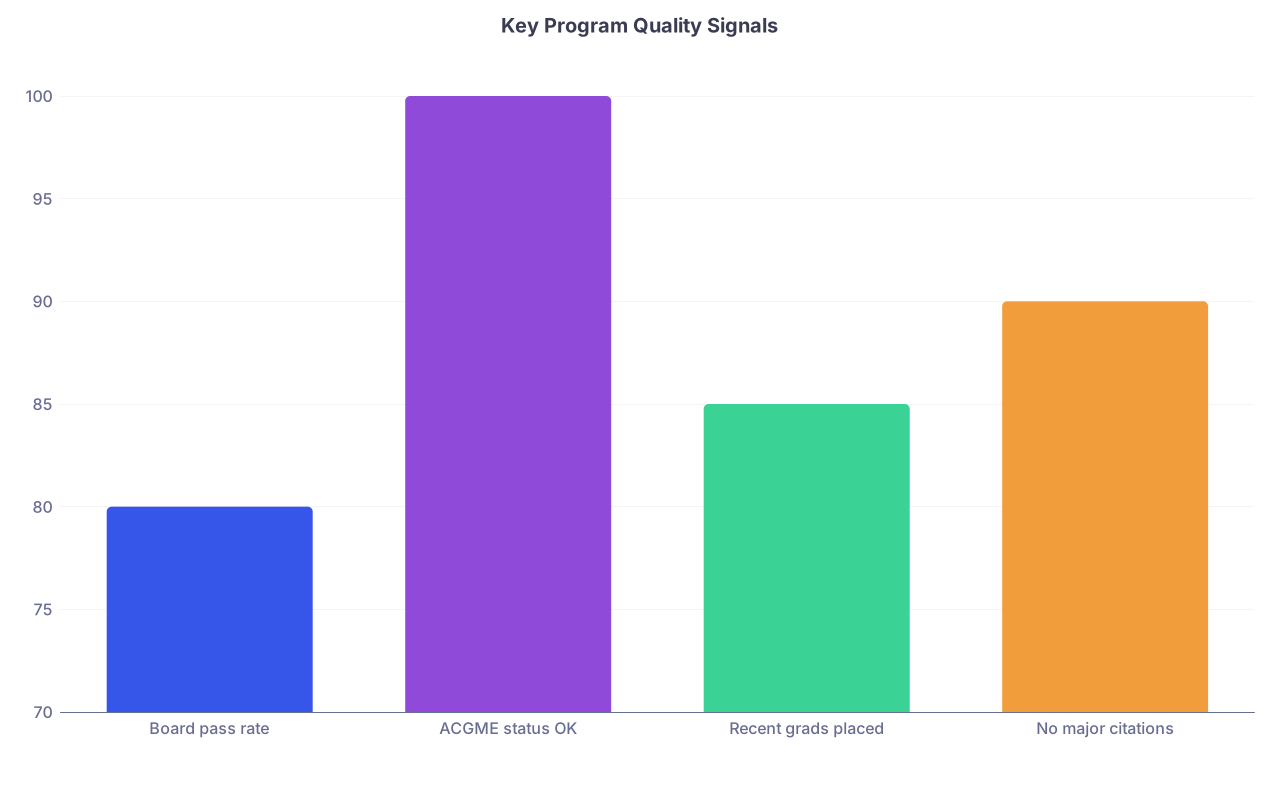
| Category | Value |
|---|---|
| Board pass rate | 80 |
| ACGME status OK | 100 |
| Recent grads placed | 85 |
| No major citations | 90 |
I do not care if the hospital looks shiny or the PD was charming on Zoom. Look at facts: board pass rates, prior ACGME citations, attrition, where graduates go.
If this program is somewhere in the “average but sane” range, it qualifies as acceptable.
Step 2: How likely is it you’ll get something as good or better in the Match?
Be cold:
- Last cycle interview count?
- Any red flags now disclosed in your file?
- New letters? Better clinical year? Or just the same application with new dates?
If, last year, you had:
- 0–3 interviews in that specialty
and - Nothing major has changed
Then the probability of “much better outcomes” this year isn’t magically high. In that scenario, a stable pre-match at a decent program is usually a yes.
If you had:
- 6–10 interviews
and - You recognized specific strategic mistakes (late apps, narrow list, weak personal statement, etc.)
and - You’ve corrected them
Then you can justify saying no to a mediocre pre-match if your risk profile is otherwise strong.
Step 3: What’s your floor?
This is the question people dodge:
“If I end up unmatched again, what’s my plan?”
Answers like “I’ll figure something out” are delusions, not plans.
If your realistic floor (not fantasy) is:
- Back to unpaid observerships
- Working as a medical assistant with no guarantee of interviews next year
- Visa time ticking down
- Family pressure burning through your mental health
Then your tolerance for risk is low. A decent pre-match becomes much closer to an automatic yes.
If your floor is:
- You can work as a hospitalist scribe, research fellow, or non-training clinical job
- You have stable visa or citizenship
- You have financial and emotional runway for another cycle
Then you can afford to be more selective. Not reckless. More selective.
5. How to respond to a pre-match offer without blowing it
Let’s say a PD or coordinator emails or calls:
“We’d like to offer you a pre-match position for PGY-1.”
Here’s what you do in the next 72 hours.
Step 1: Do not answer immediately on the call
You say something like:
“Thank you very much, I’m honored by the offer and very interested. I want to review the details carefully so I can commit thoughtfully. When would you need a final answer by?”
You’re aiming for 24–72 hours. Less is unusual; more than a week is unlikely.
This buys you time to:
- Read the contract.
- Call trusted mentors.
- Look up program data and scutwork reports.
Step 2: Get the details in writing
You ask:
“Could you please send the formal offer letter or contract so I can review it? I want to make sure I understand all the terms correctly.”
Red flag if they drag their feet or are vague. A real program with nothing to hide sends you a document.

| Step | Description |
|---|---|
| Step 1 | Receive pre-match offer |
| Step 2 | Express gratitude and interest |
| Step 3 | Ask for timeline |
| Step 4 | Request written offer |
| Step 5 | Review with mentor |
| Step 6 | Accept offer in writing |
| Step 7 | Decline respectfully |
| Step 8 | Program acceptable and risk high? |
Step 3: Quietly gut-check with people who actually know something
Not anonymous forums. People who:
- Have matched residents in that specialty
- Know US graduate/IMG dynamics
- Understand the specific program, if possible
Send a short, focused email:
“Dr. X, I wanted to update you and ask for quick guidance. I received a pre-match offer from [Program, Specialty]. As you know, I am a reapplicant after being unmatched last year. I have to give them an answer by [date]. Do you know anything about this program’s training environment and outcomes, and would you advise taking a solid pre-match in my position, or waiting for the Match? Any quick thoughts would be extremely helpful.”
Most decent mentors will at least reply with a gut opinion.
6. Common traps reapplicants fall into with pre-match offers
You’re vulnerable to some very predictable errors here. I’ve watched people repeat them like clockwork.
Trap 1: Overvaluing prestige after you already lost a year
You lost a year of training income and seniority already. Another year costs you ~1 attending year on the back end. That’s six figures.
Turning down a stable community IM or FM pre-match because you still dream of matching an academic name brand that showed no prior interest in you is not ambition. It’s denial.
Trap 2: Believing “If they want me now, I can always match somewhere better”
No. Some programs extend pre-match offers to not have to compete in the open field. They know that in a straight comparison with 200+ programs, they may not shine.
But here’s what nobody tells you: as a reapplicant, your application does not shine either. You and that program are each other’s “right now, this is who will say yes to me.”
Stability beats speculative upside.
Trap 3: Ghosting or stringing a program along
If you stall with obviously fake excuses or suddenly stop answering emails, you will get discussed. PDs know each other. Coordinators talk. You’re not invisible.
If you’re going to decline, do it cleanly and professionally. One paragraph, thankful, clear.
Trap 4: Ignoring personal-life constraints
Location, partner, kids, elder care, visa—these are not side quests. If a pre-match offer solves several of these (e.g., it’s in your partner’s city, has a J-1, and is relatively stable), that matters.
Write it down. Literally make columns: “Life stability” vs “Training prestige.” Do not pretend the first one is irrelevant.
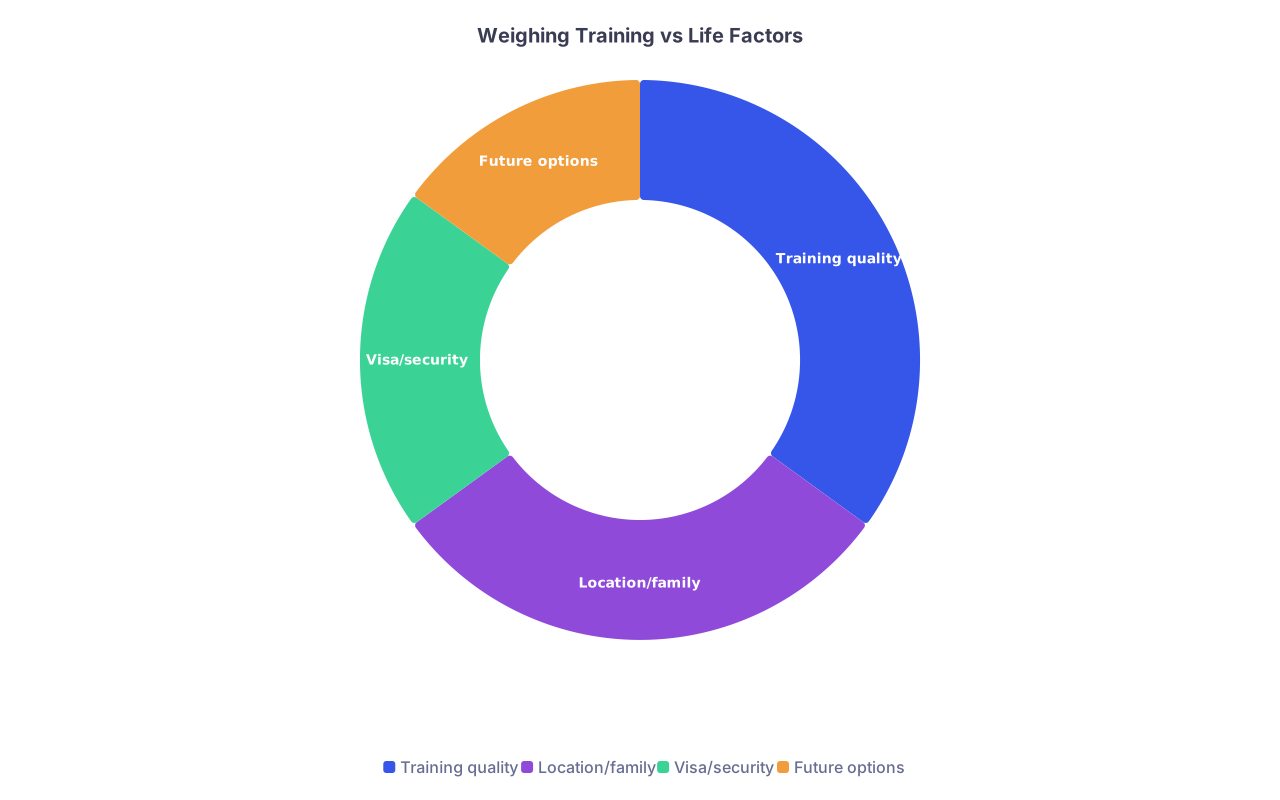
| Category | Value |
|---|---|
| Training quality | 35 |
| Location/family | 30 |
| Visa/security | 20 |
| Future options | 15 |
7. If you accept: how to lock it in without shooting yourself in the foot
So you decide: yes, this offer is good enough, and your risk profile says don’t gamble.
Confirm in writing, clearly
Something like:
“Dear Dr. [PD],
Thank you again for the opportunity. After reviewing the offer and giving it careful consideration, I’m very happy to accept the pre-match position in your [Specialty] residency program for the [year] start date. I’m excited to join your team and am committed to contributing fully to the program.
Best regards,
[Name]”
Sign whatever formal documents they require. Keep copies. Check what you’re supposed to do about NRMP (often you then withdraw).
Stop shopping.
You do not “accept” then keep interviewing hoping for an upgrade. Morally questionable, professionally stupid, and sometimes NRMP-violating.
If you’re in a situation where you have an accepted, binding offer and then suddenly a dream program appears with a late interview, you don’t just wing it. You talk to NRMP or a mentor who knows the rules. There are rare legitimate waiver situations, but they’re not DIY.
Use the months before start to make yourself a better intern
You will show up as “the reapplicant who finally matched.” Prove quickly that they made a good call.
- Do a strong clinical job or research related to your specialty.
- Fix any weakness that might have contributed to your original no-match (documentation, communication, etc.).
- Arrive on day one sharp, current, and humble.
8. If you decline: how to do it without burning bridges
If you’ve thought it through and decided not to take it, you still handle it like an adult.
Email:
“Dear Dr. [PD],
Thank you very much for the pre-match offer and for the confidence you’ve shown in me. I’ve given this serious thought. After considering my long-term goals and personal circumstances, I’ve decided to continue in the Match process this cycle and therefore must respectfully decline the pre-match offer.
I’m grateful for the opportunity to have interviewed with your program and for your consideration. I have a great deal of respect for your team and wish you and your residents all the best this year.
Sincerely,
[Name]”
No drama. No negotiation threats. No “I might reconsider if…” Unless they explicitly invite negotiation, you’re done.
Then you accept the risk. If March comes and you’re unmatched again, this was your call. Own it.
9. Special cases: visas, multiple offers, and sketchy vibes
Visa-dependent applicants
If you need a J-1 or H-1B and a legitimate program offers you a pre-match with a firm visa plan, your odds of doing better in the open Match are slimmer than many advisors admit.
In your shoes, I usually counsel: default to acceptance unless there is a clear, structural problem with the program.
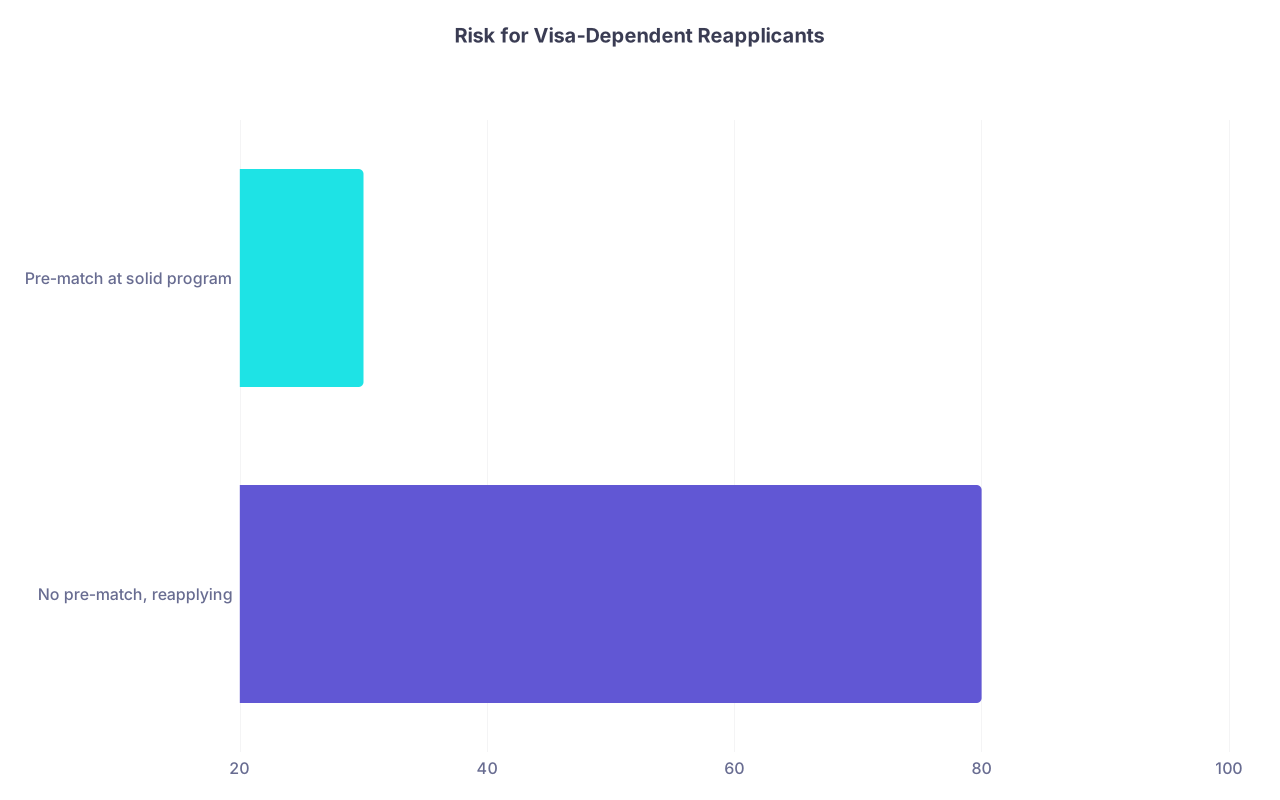
| Category | Value |
|---|---|
| No pre-match, reapplying | 80 |
| Pre-match at solid program | 30 |
Multiple pre-match offers
Rare, but it happens. If you somehow have 2–3 pre-match possibilities:
- Rank them yourself like a mini Match.
- Accept the top one as soon as it’s clear it’s real and in writing.
- Decline the others politely once you’ve committed.
Do not try to leverage offers against each other like you’re negotiating a sports contract. You’re not that valuable right now. Harsh, but true.
Sketchy program behavior
If, during this process, you see:
- Pressure to respond same-day with no contract.
- “We do not really have time to send you the formal terms, just trust us.”
- Residents telling you quietly, “Run. Do not come here.”
Then I don’t care how anxious you are—you get more cautious. A bad program is not always better than another unmatched cycle. Sometimes it’s just a different kind of trap.
10. The real question: Are you ready to trade possibility for certainty?
That’s the core of this situation.
As a reapplicant, a pre-match offer is basically asking:
“Will you give up the chance at something maybe better, to lock in something good enough right now?”
Some people should say yes. Others should say no. But you can’t dodge the trade-off.
If you’re reading this and currently staring at an email from a PD with an attached contract, here’s your move for today:
Open a blank page and write three headings:
- “What I gain if I accept this pre-match”
- “What I lose if I accept this pre-match”
- “What happens to my life if I go unmatched again”
Fill those in honestly. No fluff. Then, based on that list, set yourself a 48-hour deadline to give the program a clear, professional answer—yes or no.