
The worst decisions in residency season are made in the 24 hours after a surprise pre‑match offer.
You’re flattered, a little stunned, mildly panicked, and staring at a clock that suddenly feels way too loud. If you try to “wing it,” you’ll either lock yourself into the wrong program or let the right one slip away while you overthink.
Let’s not do that.
Here’s a structured, hour‑by‑hour guide for what to do from the moment that call or email hits, through the first 24 hours. At each point: what to ask, who to call, what to look up, and exactly what to decide and not decide yet.
First 10 Minutes: Do Not Commit. Get Control.
At this point you should not be deciding anything permanent.
You just:
- Got a phone call from the PD or APD
- Received an email titled “Pre‑Match Offer” or “Non‑Match Contract”
- Were pulled aside on interview day with, “We’re very interested in having you here…”
Your job in the first 10 minutes is simple: slow the process down.
Say something like:
- “Thank you so much, I’m honored. I take decisions like this seriously. Can I have until [tomorrow / 24 hours] to review the details and talk with my family/mentors?”
- “I really appreciate the offer. Could you please email me the specifics of the contract and timeline so I can look at it carefully?”
You must:
- Avoid saying “yes,” “absolutely,” or “I’d love to” in any binding way
- Ask directly: “Is this offer contingent on withdrawing from the Match?”
- Clarify the deadline: “By when do you need an answer?”
Then get off the call quickly and professionally. You’re not ready to negotiate or analyze yet. You’re buying time.
Hour 0–1: Capture Facts Before Feelings Take Over
At this point you should write everything down while it’s fresh.
Right after the call or email:
Document the basics
- Program name and location
- Person who made the offer (PD? APD? Chair?)
- Type of offer:
- Categorical vs. prelim vs. advanced
- How many years (3, 4, 5)
- Deadline they gave you for a decision
- Any odd phrasing: “strongly encouraged to accept,” “limited time,” “we usually expect a decision today”
Ask for written details if you don’t have them yet
- “Could you please send the offer details and any contract language by email?”
- You want:
- Salary
- Benefits
- Call schedule (or at least typical schedule)
- Start date
- Any penalties or conditions
Do a quick gut check and write it down
- 3 bullet points:
- Why you’re excited
- Why you’re hesitant
- What worries you
- 3 bullet points:
Not because you’ll decide emotionally. Because 10 hours from now, you’ll forget how strong your immediate gut reaction was.
Hour 1–3: Confirm It’s Legit and Understand the Rules
At this point you should verify what you’re actually being asked to do.
Step 1: Confirm the program and offer are real
Sounds silly, but I’ve seen:
- Offers from “affiliated” hospitals that weren’t ACGME accredited
- People misunderstand a “we’re ranking you highly” conversation as a pre‑match
Check:
- Is the program ACGME accredited for your specialty?
- Is this a real position in your specialty (not a random research or observer year)?
- Is this a direct “take it now and be done with the Match” offer vs. just strong verbal interest?
Step 2: Look up your specialty’s and region’s norms
Some specialties rarely do legitimate pre‑matches in the NRMP system. Others (especially where SOAP and off‑cycle hiring are common) do this more.
Quick tasks:
- Check your specialty organization’s guidance (e.g., internal medicine vs. neurology vs. prelim surgery can differ)
- Remember: If the program participates in NRMP, any requirement to sign and still submit a rank list is often a red flag. Either you’re in the Match or you’re not. Mixed signals are dangerous.
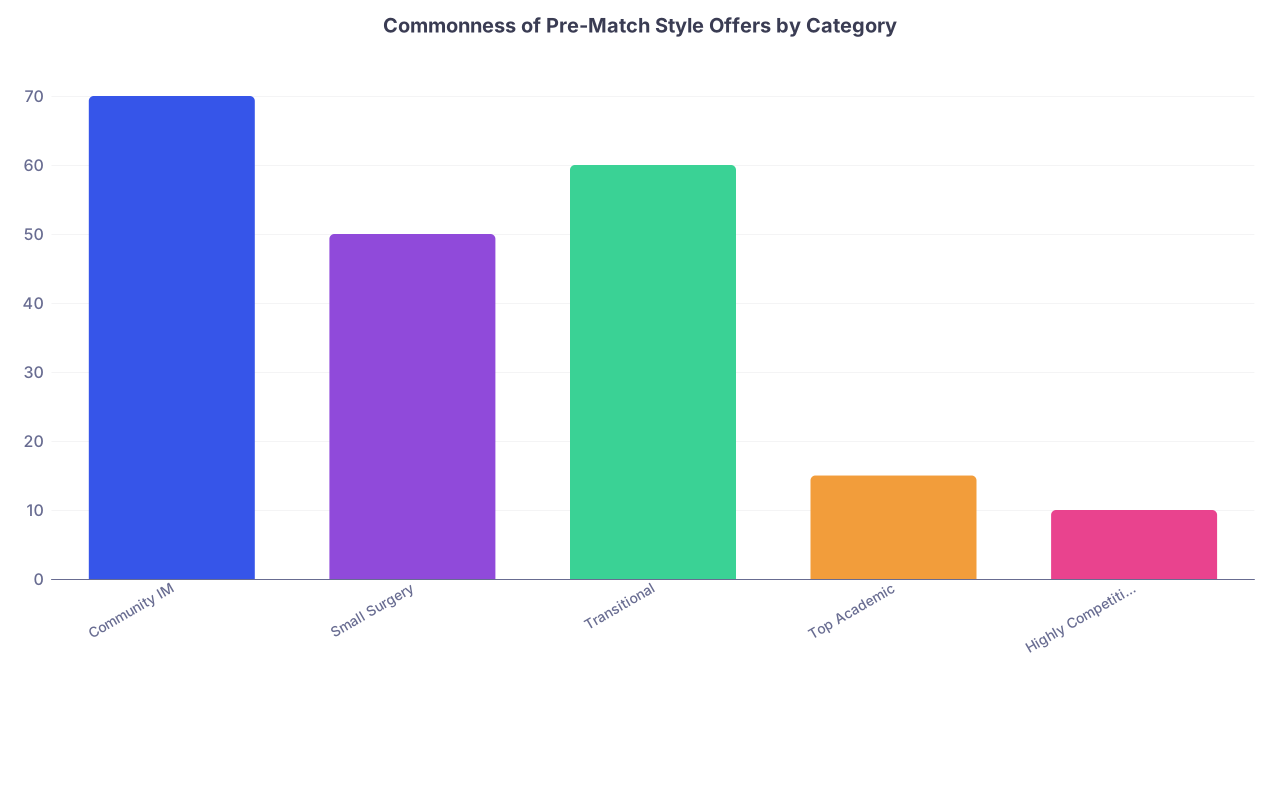
| Category | Value |
|---|---|
| Community IM | 70 |
| Small Surgery | 50 |
| Transitional | 60 |
| Top Academic | 15 |
| Highly Competitive Specialty | 10 |
Interpretation (rough, anecdotal, but honest): community internal medicine and smaller prelim programs are far more likely to throw early offers. Big‑name, hypercompetitive specialties? Rare.
Step 3: Re‑read any NRMP or match violation concerns
You don’t need to memorize the NRMP rulebook; just remember:
- Coercion, pressure, or threats tied to your rank list or match participation are not allowed
- You are allowed to ask for time
- You shouldn’t be forced to reveal your rank intentions for other programs
If something feels legally or ethically slimy, you’re probably right. Put a mental pin in that.
Hour 3–6: Build Your Comparison Baseline
At this point you should figure out what you’re actually comparing this offer against.
You can’t evaluate a pre‑match offer in a vacuum. You’re weighing it against:
- Your expected Match outcomes
- Your existing interviews and pending ones
- Your willingness to risk going unmatched vs. locking in something solid
Step 1: List your realistic alternatives
On a blank page, write:
- Number of interviews in this specialty
- Number of backup specialty interviews (if any)
- Where this program sits among them (top third / middle / bottom third)
For many applicants, the honest answer is:
- “I have 5–6 interviews in a moderately competitive specialty.”
- Or: “I’m at risk of not matching; this might be my safest option.”
If you don’t have many interviews and the program is decent, a pre‑match can be a lifeline. If you’re holding multiple strong interviews at academic powerhouses, the calculus changes.
Step 2: Objectively rate the program
Use a simple 1–5 scale for each category:
| Category | Rating 1–5 (5 = best) |
|---|---|
| Location / Family Fit | |
| Training Quality | |
| Fellowship / Career | |
| Culture / Wellness | |
| Gut Feeling |
Fill it out based on:
- Your interview day
- What residents told you on virtual or in‑person tours
- Your own priorities (family, geography, lifestyle, fellowship plans)
If you never interviewed there and this is a blind offer? That’s a big caution flag. You should be pushing for at least a virtual conversation with current residents before you commit.
Hour 6–12: Get Outside Eyes (Strategically)
At this point you should stop spinning in your own head and bring in 2–3 key people. Not 10.
You’re looking for:
- A specialty mentor (ideally in your field)
- Your home program director or advisor
- One person who knows your personal situation well (partner, close family member)
How to present it to them
Send a short, direct message:
“I received a surprise pre‑match offer from [Program, City]. They want an answer by [deadline]. I’ve attached what I know so far. I’d really value a quick 10–15 minute call to sense‑check whether this is something I should seriously consider vs. hold for the Match.”
Attach:
- Offer details (or your notes)
- Your quick program evaluation grid
- Your interview list snapshot (how many programs, where this program sits)
Then, on the call, ask very specific questions:
- “Would you be comfortable training here yourself?”
- “If you were me, with my application and interview list, would you take this?”
- “Does anything about this offer sound like a red flag to you?”
Listen for:
- Immediate “this is fine but not amazing” vs. “you’d be crazy to say no” vs. “this makes me nervous”
- Detailed reasons: culture issues, reputation, fellowship track record, known scut‑heavy programs
You are not asking for permission. You’re extracting high‑yield intel fast.
Hour 12–18: Stress-Test the Offer Against Your Future
At this point you should pressure‑test the decision from a 3–5 year perspective, not a 24‑hour panic.
Ask yourself:
If I woke up matched here on Match Day, would I feel relief, disappointment, or dread?
- Relief = strong argument to accept
- Disappointment but not dread = maybe still worth it if risk of not matching is real
- Dread = do not chain yourself there for 3+ years
Does this program realistically support my long‑term goals?
- Want a competitive fellowship (cards, GI, derm, ortho)? Check:
- Fellowship match list
- Research opportunities
- Regional reputation
- Want to return to a specific city/state eventually?
- Where are alumni practicing?
- Do they place graduates into that region?
- Want a competitive fellowship (cards, GI, derm, ortho)? Check:
Lifestyle and personal constraints
- Partner’s job situation
- Visa issues (for IMGs, sometimes the pre‑match is the only stable H‑1B/J‑1 path)
- Kids, caregiving responsibilities
This isn’t about perfection. It’s about whether this choice keeps doors open or slams them shut for what you know you want.
Hour 18–22: Clarify the Fine Print and Logistics
At this point you should squeeze out every last piece of concrete information before you call back.
If you haven’t already received written details, push again:
- “Before I commit, could I see the actual contract or at least a written summary of terms?”
Specifics to confirm:
- Salary and benefits
- Call schedule:
- “How many calls per month for PGY‑1?”
- “Is there night float vs. 24‑hour calls?”
- Support:
- “How many residents per year?”
- “How many full‑time faculty?”
- Known problem areas:
- Has there been recent loss of accreditation, major leadership turnover, or resident exodus?
If your gut is uneasy, ask to speak with one or two current residents:
- “Could I briefly talk to a current intern and a senior resident today to ask a few questions before I decide?”
- If they resist this strongly or gatekeep access to residents? That’s not a good sign.
Suggested quick resident questions:
- “What surprised you most after starting?”
- “Would you choose this program again?”
- “How responsive is leadership when problems come up?”
You’re not doing a full interview again. You’re sanity‑checking the sales pitch.
Hour 22–24: Make the Call (and Own It)
This is the decision window. At this point you should decide, call, and then stop reopening the question.
Path A: You Decide to Accept
You accept when:
- You’d be content, maybe even happy, to train there
- Your risk of not matching is non‑trivial
- The offer seems clean (no obvious NRMP violations, no bizarre pressure tactics)
- Your trusted mentors are at least neutral‑to‑positive on it
When you call:
Be clear and professional:
- “Thank you again for the offer. After thinking it through, I’d be happy to accept the pre‑match offer for [position] at [program].”
Confirm next steps:
- “What are the next steps on your end?”
- “When will I receive the official contract?”
- “Are there any match‑related forms or notifications I need to complete?”
Clarify your Match status:
- Often, accepting a pre‑match means:
- You do not enter the NRMP for that specialty, or
- You will withdraw from the Match once the contract is fully executed
- Make sure you understand which one it is and what you must do on ERAS/NRMP.
- Often, accepting a pre‑match means:
Then:
- Notify your advisor or home PD that you’ve accepted
- Withdraw pending interviews if appropriate, rather than ghosting
- Stop second‑guessing every alternative universe where you maybe matched somewhere else
You traded optionality for certainty. That’s not cowardice; that’s rational, especially in a tight market.
Path B: You Decide to Decline
You decline when:
- The program clearly sits at the bottom of your realistic options
- Red flags outweigh the relief of having something locked in
- Your mentors strongly advise against it in your specific situation
- You’re reasonably confident you’ll match at equal or better places
When you call:
Be respectful but firm:
- “Thank you again for the generous offer. After careful consideration, I’ve decided not to accept the pre‑match offer and will remain in the Match process.”
Do not over‑explain:
- You don’t need a 3‑paragraph justification
- Avoid criticizing the program
Accept that this may drop you on their rank list:
- That’s fine. You’re betting on a better match elsewhere.
Then:
- Let your advisor know you declined, and why
- Re‑commit to preparing for remaining interviews and ranking smartly
- Don’t torture yourself with, “What if I go unmatched now?” If your risk was very high, you probably should have accepted. If it was moderate/low and the program was wrong for you, this was a rational bet.
Path C: You Need a Tiny Bit More Time (Carefully)
If you truly need a few extra hours:
- “I appreciate your patience. I’m very close to a decision but would like to sleep on it and confirm in the morning by 9 AM. Is that acceptable?”
If they say no and demand a decision right now?
Major signal. Solid programs don’t need hostage tactics to recruit residents.
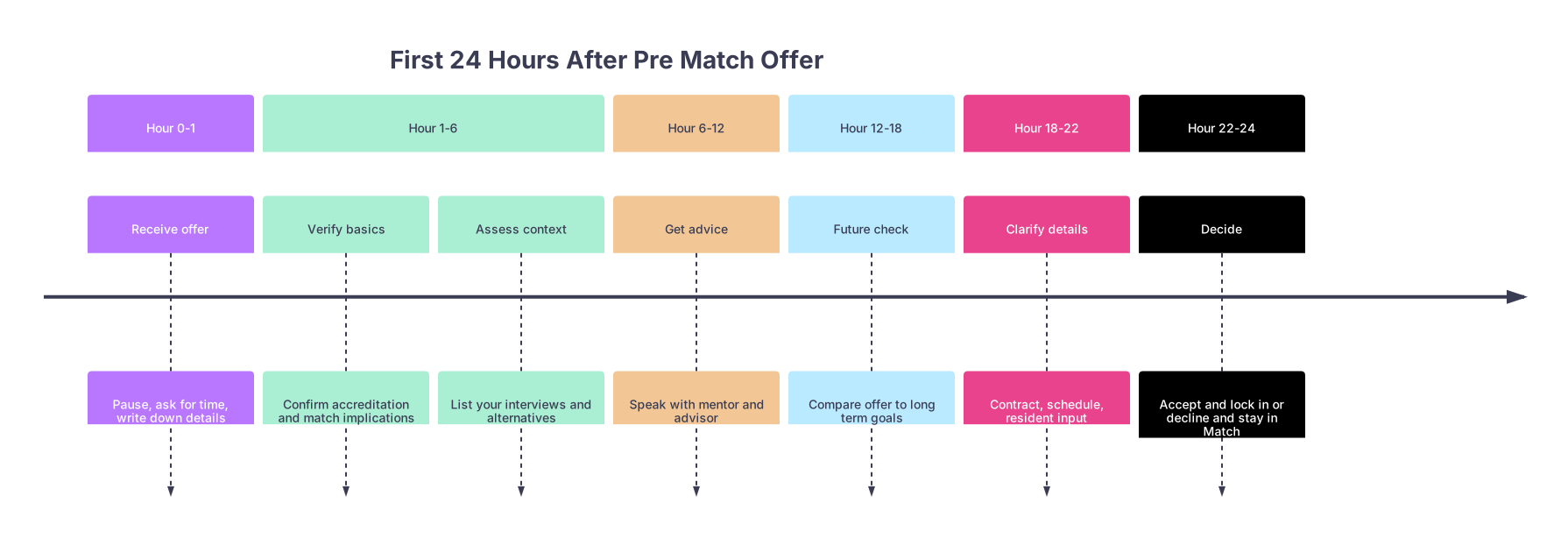
| Period | Event |
|---|---|
| Hour 0-1 - Receive offer | Pause, ask for time, write down details |
| Hour 1-6 - Verify basics | Confirm accreditation and match implications |
| Hour 1-6 - Assess context | List your interviews and alternatives |
| Hour 6-12 - Get advice | Speak with mentor and advisor |
| Hour 12-18 - Future check | Compare offer to long term goals |
| Hour 18-22 - Clarify details | Contract, schedule, resident input |
| Hour 22-24 - Decide | Accept and lock in or decline and stay in Match |
The One Thing You Can’t Do: Freeze
The only truly bad move in the first 24 hours is paralysis.
Programs that offer pre‑matches are often on a clock. If you disappear, they move on. If you answer in a panic, you lose leverage and clarity.
So, in order:
- Slow the conversation in the first 10 minutes
- Get facts and outside eyes in the next 12–18 hours
- Make a clear, owned decision by 24 hours and then commit to it
Those are the moves that separate the applicants who use pre‑match offers strategically from the ones who let surprise dictate their entire residency.