
The belief that you need totally different residency interview answers for every single program is wrong—and it’s burning people out.
You do not need 30+ unique versions of every answer. You need strong core answers that you lightly customize to each program. If you try to reinvent the wheel for every interview, your answers sound rehearsed, your brain fries by mid-season, and your personality disappears.
Let me walk you through what actually needs to change and what should stay the same.
The Short Answer: Same Skeleton, Different Clothing
Here’s the real structure of residency interview prep:
- 70–80% of your answer content: the same across all programs
- 20–30%: targeted, program-specific tweaks
You build a core script for the classic questions:
- “Tell me about yourself.”
- “Why this specialty?”
- “What are your strengths and weaknesses?”
- “Tell me about a time you had a conflict.”
- “Describe a clinical challenge and how you handled it.”
- “Tell me about a time you failed / made a mistake.”
Those do not need to be rewritten for every program. You might tweak a phrase or example, but the story stays.
Then there are program-facing questions that absolutely should change:
- “Why our program?”
- “Why this city/region?”
- “How do you see yourself fitting in here?”
- “What are you looking for in a residency program?”
These need clear, specific tailoring. If those sound generic, you’re toast.
So: you reuse your core stories, but you customize the framing and connection to each program.
What Should Stay the Same Across All Programs
Think of your main behavioral answers as your “greatest hits” album. You don’t rerecord the songs for every city on the tour. You just adjust your banter between songs.
Here’s what you keep consistent.
1. Your Personal Story
Your “Tell me about yourself” answer should be:
- A tight 60–90 second narrative
- Same chronology and themes everywhere
- Mildly tweaked for tone, not content
Example structure:
- Where you’re from / quick background
- A turning point or key influence that led you toward medicine
- Why you chose this specialty
- One or two defining strengths / interests you bring
You don’t need a “Surgery version,” “IM version,” “NYC version,” etc. The basic story doesn’t change. You might emphasize slightly different things depending on the program (research vs underserved care, for example), but you are the same person.
2. Your “Why This Specialty” Answer
This is your core professional identity. That doesn’t change between Program A and Program B.
Good “Why X” answers typically include:
- The type of problems you like solving (diagnostic puzzles, procedures, continuity, acute care)
- The type of patients you connect with most
- The work environment you enjoy (team-based ICU, longitudinal clinic, OR, etc.)
- How your strengths and values fit the specialty
None of that should flip flop between interviews. If you say you “must” have long-term continuity in one program and gush over trauma call in another, people notice.
What you can tweak:
- Which aspect you highlight more for certain programs
- How you connect your reasons to what the program offers (more on that later)
3. Your Key Stories (Behavioral Answers)
Those classic prompts:
- “Tell me about a conflict on a team.”
- “Tell me about a time you went above and beyond.”
- “Tell me about a mistake you made and what you learned.”
You should have 2–3 polished stories that you can flex into different questions by changing the framing.
For example, one ICU story might be used as:
- A conflict story (nurse vs intern disagreement)
- A leadership story (you coordinated the team)
- A resilience story (emotionally tough patient)
You don’t need “Program X conflict story” and “Program Y conflict story.” You just decide which story best fits the vibe of that program (academic, community, underserved, etc.) and adjust how you tell it.
4. Your Strengths, Weaknesses, and “Red Flag” Explanations
Your:
- Strengths
- Areas for growth
- Explanations for a leave of absence, Step failure, gap year, etc.
…should be consistent across all programs. People talk. Your ERAS, letters, and interviews collectively form a pattern. Don’t get cute and start customizing your “weakness” answer so much that your story changes from place to place.
You can choose different examples to illustrate the same weakness, but the core theme should match.
What Absolutely Must Be Different for Each Program
Now for the part you actually do need to customize.
If anything sounds “copy-paste-able” between programs in this section, you’re doing it wrong.
1. “Why Our Program?”
This is the big one. If a program director thinks you could’ve said your answer to their main competitor down the road, you’ve wasted the question.
You need to hit three buckets:
- Evidence you did your homework
- Clear match between their strengths and your goals
- Concrete details, not brochure fluff
Bad:
“I’m looking for strong clinical training, diverse pathology, and supportive faculty. Your program checks those boxes.”
That’s every program. On Earth.
Better:
“I’m looking for rigorous clinical training with early autonomy in a safety-net setting, and I see that in your county hospital rotations, especially the senior responsibility in the PGY-2 MICU months. The way your residents talked about learning to run codes by the end of second year is exactly the kind of growth curve I want.”
That answer can’t be reused easily at 20 places.
You should be able to name:
- Specific rotations or tracks (“I’m drawn to your HIV track,” “the rural continuity clinic,” “QI pathway”)
- Culture elements backed by examples (“residents repeatedly emphasized how attendings give real-time feedback,” “half-day didactics that are genuinely protected”)
- Actual people or projects (“I’m interested in Dr. X’s work on opioid use disorder in primary care,” “I loved hearing about your resident-led ultrasound curriculum”)
If you can’t name three concrete things about the program, you’re not prepared.
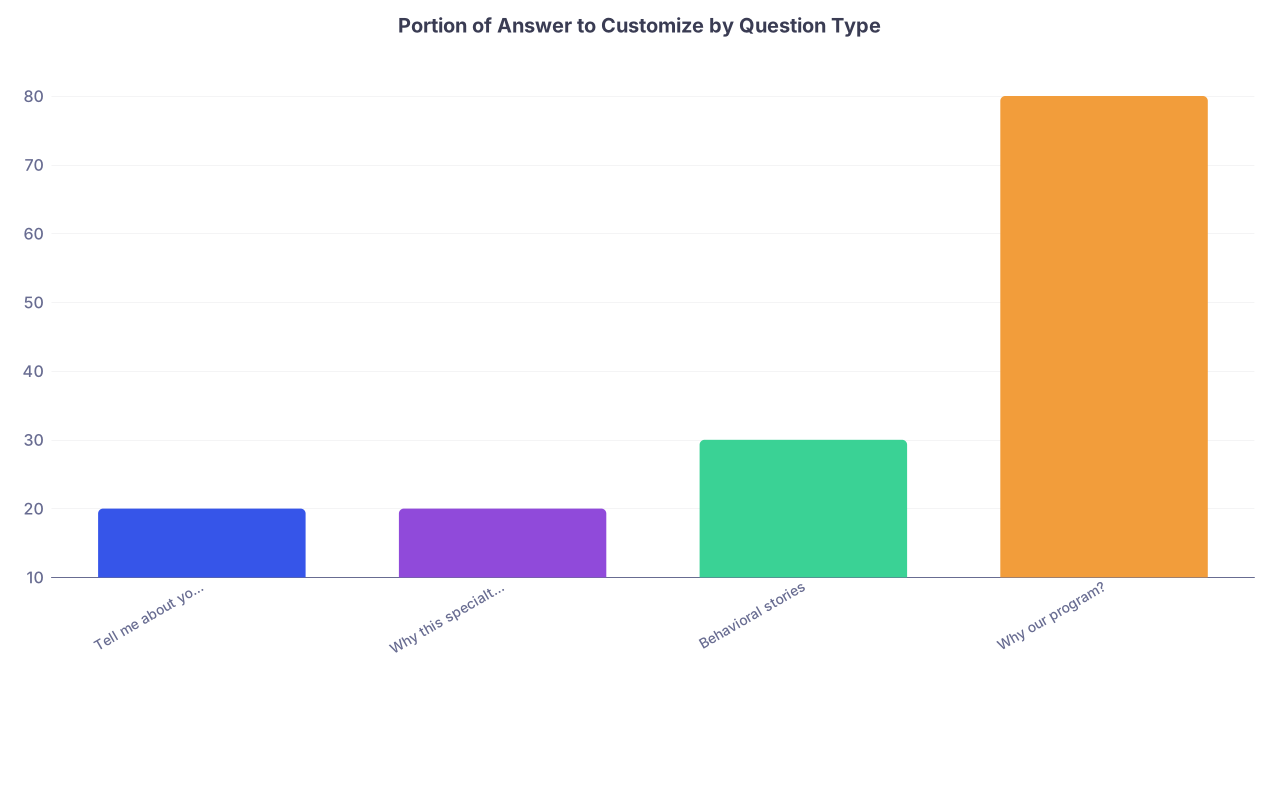
| Category | Value |
|---|---|
| Tell me about yourself | 20 |
| Why this specialty? | 20 |
| Behavioral stories | 30 |
| Why our program? | 80 |
2. “How Do You See Yourself Fitting In Here?”
Generic answers kill you here.
Wrong approach: describing a generic “supportive, diverse, academically rigorous” place. That’s the same garbage in everyone’s brochure.
Better angle: match your priorities to features they clearly have.
Example:
“I see myself fitting in as someone who values both academic rigor and a non-toxic culture. When I talked with your residents, they mentioned they still get home for dinner a few nights a week but don’t feel shortchanged on clinical exposure because of how high-volume the county hospital is. That aligns with how I want to train—work hard, but not in a way that burns out my interest in medicine by PGY-3.”
You’re still the same person. You’re just explaining why this environment is your right ecosystem.
3. “Why This City/Region?”
You don’t have to pretend you’ve dreamed of living in [Random Midwestern City] since childhood.
But you do need something more convincing than, “I’m open to exploring a new place.”
Tie it to:
- Family/social ties (partner, friends, family nearby)
- The type of community you want to serve (immigrant populations, rural, urban underserved)
- Lifestyle alignment (outdoors, cost of living, arts/music, sports)
- Your long-term plan (you can see yourself staying in the region)
You don’t rewrite your personality for each location; you just highlight the parts of your life that fit that place.
A Simple Framework: How to Prep Without Losing Your Mind
Here’s a structure that works and doesn’t make you hate your life.
Step 1: Build Your Core Answer Bank
Document—actually write out:
- 1 “Tell me about yourself” answer
- 1 “Why this specialty?”
- 3–5 behavioral stories that can flex into:
- Conflict
- Leadership
- Failure/mistake
- Ethical challenge
- Difficult team member
- 1–2 “strengths” answers
- 1–2 “weaknesses / growth areas” answers
- Explanations for any red flags
You should rehearse these enough that you can say them naturally. Not memorized word-for-word, but with a clear beginning–middle–end.
Step 2: Create a Program-Specific One-Pager
For each program, make a single page of notes:
- 3 specific program features that genuinely attract you
- 2–3 examples from conversations with residents/faculty
- 1–2 location-based reasons you’d be happy living there
- Any unique opportunities that match your experiences (e.g., “global health,” “addiction medicine,” “MedEd track”)
That page is your ammo for:
- “Why our program?”
- “Where else did you interview and how do we compare?” (yes, this happens)
- “What questions do you have for us?” (you should build questions off these specifics)
| Part of Interview | Standardized Core | Program-Specific Tweaks |
|---|---|---|
| Tell me about yourself | Yes | Minor emphasis tweaks |
| Why this specialty? | Yes | Tie to program features |
| Behavioral stories | Yes | Choose best-fit story |
| Strengths/weaknesses | Yes | Minimal tweaking |
| Why our program? | No | Heavily customized |
| Why this city/region? | No | Customized |
Step 3: Practice Switching “Layers”
When you practice, don’t just rehearse full answers. Practice adding the program layer on top.
Example drill:
- Say your generic “Why IM?” answer.
- Immediately follow with: “Now if I were at County Hospital X, I’d emphasize ___ and connect it to their ___.”
- Then: “If I were at Academic Center Y, I’d lean more on my research background and their physician-scientist track.”
You’re training yourself to reuse the core while flexing the framing.
How Much Customization Is Enough?
Here’s a decent rule of thumb:
If I hide the program’s name and I can’t tell who you’re talking about from your answer, it’s not customized enough.
Specific is:
- “Your X clinic at the VA where residents manage their own panel from PGY-2 onward”
- “Your 4+2 schedule that protects a real continuity clinic experience”
- “The resident-led QI curriculum where interns present at M&M”
Generic is:
- “Strong clinical exposure”
- “Diverse patient population”
- “Supportive environment”
- “Great teaching”
If your answer is made of brochure adjectives, it won’t land.
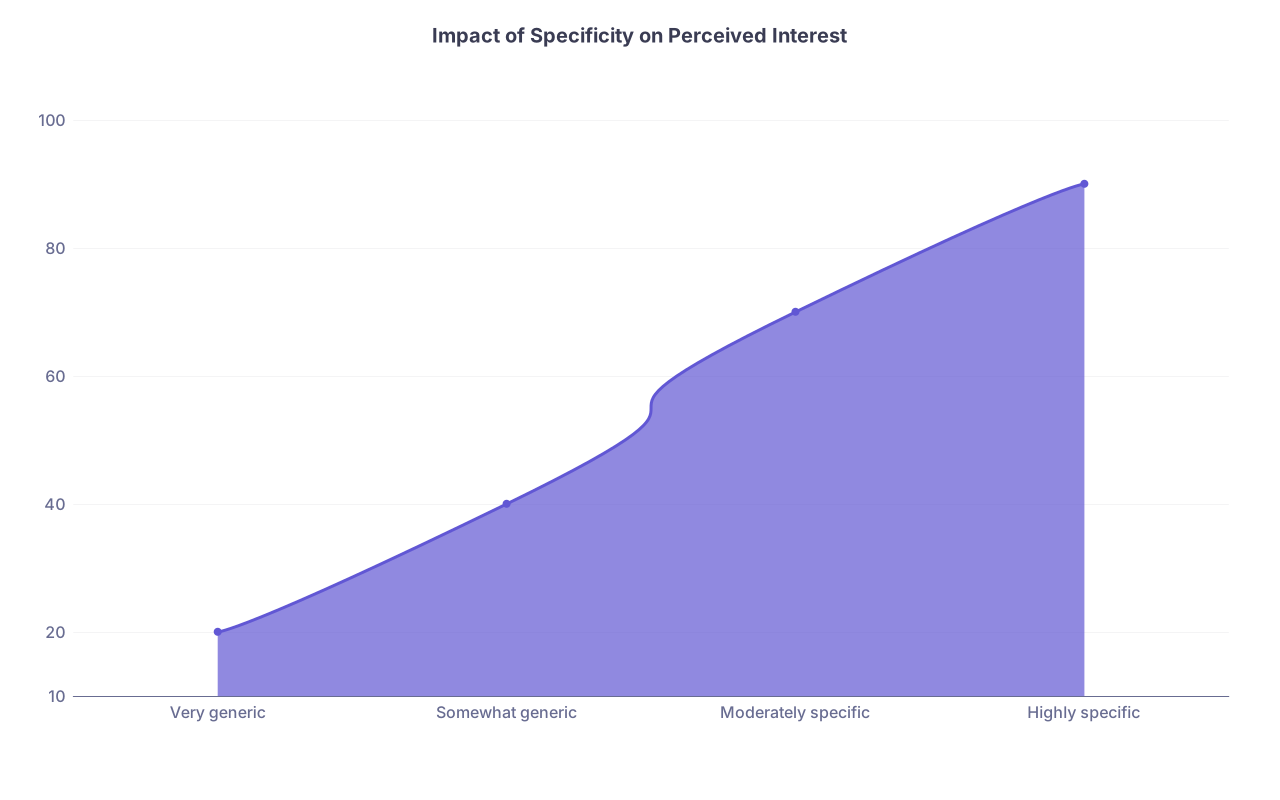
| Category | Value |
|---|---|
| Very generic | 20 |
| Somewhat generic | 40 |
| Moderately specific | 70 |
| Highly specific | 90 |
What About Multiple Specialties or Dual-Interest Applicants?
If you’re one of those people applying to, say, both IM and Anesthesia—yes, everything I just said still applies, but your core answers must be different by specialty.
Program directors do talk. And your file shows if you’re clearly hedging.
Within one specialty, however, you should look like the same person with the same reasons across programs. Your customization is about fit, not about changing your identity.
The Hidden Benefit of Reusing Core Answers
There’s another reason not to reinvent the wheel every time: your delivery.
When you repeat your core stories across interviews:
- They sound smoother and more confident.
- You stop burning cognitive energy on basic recall.
- You can actually listen and be present instead of panicking about “what to say next.”
That frees your brain to:
- Pick up on interviewer cues
- Ask better follow-up questions
- Adjust your tone to the room
That’s what separates a stiff, over-rehearsed candidate from someone who feels like a future colleague.

| Step | Description |
|---|---|
| Step 1 | List common questions |
| Step 2 | Write core answers |
| Step 3 | Develop 3-5 key stories |
| Step 4 | Create program one-pagers |
| Step 5 | Practice core answers |
| Step 6 | Layer in program-specific details |
| Step 7 | Mock interviews with feedback |
| Step 8 | Refine, not reinvent, before each interview |
Quick Reality Check: What Program Directors Actually Care About
Program leadership is not sitting there with a checklist saying, “Did this applicant say something unique to us in every single answer?”
They’re asking:
- Do you know who you are and why you’re in this specialty?
- Have you actually looked into our program, or are we just one of 50?
- Can you reflect, handle feedback, own mistakes?
- Would I trust you at 2 a.m. with my patients and my residents?
You don’t prove that by inventing 30 different personalities. You prove it with consistent core answers and smart, specific customization where it counts.
Bottom Line
Let’s keep this tight:
- You do not need totally different residency interview answers for each program. You need strong, reusable core answers and a smaller layer of program-specific customization.
- Standardize your personal story, specialty choice, and key behavioral stories. Customize heavily for “Why our program?” and “Why this city/region?” with specific, non-generic details.
- Build a core answer bank + program one-pagers, then practice layering the program details on top. That’s how you sound prepared, genuine, and consistent—without burning out halfway through interview season.