
Program directors are not confused about whether you’re interviewing elsewhere. They’re annoyed when you make them think about it.
Let me tell you what actually runs through a PD’s mind the second you start talking about “other programs” on interview day. It’s not what the generic advising office tells you. And yes, there is a right way and a very wrong way to bring up other places.
The One Thing You Need To Understand First
Every PD is running the same mental algorithm during your interview:
- Can this person do the work?
- Will they be a problem?
- Are we realistically going to match them?
When you mention other programs, you’re messing with bucket #3. You’re making them doubt whether a rank on you is “high yield.”
No PD consciously thinks, “They mentioned Hopkins, I’m offended.” That’s not how it works. The thought is closer to: “Ah. They’re probably not coming here. Next.”
They smile. They keep talking. You don’t see the switch flip. But it flips.
And you usually flipped it yourself with some clumsy sentence like, “Well at [other program] they do X…” or “I’m really interested in your program and a few others like [Big Name].”
That’s how people quietly tank an otherwise good interview. Not because they said they were applying broadly. Because they made the PD picture them in someone else’s call room.
The Silent Rules PDs Play By
Here’s the behind-the-scenes rule almost nobody tells you:
PDs expect you to interview elsewhere. They just do not want to be forced to emotionally process it while they’re deciding whether to burn a high rank on you.
When you walk into an interview day, the program already knows some or all of this:
- Your Step scores and class quartile
- Your med school name and region
- Whether you have a competitive profile for that specialty
They’ve already guessed what your interview slate probably looks like. They talk about it in the pre-brief.
I’ve watched this happen in multiple programs:
“This guy’s from UCSF, AOA, 260s, tons of pubs. He’s got all the big names. Assume we’re a backup unless he convinces us otherwise.”
When someone like that starts casually talking about other big-name programs out loud, it doesn’t “prove they’re competitive.” It just confirms the PD’s suspicion: you’re shopping. You’re not choosing.
That matters. Because once you’re mentally filed as “unlikely to rank us high,” your interview gets graded through a different lens. Not consciously malicious. Just human psychology and time triage.
When Bringing Up Other Programs Helps You (Rare, But Real)
There are a few, very specific scenarios where referencing other programs actually helps you. But you have to understand why it works in those cases.
Think of it like this: you can talk about other programs only when it reinforces either your fit or your story—not your status.
Scenario 1: Geographic Commitment
Example of what works:
“I’ve spent my whole academic life in the Midwest. Most of my interviews are here — places like [other regional program] and [another regional program] — because my long-term goal is to build my career in this region. Your program really stands out to me because of the community ties and the patient population you serve.”
What the PD actually hears:
- “They’re geographically anchored here.”
- “Their list is regional, not coast-to-coast trophy hunting.”
- “If we rank them decently, we might actually get them.”
Notice what you did not do. You didn’t brag. You didn’t instantly jump to brand names. You made it about region and long-term fit.
Scenario 2: Thematic Fit (If You’re Surgical About It)
Another acceptable move is to reference a pattern in your interviews that reinforces what you want:
“I’ve focused most of my interviews on programs with strong [X: e.g., county hospital exposure, global health, medical education tracks]. For example, [Program A] has a big county hospital, and [Program B] has a large underserved primary care clinic. What draws me here is that you combine that safety-net mission with very strong subspecialty exposure.”
What a PD hears:
- “This person is actually intentional.”
- “They’re not blindly chasing prestige; they’re chasing a training style.”
- “We fit that pattern. We’re in the running.”
Again, you’re not using other programs as comparisons to criticize or pressure. You’re using them to define a category you clearly want—and that they clearly fit.
Scenario 3: Explaining a Couple of Weird Choices
Sometimes your interview list looks scattered. You might have 2 in the South, 1 West Coast, 4 Midwest, plus your home region. If asked, you can occasionally contextualize:
“I have a couple of interviews outside my usual region because of family ties, but my core focus is [region]. Most of my interviews, including yours, are in that area because that’s where I see myself long-term.”
That’s fine. You’re not name-dropping. You’re pattern-dropping.
When Bringing Up Other Programs Hurts You (Most of the Time)
Now the ugly truth. Here’s what programs actually think in the most common situations where applicants bring up other places.
Mistake 1: Comparing Programs Like You’re Doing a Yelp Review
The worst variant:
“At [Other Program], the residents said they never have to stay past noon on post-call days. How does your program compare?”
You think you’re asking a smart, data-driven question. You’re not. You’re signaling that you will be the resident who constantly says, “Well at [Other Hospital] we used…”
Faculty hate that energy.
What the PD thinks:
- “This person is already mentally benchmarking us against somewhere else.”
- “They’re going to be high maintenance about schedule and workflow.”
- “Pass.”
If you want to ask about schedules or culture, just ask about this program. You don’t need to drag another program into the room to do it.
Mistake 2: Flexing Your Interview List
The subtle flex:
“I’ve been fortunate to interview at a lot of strong places—[drops several Top 10 names].”
You think you’re signaling that you’re a desirable candidate. PDs already know if you’re desirable. They saw your scores and letters before they invited you.
What actually happens in their head:
- “We were right. This person has all the big names.”
- “We’re probably lower on their rank list.”
- “We should not burn a top-10 rank spot on them unless they blow us away.”
And once you’ve triggered that “we’re their safety” narrative, you’re playing uphill the rest of the day.
Mistake 3: Using Other Programs To Negotiate or Guilt-Trip
I’ve seen this happen and watched the room go cold:
“Well, [Nearby Big Name] is offering a lot of support for research time. I was wondering what your program can do to stay competitive with that.”
This is amateur-hour behavior. You’re not negotiating a contract. You’re not the only applicant they can rank.
What the PD hears:
- “They see themselves above us.”
- “They’re already calculating leverage.”
- “They’re going to be a headache when it comes to schedule trades, vacation, everything.”
No one says this out loud to you, of course. They nod, they give some generic answer, then your score sheet quietly takes a hit.
Mistake 4: Bashing Other Programs
You’d think people wouldn’t do this. They do:
“I didn’t really click with [Other Program]. The residents there seemed burned out and the faculty were kind of standoffish.”
Here’s the part you forget: faculty all trained with each other. They’ve been on committees together. They know people at that other program.
When you trash talk another place, they don’t think, “Ah, so we’re better.” They think, “This person gossips. This person complains. This person will say this about us next year.”
They also wonder whether the problem was actually you.
What PDs Actually Want To Hear Instead
PDs are trying to answer one question above all: “Can I picture this person here, happy, doing the work, not leaving?”
So language that frames your presence as a genuine, realistic choice for you is pure gold.
Reframe 1: “I’m Interviewing Broadly, But This Is What Draws Me Here”
This is the line that calms them down and keeps them interested. For example:
“I’m interviewing broadly within [region/area], but what’s really stood out to me about your program is [specific, real thing: your VA exposure, your high-volume trauma, your strong mentorship in X].”
You’ve acknowledged reality—you are interviewing elsewhere—without dragging specific names into the conversation or hinting at your internal rank list.
Reframe 2: “My Priorities Are X, Y, Z—Here’s How You Fit Them”
When PDs hear clear priorities, they can file you under “real fit” instead of “rank tourist.”
“The main things I’m looking for are strong clinical training, early autonomy, and a program where residents actually seem to like one another. From talking to your residents and seeing morning report, I really feel that here.”
Compare that to, “I’m trying to decide between here and [Top 5 name].” One keeps you in play. The other moves you to the “unlikely get” bucket.
Reframe 3: “I Could Genuinely See Myself Here Because…”
You’d be surprised how rarely people say this out loud in a convincing way. When someone looks a PD in the eye and says:
“I could really see myself training here. The residents I’ve met feel like the kind of colleagues I want for the next three years.”
That sticks. Especially if your body language matches. Especially if it comes after you’ve asked smart questions about them instead of interrogating them against your invisible comparison chart.
What Happens Behind Closed Doors After You Leave
This is the part nobody shows you: the rank meeting.
The day ends, faculty return to a conference room, and they go down the list. Every program does some version of this.
Let me paint you a real composite scene.
They get to your name.
- Faculty A: “Good clinical background. Quiet but solid. I liked them.”
- Faculty B: “Yeah, but they were talking a lot about [Other Big Program]. I got the sense we’re second tier for them.”
- Chief: “Residents said they kept comparing us to other places, asking how our schedule stacks up. They seemed fine, but not excited about us.”
What happens next? You don’t get tanked. You just get demoted.
From “rank this person aggressively” to “rank them but don’t reach.” That’s the death zone. Because you’re now sitting exactly where dozens of other reasonable applicants are. And if your name is in that mushy middle, match outcomes become unpredictable.
Now imagine the alternative:
- Faculty A: “Strong applicant. Said they were focusing on Midwest programs because of family and actually singled out our county hospital as a big draw.”
- Faculty B: “Yeah, I wrote that they ‘seemed genuinely excited about us.’ Good questions about our ICU training. I’d be happy to work with them.”
- Chief: “Residents liked them. Asked how they could get involved in QI here specifically. Said they could see themselves here.”
That’s the language that moves you up the board.
Not your Step score. Not that you interviewed at MGH too. The perception that you might actually choose them.
How To Answer The Dreaded “Where Else Are You Interviewing?” Question
Sometimes you get ambushed. A faculty member, often a little too casual, asks:
“So, where else are you interviewing?”
You feel trapped. You don’t want to lie. You also don’t want to list every prestige name and light yourself on fire.
Here’s how experienced applicants handle this.
Strategy 1: Answer by Category, Not by Brand
“Mostly in this region—so a mix of large academic centers and a couple of strong community-based programs. I’ve tried to focus on places with high clinical volume and good exposure to [your interest].”
You answered the question. You didn’t give them a rank list.
If they push: “Which ones?”
You don’t fold and start flexing. You pivot:
“A handful in [region], a couple near where my family lives, but I’m really trying to stay somewhere like this—mid-sized city, diverse patients, strong teaching culture. That’s what’s most important to me.”
You’ve subtly told them: “You are my type.” That matters.
Strategy 2: Limited, Lateral Name-Drop (When It Helps)
If you sense they’re genuinely asking to understand your pattern, you can name-drop carefully, and usually laterally, not upward:
“A few similar programs—[nearby similar-tier program], [another with shared features]—all places where I felt I’d get very strong clinical training. What’s stood out here is [specific positive about them].”
Key move: you immediately pivot from others to their differentiator. You never end the answer on another program’s name.
Strategy 3: If You Have a Truly Top-Heavy List
If you’re one of those people with a murderers’ row of interviews, resist the itch to show it off. Assume they can already guess.
You can frame it like this:
“I’m very grateful to have a range of interviews, but my focus is on finding a place where I’ll be pushed clinically and supported personally. From what I’ve seen so far today, this program definitely fits that.”
You sound grounded. Not cocky. Not needy. Just intentional.
The Resident Perspective: Why They React So Strongly
One more thing you should understand. Residents in your interviews are not neutral observers. They’re protective.
They see you talking about other programs and they think:
- “Why am I investing my energy selling this place to someone who’s already halfway out the door?”
- “We have limited spots. I’d rather they go to somebody who actually wants to be here.”
Their feedback to the PD carries more weight than you think. When chiefs and senior residents say, “They seemed lukewarm about us” or “They kept asking how we compare to other places,” that can sink an otherwise solid file.
What impresses residents is simple:
- You pay attention to what they say about their program.
- You ask curious, concrete questions about their day-to-day, not their ranking strategy.
- You don’t make them feel like you’re using their program as a measuring stick.
You’d be amazed how many residents write, “Would be happy to work with them,” purely because the applicant acted like they could actually picture themselves in that workroom.
Concrete Phrases You Should Use (And Avoid)
Let me make this painfully clear.
Things that quietly hurt you:
- “I’m trying to decide between here and [Top Program].”
- “At [Other Program] they do it this way—how do you compare?”
- “I’ve been lucky to interview at some really big-name places like [X, Y, Z].”
Things that quietly help you:
- “I’m interviewing broadly, but I’m particularly excited about programs with [specific feature], and I’ve really seen that here.”
- “What stood out to me here, compared to other places I’ve seen, is [something concrete and positive about them].”
- “I could honestly see myself fitting in really well with your residents.”
Notice the difference. One set is about your status. The other set is about your fit.
PDs don’t care about your status. They already know it. They care whether ranking you is going to give them a resident who will actually show up in July and not bolt in January.
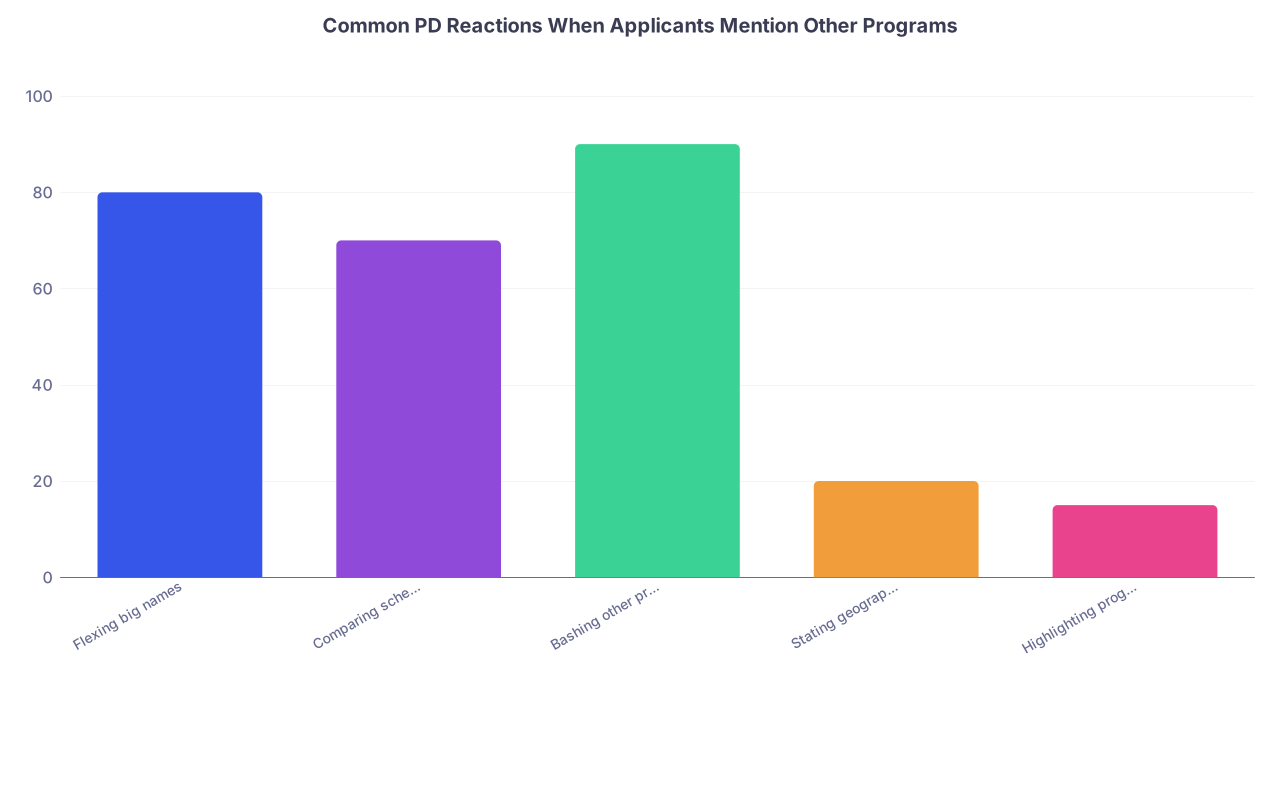
| Category | Value |
|---|---|
| Flexing big names | 80 |
| Comparing schedules | 70 |
| Bashing other programs | 90 |
| Stating geographic focus | 20 |
| Highlighting program fit | 15 |

| Step | Description |
|---|---|
| Step 1 | You mention other programs |
| Step 2 | PD thinks you wont rank them highly |
| Step 3 | PD worries youre difficult |
| Step 4 | PD sees intentional fit |
| Step 5 | Ranked cautiously or dropped |
| Step 6 | Ranked more aggressively |
| Step 7 | How you mention them? |

| Situation | Bad Approach | Better Approach |
|---|---|---|
| Asked where else you’re interviewing | Listing big names proudly | Describing regions and program types |
| Asking about schedules or workload | Comparing to specific other programs | Asking directly about this program’s workflow |
| Explaining your priorities | Saying you’re choosing between them and a top-5 name | Framing your thematic/geographic focus and how they fit |
| Talking about a negative visit | Criticizing another program outright | Focusing on what you’re looking for, not what you disliked elsewhere |