
The usual advice about “Tell me about yourself” is vague—and that’s why people blow it.
You’re not writing a memoir. You’re answering a 60–90 second test of judgment, clarity, and self-awareness.
Let me be blunt: if your “Tell me about yourself” answer is over 2 minutes, you’re hurting yourself. Under 45 seconds, you’re probably selling yourself short.
Here’s the answer you’re looking for:
Ideal length for residency interviews: 60–90 seconds. Absolute max: 2 minutes.
Everything else in this article is about how to actually hit that target without sounding robotic or empty.
The Real Purpose Of “Tell Me About Yourself” (And Why Length Matters)
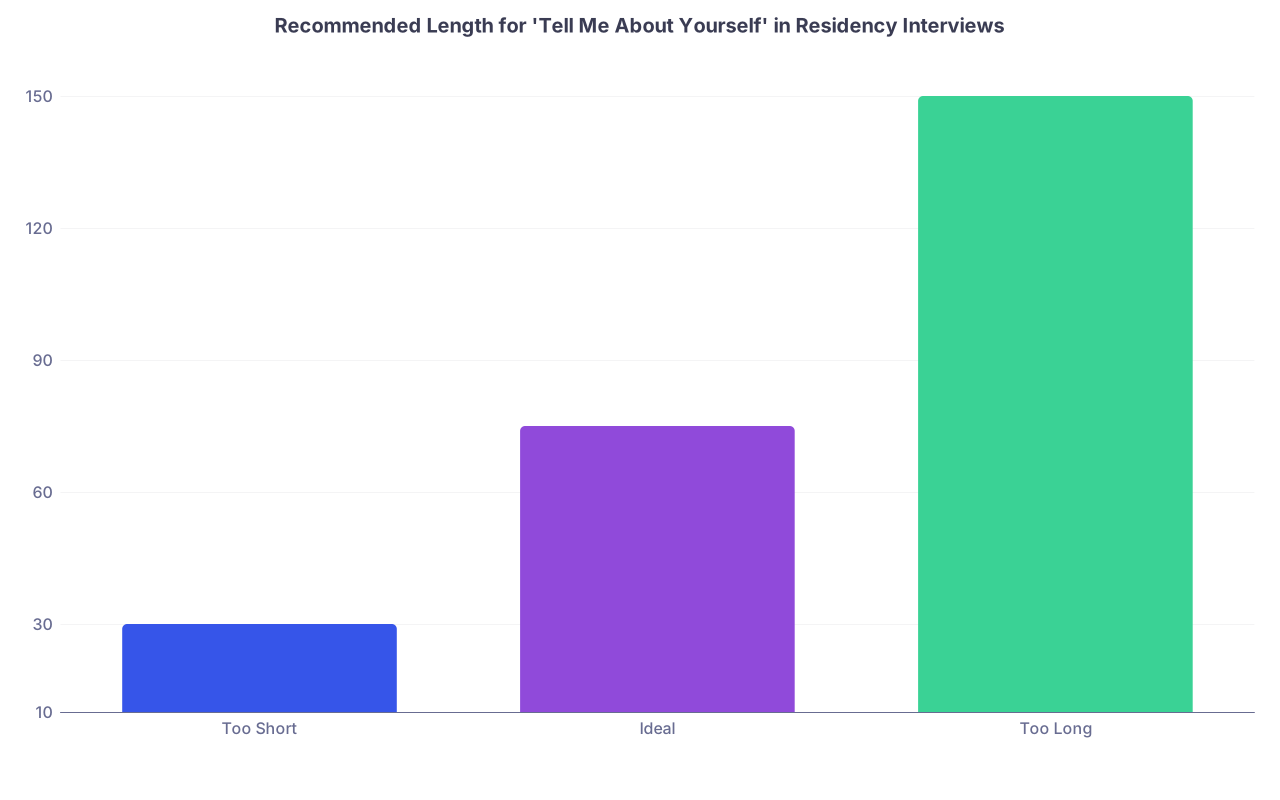
| Category | Value |
|---|---|
| Too Short | 30 |
| Ideal | 75 |
| Too Long | 150 |
You think this question is about your story. The program thinks it’s about three things:
- Can you organize your thoughts under pressure?
- Do you understand what’s actually relevant for residency?
- Are you someone they’d want to talk to for 30 more minutes?
Your length is a signal:
- 30–45 seconds: Feels thin, underdeveloped, or like you didn’t prepare.
- 60–90 seconds: Confident, focused, hits key points, shows respect for time.
- 90–120 seconds: Acceptable if it’s tight and engaging.
- Over 2 minutes: Feels rambling; many interviewers mentally check out.
Most faculty won’t time you with a stopwatch, but they absolutely feel when someone is droning on vs. when someone is crisp.
The Goldilocks Zone: 60–90 Seconds, Built Like This
Here’s the simple structure that works across specialties:
1. Now – Who you are as a near-resident (20–30 sec)
Current year, med school, intended specialty, and 1–2 defining themes.
2. Back – The brief origin story (20–30 sec)
How you got here: a quick thread from earlier experiences to this specialty.
3. Forward – What you want next (20–30 sec)
What you’re looking for in training and what you’ll bring to their program.
That’s it. Three parts. No life story. No five-minute recitation of your CV.
Example for Internal Medicine (about 75 seconds when spoken):
“I’m a fourth-year at Ohio State, applying in Internal Medicine with a strong interest in cardiology and medical education. Throughout med school I’ve gravitated toward complex, multi-morbidity patients and really enjoyed being the person who keeps the team organized and the plan clear.
I grew up in a small town where my grandmother saw the same internist for 20 years, and I think that’s where my bias toward continuity and long-term problem solving comes from. In college I studied bioengineering, which is probably why I still enjoy the analytical side of medicine and data-driven decision making.
Going into residency, I’m looking for strong training in inpatient medicine with early autonomy, good mentorship in cardiology, and a culture where residents actually enjoy working together. In return, I bring a solid work ethic, a track record of teaching junior learners, and someone who stays pretty calm when the list is long and the night is busy.”
Notice what’s not there: MCAT scores, high school, childhood illnesses, random hobbies wedged in awkwardly.
How To Hit The Right Length (Without Sounding Scripted)
Here’s how you keep this in the 60–90 second window without sounding like you memorized a monologue.
Step 1: Write it out once. Then cut.
Write the full answer first. It’ll probably be 2–3 minutes. Fine.
Then:
- Cut every sentence that duplicates something in your ERAS that isn’t core to your story.
- Kill phrases like “ever since I was a child” and “I’ve always wanted to be a doctor.” Interviewers have heard this 200 times.
- Merge details. Instead of listing every research project, say “I’ve focused my research on quality improvement in inpatient care.”
Your target on paper: 130–170 words. Spoken at a normal pace, that’s ~60–90 seconds.
| Word Count | Approx. Time |
|---|---|
| 80–100 | 30–45 sec |
| 120–170 | 60–90 sec |
| 180–230 | 90–120 sec |
| 250+ | 2+ min |
Step 2: Read it out loud with a timer
Don’t guess.
Use your phone stopwatch. Read it exactly how you’d actually speak—natural pauses, not auctioneer speed.
- If it’s under 50 seconds: you probably cut too much. Add 1–2 concrete details that show who you are.
- If it’s over 90 seconds: you’re stuffing in too much CV.
Step 3: Convert the script into talking points
You don’t take the script into the interview. You take a skeleton:
- One phrase for “Now”
- One phrase for “Back”
- One phrase for “Forward”
Example:
- Now: “M4 at OSU, IM, cards + med-ed, complex inpatients”
- Back: “Small town / continuity influence, bioengineering / data-driven”
- Forward: “Inpatient focus, early autonomy, team culture, I bring X/Y/Z”
You practice speaking from that outline until it feels automatic but not robotic.
Specialty-Specific Tweaks (Length Stays The Same)
The length doesn’t change by specialty. The content emphasis does.
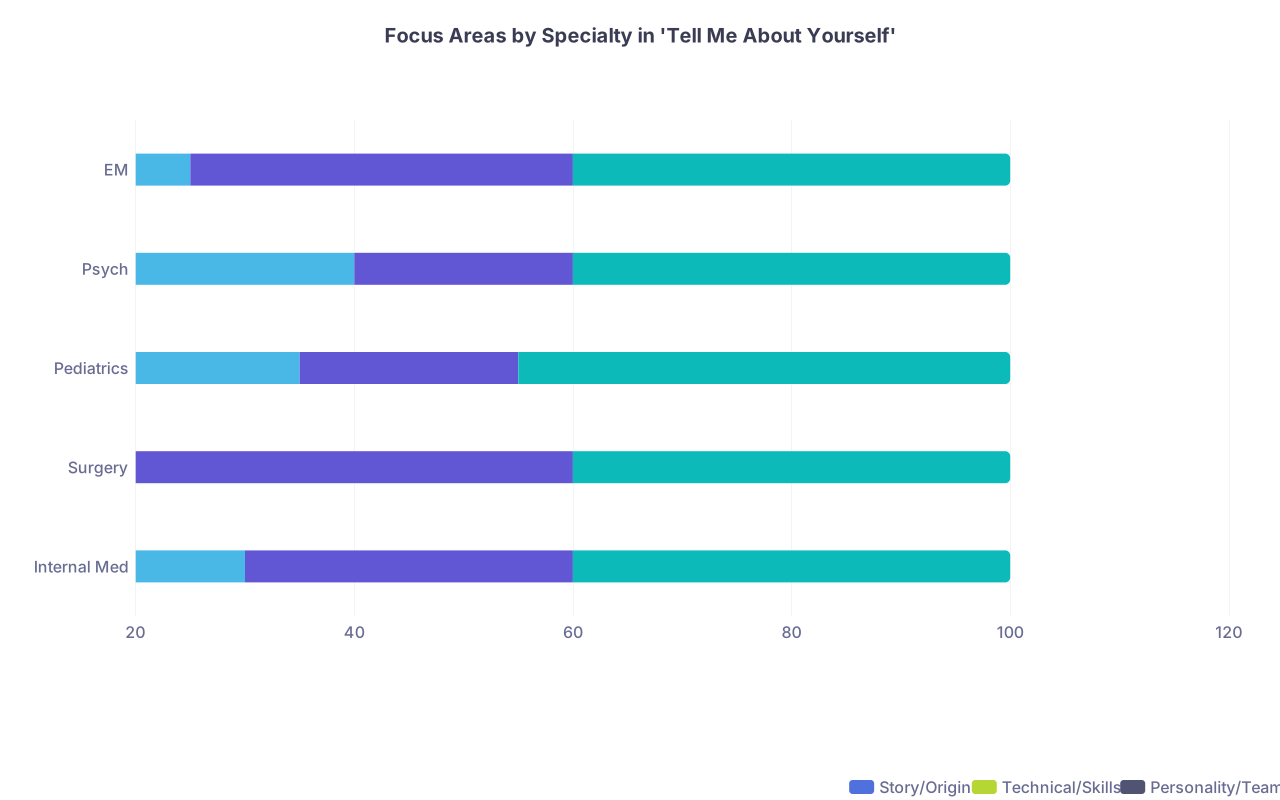
| Category | Story/Origin | Technical/Skills | Personality/Team |
|---|---|---|---|
| Internal Med | 30 | 30 | 40 |
| Surgery | 20 | 40 | 40 |
| Pediatrics | 35 | 20 | 45 |
| Psych | 40 | 20 | 40 |
| EM | 25 | 35 | 40 |
Keep your answer in that 60–90 second window, but skew what you highlight:
Surgery: Show you can handle intensity, precision, and long-term commitment.
“I’m the person who’s in the OR early, stays late for closure, and actually enjoys the repetition it takes to get technically better.”
Pediatrics: Emphasize communication, patience, working with families, child-centered thinking.
“I love meeting kids on their level and explaining things to parents in plain language without being condescending.”
Psychiatry: Insight, listening, interest in narratives and systems.
“I’m the person classmates came to with their problems—and I liked helping them sort chaos into something manageable.”
Emergency Medicine: Comfort with uncertainty, fast decisions, teamwork.
“I enjoy sorting through undifferentiated problems and coordinating a team under time pressure.”
Internal Medicine: Complex problem-solving, longitudinal care, systems thinking.
You don’t have to say all of that. But pick 1–2 sentences that quietly scream, “I fit your world.”
Common Length Mistakes (And How To Fix Them)
I’ve heard hundreds of practice answers. The same problems repeat.
Problem 1: The 4–Minute Autobiography
Symptom: You start in childhood, include your parents’ jobs, college clubs, and every research project.
Fix:
- Hard rule: No pre-college content unless it’s truly pivotal and you can say it in one line.
- Max 1 sentence on “why medicine” if at all. That ship has sailed—you’re already here.
Bad:
“I was born in a small town, the oldest of three. My dad was a mechanic and my mom was a nurse, and from an early age I saw the impact of healthcare…”
Better:
“I grew up in a small town where one internist basically cared for my whole family, and that’s where my bias toward continuity comes from.”
Problem 2: The CV Recitation
Symptom: You basically read your ERAS aloud: “Then I did research with Dr. X… then I volunteered at…”
Fix:
- Assume they’ve skimmed your application.
- Reference themes, not line items.
Bad:
“I did research in cardiology, presented a poster at ACC, and also did research in heart failure…”
Better:
“My research has focused on quality improvement in heart failure care, which reinforced how system changes can move the needle more than individual heroics.”
Problem 3: The 20-Second Vague Answer
Symptom: You’re so afraid of rambling that you say nothing.
“I’m a fourth-year at X, interested in Y, and I like to work hard and be part of a team.”
Fix:
- Add one concrete detail each to “back” and “forward.”
- Use 1 sentence that sounds like a real person, not a brochure.
Practice Strategy: How Much Is Enough?
You should be able to deliver your answer:
- Smoothly
- Without looking up or pausing to think
- In roughly the same structure every time
- With slightly different wording each time
That takes 5–10 clean run-throughs aloud, not 2.
Here’s a simple way to practice:

| Step | Description |
|---|---|
| Step 1 | Write Draft |
| Step 2 | Time It Out Loud |
| Step 3 | Cut to 60-90 Seconds |
| Step 4 | Convert to Bullet Outline |
| Step 5 | Practice 5 Times Alone |
| Step 6 | Practice 3 Times with Friend/Mentor |
| Step 7 | Final Tweak Day Before |
One more thing: record yourself at least once. You’ll hate it. Everyone does. Then you’ll fix 3–4 tiny things that make a huge difference—like speeding up when nervous or trailing off at the end.
How This Answer Fits Into The Whole Interview
“Tell me about yourself” isn’t isolated. It sets up the rest of the conversation.
Done right, it plants hooks the interviewer can pull on:
- You mention “quality improvement” → they ask about your QI project.
- You mention “teaching junior learners” → they ask about teaching.
- You mention “interest in cardiology” → they ask about long-term plans.
So you don’t have to cram everything into this first answer. You’re just setting the table.
Here’s what a smart distribution looks like over a 30-minute interview:
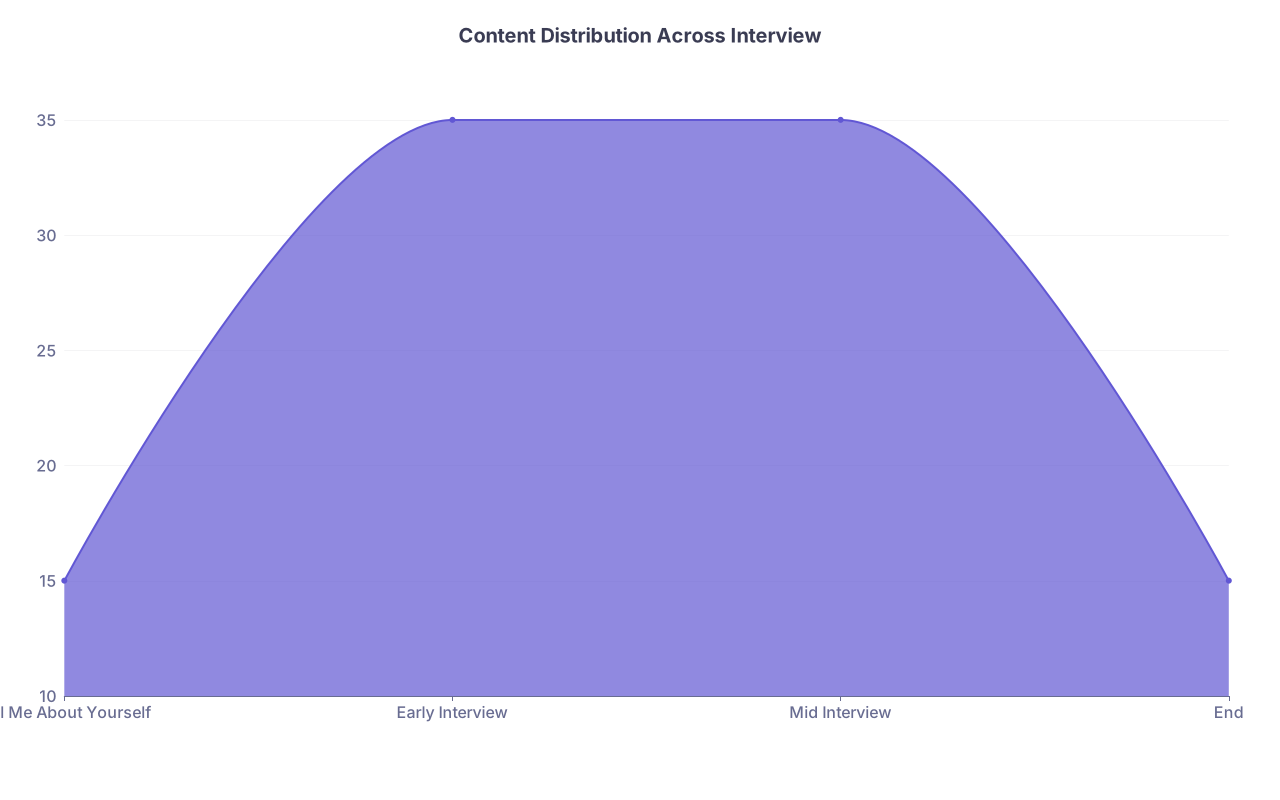
| Category | Value |
|---|---|
| Tell Me About Yourself | 15 |
| Early Interview | 35 |
| Mid Interview | 35 |
| End | 15 |
Where that 15% at the start is “Tell me about yourself.” It should feel like a teaser trailer, not the full movie.
Quick Templates You Can Steal (And Adapt)
Don’t copy these verbatim. But use them as scaffolding.
Template 1: Classic IM / Peds / Psych Style (70–90 sec)
“I'm a fourth-year at [School], applying in [Specialty], and I’ve especially enjoyed [type of patients or settings] and [specific role you like on the team].
I came into medicine through [very brief origin: major/experience] where I realized I really valued [continuity / complexity / procedures / systems / communication]. That’s carried through my clinical years, where I’ve focused on [1–2 core themes, like teaching, QI, advocacy].
For residency, I’m looking for [2–3 things: volume, mentorship, culture, patient population], and I think I’ll bring [1–2 strengths: calm under pressure, communication, work ethic, curiosity] to a program like this.”
Template 2: More Procedural / EM / Surgery Style (60–75 sec)
“I’m a fourth-year at [School], applying in [Specialty]. On rotations I’ve consistently gravitated toward [OR/trauma bay/acute care] where I enjoy [fast decisions / hands-on procedures / working in teams under pressure].
Before med school I [very brief, relevant background—engineering, athletics, military, etc.], which is probably why I’m comfortable with [discipline / repetition / hierarchy / uncertainty].
In residency, I’m looking for strong [case volume, early responsibility, procedural exposure] within a culture that’s [collaborative, direct, supportive]. I bring [1–2 traits or experiences] and someone who’s very ready to work hard and keep improving technically.”
Again: each of these clocks in at around a minute when spoken normally.
FAQ: “Tell Me About Yourself” For Residency Interviews
1. Is 30 seconds too short for “Tell me about yourself”?
Yes, usually. Under ~45 seconds almost always feels underdeveloped. You don’t need to max out time, but 60–90 seconds lets you touch on now, backstory, and future in a meaningful way. If you’re landing at 30 seconds, you’ve probably stripped out all the texture that makes you memorable.
2. What if the interviewer looks bored—should I cut my answer short?
If you’re staying in the 60–90 second range, don’t panic and bail mid-sentence. Finish your thought, then stop. If you’re approaching 2 minutes and they seem disengaged, that’s feedback for next time: you’re saying too much. The real fix happens in practice, not mid-interview.
3. Should I change my answer length for virtual vs. in-person interviews?
No. The 60–90 second rule holds in both. On Zoom, attention spans are even shorter, so staying concise matters more. What you do change is your delivery: look at the camera, keep energy a bit higher, and avoid reading off notes. But the content and length are the same.
4. Can I include personal hobbies and interests in “Tell me about yourself”?
Yes—briefly. One line, max two, and ideally tied to a trait that matters. For example: “Outside medicine I’m usually running or training for half-marathons, which has been my way of enforcing some discipline and stress relief.” Don’t list five hobbies; pick one that says something about how you operate.
5. Do I need a different version for every program?
You need one core version and small, optional tweaks. The length stays 60–90 seconds. You might adjust one sentence to reflect a program’s strength: “I’m especially drawn to programs with strong community outreach, which is something I know is a big part of this institution.” But if you’re rewriting from scratch every time, you’re wasting time.
6. How late is too late to start practicing this before interviews?
If your interview is tomorrow and you’re reading this right now, you still have time. You can get from zero to a solid 60–90 second answer in an hour of focused work. Ideally, you start 1–2 weeks before interview season, but I’ve seen people dramatically improve this answer the night before. Start now: open a document, draft your three-part answer, and time yourself once.
Open a blank note on your phone or laptop right now and write your 3-part answer—Now, Back, Forward—then read it out loud with a timer. If it isn’t between 60 and 90 seconds, fix that first. Everything else is just polish.