
What actually happens if you’re fully honest about your weaknesses in a residency interview—do you look mature or do you tank your chances?
Let me give you the straight answer first, then we’ll unpack it:
You should be strategically honest.
Not fake.
Not overly confessional.
Strategically honest.
Too many applicants fall into one of two dumb extremes:
- They give the classic “I care too much / I’m a perfectionist” nonsense. Program directors hate it. It screams canned and unreflective.
- They over-share: “I failed Step 1, burned out, had conflicts with attendings, and I’m not great with time management.” That’s not honesty; that’s self-sabotage.
The game is this:
You tell the truth about a real, relevant weakness – but you frame it in a way that shows self-awareness, learning, and control.
Let’s walk through how to do that like an adult instead of an anxious MS4.
The Real Question Programs Are Asking
When they say, “Tell me about one of your weaknesses,” they’re not asking for your therapy notes.
They’re really asking three things:
- Do you know yourself, or are you delusional?
- When you screw up, do you learn and adapt or repeat the same mess?
- Are you going to be dangerous, toxic, or high-maintenance as a resident?
So your answer has to hit three beats:
- A real but non-fatal weakness
- A clear example where it showed up
- Specific actions you’ve taken to manage or improve it
If you miss any of these, your answer either sounds fake, uninsightful, or risky.
How Honest Is “Too Honest”?
There are certain weaknesses that, if you highlight them, you’re basically handing them a reason to not rank you.
Here’s the mental model:
Don’t spotlight anything that makes them worry about safety, reliability, or professionalism.
Examples that are usually too honest or poorly framed:
- “I tend to procrastinate and miss deadlines.”
- “I’m not great with confrontation, so I sometimes avoid calling attendings with updates.”
- “I get easily overwhelmed in busy clinical settings.”
- “I struggled with professionalism issues in M3 but I’ve gotten better now.”
- “I still have test anxiety and barely passed Step 2.”
Can you recover from those things in life? Absolutely.
Should you pick them as your interview weakness? No. You’re not in confession. You’re in a job interview.
Better categories of weaknesses to use:
- Over-functioning: doing too much yourself instead of delegating
- Communication style that needed refining
- Efficiency/organization that you’ve actively improved
- Struggle with saying no / overcommitting
- Asking for help later than ideal (and you’ve changed that)
These are believable, human, and fixable.
The Formula: A Clean, Grown-Up Weakness Answer
Here’s a simple structure that works almost every time:
- Name the weakness clearly. One sentence. No long justification.
- Give a brief, concrete example of when it showed up.
- Explain what you did deliberately to improve it.
- Describe how you handle it now, in specific terms.
- Optional: Tie it to residency (“Here’s how I’ll apply this as a resident.”)
Let me show you how that actually sounds.
Example 1: Overdoing things yourself
Weakness: difficulty delegating / taking on too much.
“Earlier in medical school I had a tendency to try to do everything myself instead of delegating or asking for help. For example, on my medicine rotation, I’d hold onto tasks instead of looping in the team, and it hurt my efficiency on busy days.
I got direct feedback about this from my senior resident, and I took it seriously. Since then, I’ve been intentional about clarifying roles at the start of the day, using checklists, and handing off appropriate tasks to nursing staff or med students instead of hoarding them.
I still like to be hands-on, but now I focus more on prioritizing and using the team effectively, which has actually made me more reliable on hectic days.”
Fully honest? Yes.
Fatal? No.
Shows growth? Absolutely.
Example 2: Too tentative in speaking up
Weakness: being initially hesitant to speak up.
“In my third year, I tended to be more reserved on rounds. I worried about being wrong, so I sometimes kept quiet instead of offering an assessment or plan.
A chief resident pointed it out and encouraged me to commit to an opinion, even if it wasn’t perfect. Since then, I’ve made a habit of preparing at least one concrete assessment and plan per patient and saying it out loud on rounds. I also ask for feedback afterward on what I missed.
I’m still naturally more on the thoughtful side than the loud side, but I’m much more comfortable putting my reasoning on the table, which has helped me learn faster and be more useful to the team.”
Again: real, understandable, and clearly under control.
Where You Should Not Lie
There are areas where “being honest enough” isn’t negotiable, especially if they already see it in your file:
- A leave of absence
- A failed exam or remediation
- A professionalism incident that’s documented
- A big red flag in your MSPE
If they ask about it, pretending it’s not a big deal or dancing around it is the worst move. They already know. They’re testing whether you:
- Take responsibility
- Have insight into how it happened
- Took concrete steps to fix it
- Are unlikely to repeat the same behavior
The framing shifts from “here’s my weakness” to “here’s a challenge / red flag I faced and how I addressed it.”
Example: Failed Step 1
Bad answer:
“It was just a bad day. I knew the material, I just don’t test well.”
Better answer:
“I did fail Step 1 the first time. I underestimated how much structured practice I needed and relied too heavily on passive review. That was a painful but important wake-up call.
After that, I met regularly with our learning specialist, built a detailed study schedule, and focused on timed questions with weekly self-assessments. I adapted how I studied during clerkships using those same principles, and my Step 2 score reflects that change.
Practically, it taught me to respond early to underperformance with data and structure instead of denial, which is how I approach any area I’m struggling in now.”
You’re not hiding it. You’re showing you’re safe to bet on now.
How Much Detail Is Enough?
If your answer feels like a monologue, it’s probably too long. Aim for 60–90 seconds.
Quick test:
- Did you clearly name one weakness?
- Did you give exactly one example (not your entire life story)?
- Did you give 2–3 specific actions you took?
- Did you finish on where you are now, not on how bad it was?
If yes, you’re in the right range.
You don’t need a tearful arc, just a clear narrative:
Problem → Insight → Action → Current state.
What You Should Absolutely Avoid Saying
Here’s where people blow themselves up trying to be “authentically honest.”
Do not use:
- “I get easily flustered under pressure.”
- “I sometimes forget things if I don’t write them down.” (Sounds benign but implies unreliability if not framed well.)
- “I’m not good at asking for help and tend to push myself to burnout.” (Too close to “I will be unsafe on call.”)
- “I’m still working on my professionalism.”
- “I sometimes have trouble waking up early.” (Yes, people say this. No, you should not.)
If you have issues like anxiety, depression, ADHD, burnout – those are real and common. You manage them with your support system and, if needed, occupational health once you’re a resident. The interview is not the time to test how progressive they are about mental health by centering that as your “weakness.”
You can speak to behaviors you’ve changed (time management, setting boundaries, building routines) without disclosing diagnoses.
Practice: Turning a Real Weakness into a Strong Answer
Let’s walk through a few raw weaknesses and how to phrase them sanely.
Raw weakness: “I’m slow with notes.”
Polished version:
“Earlier in clinical training, my documentation took longer than it should have. I was meticulous, but not efficient, which sometimes meant staying late to finish notes.
I asked a resident I admired for help, and she walked me through how she structured templates and batched tasks. I started pre-charting key details, using smart phrases effectively, and time-boxing my notes.
Now I’m consistently on time with documentation without sacrificing accuracy. I still review my notes carefully, but I’m much better at balancing thoroughness with efficiency, which will be critical as an intern.”
Raw weakness: “I avoid conflict and let things slide.”
Polished version:
“I’m naturally conflict-averse, and earlier on, I sometimes avoided small interpersonal issues instead of addressing them directly. For instance, on one team there was confusion about who was responsible for follow-up calls, and I let the ambiguity linger longer than I should have.
After feedback from an attending, I started practicing more direct but respectful communication. Now when something’s unclear, I try to clarify roles early and, if needed, have a brief one-on-one conversation instead of stewing about it.
I’m still not someone who enjoys conflict, but I’m much more comfortable addressing small issues early so they don’t turn into bigger problems.”
That’s honest, but it shows control, not chaos.
How Honest Should You Be, Net-Net?
If you want a rule you can actually use, here it is:
Be 100% honest about:
- Anything they already know from your application
- The fact that you’re not perfect and have areas you’ve worked on
Be selectively honest about:
- Which weakness you choose to emphasize
- How much personal detail you share
Be 0% honest if:
- You’re tempted to say something that makes you sound unsafe, unprofessional, chronically unreliable, or miserable to work with
That last one? Keep that for your therapist, your friends, or your journal, not the PD.
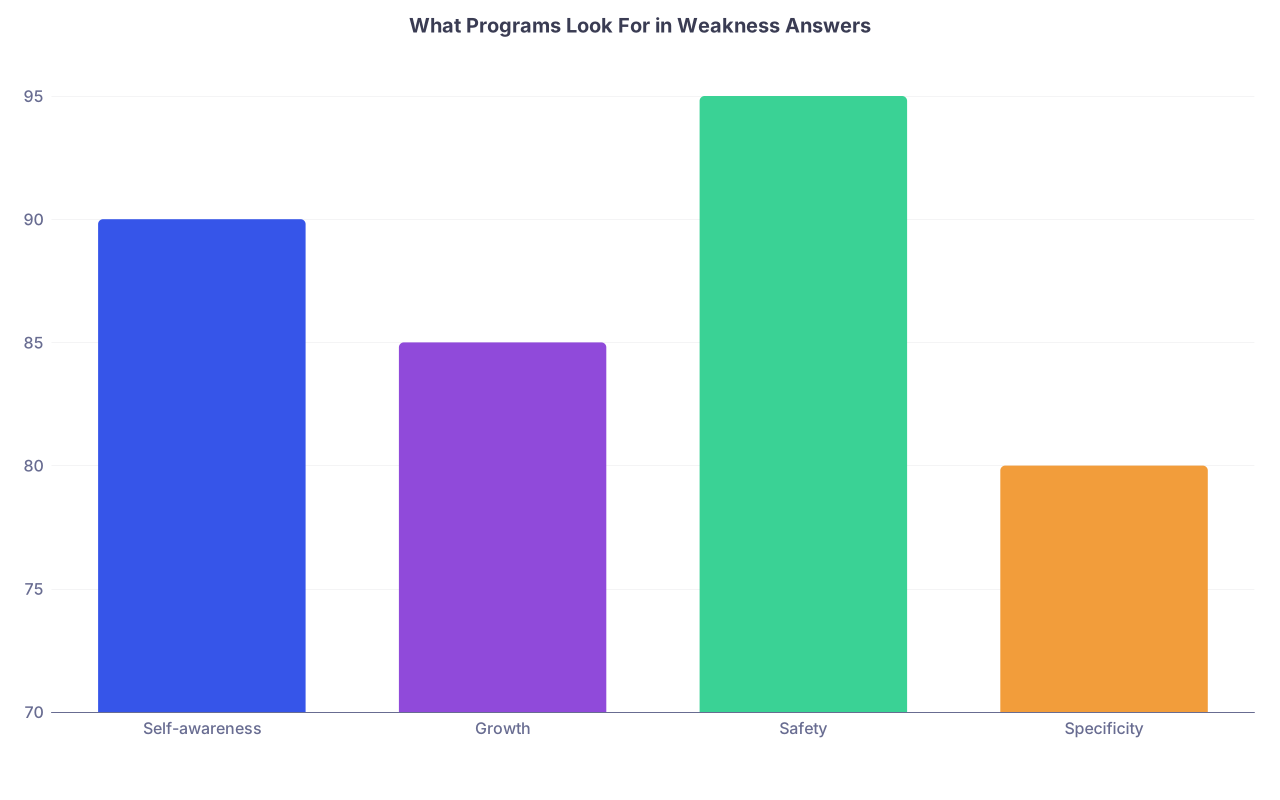
| Category | Value |
|---|---|
| Self-awareness | 90 |
| Growth | 85 |
| Safety | 95 |
| Specificity | 80 |
Quick Comparison: Safe vs Risky Weaknesses
| Category | Safer Choice (Better) | Risky Choice (Worse) |
|---|---|---|
| Work style | Over-detail oriented, improved speed | Chronic procrastination, missed deadlines |
| Communication | Initially quiet, now more proactive | Avoids calling attendings, delays updates |
| Organization | Needed systems, now structured | Frequently forgets tasks or follow-ups |
| Emotional regulation | Takes feedback hard, now reframes | Gets flustered or shuts down under stress |
| Professionalism/history | None / addressed minor issue | Ongoing issues, vague about resolution |
How to Practice Without Sounding Scripted
You should absolutely rehearse your weakness answer. Just not like a robot.
Here’s a simple process:
- Write out your answer fully once. Don’t worry if it’s long.
- Read it out loud and time it. Trim until it’s under 90 seconds.
- Record yourself on your phone answering: “Tell me about one of your weaknesses.”
- Watch once with this checklist in mind:
- Do I sound like I’m dodging?
- Do I sound like I’m confessing?
- Do I clearly show what I changed?
- Re-do until it sounds like you’re talking to a normal human, not auditioning for a TED Talk.
You want “polished but natural.” Not wooden.

| Step | Description |
|---|---|
| Step 1 | Pick Real Weakness |
| Step 2 | Check Its Non-Fatal |
| Step 3 | Find 1 Clear Example |
| Step 4 | Identify What You Did to Improve |
| Step 5 | Describe Current Habits |
| Step 6 | Rehearse Out Loud |

Putting It All Together: The Real Standard
If your answer meets these standards, you’re fine:
- You pick a real but safe weakness.
- You show you heard feedback at some point.
- You explain specific changes you made.
- You sound like someone who will get better over time, not fall apart.
Programs don’t need you flawless.
They need you coachable, reliable, and not in denial.
If you can show that in how you talk about your weaknesses, you’re doing better than at least half the applicant pool.

FAQ: Weaknesses in Residency Interviews
1. Can I say “I’m a perfectionist” as my weakness?
You can, but you shouldn’t. It’s overused and usually sounds fake. If your real issue is spending too long polishing notes or over-checking labs, talk about efficiency vs thoroughness, and show how you’ve learned to balance the two with concrete changes. Make it real, not a cliché.
2. What if my biggest weakness is something serious like burnout or anxiety?
You don’t need to disclose diagnoses or deeply personal struggles to answer this question well. Focus on professional behaviors you’ve improved: time management, boundary-setting, asking for help earlier, building routines. Talk about the systems you use now, not your entire mental health history.
3. Should I mention a weakness that’s already obvious in my application?
If they ask about it, yes. Don’t dodge. For things like a leave of absence, failed exam, or MSPE comment, you need a clear, accountable story: what happened, what you changed, and why it won’t recur. If they don’t ask, you don’t have to volunteer every detail, but you should be ready with a solid explanation.
4. Is it better to talk about a past weakness that’s “fixed” now?
Yes, but not in a fake way. The ideal weakness is something that was genuinely a problem, that you’ve substantially improved, but that you still monitor. Saying “I used to struggle with X but it’s totally gone now” sounds slick and unbelievable. Show you’re managing it with ongoing habits.
5. How many weaknesses should I prepare to discuss?
Have 2–3 solid weakness stories prepared. One “classic interview weakness” (like delegation, speaking up, efficiency) and one explanation for any red flag in your file (if applicable). That way you’re ready for variations like “What would your attending say you need to work on?” or “What feedback do you get most often?”
Key points to walk away with:
- Be strategically honest: real weakness, non-fatal, clearly managed.
- Use a simple structure: weakness → example → actions → current state.
- Never volunteer something that makes you look unsafe, unprofessional, or unreliable as a resident.