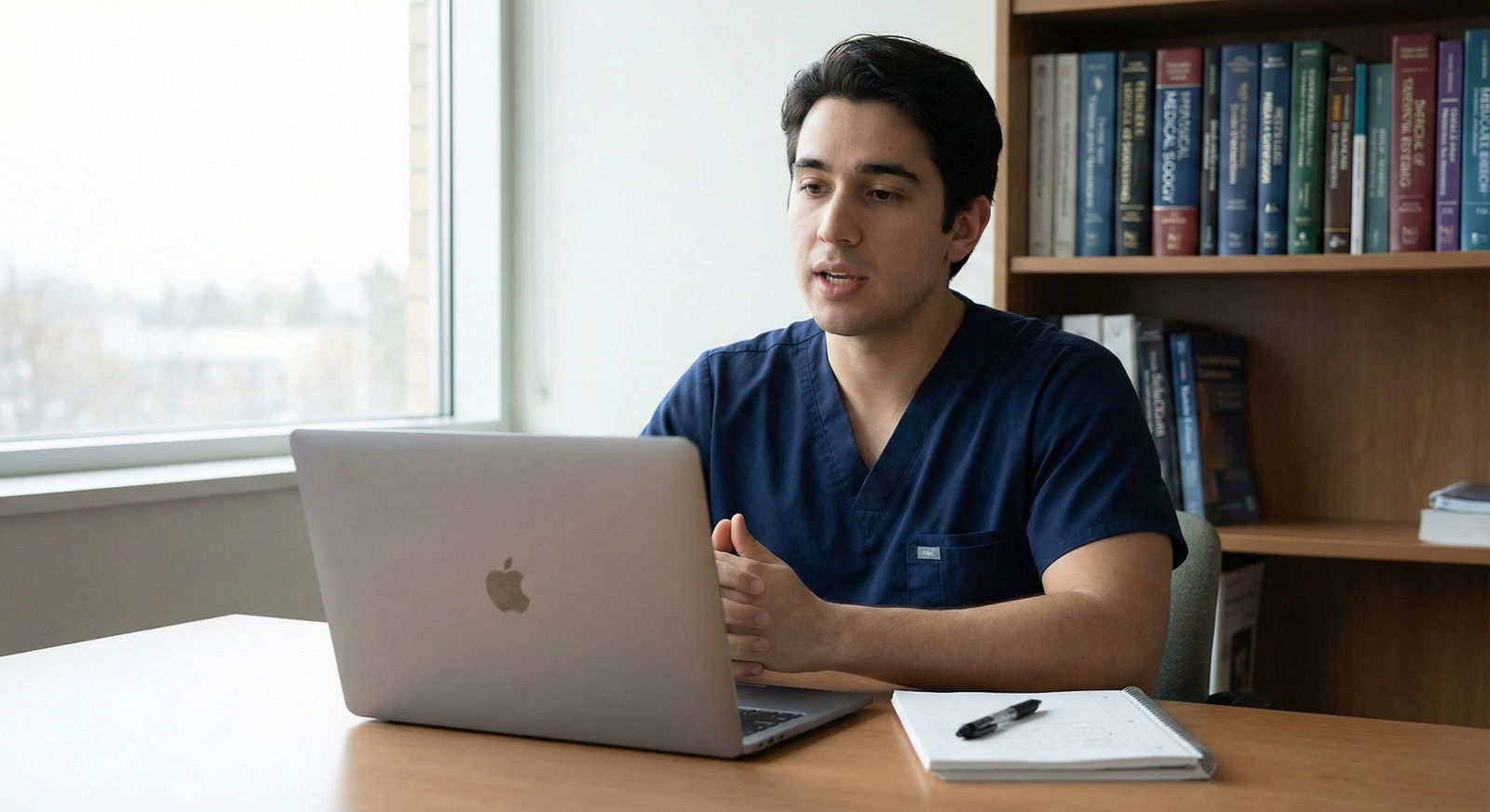
The best way to practice residency interviews without a coach is to build a ruthless, structured self-practice system—and stick to it.
You don’t need a pricey consultant. You do need discipline, a clear plan, and a way to get honest feedback that’s better than “you did great!” from your friends.
Here’s the system I’d use if you told me, “Interviews start in 3 weeks, I have no coach, and I can’t screw this up.”
Step 1: Know the Exact Game You’re Playing
Let’s kill the vague anxiety first. Residency interviews are not a mysterious art. Programs mostly ask from a brutally predictable bucket of questions:
- “Tell me about yourself” / “Walk me through your CV”
- “Why this specialty?” / “Why our program?”
- Behavioral questions (“Tell me about a time you made a mistake…”)
- Red flags / gaps / lower scores
- Career goals
- “Do you have any questions for us?”
Your job is to:
- Build strong, reusable “core stories”
- Practice delivering them out loud
- Train yourself to sound like a normal, reflective human, not a Step 1 textbook
You don’t need 100 perfect answers. You need about 8–10 rock-solid stories that can flex into 30+ questions.

| Step | Description |
|---|---|
| Step 1 | List Common Questions |
| Step 2 | Build Core Stories |
| Step 3 | Draft Bullet Point Answers |
| Step 4 | Record Mock Interviews |
| Step 5 | Review & Score Yourself |
| Step 6 | Refine Answers & Delivery |
| Step 7 | Repeat 2-3x per Week |
Step 2: Build Your Core Story Bank (No Coach Needed)
You can do this solo with a notebook and 60–90 minutes.
Write down 8–10 specific clinical or life experiences that cover:
- A time you failed or made a mistake
- A conflict with a nurse/attending/peer
- A difficult patient interaction
- A leadership role (formal or informal)
- A time you went above and beyond
- A stressful call/night/rotation
- A research or QI project
- A non-clinical challenge (family, finances, moving countries)
- Something that shows resilience
- Something that shows teamwork
Now, for each story, outline only in bullets using the STAR framework (but don’t say “STAR” out loud):
- Situation – 1 sentence, sets the scene
- Task – what you were responsible for
- Action – what you actually did
- Result – what happened, plus what you learned
Example for “conflict with a nurse”:
- Situation: Busy night on medicine; new admit with chest pain; nurse concerned about delay in orders
- Task: I was cross-covering; needed to assess, prioritize, communicate
- Action:
- Stopped what I was doing, went to bedside, examined patient
- Acknowledged nurse’s concerns; clarified what she was seeing
- Explained my thought process and plan; gave clear time expectations
- Updated attending; wrote concise note
- Result:
- Patient stable, no adverse event
- Nurse later thanked me for being responsive
- Realized proactive communication beats trying to “look efficient” on paper
You’ll reuse that same story for:
- “Tell me about a conflict”
- “A time you worked with a difficult team member”
- “A time you advocated for a patient”
- “A time you handled stress”
That’s the point. Stories are multipurpose ammunition.
Step 3: Script Your Openers, Not Your Life
You should absolutely script some parts. Just not everything.
Script (word-for-word, then later loosen up):
- First sentence of “Tell me about yourself”
- 2–3 concise points for “Why this specialty?”
- 2–3 concise points for “Why our program?”
- One clean version of any “red flag” explanation (low score, gap year, leave of absence, failed exam, visa issue)
But don’t write a novel. Aim for bullets like:
“Tell me about yourself” – sample outline:
- Start: Where you grew up + one line about your path to medicine
- Middle: 2–3 defining experiences (clinical, research, leadership) that tie to the specialty
- End: What you’re looking for in residency + very brief personal detail (hobby/family)
You want something you can say in 60–90 seconds. If it takes 4 minutes, you lost them.
Step 4: Set Up a Solo Mock Interview Studio
You don’t need a coach, but you do need a system that doesn’t let you hide from your own awkwardness.
Do this:
Pick your tech
- Use Zoom or Google Meet alone in a meeting
- Turn on “record”
- Use your actual interview setup: same chair, same camera angle, same mic
Print or open a list of 20–30 common questions
For example:- Tell me about yourself.
- Why this specialty?
- Why our program?
- Tell me about a time you made a mistake.
- Tell me about a conflict with a colleague.
- Tell me about a time you went above and beyond.
- What are your strengths and weaknesses?
- How do you handle stress/burnout?
- Tell me about a time you got negative feedback.
- What are your career goals?
Run a 30-minute mock
- Hit record
- Ask yourself questions out loud, or have them on a slide and flip through
- Answer as if someone is across from you
- No pausing to restart. No “sorry can I try that again?” You don’t get that on interview day.
Stop, then force yourself to watch it
This is where most people wimp out. Don’t.
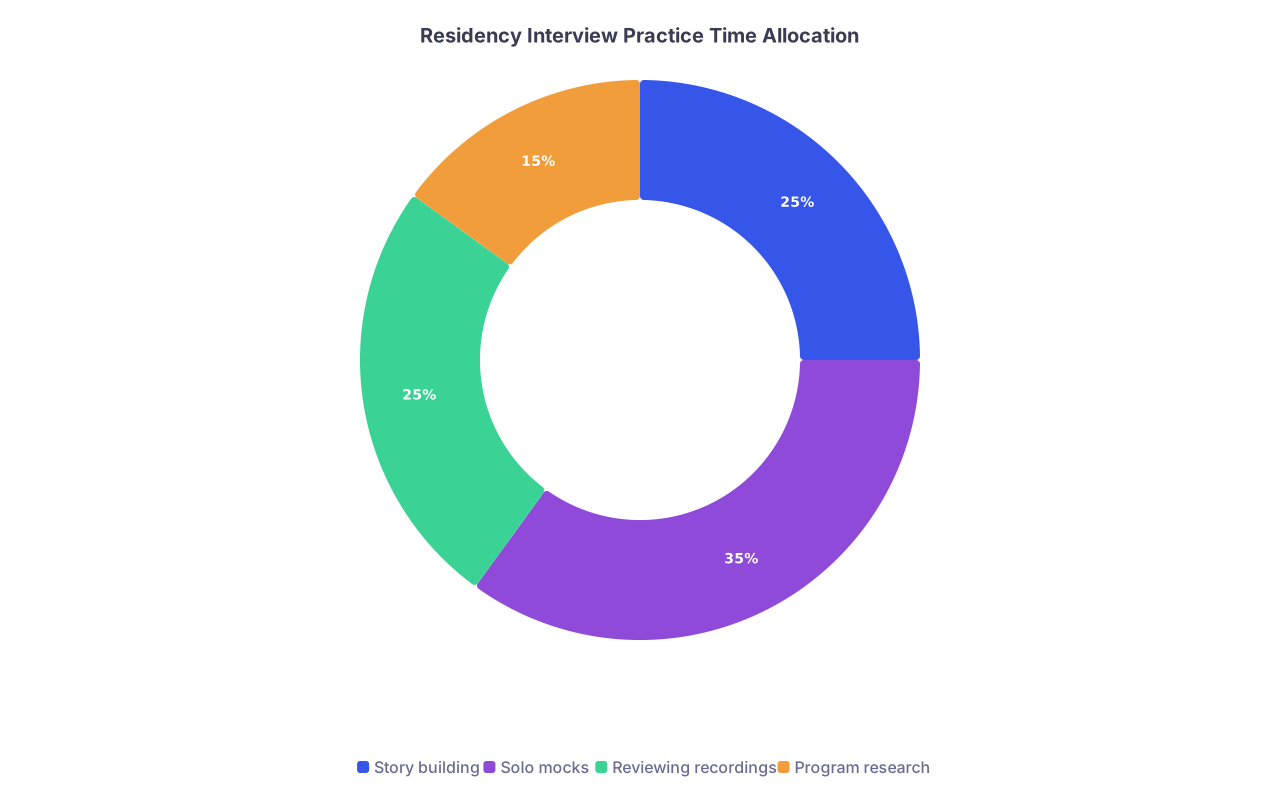
| Category | Value |
|---|---|
| Story building | 25 |
| Solo mocks | 35 |
| Reviewing recordings | 25 |
| Program research | 15 |
Step 5: Score Yourself Like a Program Director
You don’t need a coach if you can be brutally honest.
Make a simple score sheet (1–5 scale) for each answer:
- Clarity: Did I actually answer the question, or wander?
- Structure: Clear beginning–middle–end? Or rambling?
- Specificity: Real details vs vague clichés?
- Insight: Did I show what I learned, or just narrate events?
- Likeability: Do I sound like someone they’d want on call at 3 a.m.?
Example quick rubric:
| Score | What It Looks Like |
|---|---|
| 1 | Rambling, unclear, off-topic |
| 2 | Partially answers, very generic |
| 3 | Clear but basic, minimal reflection |
| 4 | Strong, specific, shows insight |
| 5 | Memorable, concise, highly polished |
On replay, pause after each answer and write the scores. Then pick the 2–3 worst answers from that session and redo them immediately with a better structure.
That’s how you compress practice time. Fix the weakest links instead of repeating what you’re already good at.
Step 6: Use Low-Stakes Humans for Targeted Feedback
No coach? Fine. But you should still use people—just strategically.
You don’t ask them, “How did I do?” You ask specific things:
- “Did my answer to ‘Why this specialty?’ actually sound convincing?”
- “Where did I lose you in that story?”
- “Did anything I said raise a quiet red flag for you?”
- “Did I talk too fast / too long?”
Who to ask (prioritized):
- Residents or recent grads in your specialty
- Co-students who are good communicators (not just your best friends)
- Non-medical friends/family for vibe and clarity
If you can, send them a 3–5 minute clip instead of making them sit through an hour. People give better feedback when you respect their time.
Step 7: Train for Online Presence (Most People Get This Wrong)
If your interviews are virtual, your “no coach” edge is doing the AV basics better than the average applicant.
Fix these 5 things:
- Camera at eye level (no “looking down into your laptop” angle)
- Light source in front of you, not behind
- Neutral, uncluttered background
- Wired headphones or reliable mic (no crackling AirPods cutting out)
- Stable internet / backup hotspot if you can
Now practice with that exact setup every time. Interview day shouldn’t be the first time you see your own face in that frame.

Step 8: Customize “Why Our Program?” Without Going Insane
This is where people waste hours or sound fake. You don’t need a coach. You need a template.
Use a 3-part structure:
One concrete program feature you genuinely like
- Rotation structure, patient population, research focus, wellness culture, etc.
One way that connects to your experiences or goals
- “This aligns with my interest in X”
- “This matches my experience doing Y”
One “fit” statement
- “I see myself thriving here because…”
Keep a short one-page doc per program with 3–5 bullets:
- Specific curriculum or track that interests you
- Something unique (location, community, niche)
- Any residents/faculty you met or talked to
- A patient population or pathology mix you’re excited about
Then practice saying it for 30–45 seconds out loud. Time it. Rewrite if you’re rambling.
Step 9: Build a Simple 3-Week Practice Plan
If you want structure, here’s a bare-bones, realistic plan you can follow without a coach.
| Week | Focus | Sessions (30–45 min) |
|---|---|---|
| 1 | Core stories + basics | 4 |
| 2 | Full mock interviews | 3–4 |
| 3 | Refinement + program-fit | 3–4 |
Rough breakdown:
Week 1:
- Session 1–2: Build story bank, outline with STAR
- Session 3: Practice “Tell me about yourself,” “Why this specialty?”
- Session 4: Record 20 minutes, review and score
Week 2:
- 2–3 full 30–40 minute solo mocks (recorded)
- 1 session with a friend/resident if possible
Week 3:
- Short, focused runs on weakest questions
- Practice “Why our program?” for any upcoming interviews
- One final full-length mock with full setup (clothes, lighting, everything)
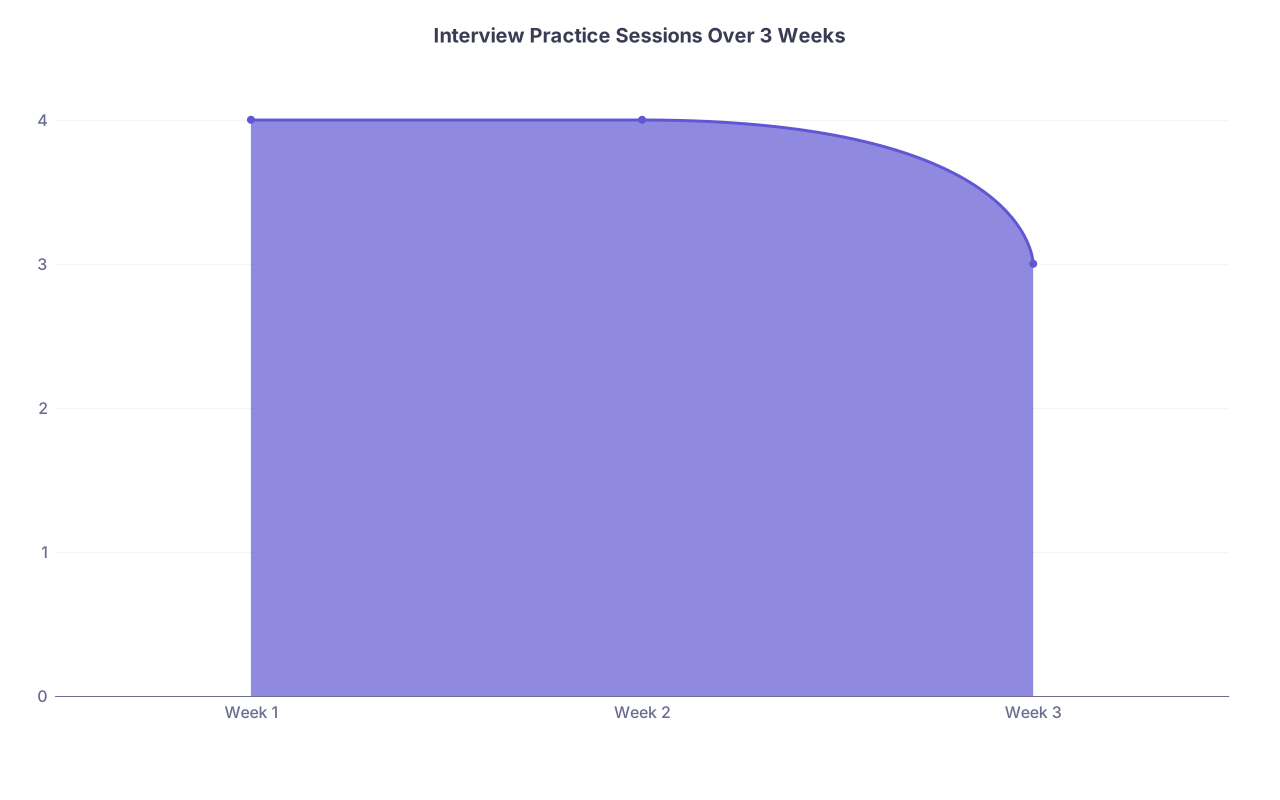
| Category | Value |
|---|---|
| Week 1 | 4 |
| Week 2 | 4 |
| Week 3 | 3 |
Step 10: Don’t Over-Polish Yourself into a Robot
There’s a point where more practice makes you worse: you start sounding rehearsed, stiff, and fake.
Signs you’ve crossed the line:
- You stress when you miss a single word from your “script”
- Your stories all sound identical in rhythm
- You can’t adapt when the question is slightly different
The fix is simple: once answers are structurally solid and you can hit the key points reliably, stop rewriting. From that point, practice variations, not memorization.
Example: Tell the same story 3 different ways:
- Focusing more on the team aspect
- Focusing more on the patient
- Focusing more on what you learned
That gives you flexibility on interview day when questions are worded unexpectedly.
FAQ: Residency Interview Practice Without a Coach
1. How many mock interviews should I do before residency interviews?
About 5–8 focused sessions is plenty for most people. That might be 3–4 solo recorded mocks and 2–3 with another human (friend, co-student, or resident). More is fine if you’re improving, but if you’re just repeating the same answers without changes, you’re rehearsing, not practicing.
2. Can I just practice in my head instead of out loud?
No. Thinking through answers helps with structure, but performance changes everything—your pacing, fillers (“um,” “like”), awkward pauses. The first time you say something should never be in front of a program director. Practice out loud, into a camera, in your actual interview setup.
3. What’s the best way to handle a low score or failure without a coach to script it for me?
Use a clean, 3-part structure: brief context (no excuses), what changed (specific actions you took), and the outcome (how your later performance or behavior reflects that). Then stop talking. Practice this specific answer several times so you can deliver it calmly in under 60–75 seconds.
4. How long should my answers be in residency interviews?
Most answers should land around 60–90 seconds. Big questions like “Tell me about yourself” or complex stories might go up to 2 minutes. If you’re talking for 3–4 minutes straight, you’re almost certainly losing your interviewer. Time yourself during practice and cut ruthlessly.
5. What if I don’t have any “dramatic” stories for behavioral questions?
You don’t need drama. You need specificity and reflection. A routine clinical scenario can be a great answer if you’re honest about what you did, how you communicated, and what you learned. Overblown, heroic stories usually sound fake. Real, small but meaningful situations usually land better.
6. How do I practice “Why our program?” for many programs without going crazy?
Create a simple, repeatable template and a one-page note per program. One specific feature you like, one way it connects to your experience/goals, and one sentence about fit. Spend 10–15 minutes per program the night before the interview reviewing that page and saying your answer out loud 2–3 times.
7. What’s one thing I can do today to meaningfully improve without a coach?
Record yourself answering “Tell me about yourself” and “Why this specialty?”—just those two. Watch the recording, score yourself on clarity, structure, specificity, and insight, then immediately re-record both with improvements. That 45-minute block will do more for you than reading interview tips for three hours.
Open your camera and record a 20-minute mock right now. Don’t wait for it to feel comfortable. It won’t. Your future self on interview day will be very glad you did.