
The biggest mistake applicants make on “Why this program?” is thinking more detail automatically means a better answer. It does not.
You do not need a 3-minute monologue listing every feature from the website. You do need a sharp, specific, believable answer that proves you actually understand the program and how you fit.
Here’s exactly how detailed to get—and where people go off the rails.
The Right Level of Detail: A Simple Rule
Use this rule and you won’t overdo it:
3–5 concrete specifics + 1–2 personal connections + clear “so what” for your career.
That’s it. That’s the level.
If you’re doing any of these, you’ve gone too far:
- Reading off a memorized paragraph that sounds like the homepage.
- Listing more than 6–7 distinct program features.
- Quoting exact numbers the faculty themselves probably don’t remember (“your 92% fellowship placement in 2021…”).
- Bringing up micro-details from a single paper, a single faculty CV, or some obscure PDF.
On the flip side, you’re not detailed enough if you say things like:
- “Great training and diverse patient population.”
- “Strong research and collegial atmosphere.”
- “I just got a great vibe.”
Those are beige wallpaper answers. Everyone says them. Programs forget them.
Your target: specific enough they know you did homework; focused enough they can remember you.
A Clean Structure You Can Reuse Everywhere
Here’s the basic framework I recommend for almost everyone:
- One-sentence headline answer
- Two or three program-specific reasons
- One or two personal/experiential links
- A closing line that ties to your long-term goals
That usually lands in the 60–90 second range. Which is ideal. Long enough to show intention. Short enough not to annoy anyone.
Let’s break that down.
1. Start With a Headline, Not a List
Open with a clear, big-picture sentence that anchors everything that follows.
Examples:
- “I’m interested in [Program] because it combines very strong clinical training in complex tertiary care with a culture that genuinely supports resident teaching and mentorship.”
- “What draws me most to [Program] is the combination of underserved urban patient care and the chance to develop as an academic hospitalist.”
- “For me, [Program] stands out as the place where I can become a confident, independent community emergency physician while still having access to meaningful research mentorship.”
Notice what these are not:
- They’re not, “There are many reasons I’m excited about your program…”
- They’re not a disorganized gush.
You’re setting a theme. Clinical intensity. Underserved care. Academic growth. Whatever is truly you.
2. Use 2–3 Program-Specific Reasons (Not 10)
This is where detail matters—but only the right kind.
You want 2–3 specifics that:
- Are clearly this program, not every program.
- You can explain in one sentence each.
- Actually matter to your training, not just “seem impressive.”
Good examples of appropriately detailed specifics:
- “Your X+Y schedule with a full ambulatory week every 6 weeks lines up with how I learn and with my interest in continuity clinic.”
- “The deliberate focus on resident-run teaching conferences, like your morning report being led by senior residents, matches my interest in medical education.”
- “I’m particularly drawn to your dedicated addiction medicine consult service; I’ve worked with patients with substance use disorders throughout med school and want more structured training in that area.”
Weak, generic, or too-detailed specifics:
- “You have strong research.” (Too generic.)
- “You’re ranked #23 in US News.” (They do not care that you memorized that.)
- “Your night float schedule is 5 nights, then 2 days, then…” (No one wants a recitation of the block diagram.)
- “I noticed that in 2019 you published 47 papers in JAMA and 36 in NEJM…” (You sound like ChatGPT gone wild.)
You do not need:
- The exact number of beds.
- The exact number of admissions.
- The full list of all fellowships available.
- The mission statement verbatim.
You do need:
- Clear elements of training that match your interests and how you see yourself practicing.
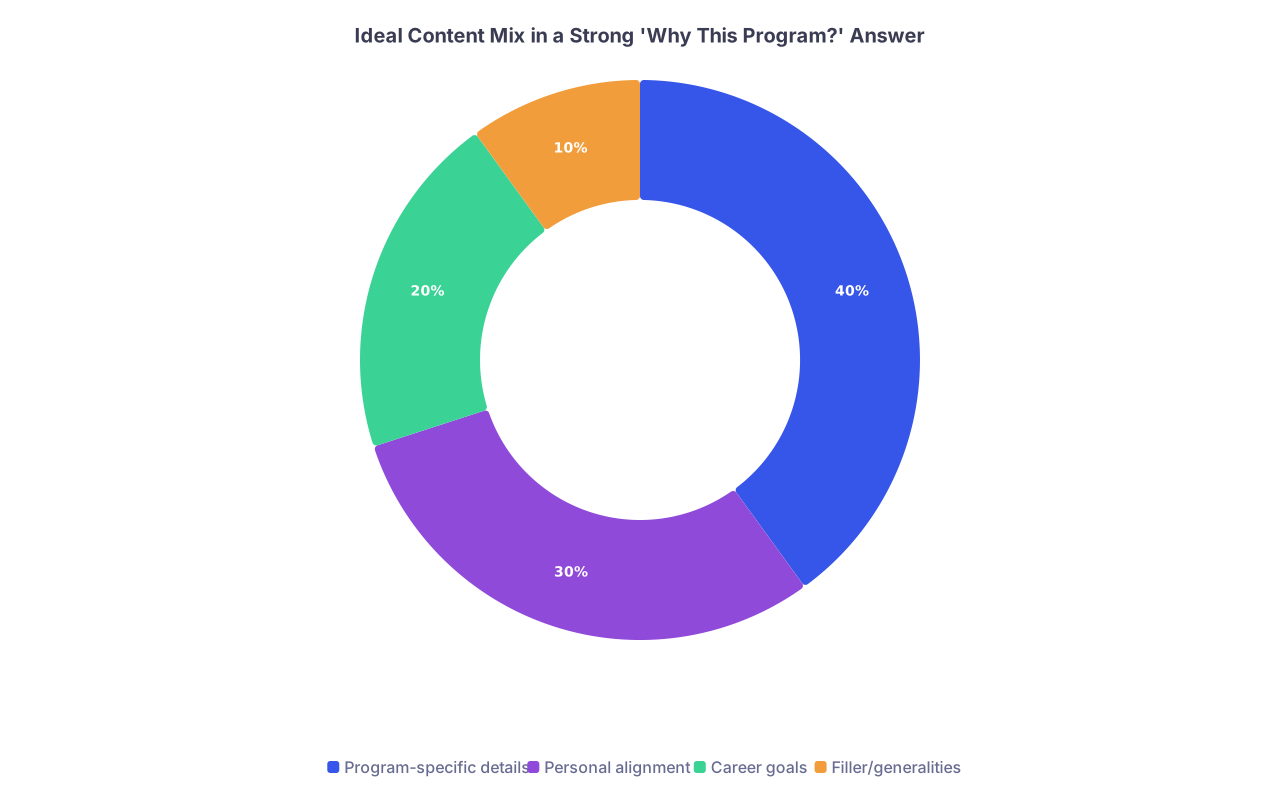
| Category | Value |
|---|---|
| Program-specific details | 40 |
| Personal alignment | 30 |
| Career goals | 20 |
| Filler/generalities | 10 |
How Personal Should You Get?
You want some personal context, but not your entire autobiography.
Here’s the right depth:
- 1–2 short sentences linking your experience to what you just praised about the program.
Examples:
- “On my sub-I at a county hospital, I saw how much I thrive in safety-net settings, so your strong relationship with [specific county or VA hospital] really resonates with me.”
- “I’ve been involved in longitudinal QI work around heart failure readmissions, so your QI tracks and the chance to work with Dr. X on inpatient cardiology projects are very appealing.”
- “I’m from a small town and ultimately see myself practicing in a community setting, so your mix of tertiary care and community hospital rotations feels like the right preparation for that path.”
That’s enough. You’ve:
- Shown them you know yourself.
- Connected your background to their strengths.
- Not made it melodramatic or self-indulgent.
Too much personal detail:
- Your entire life story.
- Long tangents about one patient that don’t link to the program.
- Trauma dumping or oversharing that makes the room uncomfortable.
Remember the question is “Why this program?”, not “Why are you the way you are?”
How Much Program Research Is Enough?
You don’t need a thesis; you do need more than scrolling the homepage in the Uber on the way there.
For most programs, this level of prep is sufficient:
| Task | Time Needed |
|---|---|
| Skim website (curriculum, tracks, hospitals) | 10–15 min |
| Read resident bios or Instagram posts | 5–10 min |
| Look at recent grads / fellowship list | 5 min |
| Note 1–2 faculty or tracks that match your interests | 10 min |
| Jot 3 bullet points for your answer | 5–10 min |
That’s roughly 35–45 minutes up front for a program you care about. For lower-priority programs, you can get away with half that, but don’t go in cold.
You do not need to:
- Read every single faculty bio.
- Memorize all call schedules.
- Stalk every resident on LinkedIn.
You just need enough to say 3 intelligent, specific things and back them up.
Example Answers at the Right Level of Detail
Let’s make this concrete.
Strong, Appropriately Detailed Answer (Internal Medicine)
“I’m drawn to [Program] because it combines rigorous inpatient training with a real commitment to resident teaching and to underserved care.
More specifically, the structure of your X+Y schedule, with protected ambulatory weeks and the continuity of following your own panel in clinic, fits how I like to learn and aligns with my plan to be an academic hospitalist who still has some outpatient time. I’m also very interested in your health equity track; I worked on a longitudinal project addressing hypertension control in a safety-net clinic, and I’d like to continue that type of work with your community partners.
Finally, your graduates’ outcomes resonate with me: many stay on as chief residents or go into hospitalist roles at academic centers, which is exactly the kind of path I’m considering.”
Why this works:
- 3–4 clear specifics.
- One concise personal link.
- Clear career direction.
- No laundry list.
Overly Detailed (Bad) Answer
“I want to be at [Program] because you have 750 beds, 12 residency positions per year, and a night float system that’s Sunday through Thursday with 6 pm to 7 am shifts. I also noticed that your residents rotate at [Hospital A], [Hospital B], and [Hospital C], and that you have morning report at 7:30 and noon conference every day at 12. You also published 126 papers last year, including 9 in NEJM and 6 in JAMA, and your board pass rate has been 100% for the past 4 years. The diversity of your patient population and the collegial atmosphere also appeal to me.”
This sounds like a brochure recitation, not a human. No one cares that you memorized this.
Too Vague (Also Bad)
“I really like the people here. Everyone seems so nice and supportive. I also value strong clinical training and a diverse patient population, and I feel like I’d get that here. I also just had a great gut feeling.”
This could be said, word for word, at every program on your list. It answers nothing.
How to Tailor by Program Type (Without Rewriting Your Soul)
You don’t need a completely different philosophy for every program. You need one core story about yourself, then you adjust the dials depending on where you are.
Think like this:
- Big academic programs: Emphasize subspecialty exposure, research/QI, teaching culture, complex patients, career development.
- Community programs: Emphasize broad clinical exposure, autonomy, patient continuity, preparing for community practice, local ties.
- Hybrid / university-affiliated community: Blend both—community preparation + academic or subspecialty access.
- Underserved / safety-net focus: Emphasize health equity, language skills, prior underserved work, long-term commitment to similar populations.
You’re not inventing a new persona each time. You’re choosing which 2–3 aspects of your authentic goals to spotlight.

| Step | Description |
|---|---|
| Step 1 | Know your career direction |
| Step 2 | Identify 3 program strengths |
| Step 3 | Link each strength to your experience |
| Step 4 | Craft 1-sentence headline |
| Step 5 | Practice 60-90 sec version |
Delivery: How It Should Sound in the Room
Content matters, but so does how you say it.
A good “Why this program?” answer:
- Takes 60–90 seconds.
- Sounds conversational, not memorized.
- Has 2–3 natural-sounding pauses.
- Lets you adjust on the fly if they interrupt (which they often will).
Quick practical tips:
- Memorize the outline, not the full script: headline → 3 bullets → closing line.
- Practice saying it out loud 3–5 times, not 30.
- If you’ve answered this question 6 times in the same day, tweak a sentence to keep your brain awake.
If they interrupt you after reason #2 and pivot to another question, that’s fine. It usually means they heard enough and want to explore something you said.
Common Pitfalls and How to Avoid Them
Using the wrong name or generic copy-paste
- Fix: Always say the program’s actual name early. Double-check your notes. If you interview at “University Hospital” and “University Medical Center,” keep those separate.
Overfocusing on geography
- “I want to be in Boston because my partner is here.”
Geography can be one supporting reason, not the headliner. Lead with training, then mention location briefly if relevant.
- “I want to be in Boston because my partner is here.”
Overdoing prestige
- “You’re a top program, highly ranked, and that’s important to me.”
They know where they sit in the pecking order. You don’t need to fanboy. Talk about fit and training.
- “You’re a top program, highly ranked, and that’s important to me.”
Acting like they’re the only program
- “This is my absolute top choice and I’d come here over anywhere else.”
You can say this honestly late in the season if you mean it. Don’t spray this line at 12 interviews. You’re not fooling anyone.
- “This is my absolute top choice and I’d come here over anywhere else.”
Sounding like a tourist
- “Your city has great restaurants and outdoor activities.”
That’s fine as a side note, not as a reason you’re devoting 3 years of your life to the program.
- “Your city has great restaurants and outdoor activities.”
How to Adjust If You Genuinely Don’t Know Much About the Program
Maybe it’s a late invite. Maybe you didn’t expect to get an interview. You’re not doomed.
Here’s the honest, minimal-prep version that still works:
- One clear, program-specific thing from the website or interview day.
- One connection to your background.
- One statement about the type of physician you want to be.
Example:
“I’ll be honest that I didn’t know much about [Program] before the interview offer, but what’s really stood out as I’ve read more and talked to residents today is the amount of responsibility you give senior residents in managing the inpatient services. I’ve really enjoyed being in charge of admissions and cross-cover on my sub-Is, and I want a program that will push me to make independent decisions but with strong backup. Long term, I see myself as a community hospitalist, and the combination of your tertiary center and community site seems like excellent preparation.”
That’s still a solid answer. Not flowery. But real.
FAQ: “Why This Program?” Answer
1. How long should my “Why this program?” answer be?
Aim for 60–90 seconds. Under 45 seconds usually means you’re too vague or generic. Over 2 minutes and you’re probably listing features or repeating yourself. Practice with a timer once or twice so you know what that range feels like.
2. Should I mention specific faculty by name?
Only if it’s genuine and you can explain why in one sentence. “I’m interested in working with Dr. X because of their work in Y, which overlaps with my project in Z.” Do not rattle off three faculty names just to prove you looked at the website. One meaningful connection > three name-drops.
3. Is it bad to say I don’t know exactly what I want to do (fellowship vs generalist)?
Not at all. You can still be specific about what you want from residency: broad exposure, mentorship in deciding, a range of electives, etc. For example: “I’m undecided between cardiology and staying general, so I’m looking for strong general medicine training with enough subspecialty exposure and mentorship to help me make that decision.”
4. Can I reuse the same core answer for multiple programs?
Yes—and you should. Your core career goals and training needs don’t change every zip code. But you must customize 2–3 specifics and the program name each time. Think: 60–70% reusable core, 30–40% tailored to that program.
5. What if I liked the people more than any specific curricular feature?
You can absolutely frame that—just add one or two concrete details. For example: “The main reason I’m excited about [Program] is the resident culture. On my interview day, residents were candid about challenges but still clearly supportive of each other. Combined with your strong inpatient volume and the chance to rotate at both the VA and county site, I see this as a place where I’d be pushed clinically but also supported by my peers.”
Key points to remember:
Keep it focused: 3–5 real specifics, not a brochure recital.
Make it yours: connect program features to your actual experiences and goals.
Stay human: conversational, honest, and clear about what you want out of residency.