
The worst thing you can do with a delayed Step 2 CK score is go silent and hope no one notices.
If you are an IMG with a Step 2 CK score that will release late—or you already applied without it—you are in a fragile position. Programs are skeptical by default. Your job is to remove doubt fast, clearly, and professionally.
This article is for one specific situation: you are an IMG applying this cycle, your Step 2 CK score is not available yet (or will be released after key dates), and you need concrete communication templates you can actually send.
You will not find vague “keep them updated” advice here. You will get word-for-word emails and ERAS explanations you can copy, paste, and customize.
1. Understand How Bad (or Manageable) Your Situation Is
Before you start emailing anyone, you need to be brutally clear which bucket you’re in.
| Scenario ID | Situation Summary | Risk Level |
|---|---|---|
| A | Step 2 CK taken, score pending, release before rank list deadline | Moderate |
| B | Step 2 CK taken, score pending, release after many interview invites | High |
| C | Step 2 CK not yet taken, date is after ERAS opens | Very High |
| D | Step 2 CK failed, retake scheduled, score after many invites | Critical |
| E | Strong Step 1, Step 2 CK delayed but scheduled early in season | Moderate |
Here’s the blunt version:
- If your Step 1 is average or low and Step 2 CK is missing: programs will assume the worst unless you control the narrative.
- If you have a strong Step 1 but delayed Step 2 CK: you still raise questions, but it is survivable with smart communication.
- If you failed Step 2 CK: you must say something; if they find out late without any explanation, you’re done at most places.
Once you know your scenario category, you’ll plug into the right templates below.
2. Core Principles Before You Hit Send
Before we get into the actual templates, you need to understand the rules of the game. Otherwise you’ll misuse even a good template.
Be early, not reactive.
If you know the score release date will be late relative to ERAS opening or common interview invite waves, you mention it proactively. You do not wait until programs are already suspicious.Keep it short and specific.
Nobody’s reading a wall of text from an unknown IMG. You’re aiming for 150–250 words per email, max.Own the delay. Don’t sound defensive.
You explain. You do not apologize ten times or sound like you’re begging for mercy.Always include:
- Your full name
- AAMC ID
- Specialty and cycle (e.g., Internal Medicine, 2025 Match)
- USMLE status: what’s done, what’s pending, exact planned dates
Never lie or be “strategically vague.”
Program coordinators talk. PDs remember names. If you say “I anticipate a strong score” and then drop a 211, that email will live rent‑free in someone’s inbox as a reason not to rank you.
3. ERAS Application Sections: How To Explain The Delay
You do not just rely on emails. You use ERAS itself wherever possible.
A. Personal Statement – One Clean Line (Optional but Useful)
Do not turn your personal statement into a Step 2 CK essay. One line is enough, especially if you’re Scenario A, B, or E.
Example line to insert near the end of your PS:
“My Step 2 CK exam is completed with score release expected on [Month Day, Year], and I look forward to sharing this result as a further demonstration of my clinical readiness.”
Use this if:
- You’ve already taken the exam, and
- The release date is within this application season.
Skip it if:
- You haven’t scheduled the exam yet (it will look weak), or
- You failed Step 2 CK and are retaking (handle that separately).
B. ERAS Experiences or “Additional Information” Field
Some specialties or programs allow a short free-text area for updates or context. This is where you can explain a delay in two sentences.
Template (general delay, exam taken):
“Step 2 CK was completed on [Month Year] with an expected score release of [Month Day, Year]. Due to testing site availability and visa logistics, my exam date fell later in the season than planned, but I remain committed to timely communication of this result to all programs.”
Template (scheduled but not yet taken):
“My Step 2 CK exam is scheduled for [Month Day, Year]. As an international medical graduate managing clinical responsibilities and test site availability abroad, this was the earliest feasible date, and I will promptly release my score to all programs once available.”
You’re stating facts, giving a reasonable logistical explanation, and signaling reliability.
4. Email Templates: Before You Have the Score
This is the core of what you asked for. Here’s how to talk to programs while your Step 2 CK is still pending.
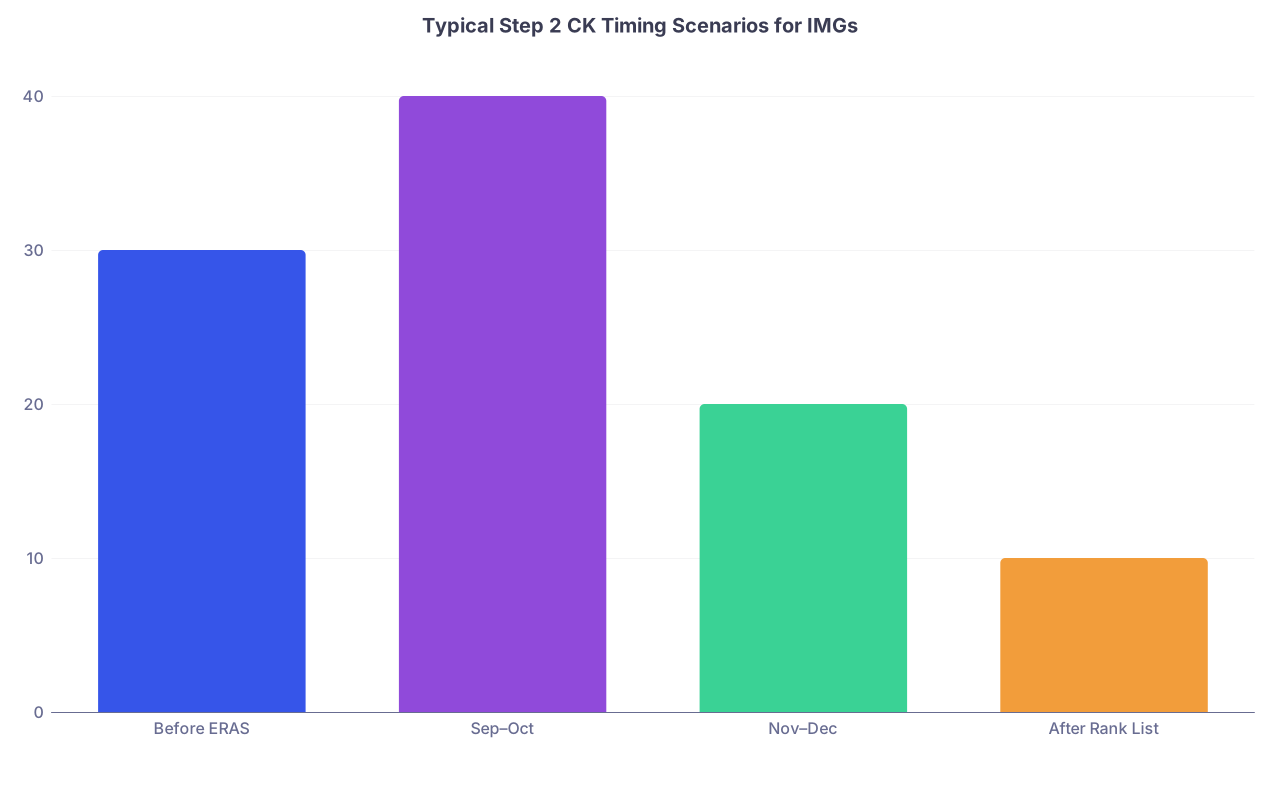
| Category | Value |
|---|---|
| Before ERAS | 30 |
| Sep–Oct | 40 |
| Nov–Dec | 20 |
| After Rank List | 10 |
Template 1: General Pre-Score Email (Taken, Score Pending)
Use this if you’ve already taken Step 2 CK and your score will release during the interview invitation window (September–November).
Subject lines you can use:
- “Application Update – Step 2 CK Status – [Your Name, AAMC #######]”
- “USMLE Step 2 CK Timing – [Your Name, AAMC #######]”
Email:
Dear [Program Director/Program Coordinator/Dr. LastName],
My name is [Full Name], an international medical graduate applying to your [Specialty] residency program for the [Year] Match (AAMC ID: [#######]).
I am writing to briefly update you on my USMLE Step 2 CK status. I completed Step 2 CK on [Exam Date], with an anticipated score release on [Month Day, Year]. My Step 1 score is [###], and I am committed to keeping your program informed as my application becomes fully complete.
Due to [testing site availability/visa scheduling constraints/required clinical duties in my home institution], my exam date fell slightly later in the season than I initially planned. I wanted to proactively clarify this, as my ERAS application currently reflects a pending Step 2 CK score.
Thank you for your time and for considering my application. I look forward to the possibility of contributing to your program.
Sincerely,
[Full Name], MD
AAMC ID: [#######]
[Medical School], Class of [Year]
Customize the explanation bracket to what is true. Do not write a sob story. One clause is enough.
Template 2: Score Will Release Late in Season (Higher Risk)
Use this if your score release date is after most interview invites go out (e.g., exam in late October, score in late November/December).
Subject:
“Application Context – Late Step 2 CK Score Release – [Your Name, AAMC #######]”
Email:
Dear [Program Director/Program Coordinator/Dr. LastName],
My name is [Full Name], an international medical graduate applying for the [Year] Match in [Specialty] (AAMC ID: [#######]). I am reaching out to provide context regarding my Step 2 CK timing.
My Step 2 CK exam is scheduled for [Month Day, Year], with an expected score release approximately [3–4] weeks later. Given this schedule, my score will likely become available after many initial interview invitations are extended.
This timing resulted from [brief, factual reason – e.g., “limited test center availability in my country combined with ongoing clinical responsibilities”]. I recognize that a completed Step 2 CK score is an important part of the evaluation for IMGs, and I wanted to be transparent instead of leaving my application appearing incomplete without explanation.
I remain fully committed to completing this requirement and will release my Step 2 CK score to your program as soon as it is available. Thank you very much for your consideration.
Respectfully,
[Full Name], MD
AAMC ID: [#######]
This will not magically get you interviews at ultra‑competitive programs, but it will clean up the “red flag by silence” problem.
Template 3: You Failed Step 2 CK and Retest Is Scheduled
This one is uncomfortable, but hiding it is worse. Use this primarily after your new exam date is locked in.
Subject:
“USMLE Step 2 CK Update – [Your Name, AAMC #######]”
Email:
Dear [Program Director/Program Coordinator/Dr. LastName],
My name is [Full Name], an international medical graduate applying to your [Specialty] residency program for the [Year] Match (AAMC ID: [#######]). I am writing to provide a direct update on my Step 2 CK status.
I recently received a failing score on my initial Step 2 CK attempt. I take full responsibility for this outcome. In response, I have [adjusted my preparation approach/enrolled in a structured review course/implemented a full-time dedicated study schedule] and have scheduled a retake for [Month Day, Year], with an expected score release [3–4] weeks afterward.
While I understand this significantly affects my competitiveness, I wished to be transparent and to communicate my plan to address this weakness. I remain deeply committed to improving my performance and demonstrating that I can meet the clinical knowledge expectations of your program.
Thank you for your time and consideration.
Sincerely,
[Full Name], MD
AAMC ID: [#######]
Do not oversell your “new strategy.” One phrase is enough.
5. Email Templates: After You Have The Score
Once your Step 2 CK score is in—and it is at least not disastrous—you send a tight update. No drama. Just data and a short frame.
Template 4: Strong or Improved Step 2 CK Score
If your Step 2 CK is >= 240 or clearly higher than Step 1, use this.
Subject:
“Update – Step 2 CK Score Available – [Your Name, AAMC #######]”
Email:
Dear [Program Director/Program Coordinator/Dr. LastName],
My name is [Full Name], an international medical graduate applying to your [Specialty] residency program for the [Year] Match (AAMC ID: [#######]).
I am writing to inform you that my USMLE Step 2 CK score is now available and has been released to ERAS. My Step 2 CK score is [###], representing an improvement from my Step 1 score of [###].
I appreciate the opportunity to update my application with a more current measure of my clinical knowledge and readiness for residency. Thank you again for your consideration.
Sincerely,
[Full Name], MD
AAMC ID: [#######]
No extra fluff. Let the numbers speak.
Template 5: Average or Slightly Lower Step 2 CK Score
If your Step 2 CK is mid‑220s or slightly below Step 1 but still passing and not catastrophic, you spin it calmly.
Subject:
“Application Update – Step 2 CK Score Reported – [Your Name, AAMC #######]”
Email:
Dear [Program Director/Program Coordinator/Dr. LastName],
My name is [Full Name], an international medical graduate applying to your [Specialty] residency program for the [Year] Match (AAMC ID: [#######]). I wanted to share that my USMLE Step 2 CK score is now available and has been transmitted through ERAS.
My Step 2 CK score is [###], with a Step 1 score of [###]. While these scores do not fully capture my clinical work ethic and communication skills, I am glad that my application is now complete for your review.
Thank you for your time and consideration.
Respectfully,
[Full Name], MD
AAMC ID: [#######]
Notice: you do not try to “explain away” the score. You just acknowledge the limitation and move on.
Template 6: Updating Programs After Interviews
If you interviewed somewhere without a Step 2 CK score and now have one, you absolutely should send an update—especially if the score is strong or shows improvement.
Subject:
“Post-Interview Update – Step 2 CK Score – [Your Name, AAMC #######]”
Email:
Dear [Program Director/Dr. LastName],
Thank you again for the opportunity to interview with the [Program Name] [Specialty] residency program on [Interview Date]. I appreciated learning more about your residents and training environment.
I am writing to provide a brief update: my USMLE Step 2 CK score is now available and has been transmitted to your program via ERAS. My Step 2 CK score is [###], compared to a Step 1 score of [###]. I am pleased that this score now offers an additional and more recent measure of my clinical knowledge.
I remain very interested in your program and would be honored to train at [Program Name].
Sincerely,
[Full Name], MD
AAMC ID: [#######]
If you genuinely plan to rank them highly, you can say “I intend to rank your program very highly” in late season—but do not play games and tell that to ten programs.
6. Program-Specific Messaging: When and How to Send
You do not spam every single program with every minor update. That’s how you get filtered as noise.
Here’s a simple flow.

| Step | Description |
|---|---|
| Step 1 | Know Step 2 CK Timing |
| Step 2 | Email programs once with date and expected release |
| Step 3 | Email only if exam after ERAS or very late |
| Step 4 | Send score update to all applied programs |
| Step 5 | Send update mainly to realistic target programs |
| Step 6 | Send separate post interview updates |
| Step 7 | Exam taken? |
| Step 8 | Score strong? |
Rules of thumb:
Before score release:
One clear email early in the season to all programs where the missing score is likely to matter (for IMGs, that’s usually most of them).After score release:
- Strong score (≥ 240 or big jump from Step 1): update broadly.
- Okay score (220s with average Step 1): focus on realistic targets, community or mid‑tier university programs.
- Weak passing score: update only when necessary (e.g., program requested it, or you already interviewed and hiding it would look bad).
Do not send weekly “just checking in” emails. That reads as desperation, not professionalism.
7. Specialty-Specific Framing (Short Inserts You Can Use)
You can lightly customize your emails depending on specialty.
For Internal Medicine / Family Medicine:
“Given the broad clinical demands of [Internal Medicine/Family Medicine], I recognize that a strong Step 2 CK performance is particularly important, and I am eager to demonstrate my readiness.”
For Pediatrics:
“I know that performance on Step 2 CK is often viewed as a closer proxy for day‑to‑day clinical reasoning in pediatrics, and I am committed to meeting that standard.”
For Surgery / OB-GYN (if you have a decent score):
“I understand that surgical and procedural specialties place significant emphasis on strong Step 2 CK performance, and I am pleased that my score reflects my commitment to rigorous clinical preparation.”
These are single-sentence inserts. Do not turn them into paragraphs.
8. What Not To Write (Common Mistakes That Sink IMGs)
I’ve seen variations of these emails; they do more harm than good.
Avoid:
Long excuses:
“I was under a lot of stress, my family had issues, I was traveling…” Programs are tired; they don’t want an essay.Predictions:
“Based on my UWorld scores, I expect to score above 250.” Then you score 228. Congratulations, you just documented overconfidence.Blame:
“USMLE was unfair,” “NBME changed the exam,” “Prometric issues ruined my timing.” You can mention logistics briefly, but never in a blaming tone.Emotional oversharing:
“I cried after seeing my failure and fell into depression…” This may be true, but email to PD is not the place to process that.
If you’re not sure whether something sounds like an excuse, cut it.
9. Quick Reference: Which Template Should You Use?
| Scenario | Status | Template(s) to Use |
|---|---|---|
| A | Taken, score pending, normal release | Template 1 |
| B | Taken, late release after invites | Template 2 |
| C | Not yet taken, scheduled late | Template 2 (adapted) |
| D | Failed, retake scheduled | Template 3, then 4/5 after result |
| Any | Score back, strong | Template 4 (+6 if interviewed) |
| Any | Score back, average/weak but passing | Template 5 (+6 if interviewed) |
10. Your Next Concrete Step (Do This Today)
Open a blank document and do three things right now:
- Write down your exact Step 2 CK status: taken/not taken, date, expected or actual score, release date.
- Pick the one template above that matches your situation most closely.
- Customize it for one real program—name, date, your USMLE numbers—and read it out loud once to check if you sound clear and professional, not defensive.
Once that first email is locked in, you can adapt it to the rest of your programs in under an hour. Do not wait until invites slow down and you start panicking. Take control of the narrative today.